After my billionaire grandfather died and left me his entire estate, my parents—who’d ignored me most of my life—finally decided I was worth noticing again.
Not as a daughter. As a defendant.
In the hallway outside Courtroom 7B, the stale air smelled like burned coffee and floor polish. A tiny American flag magnet clung crookedly to the vending machine by the water fountain, its red and white stripes warped by years of fingerprints. I stared at it while reporters whispered my name, while camera lenses tracked every twitch of my mouth. Somewhere above us, the Stars and Stripes flapped on the courthouse roof, but down here it felt like the flag on the vending machine was the only thing really watching.
They were suing me for every cent of his $1.6 billion estate.
By the time the bailiff opened the heavy doors and called, “Case of Charles and Victoria Whitmore versus Emma Whitmore,” my palms were slick against the strap of the leather journal hanging at my side and my pulse was loud enough to drown out the hum of fluorescent lights.
When I walked into the courtroom, my parents were already there, smiling like they were hitting their marks on another reality show. The judge glanced at the case file, then up at me—and froze.
“Wait…” His brows pulled together. “The charges are against you?”
In that moment, with every eye in the room fixed on me, I made myself a quiet promise: if I walked out of this courthouse with my grandfather’s legacy still in my hands, I would never let anyone—especially them—rewrite my story again.
That promise was the only thing keeping my knees from shaking as the past began to unspool in my head.
The moment I stepped fully inside, I saw my parents’ smiles sharpen. I knew that expression. It was the same one that had frozen me in place when I was little, the same one that said I was small and inconvenient and entirely forgettable. They looked convinced victory was theirs before a single word was spoken. Why wouldn’t they be? To the world, they were the dazzling Whitmores from television—polished hosts of a redemption-themed reality show, adored, admired, untouchable.
And I was the daughter they’d discarded twenty-two years earlier.
But the rules of this game had changed the day my grandfather died.
He was the only person who had ever truly cared for me, and when he passed, he left every cent of his fortune—every house on every cliff, every share in Whitmore Industries—to me alone. Now the very people who’d abandoned me at his doorstep were dragging me to court to take it back.
The marble floor felt cold beneath my heels. The judge’s gaze lingered on me, something like recognition flickering in his eyes, but before he said another word, my mind slipped backward, to another doorway and another day my life had split in two.
I was five the day my parents vanished from my world.
The Santa Barbara sun was merciless that afternoon, blazing and relentless, scorching everything except the hollow chill inside my chest. Our driveway stretched long and pale toward the iron gates, the ocean glittering beyond them like a promise meant for someone else.
My mother, Victoria, crouched in front of me, her white summer dress fluttering in the heat, the scent of lilac clinging to her like a lie.
“Be good for Grandpa, all right, sweetheart?” she said.
Her forced smile trembled at the edges. Her lipstick looked too bright, her eyes too dry. Behind her, my father, Charles, leaned against the silver convertible, drumming his fingers on the hood like he was bored between takes.
“Vic, come on,” he called. “We’ll miss the flight.”
“Flight?” I grabbed a fistful of her dress with my small hand. “Where are you going? Can I come?”
For a heartbeat, she froze.
“It’s just a quick trip, darling,” she said. “We’ll be back soon.”
Even at five, I heard the crack in her voice. She didn’t hug me. Instead, she leaned close enough that her earrings brushed my cheek and kissed the air beside my face. Her heels clicked down the stone steps like a clock ticking down, each step a second closer to something I didn’t understand.
The car door slammed. Tires crunched against gravel. The convertible’s engine purred and then roared as it swept down the drive. I chased after it until my breath tore in my chest and my legs burned, until the car disappeared behind the gates and all that was left was the smell of dust and gasoline.
I called out to them until my throat hurt, but only the wind and distant seagulls answered.
Then a steady hand rested on my shoulder—firm, kind, familiar.
Grandpa Henry knelt beside me, his presence quiet but solid. He never spoke in haste; his words always carried weight. His gray eyes gentled as he brushed the dirt from my scraped knees.
“They don’t understand what they’ve lost, my dear,” he whispered, his voice trembling with a mix of sorrow and something fiercer. He paused, tilting my chin upward until our eyes met. “You will never be unwanted again.”
Then he lifted me into his arms as if I weighed nothing and carried me back toward the mansion.
My head rested on his shoulder. The slow, steady rhythm of his heartbeat began to drown out the sound of the car that wasn’t coming back. That was the first moment all day that felt safe.
Later that night, I sat in the vast kitchen, my legs swinging above the cool tile floor while he stood at the stove making cocoa himself. No staff. No formality. Just him.
“Extra marshmallows, right?” he asked, glancing over his shoulder with a faint smile.
I nodded, tears blurring my vision.
When he tucked me into bed, the house felt too large and too still. The slow tick of the grandfather clock in the hall sounded like footsteps echoing from rooms where no one lived anymore.
“Will they come back?” I whispered.
He hesitated, then ran a gentle hand through my hair.
“Some doors, my dear Emma, once closed, should stay shut,” he said softly.
Before switching off the lamp, he touched his hand lightly to my chest, right over my heart.
“You’ll never have to chase love again,” he murmured. “From now on, it lives right here.”
In the dim light, I clung to his hand and believed every word. That was the night I stopped waiting for my parents and started belonging to someone who truly stayed.
Life with Grandpa Henry looked nothing like the movies about billionaires.
His estate perched on the cliffs of Santa Barbara, gazing out over the Pacific like a quiet sentinel. Inside, there were no endless galas, no red carpets, no photographers lurking in the hedges. The rhythm of the house was calm, precise, and steeped in meaning instead of spectacle.
Every morning at six, his gentle knock woke me.
“Up, Emma. The world doesn’t wait for those who linger,” he’d remind me.
I would shuffle to the kitchen, hair tangled, socks mismatched, to find him already at the table with black coffee and the morning paper spread wide. The smell of toast and the sound of Sinatra humming from the old radio filled the room.
“Read this,” he’d say, tapping a headline. “Then tell me what they’re not telling us.”
At first, I barely understood, a little girl trying to finish her breakfast while sounding out words like “litigation” and “congressional.” But over time, his lesson unfolded.
Never believe a story just because it’s printed. Truth hides beneath the surface, waiting for the people willing to dig.
He was the founder of Whitmore Industries, a sprawling network of shipping and logistics that tied ports and warehouses and highways together across the country. Yet to him, integrity always outweighed profit.
“Money,” he’d say, “is like salt water. The more you drink, the thirstier you get. So make sure what you crave is worth it.”
I watched the world bend toward him. Politicians eager for his handshake. Lawyers seeking his counsel. Employees driven not to disappoint. He ruled with fairness instead of fear, his authority quiet but absolute.
When I turned ten, he finally brought me to his office downtown.
The glass towers shimmered under the fading light, glowing like the future he was quietly preparing me to inherit. Inside the building, every person greeted him with respect and me with cautious curiosity.
“This is my granddaughter,” he announced, pride unmistakable in his tone. “Someday she’ll ask tougher questions than any of you.”
His hand settled lightly on my shoulder, anchoring me. I smiled, shy but certain. He wasn’t preparing me to inherit power; he was teaching me how to see through the gloss to the truth underneath.
Every weekend, we drove to the community center he’d built in a rougher part of town. While other tycoons sent checks and posed for pictures, Grandpa stayed for hours—kneeling beside children as they learned to read, showing teenagers how to manage their first savings accounts, asking names and remembering them.
“Power means nothing,” he often whispered, “if you only use it to stand above other people.”
When I turned sixteen, my parents’ faces returned to my life—glowing on a television screen.
They were walking a Los Angeles red carpet, laughing for the cameras, promoting a new reality show about second chances. My fingers clenched around the remote until my knuckles turned white.
Grandpa came in quietly, his eyes following the flickering image.
“Do you miss them?” he asked.
The truth trembled on my lips, sharp and bitter. What came out was softer.
“Not anymore.”
He gave a slow nod.
“Good. Missing the ones who left is like staring at closed doors,” he said. “You’ll miss the ones still open.”
That night, he handed me a small, worn journal bound in brown leather. The same journal that now hung from my shoulder in that Los Angeles courtroom, its spine cracked, its pages softened by years of turning.
“For your truth,” he said. “One day the world will try to change it. Don’t let them.”
I had no idea that book would become my shield—the one piece of evidence that would still be standing when my parents tried to erase me in court.
The morning he died, the world felt tilted.
The air hung too still. The sea below the cliffs was too calm, the waves sliding in like they were afraid to make noise. I found him in his study, his head bowed over his desk, glasses still perched on his nose above an open page of his journal.
The final line he’d written read: Truth in the wrong hands turns to poison.
For a long time I didn’t cry. I just stood in the doorway, staring at the man who had filled every empty space in my life. The man who had walked me through math homework and bad dreams and the first time someone at school called me “the abandoned kid on the hill.”
Then the grief broke through, sharp and relentless.
His funeral pulled in the city’s elite—magnates, judges, even former Presidents, all eager to be seen honoring Henry Whitmore, the man who built an empire on integrity. I wanted none of it. I would have traded every floral arrangement and every carefully folded flag on an official motorcade for one more of his lessons, one more cup of cocoa on a rainy night.
And then I saw them.
My parents stood near the front, dressed in sleek black, faces hidden behind designer sunglasses. My mother dabbed at her eyes with a lace handkerchief, her tears as manufactured as her red-carpet smile. My father looked detached and impatient, like the service was keeping him from something more important—another interview, another spotlight.
When the ceremony ended, they came toward me—for the first time in twenty-two years.
“Emma,” my mother said softly, tilting her head just so, like she was finding her light. “You’ve grown so much.”
I took a step back, meeting her painted face with a steady gaze.
“You remembered my name,” I said.
Her smile faltered for half a second before she forced it back into place.
“We’re family,” she said lightly. “We should reconnect.”
“Family?” I repeated, the word tasting bitter. “You left me with him like I was baggage too heavy to keep.”
Charles’ expression hardened, his jaw tightening.
“You always did have a flair for drama,” he muttered.
Before I could answer, my grandfather’s attorney, Samuel Briggs, appeared in the doorway and asked everyone to gather in the estate office for the reading of the will.
A low murmur rippled through the guests as they filed inside. My pulse pounded so loudly I could hear it in my ears.
Samuel cleared his throat and began.
“The late Judge Henry Whitmore leaves all properties, including the Whitmore residence, corporate assets, and financial holdings, to his granddaughter, Emma Whitmore.”
The silence that followed was absolute.
My mother gasped. “That’s not possible,” she stammered.
My father slammed his palm on the polished table. “He was old. He wasn’t in his right mind.”
Samuel didn’t flinch.
“He also left a written message for his son and daughter-in-law,” he said. He unfolded a smaller sheet of paper. “It reads: Those who abandon truth for comfort have already surrendered their inheritance.”
Victoria’s lips trembled. “He can’t do this. We’re his children.”
Samuel met her eyes.
“He already gave you everything that mattered,” he said. “A chance to be decent. You chose to waste it.”
I stood frozen, my fingers digging into the edge of the table until they ached. For the first time, I saw my parents stripped bare. The gloss gone. The charm unraveling in front of an audience that had always applauded them.
When the guests began to drift away, my mother turned toward me, her voice low and venomous.
“You’ll regret this, Emma,” she hissed. “You don’t deserve a single piece of what he built.”
I met her stare evenly.
“Neither do you,” I said.
Outside, the wind roared through the gates, scattering white petals from the funeral wreaths over the gravel drive. In the rush of air, I understood something I’d only half grasped before: grief and greed often travel together.
And somewhere in the clatter of petals against stone, I could almost hear Grandpa’s voice.
Stand tall, Emma. The truth always reaches back.
It reached for me again a week later in the form of a thick white envelope on my doorstep. No sender. Just my name in sharp black letters:
EMMA WHITMORE.
I tore it open, expecting some final piece of estate paperwork or another condolence note someone had been too shy to hand me in person.
Instead, the words at the top froze my breath:
NOTICE OF CIVIL ACTION.
Below it, in cold, precise type:
Charles and Victoria Whitmore v. Emma Whitmore — Claim of Undue Influence.
For several seconds, I couldn’t move. My hands shook so hard the pages slipped from my grasp and scattered across the foyer tile like a blizzard of betrayal.
My own parents were taking me to court, accusing me of manipulating the only man who had ever loved me into leaving me everything he owned.
Within hours, the story exploded.
By evening, every headline screamed the same scandal: BILLIONAIRE’S GRANDDAUGHTER SUED BY ESTRANGED PARENTS FOR $1.6 BILLION ESTATE.
Paparazzi camped outside the gates, camera flashes slicing through the dark like erratic lightning. Long-lens cameras peeked over the walls that had always sheltered me. The house that had once felt like a fortress now felt like a display case.
Early the next morning, my attorney, Robert Hayes, called.
“Emma, they’re moving fast,” he said. His voice carried that practiced calm you only get after years wading through other people’s chaos. “The filing’s in Los Angeles County. Your father still has friends down here.”
“Of course he does,” I muttered. “He’s always had power. Just never the kind that counted.”
Later that day, I met Robert in his downtown office, Los Angeles traffic humming below the window like a restless animal. He pushed a thick stack of documents across his desk.
“They’re alleging you cut off your grandfather’s visitors, interfered with his medical care, and pressured him to change his will,” he said.
A sharp, humorless laugh escaped me.
“Controlled access,” I said. “He was protecting me from them, not the other way around.”
Robert exhaled slowly.
“I’ve handled some ugly estate disputes,” he admitted, “but parents suing their own daughter? That’s a first.”
“They’re not my parents,” I said quietly. “They’re strangers tied to me by DNA.”
Still, that night my thoughts drifted back to Grandpa’s final weeks—the softer dinners, his weary smile, the faint tremor in his hand when he signed letters. Had he seen this coming? Is that why he’d given me the leather journal? Had he known I’d need more than memories?
Two days later, as I stepped out of a café, a tabloid reporter lunged toward me, cameras popping.
“Emma, did you manipulate your grandfather?” he shouted. “Did you threaten him?”
I stopped on the sidewalk, the city blurring behind the wall of cameras.
“If loving the man who raised me counts as manipulation,” I said steadily, “then yes, I’m guilty.”
By the next morning, my phone lit up with a blocked number.
“Enjoying your fame?” my mother’s voice slid through the line, cold as ice water.
“Why are you doing this?” I asked.
“Because you took what’s ours,” she said, no tremor, no hesitation. “You stole our life. Now we’ll take yours.”
The line went dead before I could respond.
That night, I sat alone in the study where Grandpa had taught me how to read a contract and how to hear the parts of a sentence that weren’t spoken aloud. His photograph rested beside the leather journal on his desk.
I opened it, my fingers tracing the grooves of his handwriting.
When truth is tested, stand still. Let them strike. They’ll only hurt themselves.
I closed the journal and drew a slow breath. The fear was still there—thick and heavy—but beneath it something stronger began to grow.
Resolve.
If they wanted a war, they’d picked the wrong Whitmore.
When the first hearing finally arrived, the sky over downtown Los Angeles hung heavy and bruised, clouds pressing low over the courthouse like they, too, were waiting for a verdict. Reporters crowded the steps, microphones poised like spears.
I didn’t know whose reputation would die that day—theirs or mine—but I was done running.
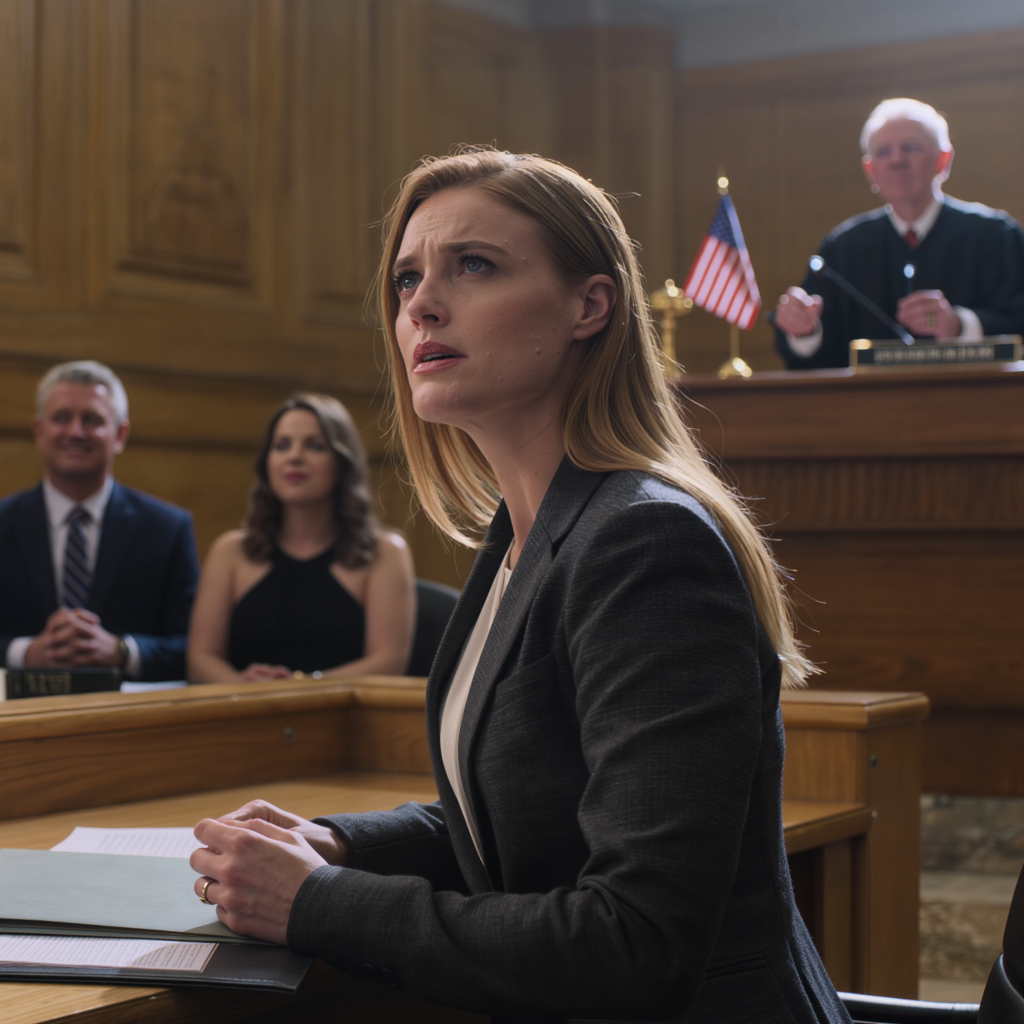
Inside, the courtroom smelled faintly of polished wood and old paper. My parents occupied the plaintiff’s table, perfectly posed for the cameras allowed before the session opened. My mother was immaculate in a black dress. My father looked crisp and controlled in a navy suit. They didn’t look heartbroken.
They looked rehearsed.
As I walked down the aisle, murmurs rippled through the gallery.
“That’s her,” someone whispered. “The granddaughter.”
My heels clicked on the marble with deliberate rhythm. Inside, my palms were damp again around that same worn leather journal.
Robert leaned toward me, his voice low and steady.
“Stay composed, Emma,” he murmured. “Let the facts do the talking.”
At the bench sat Judge Marcus Nolan, a man with silver hair and eyes that missed nothing. His presence settled over the room even before he spoke. When his gaze met mine, something like recognition flickered across his face. Surprise, maybe disbelief.
He took off his glasses slowly.
“Ms. Whitmore?” he asked, his tone unexpectedly gentle. “Step forward, please.”
My stomach tightened as I approached the bench. The gallery fell silent. He studied me for several moments, then looked down at the case caption again.
“Charles and Victoria Whitmore,” he read aloud, “versus… Emma Whitmore.” His brows rose. “The charges are against you?”
“Yes, Your Honor,” I said.
Something inside his expression shifted.
“You’re Henry Whitmore’s granddaughter,” he murmured, more to himself than to me.
“Yes, Your Honor,” I repeated, my voice steadier than I felt.
A small nod. Then, in a lower voice only half meant for the microphones, he added, “I clerked for your grandfather once.”
The room seemed to draw in a breath.
“He told me,” the judge went on, “that if his granddaughter ever appeared in my court, I should listen closely, because she’d be the one telling the truth.”
Gasps swept through the spectators.
Behind me, I heard the crack in my mother’s perfect mask and the sharp click of my father’s jaw as his teeth clenched.
Judge Nolan straightened.
“Proceed,” he said, his calm voice edged now with something like conviction. The kind that warned everyone that honesty still mattered in this room.
Their attorney, a polished man named Elliot Graves, rose with the confidence of someone accustomed to winning in front of cameras.
“Your Honor,” he began smoothly, “this young woman isolated her elderly grandfather, interfered with his medical care, and coerced him into revising his will. We intend to prove deliberate fraud and financial exploitation.”
Robert remained unruffled.
“We look forward to refuting every falsehood, Your Honor,” he said.
Graves turned, his smile sharp as he looked at me.
“Ms. Whitmore seems remarkably composed,” he said aloud, as if commenting for a televised jury. “Most people accused of stealing a billion dollars are a little more rattled.”
I met his stare.
“Composure isn’t guilt, Mr. Graves,” I replied. “It’s faith in the truth.”
A low hum of approval rippled through the courtroom. The sound of an audience beginning to adjust where its sympathy lay. Even Judge Nolan’s lips twitched—almost a smile.
Testimony began.
My parents’ team threw everything they had—distorted emails, cropped lines from staff reports, fragments of old correspondence twisted out of context. Each time, Robert met them head-on with clean records, precise timelines, and witnesses whose loyalty to my grandfather’s integrity didn’t waver when asked under oath.
But the most brutal blow came when my mother took the stand.
Her voice trembled on cue. Every tear seemed perfectly timed.
“We only wanted to reconnect with our daughter,” she said, pressing a tissue delicately to her cheek. “But Emma pushed us away. She cut us off from Dad. We were just trying to protect his legacy.”
Her testimony oozed pity, a performance honed by years in front of cameras. I watched jurors shift in their seats, caught somewhere between sympathy and suspicion.
All I could hear, over the soft sniffling and the clicking of reporters’ keyboards, was Grandpa’s warning.
Truth in the wrong hands turns to poison.
It struck me then: poison only harms you if you swallow it. I wasn’t going to.
By the second day, the trial felt less like a hearing and more like a battlefield.
Graves paced the floor like a performer on a soundstage, waving papers and injecting outrage into his questions at all the right places. I hadn’t come to deliver monologues.
I’d come to finish what my parents had started when they dropped me on a doorstep and drove away.
Robert rose slowly, composed as ever.
“Your Honor,” he said evenly, “the defense submits additional evidence: medical evaluations, witness statements, and the late Judge Whitmore’s personal correspondence. One document, in particular, deserves the court’s attention.”
At the word correspondence, my mother’s back went rigid. She already knew what was coming.
Judge Nolan gestured for him to continue.
Robert approached the bench with a thick folder, then turned back toward me.
“Ms. Whitmore,” he said, “please take the stand.”
My pulse thundered as I crossed the room. Every step sounded louder than the last. I’d rehearsed this moment in my head a hundred times, but nothing could fully prepare me for the reality of facing the two people who had created me and then tried to erase me.
Robert placed a letter beneath the evidence camera. My grandfather’s familiar handwriting appeared on the screen, steady and unmistakable.
“To my dearest Emma,” it read. “You were never my duty. You were my choice. If you ever stand against those who left you behind, don’t meet them with hate. Let truth defend you. It always will.”
The room went utterly still.
My mother’s painted composure began to crack. My father stared down at the table, jaw clenched so hard I could see the strain in his neck.
“These letters,” Robert said, his voice steady, “span ten years. Each one affirms Judge Whitmore’s clear mind, affection, and deliberate decision to leave his estate to his granddaughter.”
Graves shot to his feet.
“Objection, Your Honor. These letters are nothing but emotional theatrics. They prove nothing of legal significance.”
“Overruled,” Judge Nolan said sharply. “The decedent’s intent is precisely what this court must determine. Continue, Mr. Hayes.”
Robert gave me the smallest nod. My signal.
I reached into my bag and drew out the leather journal Grandpa had given me on my sixteenth birthday. The same journal that had sat in my lap that first hearing, the same one that had caught my tears the night the notice of civil action arrived.
Its edges were frayed, the spine cracked. Years of turning pages had softened the leather.
“This,” I said quietly, my voice carrying in the hushed courtroom, “is my grandfather’s personal diary. He wrote in it every night until the week he passed.”
Carefully, I opened it to the final entry.
The ink had faded just a little, but his handwriting was still strong.
“My son and his wife live for appearances,” I read aloud. “My granddaughter lives for truth. The estate must belong to her—not as a reward, but as protection. She carries my conscience where I no longer can.”
The silence that followed felt almost sacred.
Then my mother snapped.
“He was sick!” she cried, leaping to her feet. “He didn’t know what he was saying. She manipulated him.”
The gavel came down with a sharp crack.
“Mrs. Whitmore, sit down,” Judge Nolan ordered.
Her words shattered against the wooden walls and fell useless to the floor.
I turned toward her—the woman who had given me life but never love.
“No one manipulated him, Mother,” I said softly. “He just finally saw you for who you are.”
For the first time in years, I felt the truth settle inside me like armor.
I wasn’t their pawn anymore.
I was Henry Whitmore’s granddaughter.
By the third day, time itself seemed to drag. Every cough, every shuffle, every squeak of a chair sounded amplified. I sat at the defense table, fingers locked together, eyes forward.
Across the aisle, my parents whispered frantically to their lawyer, the polished confidence they’d worn into the courthouse peeling away with each passing hour.
Then the door at the side of the courtroom opened.
Judge Nolan entered, robes sweeping, his face unreadable. Instantly, the room fell silent.
He took his seat, adjusted the papers before him, and glanced at me. For just a heartbeat, I saw something like pride flicker in his eyes.
“This court,” he began, his voice calm but unyielding, “has examined all testimony, documents, and correspondence of the late Judge Henry Whitmore.”
He paused, letting the weight of the moment settle.
“What stands before me,” he continued, “is not evidence of coercion, but of greed—misplaced and deliberate.”
A low stir spread through the gallery.
My father’s jaw clenched; my mother’s fingers trembled visibly.
“The plaintiffs,” Judge Nolan went on, “have failed to prove undue influence. On the contrary, the record shows clear intent, mental soundness, and deliberate judgment by the decedent.”
He let the words hang in the charged air.
“Therefore, the court dismisses the plaintiffs’ claims in full,” he said. “The will of Judge Whitmore stands. The estate belongs to Ms. Emma Whitmore.”
For one suspended heartbeat, no one moved.
Then the room erupted—pens scratching, cameras flashing, reporters scrambling for quotes.
I stayed still. My heartbeat roared in my ears, drowning out everything else.
Judge Nolan turned to my parents.
“Justice,” he said evenly, “does not belong to blood. It belongs to truth.”
The words hit them harder than any fine ever could.
My father sank into his chair as if the weight of the verdict had finally found his shoulders. My mother stared blankly at the floor, her lips parted, but no spin left.
The gavel struck once more, a sharp final crack that sounded like the last shot in a long war.
When I stood, my legs trembled. Robert placed a steadying hand on my shoulder.
“It’s over,” he murmured. “You did it.”
But victory didn’t taste like triumph. It tasted like ash—the quiet that comes after a storm, when the sky is clear but smoke still clings to everything.
As I turned toward the aisle, my mother’s hand shot out and clamped around my wrist. Her nails dug into my skin.
“You think this makes you better than us?” she hissed. “You’ll regret this, Emma. You’ll end up alone, just like him.”
I looked straight at her.
“I’d rather be alone than hollow,” I said.
I pulled free.
Outside, sunlight flooded the courthouse steps—fierce, almost blinding. The same American flag that had been flapping above us all week snapped in the wind, bright against the washed-out sky.
The press surged forward, microphones thrust toward me, questions overlapping until they blurred together.
“How does it feel to win?” someone shouted. “What will you do with the money?”
I paused halfway down the steps. The wind off the Pacific tugged at my hair.
“It wasn’t about the money,” I said, just loud enough for every microphone to catch it. “It was about the truth.”
That night, I sat in the study beneath Grandpa’s portrait. The court’s final order lay on the desk beside his leather journal.
“You were right, Grandpa,” I whispered. “Truth really does have long arms.”
And today, finally, they had reached back.
Weeks drifted by after the ruling, but peace didn’t arrive as quickly as the headlines had.
The media frenzy faded. The cameras turned toward newer scandals. The estate remained mine—the mansion on the cliffs, the companies, the fortune—but without him, all of it felt like a museum exhibit.
At night, I walked the long corridors lined with oil portraits and old photographs. Sometimes I could almost hear his voice woven into the stillness.
Power means nothing if you can’t live with your conscience.
For the first time, I slept without fear, though not without grief.
Then one evening, as the sun sank into the Pacific and painted the horizon in streaks of red and gold, my phone rang.
An unfamiliar number glowed on the screen.
I considered letting it go to voicemail. Then I remembered Grandpa’s handwriting in the final pages of the journal:
True justice isn’t found in courtrooms, but in the hearts of those who keep believing in it.
I answered.
“Hello?”
A pause. Then a voice—familiar, but fragile in a way I’d never heard before.
“Emma.”
My father.
For a moment, I forgot how to breathe.
The same man who had hurled accusations across a courtroom now sounded like someone standing on the edge of something too high, afraid to look down.
“I… I read the journal,” he said, the words halting. “Your grandfather’s entries. I didn’t want to believe them, but I couldn’t stop reading.”
His breath hitched.
“He wrote that I lost my way,” he said quietly. “That I stopped being his son long before he signed the will.”
I closed my eyes.
“He also wrote that it’s never too late to do what’s right,” I answered. My voice surprised me. It was gentler than I expected. “You saw that part too, didn’t you?”
There was a longer pause this time, then a trembling exhale.
“I don’t deserve forgiveness, Emma,” he said. “But I needed you to know I’m sorry—for leaving you, for blaming you, for becoming the kind of father he warned you about.”
His words hung there between us, fragile and unbearably human.
I looked out the window toward the garden, toward the roses Grandpa had planted for Grandma years before I was born. The evening breeze moved through them, a soft rustling like pages turning.
“I don’t know if I can forgive you,” I said finally. “Not yet.”
I heard his inhale—sharp, then shaky.
“But I know Grandpa would have wanted me to try,” I added.
He let out a breath that sounded almost like a sob.
“I’ll take that,” he whispered. “It’s more than I deserve.”
Before the line went dead, he added one more thing.
“You remind me of him,” he said. “The way you never back down.”
After the call ended, I stayed by the window, watching the last strip of sun disappear into the dark line of the horizon. The world felt still again.
This time, the quiet didn’t feel empty.
It felt like healing.
I stepped outside barefoot, the cool grass soft beneath my feet. The evening air carried the faint scent of salt and roses up from the garden. Above the mansion, the flag on the pole flapped lazily in the fading light, less like a symbol for the world and more like a promise just for us.
In my hands, I held the leather journal.
I opened it to the final page and read the words that had outlived him:
True justice isn’t found in courtrooms, but in the hearts of those who keep believing in it.
Tears finally came then—soft, unhurried. Not the choking sobs of that first funeral night, but something quieter.
“I believe you, Grandpa,” I whispered. “I always will.”
For a heartbeat, the wind stilled. Then it moved again, slipping past my cheek like a gentle hand. In that moment, I could almost hear his reply—steady, proud, at peace.
Then I can finally rest, my girl.
As the ocean wind moved through the roses and rattled the pages of the journal, it hit me with quiet clarity.
The verdict had decided the money.
But forgiveness—that was the real inheritance he’d left behind.
But justice, I was learning, doesn’t come with a neat fade-out and rolling credits. It comes with fallout.
The first ripple hit a week later at a board meeting that was supposed to be routine.
The Whitmore Industries conference room on the thirty-second floor had floor-to-ceiling windows overlooking downtown L.A., the kind of view that made people stand a little taller when they walked in. A polished wood table stretched the length of the room. Bottled water, legal pads, printed agendas—everything laid out with the same precision my grandfather had loved.
Except he wasn’t at the head of the table. I was.
I’d worn a navy blazer that still felt like it belonged to someone else and had tucked the leather journal into my bag like a secret weapon. My reflection in the glass showed a woman who looked composed, but the pulse hammering in my neck told a different story.
“Emma,” said Daniel Cho, the COO, as he took his seat on my right. He was in his fifties, with sharp eyes and a tie that never seemed to sit crooked. “You ready?”
“Define ready,” I muttered.
He gave me a small, real smile.
“Your grandfather used to say that if you wait to feel ready, you’ll miss the moment,” Daniel said. “You’re here. That’s ready enough.”
One by one, the board members filed in. Some I’d known since I was a kid, people who’d watched me color at the far end of this same conference table. Others were newer faces, brought in during expansion years I’d only lived from the perimeter of the business.
Today, they were all studying me like I was a quarterly report they hadn’t decided how to spin yet.
We ran through the agenda—shipping routes, fuel costs, labor negotiations. On paper, it was business as usual. In reality, tension hummed beneath every line item.
Midway through, a director named Harrison cleared his throat.
“With respect, Ms. Whitmore,” he said, “there’s concern among shareholders about… optics.”
There it was.
“Optics,” I repeated. “You mean the lawsuit.”
He shifted in his seat.
“The press coverage has been… intense. The phrase ‘undue influence’ doesn’t vanish just because the case was dismissed. Some were hoping you might consider stepping back as primary heir—at least publicly—until things settle.”
Heat flared in my chest.
“My grandfather didn’t teach me to hide when people lied about him,” I said. “He raised me to stand in the room and answer for the truth.”
Across the table, a woman in a gray blazer—Leah Martinez, head of logistics—spoke up.
“With respect, Harrison, our clients care more about whether their cargo arrives on time than about a tabloid headline,” she said. “Judge Nolan’s ruling was pretty clear.”
“It was,” Daniel added quietly. “And the market barely dipped. That tells us what actually matters.”
I opened my bag and set the leather journal on the table, my fingers resting on the worn cover.
“My grandfather wrote that he wanted this company to outlive any one name attached to it,” I said. “If stepping aside would protect what he built, I’d do it. But I’m not going to surrender just because the people who abandoned him don’t like where he left his signature.”
Silence stretched. The windows reflected their faces back at them—doubts, loyalties, calculations.
Finally, Harrison looked away.
“I just needed it on the record,” he said.
“Duly noted,” Daniel replied. “Now, unless any of you have a plan to make fuel cheaper by debating Emma’s last name, we should move on.”
A few reluctant smiles broke through the tension. Pens lowered to paper again. The meeting rolled forward.
One battle down.
Twenty-nine more waited in my voicemail alone.
That became the number that haunted me—twenty-nine.
Twenty-nine missed calls from unfamiliar numbers.
Twenty-nine messages from reporters, relatives I barely remembered, strangers who claimed my grandfather had promised them something.
Twenty-nine different ways the world tried to tell me who I was now that there was a dollar figure attached to my last name.
Some people wanted money. Some wanted favors. Some wanted a piece of the story.
And some wanted to break me just to see if they could.
The first threat came disguised as a documentary offer.
I met the producer—slick suit, practiced empathy—at a café in West Hollywood because Daniel insisted it was better to hear people out than let them invent narratives without us.
“We want to tell your side,” the producer said, hands wrapped around an untouched latte. “America loves a survivor. The abandoned girl who inherited a billion-dollar empire? That’s a story.”
“I’m a person, not a pitch deck,” I replied.
“Of course,” he said smoothly. “But people connect to stories. You could control the narrative. Show your parents for who they really are.”
The idea should have been tempting. A chance to expose their lies on my terms. To let the world hear every word my mother had hissed at me in private.
Instead, I saw my grandfather’s face in my mind, the way he’d winced at reality shows that fed on humiliation.
“Truth in the wrong hands turns to poison,” I said.
The producer blinked.
“Excuse me?”
“Something my grandfather wrote,” I said, pushing back my chair. “I’m not interested in turning his legacy into a primetime spectacle.”
He didn’t bother to hide his disappointment.
“You’re passing on the chance to define yourself,” he warned.
“I already know who I am,” I said. “That’s enough.”
But it turned out you could know exactly who you were and still be shaken by the world’s reflection of you.
One night, unable to sleep, I Googled my own name.
Mistake.
Headlines. Comment sections. Threads dissecting my expression on the courthouse steps.
One anonymous post read: She looks cold. Bet she really DID manipulate him.
Another: Poor old guy. Bet she iced his kids out and cashed in.
I slammed the laptop shut, breath coming too fast.
In the darkness of the study, my grandfather’s portrait watched over me, painted eyes calm, steady.
“I know,” I whispered to him. “I know none of that’s true. But it still stings.”
The house creaked in the night—old wood remembering footsteps. The grandfather clock in the hall chimed once. A single, low note.
I opened the journal and ran my fingers over the last page. Then I flipped back through earlier entries, his neat script marching across the paper.
Found Emma reading the paper without being asked today. She underlined a number that didn’t add up and said, ‘They’re hiding something.’ She’s thirteen. The future will be fine.
The tightness in my chest eased.
They could argue about my motives all they wanted.
He knew the truth.
I just had to keep living like I believed it, too.
The next round of fallout arrived courtesy of my mother’s talent for a camera lens.
She booked an interview on a glossy morning show—soft lighting, cream sofas, a host whose empathy was as rehearsed as his jokes.
I only watched because Leah texted me a link with three words: You need this.
On screen, my mother wore light blue, the color of innocence. Her makeup was softer than usual, a careful shift from red-carpet glam to wounded-mother-next-door.
“I just… I don’t know my daughter anymore,” she said, voice catching at all the right moments. “We made mistakes when we were young, but we went to the funeral to make amends. And then—then we were cut out of everything. We weren’t even allowed time with Dad before he passed.”
My jaw clenched.
“That’s not true,” I muttered.
The host leaned forward.
“Are you saying Emma prevented you from seeing him?”
My mother dropped her gaze.
“I’m saying we tried,” she whispered. “And doors kept closing.”
The lower-third graphic read: BILLIONAIRE’S FAMILY TORN APART.
Leah called before I could throw the remote.
“Turn it off,” she said. “It’s a performance. The people who matter know the court record.”
“The people who vote on next season’s ratings don’t read court records,” I shot back.
She was quiet for a second.
“Come down to the center,” she said. “We’ve got the financial literacy workshop tonight. If you’re going to watch anything, watch a kid realize she doesn’t have to get crushed by a bad paycheck.”
I hesitated.
Then I grabbed the journal and my keys.
The community center smelled like crayons and floor cleaner and hope. In a back room, a handful of teenagers sat around battered tables, calculators and notepads in front of them.
Leah stood at the whiteboard, writing two numbers: 7.25 and 18.50.
“Federal minimum wage versus what you actually need in this city not to drown,” she said as I slipped in. “Don’t let anyone tell you those numbers happen by accident.”
A girl with braids raised her hand.
“So how do we… not drown?” she asked.
Leah grinned.
“We start by learning how to make every dollar answer to you instead of the other way around,” she said. “And by the way, this is Emma. Her grandfather built this place. She’s the reason we’re expanding this program.”
Dozens of eyes turned to me.
Not with hunger. Not with accusation.
With curiosity.
“Did you always know about money?” one kid blurted.
I laughed.
“No,” I said. “But I knew what it felt like to not have power. That’s what this is really about. Power to not get trapped.”
As I walked them through basic budgeting—a skill Grandpa drilled into me with mock invoices when I was twelve—something inside me settled.
Let them talk about the $1.6 billion.
This, right here, was the number that mattered: one classroom, fourteen teenagers, and the possibility that even one of them would carry these lessons into a life where they didn’t get taken advantage of.
When the workshop ended, the girl with braids hung back.
“Hey,” she said shyly. “That thing you said about not chasing people who already walked away? That true?”
I blinked.
“You saw the interview?” I asked.
She shrugged.
“My mom had it on,” she said. “But, like… you’re the one who’s actually here.”
Her words hit harder than any headline.
In the parking lot, I leaned against my car and looked up at the sliver of sky between the buildings. No flags, no cameras, no marble.
Just air.
Maybe that was the real re-centering I needed.
Not another statement.
Another choice.
The choice to show up where my grandfather would have wanted me.
The choice to build something new instead of spending every minute defending something old.
I decided the estate wasn’t going to be a trophy.
It was going to be a tool.
Within a month, with Daniel’s help and a swarm of attorneys who spoke fluent tax code, we filed paperwork to create the Whitmore Truth Initiative—a foundation focused on legal aid for exploited elders and financial literacy programs for kids who’d never seen a trust fund outside of TV.
Reporters called it rebranding.
I called it breathing.
There were still days when it all pressed in on me. When twenty-nine unread emails turned into two hundred, when another op-ed wondered if a young woman in her early thirties could really steer an empire without crashing it into the rocks.
On those nights, I found myself back in the kitchen with Sinatra low on the radio and cocoa on the stove, even when the air outside was hot and still.
The first time I made it alone after the trial, I burned the milk and swore under my breath.
“Okay, that’s not how you did it,” I muttered, fanning the pan.
I tried again.
This time, the cocoa came out closer to right—too sweet, but warm in a way that soothed.
I carried the mug to the back porch and sat on the steps, journal open on my lap. The night was quiet except for the faint crash of waves below the cliff and the soft flap of the flag on the pole by the garden.
“Here’s the thing, Grandpa,” I said softly. “You told me truth would defend me. You didn’t mention how exhausting it would be.”
The flag lifted in a small gust, then settled.
“Yeah,” I said. “I guess if you’d warned me about that part, I might have hidden.”
I wrote three lines in the journal before I went back to bed:
Today I said no to a documentary and yes to a classroom.
Today I chose to build instead of argue.
Today the weight felt heavy, but the ground under it felt solid.
The ground stayed mostly solid until the day my mother showed up at the gate.
I was in the study going over foundation proposals when the intercom crackled.
“Ms. Whitmore,” came the guard’s voice. “There’s a woman at the front entrance asking to see you. Says her name is Victoria.”
My pen froze.
For a moment, the room seemed to tilt—the shelves, the portrait, the light.
“She alone?” I asked.
“Yes, ma’am. No cameras. No obvious press.” He hesitated. “You want me to turn her away?”
I looked at the journal on the desk, at the line in Grandpa’s handwriting about doors and who should close them.
Some doors, once closed, should stay shut.
But he’d also written about justice living in the hearts that kept believing.
“Bring her up the drive,” I said quietly. “But keep the gate closed behind her.”
When she stepped out of her car, she looked different.
Not camera-ready. No sunglasses, no perfect blowout. Just a woman in jeans and a plain white shirt, hair pulled back, face bare in a way I’d never seen.
For a second, she looked small against the house she’d once walked away from.
“Emma,” she said when I opened the front door.
Her voice was raw around the edges.
“Why are you here?” I asked.
“I’m not wired,” she said quickly, lifting her hands like someone used to being accused. “No interviews. I just… I needed to see you without a judge or a lens between us.”
I stepped aside.
“Ten minutes,” I said.
In the kitchen, she stared at the mug rack like it was a museum display.
“He always drank out of that blue one,” she murmured, pointing.
“You remembered that,” I said.
She flinched.
“Believe it or not, leaving didn’t erase my memory,” she replied.
“Just your conscience,” I said.
She swallowed.
“That’s fair.”
We sat at the island, the same place where Grandpa had taught me to question headlines and compound interest.
“I watched the verdict,” she said. “Not just the parts they replayed on the morning shows. The whole thing.”
“Planning your next appeal?” I asked.
She shook her head.
“No. That’s over,” she said. “Our lawyers made that clear. There’s nowhere left to go with it. Not legally, anyway.”
“So this is about public opinion,” I said.
“It’s about my soul,” she shot back, then closed her eyes. “God, listen to me. Twenty years of cameras and I still don’t know how to talk when they’re not there.”
Silence stretched between us.
“When I left, I told myself it was for opportunity,” she said finally. “Your grandfather’s house felt like a cage to me back then. Rules, early mornings, no shortcuts. Charles and I thought we were meant for more. That we’d come back for you once we were… established.”
“And then?” I asked.
“And then we got the show,” she said, voice dull. “The public loved us. The network signed us. The producers said a kid would ruin the brand, that we were the couple with chemistry, not parents with responsibility. So we told ourselves you were better off here. All that money, all that stability.”
She met my eyes, and for the first time I saw something behind the performance.
Shame.
“We told ourselves that so many times it turned into the truth we lived in,” she said. “Until your grandfather cut us off. Until we realized the doors we’d walked through didn’t lead where we thought.”
“You could have come back,” I said. “You could have knocked on that door any time in the last twenty-two years.”
She winced.
“Every year that passed, it got harder to imagine what I’d say,” she whispered. “ ‘Sorry we missed your birthday. And your first day of middle school. And high school graduation. And—’”
She stopped.
“And the moment you realized we weren’t coming back,” I finished.
A tear slipped down her cheek. She wiped it away roughly, like it offended her.
“I came today because I saw something,” she said. “Not on TV. At the grocery store. A flyer for the Whitmore Truth Initiative, with your name at the bottom. Legal aid for exploited seniors. Financial classes for kids. Using the money to actually do something good.”
“That surprises you?” I asked.
“It humiliated me,” she said. “In a way the verdict didn’t. You did more for strangers in six months than I did for my own father in twenty years.”
Her shoulders sagged.
“I can’t fix what we did,” she said. “I can’t undo the lawsuit or the interviews or the fact that your earliest memory of me is walking away. I just needed to say I’m sorry—to your face, not to a camera.”
I thought of Grandpa’s journal. Of my father’s shaking voice on the phone. Of my own words scribbled between his lines about trying to forgive people who didn’t deserve it.
“You both walked away,” I said. “Now you’re both trying to walk back. Do you know how confusing that is?”
“Yes,” she whispered. “Because I lived on the other side of that door for two decades, wondering when it would slam for me.”
I studied her.
This was not the woman from the morning show.
This was the woman who had kissed the air beside my cheek on a sun-baked driveway and walked to a car she thought would take her somewhere brighter.
“You told the host you didn’t know your daughter anymore,” I said. “You were right. You don’t.”
She nodded, eyes shining.
“I’d like to,” she said. “If there’s any part of you that can… maybe not now, maybe not soon. But someday.”
The house seemed to hold its breath.
“If I let you in a little,” I said slowly, “it won’t be because of your apology. It’ll be because of his handwriting.”
I tapped the journal on the counter.
“He believed people could change,” I said. “I’m not that generous. But I’m trying to be his granddaughter.”
Her chin wobbled.
“I’ll take trying,” she said. “It’s more than I deserve.”
I almost smiled.
Those had been my father’s exact words.
When she left, the sky was blushing pink over the ocean. The flag by the garden hung still, the air momentarily calm.
I opened the journal and wrote:
Today both of my parents admitted they were wrong.
Today I didn’t slam the door.
Today the past didn’t feel like a shackle. It felt like a story I survived.
Years from now, if anyone asks me about inheritances, I’ll think of numbers, yes.
$1.6 billion.
Thirty-two floors of glass and steel.
Twenty-nine missed calls.
But I’ll also think of smaller things.
A crooked American flag magnet on an old vending machine.
A chipped blue mug in a sunlit kitchen.
A worn leather journal, heavy with another man’s handwriting and my own added lines.
I’ll think of how truth didn’t arrive like a lightning bolt, once and for all.
It arrived in echoes.
In a judge’s quiet recollection.
In a teenager’s skeptical question.
In a father’s cracked apology.
In a mother standing at a gate without makeup or microphones.
And in me, standing in the middle of all of it, trying to choose the version of myself my grandfather believed in.
On the night the first case came through the Whitmore Truth Initiative—a retired teacher nearly swindled out of her home by a forged signature—I sat at my desk long after the staff went home.
The house was dark except for the pool of light on the paperwork. The clock ticked in the hall. The ocean whispered beyond the cliffs.
I signed the approval for our lawyers to take her case on, pro bono.
Then, just because it felt right, I flipped to a blank page in the journal and wrote her name.
“Welcome to the list,” I said softly. “You’re why he left it all to me.”
Outside, the wind picked up, snapping the flag against the night.
For a second, it sounded like applause.
I smiled, wiped a tear I hadn’t realized had fallen, and reached for the next file.
Justice, it turned out, wasn’t a moment.
It was a habit.
And I intended to practice it for the rest of my life.
News
On my birthday, my parents hosted a dinner with 100 relatives just to disown me. my dad handed me a bill, said: “every cent we wasted raising you. pay or never contact us again”. my sister grabbed my car keys from the table: “dad already transferred the title to me.” i walked out without a word — four days later, they’re calling me…50 times a day
On my birthday, my parents didn’t bring out a cake. They brought out witnesses. Nearly a hundred relatives sat shoulder…
At My Mom’s Birthday, My Brother’s Son Threw My Son’s Drawing Into The Fire And Yelled, “Nobody Wants His Crappy Art Anyway.” Everyone Laughed. That Night, My Dad Texted, “You’re Making Things Uncomfortable — Just Skip Christmas.” I Replied, “So Does The Funding.” By 1 A.M., My Phone Was Melting. 27 Missed Calls.
By the time the clock on my stove blinked 1:00 a.m., my phone looked like it was about to catch…
My whole childhood I was treated like a maid. On Christmas Eve, my mother coldly said: “Your sister’s 25 friends are coming, you cook – clean – serve them properly,” I just said “Okay” then got on a plane straight to the beach; when my family came home and stepped into the kitchen, they SCREAMED, but what made them tremble the most came after that.
My parents treated me like hired help. The irony hit me every time I saw the little chipped American flag…
“You’re not family, don’t show your face here,” the whole table burst out laughing, I picked up the entire lasagna and left – 4 days later, their loan was rejected by the bank, that night, my phone lit up
My name is Jean William. I’m thirty years old, and the night I realized my family didn’t love me the…
I was serving champagne at a gallery when i saw it. a painting i made when i was 6. price tag: $150,000. ‘sir, that painting is mine,’ i said. ‘impossible,’ the gallery owner laughed. he called security to kick me out. but he forgot to check the secret message on the back of the canvas.
I was balancing a silver tray of champagne flutes when I saw it. Not the painting, not yet. First I…
“Mom texted: ‘Ice storm, Christmas is canceled, everyone stay home to be safe’ — the next morning the whole family called saying ‘we miss you so much’, I opened Instagram and saw all of them raising their glasses at my sister’s house… and that night I decided to do something that would make their fifteen years of pretending unable to go back to how they were.”
I believed my mother’s text the way I had believed a thousand small mercies before it. “Everyone’s staying home due…
End of content
No more pages to load