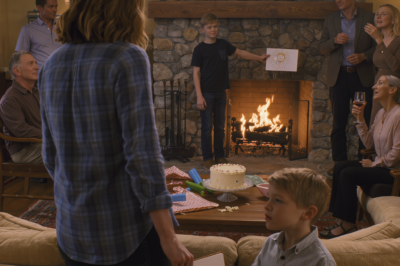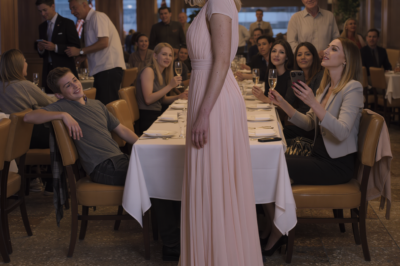
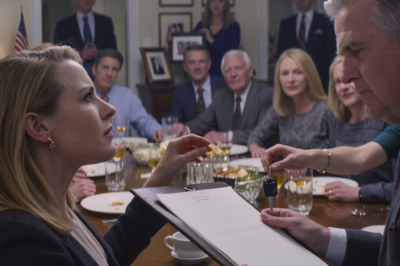
I didn’t say a word when my nephew slammed both hands into the side of my engagement cake and sent it spinning off the restaurant table. It hit the tile in a dull, wet thud, buttercream and red velvet exploding across the terrazzo. A tiny plastic American flag that had been stuck in the top for fun skittered across the floor and came to rest by my heel.

“Eat it off the ground,” he crowed, pointing at the mess like he’d just won a game. He was eight, but the laugh that tore out of him belonged to someone older and meaner.

The table roared. My father slapped his palm against the wood. My mother wheezed with laughter, clutching her glass of sweet iced tea. My sister tipped back her champagne flute and actually clapped. Phones were out, screens glowing, catching the cake sliding, the flag spinning, my face doing absolutely nothing.

Next to me, Nate went very still. I felt him more than saw him, the way a room feels a power outage. I watched a smear of frosting bloom across the floor like a slow white flower and set my fork down carefully beside my plate, tines pointing up like a small surrender I hadn’t agreed to.

Calm has a sound when you mean it. It’s quiet, but it’s not soft.

I pushed my chair back. The legs scraped. My nephew looked up, suddenly unsure, the ring of light from the overhead fixture caught in his eyes. He wasn’t the architect of any of this. He was just a kid learning what got applause.

My sister lifted her glass toward him. “Atta boy,” she laughed. “Guess we know who the real star of the party is.”

Nate started to rise. I touched his arm first, leaned down, and kissed his cheek. “We’re leaving,” I said. No sharpness. No raised voice. Just a sentence placed on the table like a bill they hadn’t expected.

Nobody told me to wait. Nobody said my name. Laughter doesn’t like being interrupted; it sulked into silence as we walked away. My sister’s smirk stayed pinned to her face like a brooch she’d decided was too important to take off.

Outside, the evening had cooled. The restaurant’s neon sign buzzed faintly. A fabric flag above the doorway hung limp against the brick, its red stripes dulled by dusk. Nate unlocked the car, and the dome light came on, washing the leather seats in pale gold.

“You okay?” he asked as he backed out of the parking spot, hands loose on the wheel.

“I’m done,” I said.

“With the dinner?”

“With the performance.”

The city slid by in orderly blocks—laundromats with fluorescent hum, a deli with Sinatra playing through tin speakers, kids on skateboards weaving around parked cars. At a crosswalk, the red hand blinked and the countdown started at thirty. I watched it fall—twenty-nine, twenty-eight, twenty-seven—and thought about other numbers. Years. Balances. Due dates. Missed calls. The kind of math that makes or unmakes a person.

By the time the light turned green, I knew the next numbers I cared about wouldn’t be candles on anybody’s cake.

Back home, I set my phone on the kitchen counter and slipped out of my heels. One strap was streaked with buttercream, a white scar across tan leather. I carried the shoe to the sink and washed it with lemon dish soap until the water ran clear. Under the warm stream, the frosting dissolved into a cloudy swirl and vanished. The leather looked almost new, like nothing had ever hit it.

I wished cleaning a history was that easy.

The red accordion folder sat on top of the fridge where I’d left it months ago. Its plastic edges were nicked from being opened and snapped shut, opened and snapped shut, every time I’d almost said enough and then shoved it back out of sight.

I dragged a chair over, grabbed it, and set it on the table like evidence.

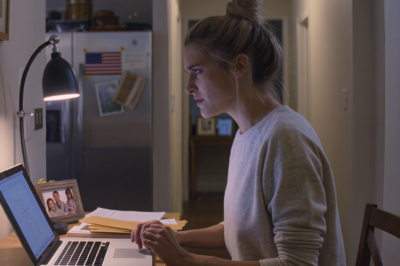
Inside was the map of my “good daughter” years. The auto loan I co-signed for my brother-in-law, neat black type under a bank logo: $19,500.00. The boutique line of credit my sister needed to “launch her brand,” my name under the word guarantor in print that felt like industrial lighting. Utility accounts for their rental—electric, gas, internet—all under my profile because I “got better rates.” Three authorized-user cards on my main credit accounts, swiping dinners and vacations and emergency salon appointments straight through my future.

Every signature on every page leaned the same direction. Mine was the only one that didn’t shake.

I’d told myself it was temporary. Family helps family. You don’t leave your sister stranded. You don’t leave your parents stressed. You sign. You smile. You clean up quietly when things go sideways. You show up with dessert and your newest card.

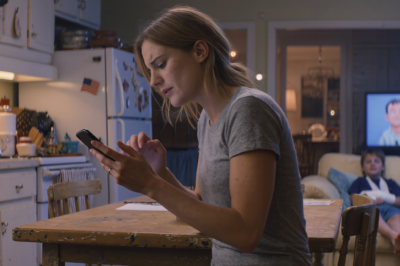
My phone buzzed against the counter, startling me. A text slid across the lock screen from my mother.

We’ve chosen to sever all contact. Stay away forever.

I stared at the words until they blurred, the way headlines do when you’re reading them half-awake. A second later, a tiny heart popped up under the message. My sister had liked it.

There it was. Their verdict, in gray and pink. I could almost hear my mother’s voice saying it at a family barbecue, apron on, spatula in hand: We’re cutting you off. Drama with a side of potato salad.

Instead, she’d typed it. And instead of calling her back and begging to understand what I’d done wrong this time, I felt something else slide into place.

Certainty.

My thumbs moved before the old training could catch up.

Removing my name from every loan tomorrow.

I pressed send.

Silence fell over my tiny kitchen like fresh paint. For a moment, nothing happened. Then the group chat woke up like a siren.

Are you kidding me?

Answer your mother.

It was just a joke.

You’re being ridiculous.

Pick up the phone or don’t bother coming back.

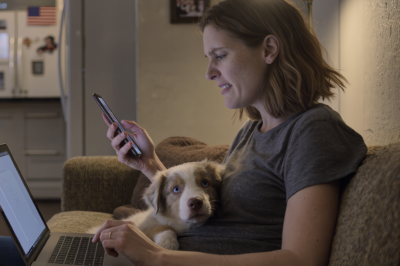
Missed call after missed call stacked in the corner of the screen—blue circles, red numbers, emojis crying theatrical tears. Thirty-six. Forty-one. Fifty-nine.

By midnight, they’d tried seventy-six times to reach me. I set the phone face down on the counter. The black glass gave me my reflection back, only larger. My shoulders squared. My jaw settled. The red folder sat open in front of me, pages fanned out like a deck of cards finally turned face-up.

Tomorrow, I thought, the money will tell the truth. They won’t.

I sleep best when I’m certain, and that night certainty tucked itself under my bones like a cold cloth. In the morning, I woke to pale light sliding across the blinds and the distant sound of a neighbor’s dog barking at nothing. It was 7:42 a.m. My alarm was set for 8:00. I turned it off, made coffee, and got dressed.

I didn’t put on armor. I put on a white button-down and navy slacks, the way I do when I want my thoughts to stay where I put them. I pulled my hair back, slipped my clean heels on, and tucked the red folder under my arm.

The bank lobby smelled like carpet cleaner and tempered glass. A Christmas cactus on the windowsill was trying to bloom out of season, hot-pink buds against dusty green. Behind the counter, Mrs. Donnelly, the branch manager, looked up and smiled.

“Avery,” she said. “Haven’t seen you in a while.” Her keyboard posture said kind, but with a spine.

“Busy morning,” I answered, setting the red folder on her desk when she waved me into her office.

She raised her eyebrows at the stack of papers I pulled out. “I’ll need to see your ID,” she said. The words were procedural, but there was something else in her tone—a quiet recognition that whatever this was, it wasn’t casual.

I handed her my license, then slid over the forms I’d filled out at the kitchen table between sips of cooling tea and the sound of my phone vibrating itself to exhaustion.

“I need these three authorized users removed from my accounts,” I said. “Effective immediately. And I’d like any linked accounts flagged for suspicious activity.”

She glanced at the names, then back up at me. “These are relatives,” she said gently.

“Were,” I replied. The word landed softer than I expected.

While she typed, my phone buzzed across the surface of her desk like it was trying to escape. Twenty-seven missed calls from Mom. Five from my sister. One from a blocked number I recognized as my brother-in-law’s, because cowardice always hides its caller ID.

“Everything okay?” Mrs. Donnelly asked.

“It will be,” I said. “This is me catching up with my own life.”

She gave a small nod, the kind professionals give when they know better than to ask for the whole story. Printers hummed. The screen reflected in her glasses. The Christmas cactus glowed faintly in the morning light.

“All processed,” she said eventually, sliding a small stack of warm pages toward me. “You’ll get verification emails within the hour. The authorized users are removed. Fraud monitoring is on. Your credit file will note that no one is to open accounts in your name without your direct consent.”

“Perfect.” I tucked the receipts into the red folder, its pockets heavier now with proof than with obligation.

On the way out, I caught my reflection in the glass doors and startled for a second. My face looked like mine, but sharper, as if someone had adjusted the focus. Behind me, the bank lobby hummed with business as usual. In front of me, Main Street was rubbing the sleep from its eyes—coffee shop lights flicking on, a city bus sighing to a stop.

Across the street, the bakery that had made my engagement cake was lifting its metal gate. Through the window, I saw the baker, flour on her forearms, box pastel cupcakes for a woman with a toddler on her hip. The little boy pressed his hands to the glass display case, eyes wide. The woman smiled with her whole face. So did the baker.

It stung less than I thought it would. The bakery hadn’t hurt me. The cake hadn’t, either. It was the people who thought smashing it made for good content.

Distance, I realized, could hurt and heal at the same time.

By noon, my emails chimed.

Authorized user removal complete.

Fraud monitoring initiated.

I scrolled through them with the calm focus of someone checking items off a surgical checklist. Then the messages from my family shifted tone.

Mom: Avery, what have you done? Your sister can’t pay her car note now.

Ela: You are ruining our lives over a joke.

Mom: Answer your mother. We are still your parents.

Me: I’m just giving you the independence you wanted so badly.

At 2:00 p.m., my phone rang with an unfamiliar number. I answered because I was in that mode now—handle it, don’t fear it.

“Ms. Lockach?” a brisk voice asked. “This is Claire from Summit Boutique Lenders. We received notice this morning that you’ve removed yourself as guarantor on account ending 4132. The account holder has defaulted. Would you like to settle your portion?”

“I no longer have a portion,” I said. “Please direct all communication to the account holder, Ela Lock.” I had to stop myself from apologizing for the inconvenience. “I’ve sent you written notice through my attorney as well.”

There was a paper shuffle on the other end of the line, the sound of someone realizing the script had changed.

“Very well,” she said at last. “We’ll update our records.”

That evening, I opened a cold bottle of white wine and poured a small glass. I stood at the kitchen counter, the same spot where my phone had screamed for my attention the night before, and watched the missed calls climb past seventy. Seventy-two. Seventy-four. Seventy-six.

Each ring was a bead on a string I’d finally decided to set down.

Revenge has a sound if you listen for it; it’s loud and dramatic, all cymbals and fire. Recovery is different. It sounds like your phone buzzing in another room and you deciding not to move.

At 7:12 the next morning, the knock on my door wasn’t a knock. It was a hammer.

“Avery, open this door right now,” my mother’s voice snapped through the wood. “You’ve humiliated this family. The bank froze our accounts.”

I set my mug down and walked over. Morning light dragged its feet across the hallway rug. I cracked the door an inch and looked at them through the narrow opening.

My mother stood in a floral robe tied tight at the waist like a general’s sash. My sister was behind her in leggings and a sweatshirt, thumb hovering over her phone screen as if she could rewind the last twenty-four hours by sheer force.

“No, Mom,” I said. “You did that when you used my credit as your safety net.”

She shoved the door wider. My mother has never believed doors open unless she pushes them.

“We are family,” she said. “You don’t turn your back on blood.”

I stepped aside just enough for them to see in. The living room was small and tidy. Plants lined the windowsill. A photo of Nate and me from a weekend road trip—wind-wrecked hair, sunburned noses—sat in a simple frame on the bookshelf. Two mugs dried upside down on a dish towel by the sink, a quiet promise of a life that made sense.

“Family doesn’t cash in one daughter to fund another’s life,” I told her.

My sister rolled her eyes so hard I could almost hear the hinge. “Oh my God, Avery, you’re acting like a victim again. It was just one car payment.”

“Three,” I corrected. “Plus your boutique loan, your husband’s business account, and every utility at your rental. Remember when you said I didn’t fit your status? This is what independence looks like.”

My mother’s fury wavered and shifted into something prettier—her favorite costume. Her voice softened. Her mouth fell into that fragile line she wears when she wants to look smaller.

“Honey, we made mistakes,” she said, tilting her head toward my sister the way a magician redirects focus from the trick, “but you’re punishing everyone for her.”

“I’m protecting myself,” I answered. “There’s a difference.”

My sister’s voice thinned. “They’re repossessing the car,” she said. “Avery, what do you want me to do?”

“Walk,” I replied.

The word landed between us like a dropped coin.

For the first time in my life, my mother had no quick comeback. Her eyes flicked around the room—plants, photograph, two mugs—searching for a foothold in a life that didn’t require her permission. When she finally spoke, her voice trembled.

“You’ll regret this when you’re alone,” she said.

“I’ve been alone my whole life, Mom,” I told her. “I just stopped pretending otherwise.”

They left with the kind of exit that likes to call itself dignity: backs straight, chin lifted, the door slam a punctuation mark they thought said case closed. The picture frames on my wall rattled, then settled into new positions, as if the house itself adjusted its idea of level.

A few minutes later, a text from my father arrived.

Don’t push your mother like this. She’s fragile.

I stared at it for a full minute before replying.

So was I. You just never noticed.

Then I turned my phone over and let it be.

The law office smelled like cedar and ink—two honest scents that don’t lie about what they are. Denise Hargrove, my attorney, had the kind of presence that makes thunderstorms lower their volume. You lean in to hear her, and in leaning, you calm down.

She spread the contents of my red folder across her desk like a map of an escape route.

“You’ve removed your financial ties,” she said, scanning account numbers with practiced eyes. “Next we’ll file a credit protection notice, send formal letters to each creditor, and document any harassment. Keep the call logs, screenshots of messages, and times of visits.”

“I started a file,” I told her, pulling a blue binder from my tote bag and setting it beside the red folder. Tabs marked dates in black pen, straight as fence posts.

“Good,” she said. The word held the weight of approval and strategy. “You’re building a clean paper trail. Emotional control is your advantage here.”

The line hit like truth on ice.

Emotional control was the thing my family had always used as proof that I was cold. You’re so serious, Avery. You’re so calculating. They said it like an insult, like a character flaw I should be apologizing for.

It turned out, it was my life vest.

After I signed the paperwork, I stepped back out into the sliver of city her office overlooked. The café across the street hummed with steam and voices. A barista with sleep-creased eyes and a college sweatshirt took my order for an iced coffee.

“You’re Avery Lock, right?” he asked as he rang it up.

“Yeah,” I said slowly.

“I saw the feature on your startup last year,” he went on. “That thing where you funded internships for women in tech? My sister got one. It changed her life.” He slid a blueberry muffin into the bag and smiled. “This one’s on me.”

For a second, the world tilted. Outside my family’s version of me—the ungrateful, difficult daughter who owed them everything—I was somebody else. Someone who showed up, delivered, built small bridges and didn’t ask for applause.

Their narrative didn’t fit. Not even as a borrowed coat.

That night, Nate found me on the couch surrounded by printouts and sticky notes. The apartment smelled like lemon cleaner and printer ink, the scents of a life being inventoried and set in order.

“You’re really doing this,” he said, lowering his voice like we were in a library.

“I already did,” I answered.

He leaned down and kissed the top of my head. “Then it’s their turn to learn what accountability feels like.”

Deep down, I knew that word—accountability—would scare my family more than silence ever had. Silence they could blame on me and fill with their own stories. Accountability required mirrors.

Two days later, the first consequence arrived like a badly tuned trumpet. My sister tried calling Nate, forgetting he’d blocked her months ago when she’d called him a placeholder. Then my father left a voicemail so angry the audio clipped every few words. I could only make out the classics: ungrateful, ruined, fix.

His last line stuck.

Fix this before we go public.

Public.

We’d always been a family obsessed with the front-facing view. Designer dinners. Curated Instagram posts. The house staged like a magazine spread even on trash day. Image was the wall we kept repainting while the foundation cracked.

At the office, the fluorescent lights buzzed overhead as I poured coffee by the communal machine. My coworker Janelle studied me for a second.

“You look… lighter,” she said.

“Guess cutting toxic ties is cheaper than therapy,” I answered, winced at my own joke, then smiled anyway. Sometimes the only way to talk about hurt is sideways.

She bumped her shoulder against mine. “Whatever you did, keep doing it.” She didn’t ask for the story. That was its own kind of kindness.

By that evening, my mother was back at my door—this time with a Tupperware of casserole, baked cheese and oregano fogging the lid.

“Avery, we just want to talk,” she said when I opened the door halfway. Her voice was sugar-soft now. “You don’t understand how hard things are for your sister.”

“I understand perfectly,” I told her.

I stepped aside just enough for her to see the stack of legal folders on my table, the blue binder on top of the red folder, the highlighter uncapped beside them.

“I’m done being the insurance policy for everybody else’s choices,” I said.

Her eyes searched my face, looking for the switches she used to flip—the guilt one, the obligation one, the you’re-all-she’s-got one. I’d pulled all of them out of the wall.

“I raised you to be kind,” she said.

“No,” I replied, voice as quiet as a hospital corridor at 3 a.m., where truth sounds louder against all that linoleum. “You raised me to be useful.”

She flinched, just a little. For a second, some old reflex in me reached for apology. Then I remembered every ignored birthday, every emergency form pushed under my nose with “just sign it,” every time my credit score wore their crisis like a hand-me-down coat.

“I’m not doing this with you,” she said finally, the casserole dish trembling in her hands.

“You already did,” I said. “For years.”

She turned and walked down the hall. The smell of baked pasta trailed behind her, a domestic soundtrack that had never actually meant comfort.

That night, I emailed Denise.

Proceed with finalizing the financial separation. Full closure this week.

Some families say forever and mean ownership. I was finally learning that I could say forever and mean freedom.

Thursday drew a clean line.

By noon, a tow truck rolled up in front of my sister’s townhouse and hauled away the SUV that had extended their radius to every restaurant where it was easy to be generous with someone else’s future.

By evening, the boutique’s Instagram page disappeared—one moment a grid of curated outfits and latte art, the next a blank screen that looked a lot like shame turning out the lights.

The family group chat resurrected itself, like a bad play revived for a shorter run. My mother added me back without asking.

Avery, we need to fix this together. You can’t abandon your family over money.

I read the message three times. Then I set my phone face down and felt the old conditioning rise in me like a wave—and, for once, break without dragging me under.

Nate was packing a box in the living room, folding his things into my space with the slow, careful choreography of someone who planned to stay.

“They’re trying to pull you back in, huh?” he asked.

“Always,” I said. “They only remember love when the bills arrive.”

“Maybe don’t answer,” he suggested, as simple as flipping off a light.

“Sometimes silence is the most eloquent sentence.”

So I answered someone else instead.

I opened the document I’d been shaping in the quiet margins of my days, the one that laid out a personal grant program for women starting over after financial exploitation. Seed fund: $120,000. All mine. All earned. My money, my choice.

A woman’s credit is not a communal resource, I typed. We fund exits, not apologies.

Later that night, a text from an unknown number flashed across my screen.

They’re blaming me now. Dad says it’s all my fault. Please talk to Mom. She’s losing it.

Ela, or one of her friends, or a borrowed phone—it didn’t matter. I looked at the words until they blurred, then typed back:

I spent years losing myself for all of you. I’m done being lost.

The phone stayed quiet after that. The air in my apartment held steady, like a held note finally allowed to fade.

Peace, I realized, doesn’t always wait for forgiveness. Sometimes it begins with absence.

Friday’s storm wasn’t outside. It was online.

My brother-in-law went live on Facebook from their half-empty living room, pacing in front of a USA flag throw pillow like a preacher in a church built from grievances.

“We gave her everything,” he shouted into his phone, voice cracking. “My wife’s sister, this greedy woman, just wrecked her own family over a couple of late payments.” From off-camera, a voice that sounded a lot like my mother’s fed him lines.

I wouldn’t have seen it if Janelle hadn’t texted me a link with a quick warning: Don’t look. It’s bad.

Of course I looked. Old habits are stubborn.

The comments, though, weren’t what he expected.

Isn’t she the one who paid your loans?

Sounds like you were mooching, bro.

Wait, isn’t this the same Avery who started that internship program?

Screenshots of my foundation’s grants appeared. People from my world—the one beyond the family mirage—showed up with receipts. They remembered quiet checks I’d written, internships funded, bills covered for strangers who’d never know my last name.

The tantrum became its own undoing in real time.

Denise called that afternoon, her voice cool as a glass tabletop.

“They’ve officially violated defamation clauses by going public,” she said. “We can file if you want to.”

I looked out the window at a kid riding a bike down the block, training wheels rattling over the cracked sidewalk.

“No lawsuits,” I decided, feeling the shape of the word no in my mouth like a tooth I’d finally stopped worrying. “Let the truth breathe.”

That night, Nate and I sat on the balcony with two mugs of tea. The city lit its windows like a constellation only locals know how to read.

“You look peaceful,” he said.

“I am,” I answered, surprised to hear how true it sounded.

“For years I wanted them to see my worth,” I added, watching a plane blink its way across the sky, “but now I don’t need them to look. I can see it myself.”

“You think they’ll ever apologize?” he asked.

I shook my head. “People who confuse love with control usually don’t.”

The wind shifted just enough to pick up a dried leaf and set it down somewhere better.

Saturday arrived like the second breath after a long swim. Morning light slipped through the curtains and painted the hardwood a forgiving gold. I made coffee, checked my email, and paused at a subject line I didn’t recognize.

Community Award Nomination — Avery Lock.

The local council wanted to recognize the grant program for empowering women through financial independence.

I laughed, quietly and completely. The same city that had once echoed my family’s whispers about my failures was now saying my name out loud for something I’d built with my own hands.

That afternoon, I drove to the community center we partnered with. Inside, the rooms were small and honest—folding tables, laptops with stickers peeling at the corners, a bulletin board full of flyers that actually meant something.

A young mom in a denim jacket approached me, nerves and pride fighting for space on her face.

“You don’t know me,” she said, “but because of your grant, I got my first certification. My son’s proud of me.”

Her eyes shone in the way people’s do when relief and pride arrive at the same time.

I hugged her. “That’s the approval that matters,” I said. “Your own.”

When I got home, a single envelope lay on my doormat. No return address, but the handwriting pulled at an old thread inside me.

Avery, we didn’t know what we had until it was gone. Please talk to us. Love, Mom and Dad.

I read it twice. Then I folded the note, slid it back into the envelope, and carried it to the fireplace.

Paper wants a simple fate. I struck a match, touched it to the corner, and watched the flame catch. The edges curled inward, black confetti forming. The ink let go last.

No hate. No triumph. Just release.

Nate stepped into the room and laced his fingers through mine.

“You okay?” he asked.

“Better than I’ve ever been,” I said.

“So what now?”

“Now?” I watched the last ember collapse into ash. “Now I build a family that doesn’t need saving from itself.”

Outside, the city glowed like a heartbeat. Inside, the silence wasn’t empty anymore. It was earned.

People like to say humiliation is sudden—a slap, a shout, a cake hitting tile. It isn’t. It hardens the way sugar does when you leave it uncovered on the counter. Crystal by crystal, moment by moment, until one day you go to scoop and the spoon won’t go through.

The exact moment mine hardened wasn’t when my nephew yelled, “Eat it off the ground.” It was in the pause after, when I realized my breath was still steady, my hands were still clean, and I was done auditioning for their affection.

Back at the sink that first night, scrubbing lemon over leather, I saw my life in a montage I hadn’t asked for—signatures in tidy loops, keys handed over, the word temporary spoken in tones that meant until you say no. The errands were so ordinary. That was what undid me. All those times I’d stood in line to tidy up their futures, the way anyone stands in line to buy lightbulbs.

Later, when I smoothed the red folder’s cover and slid it onto a shelf next to the blue binder, it didn’t feel like a weight anymore. It felt like a record. Not of what they owed me, but of what I finally stopped owing them.

I wrote a list that wasn’t for groceries: bank, credit freeze, attorney, utilities, lender letters, autopay removals. I scheduled each call like a surgeon books a morning of procedures—one clean cut at a time, with breathing room in between.

I didn’t add text Mom.

The small click inside when I left that line off? That was the sound of a habit breaking.

By the time the dust settled, the numbers that mattered most weren’t the balances they’d run up or the $120,000 I’d put aside to help other women step out of similar shadows.

It was seventy-six.

Seventy-six calls I didn’t answer.

Seventy-six chances to go back.

Seventy-six tiny doors I let stay closed.

My name is Avery Lockach. I’m twenty-eight. If you think you know how this ends, you’re probably imagining a reunion, a tearful apology, a family dinner where someone buys another cake to make it right.

That’s not this story.

This story ends with a woman who finally treated herself like someone worth protecting, a red folder that lives on a shelf instead of on her back, and a single sentence sent from a tiny kitchen that changed the color of everybody’s face the next morning:

Removing my name from every loan tomorrow.

The rest was just administration.

Administration, I learned, has its own rhythm.

There were the obvious pieces: statements arriving in the mail with my name in smaller print, then disappearing altogether; credit reports that used to read like a group project slowly shrinking until they reflected only my choices. Then there were the quieter pieces, the ones nobody warns you about—the way holidays rearrange themselves when you stop driving three hours to sit at a table where your chair is always a little unstable.

The first test came at Thanksgiving.

“Avery, what are you doing for the holiday?” my manager asked in October, casually, over a tray of donuts shaped like tiny pumpkins.

“Probably staying in the city,” I said. “Maybe volunteering somewhere.”

She nodded. “Good for you. Airports are chaos that week anyway.”

I nodded back, but it wasn’t the airports I was thinking about. It was my mother’s kitchen—her rows of casserole dishes, my sister’s strategic sighs about how exhausting it was to host, the inevitable moment when someone would shove a bill into my hand with a laugh.

You’ve got the card, right, Ave?

A week later, the group chat woke from its sulk.

Mom: Thanksgiving at the house. 2 p.m. Don’t be late.

Ela: And bring that sweet potato thing you do. And wine.

I stared at the screen for a long thirty seconds, then typed:

I’ve already made plans.

There was a full minute of nothing, the digital equivalent of a stunned silence around a table.

Mom: With who?

Me: Myself.

Ela: You’re unbelievable.

Mom: Family comes first.

Me: I did that for 28 years. This year, I’m first.

Janelle and I ended up serving dinner at a community center that Thursday, handing out plates of turkey and mashed potatoes to people who actually said thank you and meant it. The room smelled like gravy and cinnamon and tired hope. Someone had taped a paper flag to the wall, hand-colored with crayons, the stars a little crooked. A kid in an oversized hoodie tugged at my sleeve.

“Miss, can I have more stuffing?” he asked.

“Absolutely,” I said, scooping an extra spoonful. “Stuffing is a human right.”

Janelle snorted behind me. “Put that on a T-shirt,” she whispered.

After the rush, we sat on folding chairs with flimsy paper cups of coffee.

“You okay?” she asked quietly.

I thought about my parents’ dining room—china, crystal, my sister’s Instagram stories probably documenting every dish. I thought about the red folder, now living on a shelf instead of under my skin.

“I’m… good,” I said, surprised by how true it felt. “It’s quieter this way.”

“Quiet isn’t the worst thing,” she said. “Sometimes it’s where you hear yourself for the first time.”

That night, Nate and I ate leftover turkey sandwiches on my couch and watched a ridiculous movie about a dog that solved crimes. At one point, he paused the TV and looked at me.

“Do you miss them?” he asked.

I thought about lying. About saying no, not at all, I’m better off.

“Sometimes,” I admitted. “I miss the idea of them. The version where they’re the people I kept trying to see.”

He nodded and unpaused the movie.

“That’s fair,” he said. “Just don’t miss them more than you remember you.”

Christmas was louder.

In early December, a cousin I barely spoke to DM’d me on Instagram.

Hey, just wanted to say I don’t know what’s going on, but Uncle Mark is telling everyone you’re having a breakdown. If you ever need anything, I’m around.

There it was: the social consequence Denise had warned me about. Stories don’t stay in houses anymore; they leak into group texts and church parking lots and Facebook comments.

I typed back:

I’m fine. Just finally paying attention to my own life.

She heart-reacted the message and sent a selfie of her and her daughter at a Christmas market, bundled in scarves.

Family is weird, she added. You’re not.

In the lobby of my apartment building, someone had hung a string of tiny flags as decorations—Christmas trees alternating with little USA banners. One of the flags had slipped, drooping at an angle, held by a single piece of tape. I fixed it on my way past without thinking, pressing it back into line.

Old habits, I thought, then laughed at myself.

At my company’s holiday party, my boss clinked a glass and gave a short speech about growth and resilience and “showing up for each other.” People cheered. Janelle and I retreated to a corner with caramel brownies.

“So,” she said, “what’s the plan now that you’re no longer the First National Bank of Family?”

I thought about the grant program proposal open on my laptop at home, the spreadsheets, the women I’d started interviewing for the first round.

“Honestly?” I said. “I think I’m finally going to build the thing I kept pretending didn’t matter.”

“Your foundation?” she asked.

“My life,” I answered. “The foundation is just… paperwork.”

She lifted her plastic cup of champagne. “To paperwork that actually helps people,” she said.

We clinked.

January brought snow and, with it, another kind of test.

A letter arrived from a collection agency I didn’t recognize, addressed to me but referencing an account number I’d never seen. The balance was $7,413.19. The paperwork claimed I’d opened a store card three months earlier at a furniture chain in a suburb I’d never been to.

I sat at my kitchen table, the envelope open in front of me, and felt that old familiar chill slide up my spine.

Of course, I thought. Of course they tried.

I called the number listed on the notice.

“Ma’am, we have records of your application in October,” the representative told me. “Social Security number, address, everything matches.”

“Pull the security footage from the store,” I said, surprising myself with how steady my voice was. “You’ll see it’s not me.”

“We’d need a formal dispute on file,” she said.

“You’ll have one within the hour,” I replied.

I hung up, scanned the letter, and emailed it to Denise.

Her response came twelve minutes later.

Already on it. You’ve got a credit freeze, so this was likely forced. We’ll escalate.

Two days later, she forwarded me a grainy still from security footage at a checkout counter.

My sister, head down, hair tucked into a beanie, signing my name with a speed that spoke of practice.

Ela.

For a second, the room tilted again. Not from shock—I’d run out of that months ago—but from the sheer exhaustion of being proven right.

Denise’s email was short.

Police report filed. Store cooperating. You’re protected. Keep this for your records.

The image went into the blue binder, under a tab labeled January.

“This is wild,” Nate said that night, staring at the printed still. “She really thought she could just… keep doing this.”

“She grew up in a world where consequences were my problem,” I said. “It must be confusing to find out they’re not.”

“Does it make you want to call her?” he asked.

“No,” I said. “It makes me want to update my passwords.”

We laughed, but only a little.

At work, I started taking late lunches to meet with the director of the community center about the grant program. We sat in a small office that smelled like coffee and dry-erase markers, talking about timelines and metrics and what success would actually look like.

“I don’t want this to be charity,” I told her. “I want it to be partnership. Women who’ve been drained financially don’t need pity. They need runway.”

“Runway,” she repeated, nodding. “I like that.”

We settled on helping twelve women in the first year, $10,000 each in a combination of grants, low-interest loans, and emergency relief. $120,000 total.

A neat number. A true one.

At night, when my phone lit up with unknown numbers, I let them go dark. Sometimes a voicemail appeared—my father’s voice, tighter now, or my mother’s weaving between fury and pleading—

You can’t keep doing this.

You’re killing your mother.

We’re your only real family.

I’d listen once, then file them in a digital folder Denise had asked me to keep. Document, don’t editorialize.

“Doesn’t it hurt, hearing them?” Nate asked one night, when he caught the look on my face as I put the phone down.

“It hurts,” I said. “But it doesn’t hook.”

There’s a difference.

Spring came early that year. One Saturday in March, I found myself walking past my parents’ neighborhood on the way to a farmer’s market with Nate. The air smelled like thawing earth and grilled hot dogs from a stand on the corner.

“Do you want to avoid the block?” he asked.

I thought about it.

“No,” I said. “I just don’t want to stop.”

We cut down their street. The house looked the same from the outside—flagpole in the yard, Stars and Stripes sliding in a lazy breeze, flower beds mulched within an inch of their lives. A new SUV sat in the driveway, smaller than the last one but still glossy.

As we passed, the front door opened. My mother stepped out in gardening gloves, a bucket of tools in one hand. She froze when she saw us.

“Avery,” she called.

I could have pretended not to hear. The breeze carried her voice cleanly, though. I turned my head.

“Hi, Mom,” I said, not stopping.

Her eyes dropped to Nate’s hand in mine.

“Are you really going to walk by your own mother’s house like a stranger?” she demanded.

I didn’t raise my voice. I didn’t step closer.

“I’m walking by like a neighbor,” I said. “That’s the relationship we have now.”

She stared, lips parted. The gardening gloves made her look oddly vulnerable, like she’d been caught in the act of taking care of something that wasn’t me.

“You’ll come around,” she said finally, a little desperately. “You always do.”

I squeezed Nate’s hand.

“Not this time,” I answered.

We kept walking. At the end of the block, my knees felt shaky. Nate stopped us under a maple tree and just stood there until my breathing evened out.

“That was huge,” he said.

“I didn’t die,” I said.

“Gold star,” he replied.

We both laughed.

The award ceremony the council had emailed me about back in the winter took place in June, almost exactly a year after the cake hit the tile.

It was held in a modest auditorium at City Hall, the kind with stackable chairs and a stage that creaked. A big banner hung at the back: COMMUNITY IMPACT AWARDS. Someone had put tiny flag magnets on the metal podium.

I wore a simple navy dress and the same heels I’d washed in lemon soap the night everything changed. The leather still held a faint citrus scent if I concentrated.

“Are you nervous?” Nate whispered as we took our seats.

“A little,” I admitted. “But the good kind.”

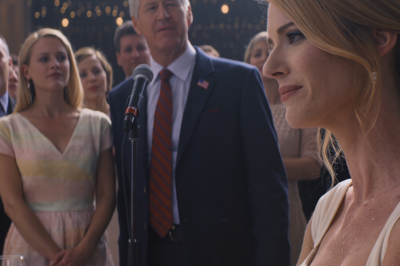
When they called my name—“For her work establishing the Lock Foundation, which provides financial runway to women rebuilding after exploitation”—the applause was real and warm. People stood. Some of the women from our first grant cohort were there, clapping and whistling.

As I crossed the stage, I caught sight of a familiar figure in the back of the room, standing in the shadow near the exit.

My sister.

She wore a dress I recognized from an old shopping trip we’d taken together, back when we still pretended to like each other in fitting rooms. Her arms were crossed, her face hard to read from that distance.

For a second, my chest tightened. I forced myself to look away.

The councilwoman handed me a plaque and leaned in.

“Say a few words?” she asked.

I stepped up to the podium. The tiny flag magnets stared up at me.

“Hi,” I said into the microphone, my voice echoing slightly. “I’m Avery. I used to be really good at paperwork that benefited everyone but me. Now I’m trying something different.”

A small ripple of laughter moved through the room.

“This program started because I learned, the hard way, that a woman’s credit can be treated like a communal resource by the very people who say they love her,” I continued. “I wanted to build something that says: your future belongs to you. Not to your ex. Not to your parents. Not to anyone who thinks your name on a document is just a convenient line.”

I talked about the twelve women we’d funded so far—the daycare owner who expanded her hours, the nursing student who paid off predatory debt, the single mom who finally left an apartment where her name had never been on the lease.

“We’re measuring success in boring numbers,” I said, “credit scores and savings accounts and balances brought to zero. But we’re also measuring it in things you can’t see on a spreadsheet—how many times someone says ‘I don’t have to ask permission anymore.’”

I paused, hands resting lightly on the edge of the podium.

“I’m grateful for everyone who helped make this possible,” I said. “My team. Our partners. The women who trusted us. And, honestly, I’m grateful for the lessons that hurt enough to make me change.”

I didn’t look at the back of the room as I stepped away.

Afterward, while people milled around with plastic cups of punch, one of the grant recipients introduced me to her teenage daughter.

“This is the lady I told you about,” she said. “The reason we’re moving into a better place next month.”

The girl stuck out her hand.

“Thank you,” she said, cheeks pink.

“You don’t owe me anything,” I told her, shaking her hand. “Just pay it forward in whatever way makes sense for you.”

From the corner of my eye, I saw movement near the exit.

“Avery,” my sister’s voice came from behind me.

I turned.

She stood a few feet away, arms wrapped around herself. Up close, she looked smaller than I remembered.

“Congrats,” she said. It sounded like the word tasted strange in her mouth.

“Thanks,” I said.

For a beat, neither of us spoke.

“I didn’t open that account,” she blurted.

“The store’s security cameras say otherwise,” I replied evenly.

She flinched.

“Dad pressured me,” she said quickly. “He said you’d never let us sink. That you were just acting out.”

I believed her. And I didn’t.

“Maybe you both believed that,” I said. “But you still picked up the pen.”

Her eyes filled, but she didn’t cry. My sister hates crying in public.

“Mom misses you,” she said. “She pretends she doesn’t, but she does. She keeps that stupid little flag from your cake in a drawer.”

The image startled me—a tiny plastic flag, stained with frosting, rattling around next to rubber bands and spare keys.

Part of me wanted to ask why. The rest of me already knew it didn’t matter.

“I hope she finds peace,” I said. “I hope you do too.”

“That’s it?” she asked. “You’re really not coming back?”

I thought about seventy-six calls I hadn’t answered. About a red folder on a shelf. About twelve women who now had their own folders, thick with possibility instead of debt.

“That’s it,” I said.

She swallowed, looked like she might say more, then turned and walked away. As she reached the door, the sunlight caught the edge of her hair, turning it copper for a second, the way it had when we were kids running through sprinklers.

I let the memory be just that—a picture in a drawer, not something I had to hang back on the wall.

That night, back home, I took the plaque from my bag and set it on the bookshelf next to the photo of Nate and me. The wood frame and the engraved metal looked oddly at ease beside each other.

Nate came up behind me, resting his chin on my shoulder.

“Looks good there,” he said.

“It does,” I agreed.

On the coffee table, my phone buzzed. I glanced at the screen.

Dad: Your sister said you ignored her. You humiliated her at that event. You could have handled that better.

I looked at the text for a long moment, then set the phone face down without replying.

“I thought you were going to say something,” Nate said.

“I did,” I answered. “Just not to him.”

I’d said it to myself, to the room full of people who knew my name because of what I’d built, not what I’d survived.

Later, as we sat on the balcony, the city humming below us, I thought again about that night at the restaurant. About the cake, the laughter, the little flag skidding across the floor.

“Do you ever wish it hadn’t happened?” Nate asked quietly.

“All the time,” I said. “And not at all.”

He waited.

“If it hadn’t,” I went on, “I might still be sitting at that table, laughing along, paying the bill, telling myself it was love.”

He nodded.

“Instead,” I said, looking out at the lights, “I’m here. With you. With this life. With seventy-six calls I didn’t answer and a future I did.”

He reached for my hand.

“To unanswered calls,” he said.

“To answered ones,” I replied, squeezing his fingers.

The night was soft. Somewhere down the block, someone played Sinatra on a porch speaker, the old crooner’s voice drifting up like a benediction.

My humiliation hadn’t been a single moment. It had been a slow drip. But the clarity after? That came rushing in, cold and clean, the second I hit send on a text from a tiny kitchen:

Removing my name from every loan tomorrow.

Their faces changed color the next morning. Mine did, too.

Theirs flushed with panic.

Mine finally matched my own life.

And the rest—every email, every binder tab, every grant, every woman who walked away from a table where she’d been the main course—that really was just administration.