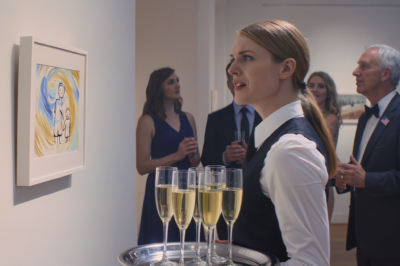
I was balancing a silver tray of champagne flutes when I saw it.
Not the painting, not yet. First I saw the flag.
A guy in a navy suit with a tiny American flag pin on his lapel lifted one glass, then another, talking about his portfolio like the whole stock market lived in his pocket. Frank Sinatra was crooning from hidden speakers, the kind of smooth, old‑school playlist rich donors expect at Manhattan gallery openings. On the far table, next to the catered deviled eggs no one ever eats, someone had parked a sweating pitcher of iced tea beside the French champagne like a joke about what “the heartland” drinks.
I did what I always do: smile, nod, float through the room like friendly furniture.
And then, past a cluster of sequined backs, I saw a painting I made when I was six years old.
Price tag: $150,000.
I’ve been serving champagne at special events for three years. It’s decent money—better than retail, worse than anything that comes with a degree I don’t have. You show up, put on the black vest and white shirt, tuck your hair back, and turn yourself into a moving tray. Smile politely. Circulate with glasses of wine and tiny appetizers that cost more than my rent. Rich people talk around you like you’re part of the décor. Invisible.
I’m good at being invisible. I’ve been practicing since I was six.
That night I was working for Elite Events Catering at the opening of a new exhibition at the Duncan Gallery. High‑end gallery, serious collectors, serious money. The show was called Voices Unheard, an outsider‑art collection. I’d read about it in the event brief: work by unknown creators, children, people who had experienced homelessness, self‑taught artists. The kind of art rich people buy to feel cultured and virtuous, then hang in second living rooms they’ll visit twice a year.
I adjusted my vest, balanced the tray, and did another slow loop around the gallery.
“This collection is extraordinary, Victor,” a woman in a column dress murmured as she took a flute from my tray without really looking at me.
“Thank you, Margot.” The man beside her was in his sixties, silver hair, tailored charcoal suit that probably cost more than my annual rent. “I’ve been curating this collection for decades. Each piece tells a story, and the provenance is verified. Each work comes with documentation of origin—orphanages, group homes, street markets. I’ve spent years tracking them down.”
He sounded proud. Sincere.
Later, I would know that almost every word he said in that speech was a lie.
I moved through the crowd, offering wine, scooping up empties, doing my best impression of a friendly ghost. Then I turned a corner and time just… folded up.
It was a small piece, maybe twelve by sixteen, watercolor and crayon on cheap paper, now framed in dark wood like it belonged in a museum. The image was a mess of blue and yellow swirls, with two crude stick‑ish figures—one tall, one small—reaching toward each other. To anyone else, it looked like something a kid made in art class, the kind you tape to a fridge until the paper curls.
To me, it looked like the only thing I had left from a life that got taken away.
In the bottom right corner, half lost under the mat, I saw three crooked green letters: ANG. And in the top left, faded but still there: 5/12/2003.
May 12, 2003. My sixth birthday.
The tray trembled in my hands. One flute clinked against another and someone nearby gave me a sharp, annoyed glance, the way you’d look at a busboy who almost dropped your dessert.
I had to move. I had to breathe.
Instead, I stared.
Have you ever seen something from your past you were sure was gone forever? A toy, a photo, a handwriting sample? Now imagine seeing it under museum glass with a six‑figure price tag, while you stand there in a rented vest, topping off flutes for the people admiring it.
The placard next to the frame came into focus.
UNTITLED (MOTHER AND CHILD)
Artist: Unknown
c. 2003
Found at St. Catherine’s Children’s Home
Price: $150,000
My painting. My painting was being sold for one hundred and fifty thousand dollars.
And I was the one serving drinks.
By the time this night was over, I decided, I was either going to lose my job or I was going to stop being invisible.
Maybe both.
I forced my feet to move, backed away before I dropped the tray, and retreated to the staff hallway at the back. The smell changed from perfume and money to bleach and old coffee. I locked myself in the tiny staff bathroom, set the tray in the sink, and sat down on the closed toilet lid.
That was when the memories hit.
The cheap, thin paper on a scarred kitchen table. The watercolor set my mom bought at the dollar store, colors in cracked plastic pans. Me dipping the brush into a chipped mug with a faded American flag printed on the side because we didn’t own real paint cups. My mom—Angela—standing at the stove stirring boxed mac and cheese, glancing over, her eyes soft and tired and proud.
“It’s beautiful, baby,” she’d said when I held the finished sheet up, water still dripping off the edges. “It’s us, right? You and me?”
“Yeah, Mama. Always together.”
I remember the way she laughed when I accidentally streaked blue sky into the yellow sun. I remember the green crayon I used to write her name in the corner and then, because she told me real artists sign their work on the back, the way I flipped the paper over and, with my tongue pressed to my teeth in concentration, printed a clumsy message in uneven letters:
For Mama. Love, Aaron.
That little secret message in green crayon was just for her.
“And don’t forget the date,” she’d said, guiding my hand. “So someday you’ll know exactly when you made it.”
5/12/03.
I was so proud of that painting I wouldn’t let it dry on the table. I fell asleep holding it.
The next day, a man came to our apartment. Thin, suit a little shiny at the elbows, smile that didn’t quite reach his eyes. He said he was from Child Protective Services. He said he wanted to help.
His name was Mr. Duncan.
He walked through our apartment, making notes. My mom kept explaining. She worked three jobs. She was waiting on a paycheck. She was doing the best she could.
“She loves me,” I remember blurting. “She always makes sure I eat.”
He crouched to my level and took the painting gently from my fist.
“That’s beautiful,” he said. “You did this?”
I nodded, tears blurring my view.
“I’ll keep this safe for you, sweetheart,” he promised. “You’ll get it back.”
I rode away in the back of his car with no seat belt because it was jammed, watching my mother’s face get smaller in the rear window. She was crying. I was crying. The painting was on his front seat.
I never saw either of them again.
Not my mother.
Not the painting.
Until that night, in a gallery full of strangers, with a price tag that could have bought my mom an entire life.
I splashed water on my face, stared at myself in the mirror—thirtyish, brown hair scraped back, cheap mascara, borrowed lipstick. To everyone out there I was just another server. But I knew what I knew.
I made that painting. I made it on my sixth birthday. I signed it in green crayon on the back.
And the man selling it was the same man who’d taken it from me.
I walked back into the gallery like I was walking into traffic.
The room hummed with money and conversation. Sinatra had given way to a Nora Jones cover, something soft and sophisticated. I set my empty tray on a side table and went straight to the painting, weaving between bodies, ignoring the looks from people who thought I was in their way.
Victor Duncan stood a few feet away, talking to a couple I recognized from the RSVPs—major donors, maybe buyers. Up close, the years had been kind to him. Same easy smile, now backed by a designer watch and cufflinks that caught the light.
I stepped up beside him.
“Sir,” I said.
He turned, polite irritation flickering over his features. “Yes?”
I pointed at the painting. My voice shook, but I made it loud enough for the couple to hear.
“That painting is mine.”
The woman’s brows lifted. The man glanced from me to the frame.
Victor’s smile didn’t falter, but something in his eyes tightened. “I’m sorry?” he said smoothly.
“I drew it when I was six. May twelfth, two thousand three. It was my birthday. I made it for my mom. Her name was Angela. That’s why it says ‘ANG’ in the corner.” I swallowed. “You know that, because you were there. You were my social worker.”
The couple leaned in a fraction. The people nearest to us started to go quiet.
“Miss,” Victor said, the word edged now. “I think you’re confused. This piece was donated anonymously from St. Catherine’s Children’s Home. The artist is unknown.”
“The artist is me. Aaron Perry.” The name tasted like a dare. “You came to our apartment. You took me away. I was holding that painting and I was crying, and you said you’d keep it safe. You kept it, all right. You framed it and slapped a six‑figure tag on it.”
He gave a low, indulgent chuckle meant for the onlookers. “I’m afraid this is a misunderstanding. Perhaps you made something similar as a child. Many children paint scenes like this. But this work has been authenticated.”
“By who?” I shot back. “You?”
“By professionals,” he said. “And right now you’re disrupting a private event. I’ll need you to return to your duties.”
“I’m not going anywhere,” I said. “That’s my painting.”
The air around us changed. Conversations paused. The silver‑haired donor couple looked uncomfortable now, as if they’d stumbled into a family fight in the middle of a restaurant.
Victor’s jaw ticked. “Security,” he said over my shoulder.
A security guard appeared at my side like he’d been waiting for that word all night. He was large, in a black blazer and an earpiece, and his hand wrapped around my upper arm—not rough, but firm in the way of someone paid to move bodies without making a scene.
“Escort this woman out, please,” Victor said. “She’s had too much to drink.”
“I haven’t had a single sip,” I snapped. “But sure, tell yourself whatever you need to.”
I looked him dead in the eye.
“I’ll prove it,” I said, my voice steady now. “I’ll prove that painting is mine. And I’ll prove you stole it from a six‑year‑old.”
He already had his back half‑turned, dismissing me.
The guard walked me through the sea of expensive fabrics and curated indifference, through the glass doors and out onto the cold New York sidewalk. The air slapped my cheeks.
My manager, Tony, rushed out after us, his face tight. “Aaron, what the hell just happened?”
“I saw a painting I made when I was a kid being sold for one hundred and fifty thousand dollars,” I said. “I confronted the guy who took it from me.”
Tony scrubbed a hand over his face. “You can’t do that. You can’t confront clients during events.”
“He stole from me.”
“Can you prove it?”
I opened my mouth. Closed it. “Not yet,” I admitted. “But I will.”
“Well, until you do, you’re off the schedule,” he said, eyes softening just a little. “I can’t have scenes like that. Call me when you’ve got it sorted, okay?”
The guard lingered until Tony walked back inside. Then he gave me a sympathetic shrug and followed.
And just like that, in the span of ten minutes, I was unemployed and standing on a Manhattan curb in a borrowed vest and black flats, watching my breath fog the air.
Victor had the painting.
He had the money.
All I had was my memory—and a promise I’d just made in front of a room full of witnesses.
I went home on the subway, fingers numb on the cold metal pole, and lay awake half the night replaying every detail I could remember. The letters in the corner. The date. My mother’s voice. Mr. Duncan’s promise.
And the green crayon message on the back.
I’d almost forgotten about it. The way my six‑year‑old self had flipped the paper over and pressed hard, writing For Mama. Love, Aaron in letters that slanted uphill. My mom had laughed and kissed my forehead like I’d just signed a contract with the universe.
If that painting on the gallery wall was really mine, that message would still be there, hidden under the fancy backing.
Victor could lie about kids and orphanages and anonymous donations. But he couldn’t rewrite what a six‑year‑old wrote in green crayon.
That was my first real piece of evidence. I just had to get to it.
The next morning I went to the public library, the one with the stone lions out front and a line of tourists taking selfies. I logged into a computer that smelled faintly of dust and hand sanitizer and typed in a name I hadn’t thought about in years.
“Victor Duncan” plus “social worker.”
Within minutes, there he was in search results—licensed in New York State from 1985 to 2005. Employee of Child Protective Services. Case worker on dozens of files.
Including, I was suddenly sure, mine.
In 2005, the records showed, he left CPS.
In 2006 he opened the Duncan Gallery, specializing—according to his own website—in outsider art, particularly “voices at the margins: children, survivors, the unhoused.”
Convenient.
I clicked through article after article.
DUNCAN GALLERY FEATURES RARE COLLECTION OF CHILDREN’S ART.
VICTOR DUNCAN’S EYE FOR UNDISCOVERED TALENT.
HOW ONE MAN PRESERVES THE ART OF THE FORGOTTEN.
Forgotten artists, right. Stolen artists.
I didn’t have the painting. I didn’t have photos with it. We hadn’t owned a camera back then; disposable income had gone to rent and boxed mac and cheese. All I had was what a lot of people like to dismiss: a foster kid’s word against a respected man’s reputation.
But I also had that message in green crayon.
Two days later, I called the gallery.
“Duncan Gallery, how may I help you?” a bright receptionist voice chirped.
“Hi,” I said, smoothing my tone into something cooler, flatter. “I’d like to speak with Mr. Duncan about purchasing a piece from the outsider art collection. The watercolor, Mother and Child.”
“Oh, wonderful,” she said. “May I ask your name?”
“Claire,” I said, picking the first name that came to mind. “Claire Pine.”
“Are you a collector, Ms. Pine?”
“My family is,” I said. “I’m just getting started. I have a budget of two hundred thousand dollars for the right piece.”
The number tasted surreal in my mouth, but it had the effect I wanted. There was a pause, then, “Of course. Let me connect you to Mr. Duncan.”
Click. Another click. Then his voice.
“This is Victor Duncan.”
“Mr. Duncan, my name is Claire Pine. I’m interested in the watercolor piece with the mother and child. I’d like to examine it before making an offer.”
“Of course,” he said, his tone already warmer. “Are you in New York?”
“I am.”
“Excellent. Are you collecting for yourself or…?”
“For my family’s foundation,” I lied. “I’m new to this, but my advisers recommended I look at your outsider collection.”
There was the smallest beat of satisfaction in his voice. “I’m honored. When would you like to come in?”
“Tomorrow,” I said. “Around two?”
“Perfect. I’ll have the piece ready for private viewing.”
We hung up. My heart pounded with a mix of terror and something sharper—anticipation.
Tomorrow I was going to stand in front of my painting again.
And this time, I wasn’t coming as invisible staff.
I pulled every vaguely fancy thing I owned out of my closet and realized none of it would cut it. My roommate, Nina, solved that problem with a snort.
“You’re not going to nail a rich‑girl impersonation in Target slacks,” she said, rifling through her own wardrobe. “Here. Take the blazer. And the pants. And the glasses.”
“The glasses?”
“They say, ‘I didn’t have to study this. I simply absorbed it through money.’”
The next afternoon I stood outside Duncan Gallery in Nina’s navy blazer, tailored pants, ankle boots, oversized tortoiseshell glasses, and lipstick that made me look like I owned at least one yacht.
I took a breath and stepped inside.
The same receptionist smiled. “Welcome back to Duncan Gallery. How can I help you?”
“I have a two‑o’clock with Mr. Duncan,” I said. “Claire Pine.”
“Of course, Ms. Pine.” She picked up the phone. “I’ll let him know you’re here.”
A moment later Victor himself appeared, all professional warmth.
“Ms. Pine,” he said, extending his hand. “A pleasure.”
Up close, I watched his eyes move over me—expensive blazer, confident posture, easy. Not a flicker of recognition. Two nights ago I was a server in a black vest. Today I was a potential six‑figure sale.
Money really is the best costume.
“Thank you for seeing me,” I said, shaking his hand.
“Of course. You’re interested in the Mother and Child watercolor?”
“I am,” I said. “I’d like to examine it closely, if that’s all right.”
“Absolutely. Follow me.”
He led me down a quiet hallway to a small, climate‑controlled viewing room. Soft recessed lighting. Neutral walls. A single table in the middle of the room with an easel on top.
On the easel was my painting.
My chest tightened, but I kept my expression politely interested.
“Beautiful, isn’t it?” Victor said. “There’s something… haunting about it. The simplicity, the raw emotion.”
“It is remarkable,” I agreed, and stepped closer. “May I?”
“Please.”
I studied it like a stranger, letting my gaze trace the blue and yellow swirls, the two uneven figures, the tiny ANG in the corner, the faded 5/12/03 up top. It looked both exactly the same and completely different in the expensive frame.
“The provenance says it was found at St. Catherine’s,” I said.
“Yes.” He folded his hands behind his back. “A staff member found several children’s pieces in storage. This one stood out. I acquired it legally, of course.”
Liar.
“Would you mind if I saw the back?” I asked, letting curiosity edge my voice. “I like to see the full piece. Sometimes there are marks, signatures, little things that add to the story.”
He hesitated. Just for a heartbeat, but I saw it.
“The back?” he repeated.
“Yes.” I smiled. “If I purchase, it will go into our foundation’s permanent collection. I like to understand everything about a piece before I commit. I’m sure you understand.”
He recalculated in the silence that followed. Two hundred thousand dollars flashed somewhere behind his eyes. Finally he nodded.
“Of course. It’s been professionally framed to preserve it, so there’s a protective backing, but…” He lifted the frame carefully off the easel and turned it around.
Brown paper covered the back, sealed with neat lines of framer’s tape.
“The backing protects the original paper,” he said. “Removing it could cause damage.”
“I understand,” I said. “But I’m willing to take that risk. I won’t make an offer otherwise.”
He watched me for a long second.
“Very well,” he said at last. “Let me get my tools.”
When he left the room, I finally let myself exhale.
This was it.
If I was wrong—if the message wasn’t there—I was a liar, a fraud, a foster kid with a vendetta.
If I was right, that green crayon message was going to crack his whole story open.
He returned with a small toolkit, metal clinking softly as he set it on the table. He laid the frame face down on a padded mat and began carefully prying up the tiny nails that held the brown paper in place.
I watched his hands. They didn’t shake. Mine did.
The paper peeled back with a dry whisper.
Underneath was the back of the watercolor paper itself, yellowed around the edges but intact. In the center, in childish green crayon, the words slanted uphill:
For Mama. Love, Aaron.
Victor stopped moving.
I leaned in, letting my voice stay mild. “What does that say?” I asked.
He didn’t answer.
“It says, ‘For Mama. Love, Aaron,’” I said. “Doesn’t it?”
He looked up at me then, really looked, and recognition flickered across his face. Caterer’s black vest. Tray of champagne. A girl saying, That painting is mine.
“You,” he breathed. “You’re the—”
“Server?” I supplied. “The foster kid? The problem?”
I straightened, meeting his eyes. “My name is Aaron Perry. You took me from my mother twenty‑two years ago. You took this painting out of my hands and told me you’d keep it safe. And now you’re selling it for one hundred and fifty thousand dollars.”
His mask snapped back into place. “This is absurd,” he said, but his voice was thinner now. “Lots of children are named Aaron. That inscription could belong to anyone.”
“Sure,” I said. “But not every Aaron painted this scene on May twelfth, two thousand three, for a mom named Angela, whose name you can see in the corner. Not every Aaron had a social worker named Duncan who walked out of Child Protective Services and opened a gallery dedicated to ‘forgotten’ children’s art.”
His jaw clenched.
“You have no proof these are the same,” he said. “And either way, the piece was acquired legally. The work was abandoned property, left in institutional storage. I preserved it.”
“You stole it from a six‑year‑old,” I said quietly.
“You need to leave,” he snapped. “Now. Or I’ll call the police.”
“Good,” I said. “Call them. I’ll show them the back with my name on it in crayon. I’ll tell them how you were my case worker. We can all sit together and talk about it. Maybe they’ll be interested in the other pieces you ‘acquired’ too.”
He stared at me, calculating again, realizing maybe for the first time that I wasn’t just a girl with a tray.
“Security,” he barked.
The same guard from opening night appeared in the doorway.
“She’s trespassing,” Victor said. “Remove her.”
I already had my phone out. While the guard crossed the room, I snapped photos as fast as I could—front of the painting, back of the paper, the words For Mama. Love, Aaron in green crayon, his hands in the frame.
“Ma’am,” the guard said, gentler this time. “I’m going to have to ask you to come with me.”
“I’m good,” I said, letting him take my arm. “I’ve got what I came for.”
Victor said nothing as I was escorted out. But his face—pale, tight, eyes flat with something that looked a lot like fear—stayed with me all the way down the block.
That night, sitting cross‑legged on my mattress in my tiny apartment, I pulled up the photos again. The painting. The inscription. The date.
For the first time, I had more than a memory.
I had proof.
What I didn’t have was money for a lawyer or any idea how to fight someone who’d been winning his whole life.
So I did what any millennial who’s ever suspected something rotten behind a glossy surface does.
I Googled.
“Art theft investigative journalist New York” brought up a handful of names. One showed up again and again attached to stories that made powerful people very unhappy.
Jodie Coleman.
She’d broken stories about forged Old Masters, stolen museum artifacts, a billionaire who’d been hoarding antiquities in a Long Island warehouse. I found her professional email at the bottom of one article and stared at it for a solid five minutes.
Then I started typing.
Ms. Coleman,
My name is Aaron Perry. I have evidence that Victor Duncan, owner of Duncan Gallery, has been stealing and selling artwork created by children in foster care. I can prove one of the pieces currently for sale is mine. I was his foster child. I’d like to speak with you.
I attached the photos. My finger hovered over the trackpad.
Then I hit send.
Three days later, my phone rang with an unknown number.
“Aaron Perry?” a woman’s voice asked when I picked up.
“Yes?”
“This is Jodie Coleman. I got your email. Tell me everything.”
So I did.
I told her about the kitchen table and the dollar‑store watercolor set. About Mr. Duncan and the promise to keep the painting safe. About the fosters and the years and how I’d aged out of the system with a trash bag of clothes and nothing that belonged to me. I told her about the gallery opening and being kicked out, about “Claire Pine” and the private viewing, about the green message on the back he hadn’t remembered to hide.
On the other end of the line, Jodie didn’t interrupt. When I finished, there was a long silence.
“Do you have the photos?” she asked.
“I do.”
“Send them to me right now.”
I forwarded everything while she waited. A minute ticked by.
Finally she exhaled. “Aaron,” she said. “I’ve been looking at Duncan for two years. I suspected he was acquiring works unethically, especially from kids in state care, but I couldn’t make anything stick. This…”
“Is it enough?” I asked.
“It might be,” she said. “You’re not just alleging theft. You’re tying his past as a social worker to specific works he’s selling now. And we have your name in crayon on the back. If what you’re saying about the dates and your case file checks out, this could blow the whole thing open.”
“Do you believe me?” I asked, quieter than I meant to.
“I do,” she said. “And I don’t think you’re the only one.”
“How do we find the others?” I asked.
“Records,” she said. “Paper trails. He couldn’t have done this at scale without leaving one.”
In the weeks that followed, she proved she was right.
Through a combination of public records requests, grant audits, and one whistleblower at a state agency who’d apparently been waiting for someone to ask the right questions, Jodie got access to twenty years of Duncan Gallery sales records.
Two hundred and four pieces of outsider art sold.
When she cross‑referenced the dates and descriptions with his years as a social worker, patterns popped like red flags in a spreadsheet. Many of the works dated from the late nineties and early two thousands. Many were described as “found at children’s homes” or “anonymous donations from youth shelters.” And more often than not, the kids associated with those institutions had once had a case worker named Duncan.
She tracked down five of them who were now adults.
One of them was a man named Gary.
We met at a coffee shop in Queens, Jodie sitting between us with a stack of printouts.
Gary was thirty‑five, with a buzz cut and a tattoo peeking out from under his sleeve. He looked tired in the way people do when they’ve been carrying anger for a long time.
“I saw my drawing on Duncan’s website three years ago,” he said, tapping a photo Jodie had printed. It was a kid’s drawing of a dog, all lopsided ears and earnest eyes. “I did this when I was eight. That dog was the only good thing in my life. He died right before I went into foster care. I drew him so I wouldn’t forget.”
“Did Victor take it?” I asked.
“Yeah,” Gary said. “Came to the house, said he was my case worker, said he liked it so much he’d keep it safe for me. I thought that meant I mattered to somebody.”
“What happened?” Jodie prompted.
“I found it on his website being sold for eighty grand,” Gary said, his jaw clenching. “I called. He said I was mistaken. Said lots of kids draw dogs. I didn’t have proof, so… I let it go. I tried to, anyway.”
“That’s what he counts on,” I said. “Kids like us not having proof. Not having anyone to listen.”
Gary looked at me, something steely settling in his eyes. “But you do,” he said. “You’ve got that message on the back. For Mama. Love, Aaron. That’s not just some random scribble.”
Jodie nodded. “If you both come forward,” she said, looking at Gary, then at me, “and if the others do too, we don’t just have one foster kid’s word against a respectable gallery owner. We have a pattern. A story the public will understand.”
“I’m in,” Gary said. “I’m tired of guys like him taking from people who already had nothing.”
His words clicked into place inside me, like the last piece of a puzzle.
Two months after my first email, Jodie’s piece went live.
Stolen Childhoods: How One Gallery Owner Profited from Foster Kids’ Art.
Within hours it was everywhere—linked, reposted, stitched into commentary videos, dissected on art blogs and Twitter threads and local news. She laid everything out: Victor’s history as a social worker, the timeline of his gallery, the suspicious clustering of works from institutions where he’d been case worker, the five of us who’d recognized our childhood art and come forward.
There were photos of the pieces side by side with our current selves. Statements from former foster parents and a retired supervisor who confirmed he’d had access to kids’ belongings. A screenshot of the back of my painting with For Mama. Love, Aaron in green crayon.
It was one thing for me to say it.
It was another thing entirely for the world to see it.
Duncan Gallery’s phone lines melted. Protesters showed up on the sidewalk with hand‑lettered signs reading OUR ART, NOT YOURS and KIDS AREN’T YOUR CASH COWS. A city council member called for an investigation. Former donors announced they were “pausing their relationships” with the gallery pending answers.
Victor released a statement that hit every PR note: allegations false, acquisitions legal, artists honored, deeply hurt, will cooperate fully. His lawyers used phrases like “abandoned property” and “misunderstood beneficence.”
But the damage was done. The story had a face now, several faces, and mine was one of them.
A week after the article dropped, my phone rang again. This time the number was from the district attorney’s office.
“Ms. Perry?” a man’s voice said. “This is Assistant District Attorney Michael Reyes. We’ve been reviewing Ms. Coleman’s reporting and the documentation she provided. We’d like to speak with you.”
My stomach flipped. “Did I do something wrong?” I blurted, because trauma doesn’t care how old you are.
“No, ma’am,” he said, gentle. “Quite the opposite. We believe you and the other former foster children may be victims of theft and fraud. We’d like you to testify, if you’re willing.”
“Yes,” I said before he finished the sentence. “Absolutely.”
“There’s something else,” he said. “In the course of our investigation, we’ve pulled your old CPS file. That includes records related to your removal from your mother’s care.”
My heartbeat stuttered.
“My mother,” I repeated. “Do you… Do you know what happened to her?”
He paused, and something about that pause told me the answer before he spoke.
“According to the records, your mother, Angela Perry, passed away in 2007,” he said. “Complications from pneumonia. She was hospitalized but didn’t seek treatment in time. There are notes in the file about significant depression.”
The world tilted. The kitchen table and the dollar‑store paints and her tired, soft eyes blurred behind my eyes.
“She… died,” I said numbly.
“I’m very sorry,” he said. “I know this is a lot to hear on a phone call. There’s more I think you should know, but we can discuss it in person if you prefer.”
“No,” I said, my voice coming out thin. “Tell me.”
There was the faint rustle of papers.
“Between 2003 and 2007, your mother filed multiple petitions to regain custody,” he said. “She attended parenting classes. Completed the requirements the court set. Found stable housing and employment. There are records of her appearing at hearings, requesting visitation.”
My throat closed. “She… tried?” I whispered.
“Yes,” he said. “Repeatedly. However, the case worker’s reports—Mr. Duncan’s reports—consistently stated that she failed drug tests, missed appointments, remained unstable. We’re currently investigating inconsistencies in those reports. Some of the dates don’t align with court records. Some of the supposed test results… don’t exist in the lab systems.”
“He lied,” I said dully. “He lied about her.”
“It appears so,” he said. “It’s possible he misrepresented her compliance to keep you in foster care. We’re still working to determine why. Additional payments to foster homes, potential financial arrangements. We don’t want to speculate yet.”
“What happened to her things?” I asked. “After she died. Did she keep any of my…?”
“Yes,” he said softly. “According to the inventory, your mother kept a box of your drawings and school papers in her apartment. When she passed, her belongings went into state storage. That box was archived and eventually ended up in a records warehouse. We located it. It’s currently being held as evidence, but when the case concludes, it’s yours.”
Something broke loose inside me—grief, relief, rage, all tangled.
“She kept my drawings,” I said, tears spilling now. “All this time I thought… I thought she just let me go.”
“She never stopped fighting for you,” he said quietly. “I thought you should know that.”
For the first time since I was six years old, I let myself cry for my mother.
The case moved faster than I expected. In the end, the DA’s office filed fifteen counts against Victor Duncan: theft, fraud, exploitation related to minors’ property, falsifying records.
In the courtroom, he looked smaller without the gallery around him, without the Sinatra and the polished floors and the flag pins and the iced tea jokes. Just a man in a suit sitting at the defense table, lips pressed thin.
I took the stand and told my story under oath. Gary did too. So did the other three former foster kids Jodie had found. The prosecutor walked the jury through the timelines, the sales records, the forged reports, the green crayon message.
The defense tried. They leaned hard on words like “misremembered,” “coincidental,” “anonymous generosity.” They suggested we were motivated by money and a desire for attention.
But it’s hard to argue with handwriting in crayon, dates that don’t line up, and two hundred and four works of art that all seemed to travel the same path: from kids in the system to Duncan’s private inventory to wealthy living rooms.
After three days of testimony and a day of deliberation, the jury filed back in.
“On the count of theft in the first degree,” the foreperson said, voice steady, “we find the defendant, Victor Allen Duncan, guilty.”
The word fell into the silence like a stone into water, ripples spreading through the courtroom.
He was found guilty on every count.
At sentencing, the judge looked over her glasses at him.
“You were entrusted with the care of vulnerable children,” she said. “You exploited their trust, stole their possessions, and profited off their pain for decades. This court has no patience for that kind of betrayal.”
She sentenced him to eight years in state prison, ordered restitution and the forfeiture of all works obtained through his crimes.
They led him away in handcuffs.
I thought I would feel triumphant watching him go.
Instead I just felt… tired. Like the little girl at the kitchen table and the woman on the witness stand were finally occupying the same body, and it was heavier than either of them had expected.
Three months later, the DA’s office called me back.
“We have some things for you,” Reyes said. “If you’re ready.”
I went down to the evidence room, a place of metal shelves and labeled boxes. A clerk brought out two items and set them on a table.
The first was my painting.
Not in a pretentious frame now—just the watercolor on its original cheap paper, the edges still faintly crinkled from where six‑year‑old me had used too much water. On the front, the blue and yellow swirls and the two figures. On the back, in green crayon, the words that had cracked Victor’s story wide open:
For Mama. Love, Aaron.
The second was a cardboard box with my mother’s name written in black marker.
Inside were dozens of drawings. Crayon scribbles, stick‑figure families, lopsided houses. Some I half remembered; others I’d forgotten until they were in my hands again. At the bottom, tied with a rubber band gone brittle with age, were letters.
Letters my mother had written to the court.
Please let me see my daughter. I’m doing everything you asked. I got a better job. I have stable housing. I completed the classes. Please. She’s my whole world.
I miss Aaron every day. I think about her constantly. Is she okay? Is she happy? Please tell her I love her. Please tell her I’m trying.
And finally, dated two weeks before she died:
I don’t think I’m going to make it. I’m too tired. But please, someone tell Aaron I loved her. Tell her I never stopped fighting. Tell her I’m sorry I couldn’t bring her home.
The words blurred. I sank into a metal chair in that windowless room and sobbed in a way I hadn’t since I was a child, clutching paper that smelled faintly of dust and old ink and my mother’s stubborn hope.
She had loved me.
She had fought for me.
And a man who wanted my art—and whatever money he could make off kids like me—had lied to keep us apart.
Later, when I could stand again, I took the box and the painting home.
Jodie helped me find my mother’s grave—a small cemetery in Queens, patch of green tucked between apartment buildings and a busy road. Her headstone was modest.
ANGELA PERRY
1975–2007
BELOVED MOTHER
No family plot. No fresh flowers. Just sun‑bleached grass and a tiny American flag someone had stuck in the ground nearby, probably left over from Memorial Day and now faded at the edges.
I knelt and set the painting against the base of the stone, the blue and yellow swirls bright against the gray.
“Hi, Mama,” I whispered. My voice shook. “I’m sorry it took me so long to find you. I didn’t know. I didn’t know you tried. I didn’t know you fought.”
The wind moved through the trees at the edge of the cemetery, soft and steady, like breathing.
“I got the painting back,” I said. “The one I made you. Remember? With the green crayon message on the back. I wanted you to have it, like I promised.”
My fingers traced her name on the stone, then moved to the back of the paper, feeling the faint grooves of the words even though I knew them by heart now.
For Mama. Love, Aaron.
“I know you loved me,” I said. “I know you did everything you could. And I love you, too. I always did. I just…” My throat closed. “I wish I could have told you.”
I stayed there a long time, just sitting with her and the painting and all the years between us that a lie had stolen. For the first time, the grief felt full instead of empty—as if part of me that had been frozen since I was six had finally thawed enough to move.
Six months after Victor’s sentencing, the stolen artworks were returned to the people who’d made them.
The DA’s office could have just mailed them out in bubble wrap and called it a day, but instead they held a small, awkward ceremony in a municipal building with bad fluorescent lights and an American flag drooping in the corner. A social worker had made store‑bought brownies disappear onto a plastic plate. Someone in a navy blazer read a statement about “restoring what was taken.”
The optics were clumsy. The moment wasn’t.
Gary stood in front of the metal table, staring at his drawing. Up close, it really was just a kid’s dog: oval body, stick legs, tongue lolling out in a bright red line. But the way his fingers hovered over it, like he was afraid it would vanish if he touched it, made my throat burn.
“That’s him,” he said finally, voice cracking. “That’s Duke.”
When he picked the paper up, this broad, tattooed man who had once stared down a jury without blinking started to cry. Not loud, not messy. Just these quiet tears that kept slipping out while he laughed.
“I kept thinking I made him up,” he said to me later in the hallway, dog drawing clutched in both hands. “Like you do when nobody believes you. Feels stupid to admit, but… seeing this again? It’s like proof my life actually happened.”
“I know exactly what you mean,” I said.
Another survivor, Maya, was handed a charcoal sketch of a city street at night. She stared at it so long the clerk shifted uncomfortably, like he wanted to apologize on behalf of an entire system. She ended up selling it to a museum—her choice—and used the money for a down payment on a little house in Jersey. “A place that’s actually mine,” she texted our group chat, adding a blurry photo of a key between her fingers.
One guy, Tomás, took his painting home and shoved it in the back of a closet. He wasn’t ready. Healing, I was learning, doesn’t show up on a synchronized schedule, no matter how much the court system wants its closure charts to look tidy.
When it was my turn, the clerk slid my watercolor across the table in a clear plastic sleeve, like it was something fragile and dangerous.
On the front, the same blue and yellow swirls. The same two figures reaching for each other.
On the back, in stubborn green crayon, the words that had cracked a man’s reputation in half:
For Mama. Love, Aaron.
The letters were smaller than I remembered. Or maybe my hand was just bigger now.
I pressed my thumb lightly over the loops of the F, the slant of the A, as if I could reach back through time and steady my six‑year‑old wrist.
“Do you want a different envelope?” the clerk asked softly. “Something more secure?”
I shook my head. “I’ve waited twenty‑two years,” I said. “I’m not letting it out of my hands again.”
I walked out of that building holding the painting flat against my chest, like a shield.
The box of my mother’s things came home with me too. For weeks, it sat in the corner of my apartment under the little metal table I’d found on Craigslist, the one with a chipped flag magnet stuck to one leg from some previous tenant.
Some nights I’d pull the lid off and sift through the drawings and letters again, tracing her handwriting until the words blurred. Other nights I couldn’t bear to look, like the grief had a weather system of its own.
One letter in particular hooked itself under my skin. The last one.
I don’t think I’m going to make it. I’m too tired. But please, someone tell Aaron I loved her. Tell her I never stopped fighting. Tell her I’m sorry I couldn’t bring her home.
There’s no good way to learn your mother died praying for you in paperwork paragraphs no one answered.
So I decided to be the answer.
The legal fallout from Victor’s case didn’t stop at his sentencing. Jodie kept digging, publishing follow‑up pieces that made lawmakers look up from their budget meetings and realize, belatedly, that “kids’ belongings” weren’t just line items on a storage invoice.
A state senator invited a handful of us to testify at a committee hearing. The room had the same bad lighting as the evidence ceremony, but the stakes felt sharper. There were microphones with little red rings and nameplates and an American flag so crisp you knew someone ironed it.
I sat at the table with Gary and Maya, palms sweating, my mother’s painting shrunk down to a laser‑printed photo in the packet in front of each senator.
“Please describe what was taken from you,” one of them said, looking straight at me.
I thought of how easy it would be to say the obvious: a painting, some money.
Instead I said, “I lost proof that my mom loved me. For twenty‑two years, I thought she just… let me go. That file”—I gestured toward the folder—“and this painting were the only way I found out the truth. That someone lied in order to benefit from kids like me.”
The room went very quiet.
“We have policies for evidence,” I went on. “For guns, for drugs, for stolen cars. We track them. We sign forms. We make sure they get back to their owners when we can. But nobody thought to protect a six‑year‑old’s art. Nobody thought that mattered. I’m asking you to change that.”
By the end of the year, they had.
They passed a bill with a dry, bureaucratic name that did nothing to explain what it meant in real life. In our group chat, we called it Angela’s Law. It required that anything children brought into foster care—drawings, journals, toys—be cataloged with the same care as evidence in a criminal case. Required signatures for every transfer. Required notice before anything was destroyed.
It couldn’t bring my mother back. It couldn’t give Gary his years with Duke or Maya her nights on that city street. But it threw a small speed bump into the path of the next person who thought kids’ lives were convenient raw material.
Jodie’s article won awards, like I said. Panels, interviews, think pieces. People loved a story where the bad guy actually saw the inside of a prison. But she kept reminding anyone who would listen that awards weren’t the point.
“The point,” she said once over coffee, stirring sugar into something that was more dessert than drink, “is that the next social worker thinks twice before sticking a kid’s drawing in their tote bag. The point is a girl like you doesn’t have to find her own childhood on a gallery wall to be believed.”
Gary and I stayed friends. Sometimes we met in Queens for greasy diner pancakes at midnight, the kind of place where the coffee never stops and the jukebox still has Springsteen in it. Sometimes we went to community meetings about foster care reform, sitting in folding chairs and listening to social workers who genuinely cared try to fix a machine with parts older than any of us.
Once, on the anniversary of Victor’s sentencing, Gary texted me a photo of Duke’s drawing framed on his living‑room wall.
“Thinking about sending this mutt to obedience school,” he wrote. “He keeps staring at me like he knows things.”
I sent him a picture back of my painting above my kitchen table, a steaming mug of store‑brand coffee and a chipped red‑white‑and‑blue mug in the frame.
“Tell him my kid self says hi,” I replied.
As for me, the restitution money—eighty thousand dollars wired into an account that had never seen more than four figures—felt unreal at first. I checked my balance three times a day like the zeros might evaporate if I didn’t keep watch.
I could have run. Bought a car, moved to a warmer state, tried to outrun the part of my brain that still flinched at slamming doors and the word “home.”
Instead, I enrolled in an art therapy program at a city college with humming fluorescent lights and a campus bookstore that always smelled like paper and burnt coffee.
On the first day of internship, the director of a residential center for teens walked me through the halls. Kids lounged on couches, scrolling on cracked phones. A girl with purple hair and a nose ring glanced into the art room and rolled her eyes.
“They’ll test you,” the director warned me. “You know that, right?”
I smiled. “They can try.”
I started with blank paper and cheap supplies: crayons, markers, tempera paint in plastic cups. No rules except one.
“Whatever you make stays yours,” I told them. “If you want to throw it out, you do it. If you want to keep it, we’ll put your name on the back and store it in a folder only you can open. No one takes it without your say‑so. Not staff, not me, nobody.”
A tall boy with a buzz cut snorted. “Yeah, right.”
“I have it in writing,” I said, tapping a laminated copy of Angela’s Law I’d hung on the wall. “Signed by a judge. Trust me, the state’s really into your doodles now.”
They laughed at that. Just a little. But it was a start.
We drew monsters and mapped out what anxiety felt like as colors. We painted safe places none of them had ever actually been to. Some days they’d crack jokes and talk trash over the table. Other days they’d work in total silence, heads bent, the only sounds the scratch of pencil on paper and the hum of the AC.
One afternoon, a kid named Lena—sharp eyes, sharper tongue—stayed after everyone else left.
“Hey,” she said, hovering by the door. “If I write something on the back, like a message, will you read it?”
“Only if you want me to,” I said. “Otherwise it can just be between you and whoever it’s for.”
She hesitated, then flipped her drawing over and scribbled for a long time in green marker. When she was done, she pressed the paper to her chest like she was hiding a secret.
“Is it for you?” I asked gently.
She shook her head. “Nah. It’s for somebody who’s not here.”
I nodded, throat thick. “Those are my favorite kind,” I said. “Messages that cross time.”
I didn’t ask to see it. But when she slid the drawing into her folder, I saw three uneven words on the back before it disappeared.
For Mama, love—
The last name cut off by the motion.
That night I sat at my own kitchen table, my painting propped up against the sugar jar, a half‑finished adult assignment spread out in front of me. I was supposed to be reading about trauma‑informed practice. Instead, I found myself sketching.
Not kids’ art this time. Mine.
I painted a series of small canvases, each one a different version of that original blue‑and‑yellow scene. In some, the figures were closer together. In others, they were separated by a dark line or a busy road or a bureaucratic file folder. On the back of each, I wrote messages in green paint pen: For the kid I was. For the mom I lost. For the ones who never got their boxes back.
Months later, a tiny community gallery in Brooklyn hosted a show for emerging artists. Jodie came. So did Gary and Maya and Tomás. The curator asked me what I wanted to call the series.
“‘Evidence,’” I said.
When people walked through, they saw color and composition and a neat little description about art and memory.
When I walked through, all I saw were doors back to that kitchen table and a little girl with paint on her fingers, certain her mom would always be there when the sun swirls dried.
I still get letters about Victor sometimes. Appeals he filed that went nowhere. A program in the prison where he’s supposedly mentoring younger inmates in “ethical decision‑making.” The irony would be funny if it didn’t make my skin crawl.
Once, he wrote to me.
The envelope came to the center, forwarded from the DA’s office, thin and official‑looking. Inside, his handwriting slanted across lined paper.
He didn’t admit anything, not directly. Men like him rarely do. He was sorry “if I felt harmed,” sorry “for any misunderstandings,” sorry “that circumstances had led to pain on all sides.” He told me he’d always loved art, that he truly believed he was honoring the work he collected.
He ended with a line that made my vision go white around the edges.
I hope, in time, you will remember the opportunity I gave your painting—to be seen.
I sat at my kitchen table with that letter and my old painting propped up next to my coffee mug and laughed once, sharp and humorless.
He thought the opportunity was the frame. The gallery lights. The price tag.
He never understood that the real honor was a six‑year‑old’s green crayon message. A woman in her thirties walking into a gallery in a borrowed blazer and saying, “Sir, that painting is mine,” even when everyone in the room thought she was nobody.
I didn’t write back.
Instead I took his letter to my next group session and, without explanation, used it to demonstrate how to turn something ugly into something else. We tore it into strips and wove it into a collage under layers of paint and magazine words. By the time we were done, the sentences that had once tried to rewrite my story were just texture in the background of a kid’s abstract sunset.
“Looks cool,” Lena said, tilting her head. “What’s underneath?”
“Old paperwork,” I said. “Nothing that matters anymore.”
In my apartment, the painting still hangs over the table. The secret message on the back isn’t so secret now; I’ve told it to reporters and lawmakers and a room full of teenagers who roll their eyes at everything until suddenly they don’t.
Sometimes, when I’m cooking boxed mac and cheese after a long day, I’ll glance up and catch the way the yellow swirls glow in the lamplight, the way the blue wraps around them like a sky refusing to close.
I think about my mom at her own stove, dollar‑store paints on the table, flag mug full of murky water. I think about how she’d probably fuss at me for leaving my sketchbooks everywhere and not sleeping enough.
“I got it back, Mama,” I tell her in my head. “I really did.”
The painting. The truth. The part of myself that knew I wasn’t disposable, even when the world treated me like a line item.
Three years ago, I walked into a gallery and saw my childhood hanging on a wall with a $150,000 price tag and a lie for a label. I was supposed to serve champagne and keep my head down. Instead, I opened my mouth.
Instead, I remembered the one thing nobody counted on.
Not the money. Not the law degree I didn’t have. Not a powerful last name.
A green crayon message on the back of a cheap piece of paper that refused to disappear.
Which moment hit you hardest—the second I spotted my six‑year‑old self under gallery lights, the moment we peeled back the backing and found For Mama. Love, Aaron, or the day I learned my mother had fought for me until she couldn’t fight anymore?
If this story about stolen childhoods, a mother’s love, and fighting back against people who think kids are disposable hit something raw in you, tell me in the comments. Tell me about the time you stood up to someone who thought they were untouchable—or the moment you wish you had.
And if you want more true stories about exposing the powerful, reclaiming what’s yours, and honoring the people who loved us even when the system didn’t, hit like, hit subscribe, and click that little bell so you don’t miss the next one.
Thanks for listening.
I’ll see you in the next story.
News
On my birthday, my parents hosted a dinner with 100 relatives just to disown me. my dad handed me a bill, said: “every cent we wasted raising you. pay or never contact us again”. my sister grabbed my car keys from the table: “dad already transferred the title to me.” i walked out without a word — four days later, they’re calling me…50 times a day
On my birthday, my parents didn’t bring out a cake. They brought out witnesses. Nearly a hundred relatives sat shoulder…
At My Mom’s Birthday, My Brother’s Son Threw My Son’s Drawing Into The Fire And Yelled, “Nobody Wants His Crappy Art Anyway.” Everyone Laughed. That Night, My Dad Texted, “You’re Making Things Uncomfortable — Just Skip Christmas.” I Replied, “So Does The Funding.” By 1 A.M., My Phone Was Melting. 27 Missed Calls.
By the time the clock on my stove blinked 1:00 a.m., my phone looked like it was about to catch…
My whole childhood I was treated like a maid. On Christmas Eve, my mother coldly said: “Your sister’s 25 friends are coming, you cook – clean – serve them properly,” I just said “Okay” then got on a plane straight to the beach; when my family came home and stepped into the kitchen, they SCREAMED, but what made them tremble the most came after that.
My parents treated me like hired help. The irony hit me every time I saw the little chipped American flag…
“You’re not family, don’t show your face here,” the whole table burst out laughing, I picked up the entire lasagna and left – 4 days later, their loan was rejected by the bank, that night, my phone lit up
My name is Jean William. I’m thirty years old, and the night I realized my family didn’t love me the…
“Mom texted: ‘Ice storm, Christmas is canceled, everyone stay home to be safe’ — the next morning the whole family called saying ‘we miss you so much’, I opened Instagram and saw all of them raising their glasses at my sister’s house… and that night I decided to do something that would make their fifteen years of pretending unable to go back to how they were.”
I believed my mother’s text the way I had believed a thousand small mercies before it. “Everyone’s staying home due…
My younger sister shoved me into the corner of the table, a loud “crack” rang out — my mother snatched the phone out of my hand, “It’s just a rib,” my father barked “drama queen” as if the broken bone came from my personality. That night, I walked out the door of the house I grew up in, one arm still not even inside my coat sleeve. And what I did next… didn’t need to be loud.
By the time I heard the crack, the little plastic American flag magnet on our fridge was already tilted, pointing…
End of content
No more pages to load