At 2:47 p.m. on a Saturday, my phone lit up next to a sweating glass of iced tea and a fridge held shut by a magnet shaped like the American flag. By 2:48, my marriage, my in‑laws’ reputation, and the definition of “family” in our house would all start to come apart.
On the tile by the back door sat my six‑year‑old’s light‑up sneakers, toes pointed neatly toward the welcome mat. The last time I’d seen them on her feet that morning, they’d flashed like tiny fireworks as she bounced down the driveway, chattering about pretzels and carousel rides at Westbrook Mall.
When I picked up that unknown number and heard, “Is this Mrs. Callahan? I’m standing in the parking lot of Westbrook Mall with a little girl named Ruby…,” I didn’t know yet that my mother‑in‑law had left my child in 94‑degree heat for 5 hours to “teach her patience.”
I also didn’t know that the quietest thing I’d do—walking into a building and signing my name on a stack of forms—would one day make an entire family go silent.
“Is this Mrs. Callahan? Megan Callahan?” The woman’s voice sounded strained, winded, like she was half talking, half running.
“Yes, this is she.” My stomach dropped before she even continued. You develop that instinct as a mom—you just know when a call is going to be about your child.
“My name is Patricia Kendrick and I’m standing in the parking lot of Westbrook Mall. There’s a little girl here who’s been standing by herself for quite some time now. She told me her name is Ruby, and she gave me this number. She says her grandmother told her to wait here.”
I glanced at the digital clock glowing in the corner of my computer screen. 2:47 p.m.
My hand tightened around the phone. The words hit me like ice water.
Ruby was supposed to be having a fun day with my husband’s family. His mother, Diane Callahan, had insisted on taking all the grandkids out for what she called a special “cousins’ bonding day” at the mall. Ruby had been so excited that morning, wearing her favorite purple dress with the sparkly belt and those light‑up sneakers she’d begged for at Christmas.
“I’m on my way,” I said. “Please stay with her. Can you tell me if she’s okay?”
There was a pause that lasted too long.
“She’s clearly been crying. Her face is flushed and honestly, ma’am, she looks like she might be getting heat stroke. It’s 94°F out here.”
I was already on my feet, grabbing my keys and purse.
“I only found her about twenty minutes ago,” Patricia added. “I gave her some water from my bottle, but she looks like she’s been out here a lot longer than that.”
“Please don’t leave her,” I said, already jogging down the hallway toward the elevator. “I’m about twenty minutes away.”
It usually took twenty‑five minutes to get from our house to Westbrook Mall. That afternoon, I did it in sixteen. The whole drive, my mind sprinted ahead of my car, tripping over possibilities.
Had Diane forgotten Ruby somewhere? Was this some kind of miscommunication? Had Ruby wandered off?
Or—my brain kept trying to reject it—had my mother‑in‑law actually decided that leaving a six‑year‑old alone in a parking lot was a reasonable consequence for…what? Talking too much? Wanting attention?
Every few blocks, I tried calling my husband, Brandon. Both calls went straight to voicemail.
By the time I pulled into the crowded lot outside Westbrook Mall, my heart was pounding so hard it hurt. I scanned the sea of cars, hands shaking on the steering wheel, until I saw them.
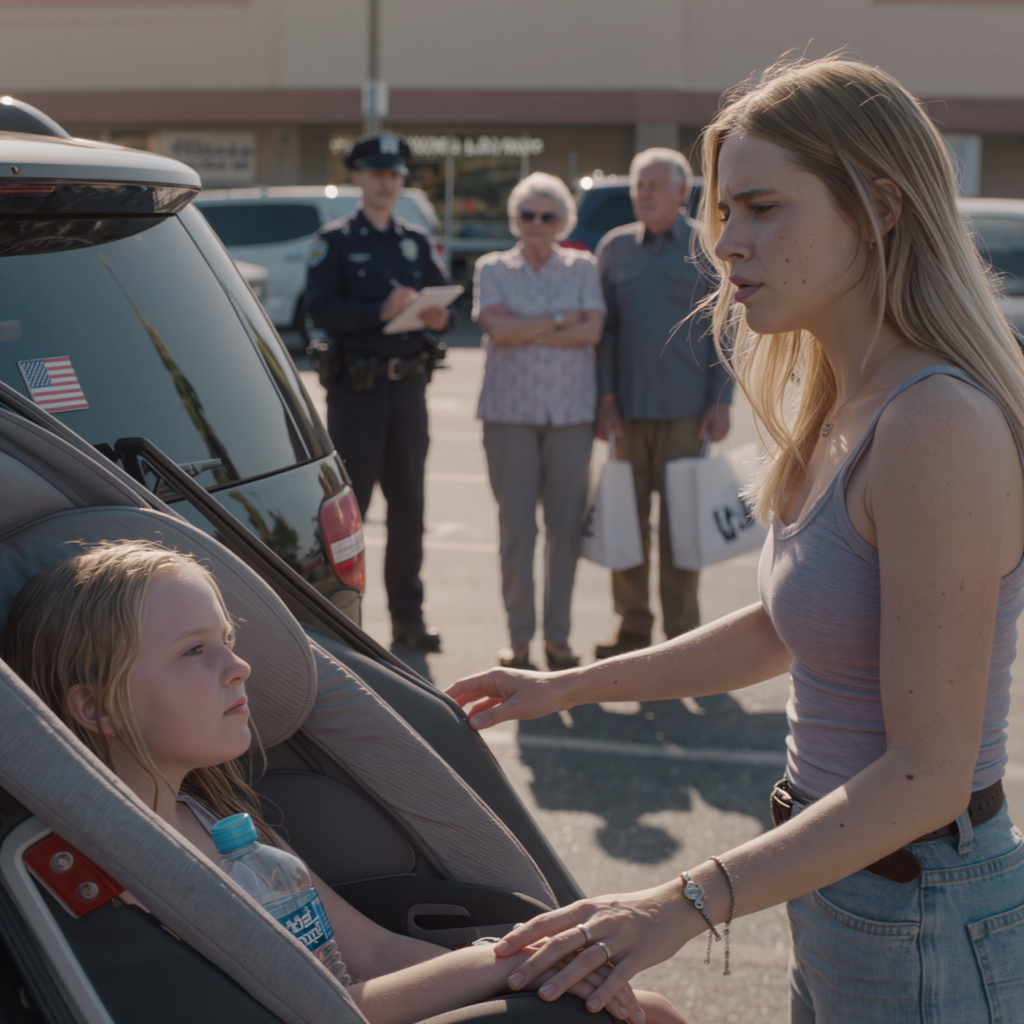
A woman in her fifties stood beside a tiny figure, holding an umbrella to cast a circle of shade over both of them. The little figure stood ramrod straight, arms at her sides, like a tiny soldier who’d been told not to move.
Ruby.
Her purple dress clung damply to her back. Dirt streaked her legs. Her face was blotchy from crying, cheeks sunburned, hair plastered to her forehead. Her light‑up sneakers were coated in dust; they didn’t flash when she shifted her weight—they just looked dull and wrong.
I didn’t bother finding a real parking spot. I slid my car across two spaces, slammed it into park, and ran.
Ruby saw me and her face crumpled, but she still didn’t move from the strip of cracked asphalt where someone had apparently told her to stand.
“Mommy.” Her voice came out as a hoarse whisper. “Grandma said to wait right here. She said don’t move until she comes back.”
I scooped her up. Her skin felt like it was on fire.
The woman with the umbrella—Patricia—pressed a water bottle into my free hand.
“I gave her some already,” she said, breathless. “But she needs more. She was completely disoriented when I first walked up. She kept saying she couldn’t move yet.”
“How long has she been out here?” My voice didn’t sound like my own.
Ruby buried her face in my neck.
“I don’t know, Mommy,” she sobbed. “It was right after we got here. Grandma brought me and Austin and McKenzie and Tyler to the mall. She told me to stand right here and wait. She said she’d be right back.”
Right after they arrived.
Diane had picked Ruby up around 9:00 a.m. The drive to Westbrook Mall was about thirty minutes. It was now almost 3:00 p.m.
Five hours.
My six‑year‑old daughter had been standing in a parking lot for 5 hours.
“Did she say why you had to wait here, baby?” I asked as gently as I could.
Ruby’s small body shook.
“She said the other kids were going fun shopping and I needed to learn to be patient. She said, ‘Good girls wait quietly.’”
Something cold and sharp slid into place inside my chest.
Patricia’s expression mirrored my own horror.
“I’ve already called 911,” she said quietly. “The police should be here any minute. What your mother‑in‑law did… that’s not okay.”
“Thank you,” I managed. “Thank you for staying with her.”
She nodded. “I have grandkids. I can’t imagine ever…” She stopped herself and looked back at Ruby with so much compassion my eyes burned. “You’re a brave girl, Ruby. You did the right thing giving me your mom’s number.”
Ruby had always been good at memorizing things. We’d practiced phone numbers as a game at the kitchen table, tapping them out between bites of mac and cheese, never thinking she’d actually need mine in an emergency.
Now here we were.
I buckled Ruby into her booster seat with shaking hands, cranked the AC, and kept checking her skin and lips and pupils like I could will her body back to normal by watching it closely enough.
That’s when I saw them.
Through the glass doors of the mall, my mother‑in‑law, Diane, strutted toward the exit with shopping bags hanging from both arms. Behind her, my sister‑in‑law, Vanessa, juggled more bags and corralled the three cousins.
Austin swung a new baseball glove. McKenzie hugged a doll still in its box. Tyler licked an ice cream cone the size of his head.
They were laughing, all of them, like they’d just had the most wonderful afternoon.
Diane pushed through the doors, spotted my car sprawled across two spots, and her face shifted from surprise to annoyance in less than a second.
She marched over, bags swaying, Vanessa and the kids trailing behind.
“Megan, what are you doing here?” Diane demanded. “I told you I’d have Ruby back by five.”
I stepped out of the car, keeping Ruby’s door open so she could hear everything.
“You left my daughter in a parking lot for 5 hours,” I said.
“Don’t be ridiculous. It hasn’t been 5 hours.” Diane waved a manicured hand. “And she’s perfectly fine. Look at her. Not a scratch on her.”
Vanessa actually snorted.
“See?” she stage‑whispered to McKenzie. “I told you she’d still be standing there like a little statue when we got back. Didn’t even move a muscle.”
The implication hit me like a physical blow.
“You saw her?” My voice went dangerously calm. “You saw my six‑year‑old alone in this parking lot and did nothing?”
Vanessa shrugged and hitched her shopping bags higher on her arm.
“Mom said she needed to learn patience,” she said. “Ruby can be so demanding sometimes, always wanting attention. This was a good lesson for her.”
Demanding.
My daughter, who said please and thank you without prompting, who shared her toys at the playground, who helped me fold laundry and set the table without being asked.
“Where’s Paul?” I asked, meaning my father‑in‑law.
“He’s bringing the car around from the other lot,” Diane said. “We had to park in two different areas because it’s so crowded. Now, Megan, I understand you’re upset, but you’re being dramatic. Ruby is fine. She needs to learn the world doesn’t revolve around her.”
“She’s six years old,” I said.
“Exactly. Old enough to understand discipline.” Diane crossed her arms. “When your husband was her age, I made him sit on the porch for three hours once because he talked back to me. It taught him respect.”
So this wasn’t forgetfulness. This wasn’t a mistake.
This was a choice.
Blue and red lights flashed across the parking lot as a police cruiser pulled in. Diane’s smug expression finally faltered.
Two officers stepped out. One of them, Officer Rodriguez, took in the scene with one sweep of his eyes—the crying child in my backseat, the shopping bags, the sweating asphalt.
“We got a call about a child in distress,” he said.
Patricia stepped forward.
“I’m the one who called,” she said. “I found this little girl”—she gestured toward Ruby—“standing alone in the parking lot. She told me she’d been here since her grandma dropped her off this morning.”
Officer Rodriguez walked over to my car and crouched by Ruby’s open door.
“Hi there, sweetheart,” he said gently. “Can you tell me what happened today?”
Ruby’s voice was small but clear.
“Grandma told me to wait right here,” she said. “She said I needed to learn patience and that good girls wait quietly. She took Austin and McKenzie and Tyler inside for fun shopping, but I had to wait outside.”
“And how long ago was that?” he asked.
Ruby frowned, thinking.
“It was after breakfast,” she said. “We had pancakes and then Grandma picked me up.”
Officer Rodriguez stood and turned to Diane.
“Ma’am, can you explain why you left a six‑year‑old child unattended in a parking lot for multiple hours?”
“I was teaching her a lesson,” Diane said, lifting her chin. “She needs to learn she can’t always get what she wants. The other children were better behaved, so they got to shop. Ruby needed to wait.”
“You left a child in ninety‑four‑degree heat without water or supervision for approximately 5 hours,” Officer Rodriguez said, his tone going from neutral to steel. “Do you understand that’s considered criminal child endangerment?”
Vanessa jumped in.
“Officer, I think you’re overreacting,” she said quickly. “Kids need discipline. My mother was just—”
“Were you aware the child was out here?” the second officer asked her.
Vanessa hesitated.
“Well, yes, but—”
“And you did nothing to help her?”
“She was fine,” Vanessa snapped. “She was just standing there. It’s not like she was in danger.”
“A six‑year‑old child alone in a parking lot for 5 hours is the definition of danger,” Officer Rodriguez said flatly.
That was the first time I saw Diane’s confidence crack.
Paul pulled up then in his Mercedes SUV, parking next to us. He got out, smoothing his jacket, confusion crossing his face when he saw the squad car.
“What’s going on?” he asked.
“Your wife left our granddaughter in a parking lot for 5 hours,” I said before anyone else could speak. “Ruby has signs of heat exhaustion because Diane decided to teach her a lesson.”
Paul looked at Ruby, then at Diane. His expression barely changed.
“Is this true?” he asked.
“Oh, for heaven’s sake, Paul, don’t you start too,” Diane snapped. “The girl needed discipline. She was perfectly safe right here in the lot. This is all being blown completely out of proportion.”
Paul walked over to Ruby’s door and took a closer look at her sunburned cheeks and cracked lips. For a second, I thought I saw something like guilt flicker across his face.
“She needed to learn patience,” he finally said, turning back to the officers. “That’s not a crime. That’s parenting.”
“You knew about this?” I asked, betrayal sharpening my words.
“Diane mentioned she might make Ruby wait by the car if she acted up,” he said with a shrug. “I thought it was a reasonable consequence. Children these days are too coddled. A little discomfort builds character.”
Officer Rodriguez exchanged a glance with his partner.
“Mr. and Mrs. Callahan,” he said, “what you’re describing isn’t discipline. It’s neglect. We’ll be filing a report with Child Protective Services.”
“You will do no such thing,” Diane exploded. “I am this child’s grandmother. I have every right to discipline her as I see fit.”
“Actually,” I said quietly, feeling that cold, sharp thing in my chest spread through my whole body, “you don’t. You have no rights where my daughter is concerned. Not anymore.”
I turned to Officer Rodriguez.
“I want to file a formal complaint,” I said. “I want everything documented, and I want to pursue a restraining order.”
“Megan, don’t be absurd,” Paul said, his voice dropping into the cool, warning tone I’d heard him use in boardrooms. “You’re angry right now. Think about what this will do to the family. Think about your marriage.”
“Family doesn’t leave a child to suffer in a parking lot,” I said. “Family doesn’t laugh at a six‑year‑old standing in the heat. Family doesn’t call cruelty ‘character building.’”
Vanessa rolled her eyes.
“God, you’re such a drama queen. This is why nobody in the family likes you,” she said. “You always make everything into a huge issue.”
Nobody likes me.
I’d attended every holiday, every birthday, smiled through every backhanded comment about my job, my house, my parenting. I’d swallowed every criticism for the sake of “keeping the peace.”
That peace had just left my child standing on hot asphalt for 5 hours.
“I’m taking Ruby to the ER,” I told Officer Rodriguez, climbing back into the car. “You have my number. I’ll cooperate fully with whatever you need.”
Diane lunged like she might try to grab the car door, but Officer Rodriguez stepped between us.
“Ma’am,” he said, “I suggest you stay back. Mrs. Callahan is within her rights to seek medical attention and to file charges if she chooses.”
“Charges? This is insane!” Diane shrieked. “Paul, do something.”
Paul looked at me through the glass.
“You’re making a mistake, Megan,” he said. “You need to think about what this will do to our family.”
“I am thinking about family,” I said. “I’m thinking about my daughter.”
Then I put the car in gear and drove away, leaving the Callahans standing in that parking lot with their shopping bags, their excuses, and a flashing set of lights behind them.
Every few minutes on the way to the ER, I checked on Ruby in the rearview mirror. She dozed in spurts, cheeks flushed, her little chest rising and falling too fast for my liking.
At the ER, the nurse took one look at her and hustled us back. Ruby was diagnosed with moderate dehydration and first‑degree sunburn. The doctor’s voice stayed professional, but her eyes hardened as I explained what happened.
“I’m required by law to report this,” she said. “What happened to your daughter meets the definition of neglect at minimum.”
“I understand,” I said. “I want it reported.”
Ruby fell asleep hooked up to IV fluids, her small hand wrapped around mine.
Looking at her in that hospital bed, I made myself a promise—one I’d pay off later in a place where people have to listen.
I promised my daughter that I would never again prioritize keeping the peace over keeping her safe.
That was my wager with myself: either I protected Ruby completely, or I accepted that I was no better than the people who left her on that asphalt.
I knew which side I was going to land on.
While Ruby slept, I made calls.
First to Brandon, who finally picked up on the third try.
“Hey,” he said. “Is everything okay? I saw a missed call earlier.”
“Ruby’s in the ER,” I said.
Silence.
“What?”
I walked him through the parking lot, the heat, the call from Patricia, the police, Diane’s justification, Paul’s “character building” speech.
“Mom wouldn’t intentionally hurt Ruby,” he said finally. “She must’ve just… misjudged the situation.”
“She told the officer she was teaching Ruby a lesson about patience,” I said. “Paul backed her up. Vanessa laughed about Ruby standing there like a statue.”
“You’re catastrophizing,” he said. “Mom can be strict, but she loves her. Don’t involve the police. Let me talk to them when I get back from Denver. We’ll handle this as a family.”
A hinge clicked shut in my chest.
“There is no ‘handling this as a family,’” I said quietly. “There is only keeping Ruby safe. And your family just made it very clear they can’t be trusted to do that.”
His voice went tight.
“Just… don’t do anything drastic until I get home, okay?”
But he wasn’t the one staring at a hospital monitor.
By the time Ruby’s fluids finished, I’d called a lawyer—Kevin Armstrong, the one we’d used when we bought our house. I’d called my own parents two states away. I’d also done something my in‑laws never expected from the quiet daughter‑in‑law who always tried to smooth things over.
I’d started a paper trail.
On my phone, I recorded myself describing everything that happened while it was still fresh: Diane’s exact words, Paul’s, Vanessa’s, the officers’ names, the time on the clock, the 94°F, the 5 hours.
If the Callahans were going to rewrite the story later—and I knew they would—I wanted the truth to exist somewhere outside of my own memory.
When we got home that night, Ruby fell asleep on the couch clutching a cool washcloth. I scrolled through my notifications and saw that the Callahan family group chat—“Callahan Crew” with a little shamrock emoji—was on fire.
Diane: Megan has completely lost her mind. She called the police on us for disciplining Ruby. This is what happens when you spoil kids and don’t teach them boundaries.
Vanessa: I can’t believe she’s pressing charges over what? Ruby standing in a parking lot? We all had to wait for our parents sometimes. This is ridiculous.
Brandon’s brother, Derek: What’s going on? Someone fill me in.
Diane again: Megan is trying to get a restraining order against me and your father, all because I made Ruby wait outside while we went into the mall with the other children. Ruby had been whining all morning and I decided she needed a timeout. Now Megan is acting like I committed a crime.
In Diane’s version, Ruby’s excitement had become “whining.” Six hours had become a simple “timeout.” The sun‑baked parking lot had become vaguely “outside.”
I typed out a response, deleted it, typed another, deleted that too.
Then I left the chat.
Let them talk to themselves. The police report, the medical records, Patricia’s statement, and my recording would say what needed to be said.
Brandon came home late that night from the airport. I was at the kitchen table with the paperwork from the ER when he walked in, suit wrinkled, eyes tired.
“How is she?” he asked immediately.
“Physically, she’s going to be okay,” I said. “Emotionally… we’ll see.”
I slid my phone across the table, photos from the ER glowing on the screen: Ruby’s sunburned cheeks, her cracked lips, the way her eyes still looked a little glassy.
“This is your daughter after 5 hours with your parents,” I said.
Brandon flinched.
“I had no idea it was this bad,” he said quietly.
“It was this bad,” I said. “And your mother is in the group chat right now calling it discipline.”
He sank into a chair.
“Mom said Ruby was complaining about being tired and didn’t want to walk around,” he said. “She thought it would be kinder to let her wait by the car instead of dragging her through stores.”
“That’s not what Ruby said,” I replied. “That’s not what your mother told the officers.”
I hit play on my recording. Brandon listened to my voice recounting Diane’s “lesson about patience,” Paul’s “little discomfort builds character,” Vanessa’s “little statue.”
“She really said all that?” he asked, looking sick.
“Yes,” I said. “And they’re already changing the story.”
He pressed his hands over his face.
“What do you want me to do?” he finally asked.
“I want you to tell your parents what they did was wrong,” I said. “I want you to agree they’ll never have unsupervised access to Ruby again. I want you to stand with me when I file for a restraining order instead of trying to smooth this over.”
“They’re still my parents,” he said, voice raw. “And she’s still their granddaughter.”
“And they left her in a parking lot on a ninety‑four‑degree day for 5 hours,” I said. “Those things can’t both be true without consequences.”
“That’s not fair,” he said, pushing back from the table. “They made a mistake.”
“A mistake is forgetting to pack her lunch,” I said. “This was deliberate. Your mother told the police she was teaching Ruby a lesson. Your father backed her up. Your sister laughed. That’s not a mistake.”
“I need to think,” he said finally.
“You need to decide whether you’re going to protect your daughter from people who hurt her,” I replied. “That’s what you need to think about.”
He went upstairs. I slept on the couch, listening to Ruby’s soft breathing on the baby monitor like we were back in the newborn days.
Monday morning, I called in sick, dropped Ruby at my friend Jessica’s house so she could play with her daughter, and met Kevin at his office.
We spent two hours going over every detail, every piece of documentation: the police report, the ER notes, my recording, Patricia’s number, the officers’ badge IDs.
“Given what you’ve told me and what’s in this report, we can absolutely file for a restraining order,” Kevin said. “I need to warn you, though—this is going to blow up your relationship with your in‑laws. It could blow up your marriage.”
“Everyone keeps telling me to think about my marriage,” I said. “Nobody seems that worried about my daughter standing alone in a parking lot.”
He studied me for a second.
“I’m not saying you’re wrong,” he said. “I just want you prepared. They will fight this. Hard.”
“Let them,” I said. “I’m done being the reasonable one.”
Then we walked into the courthouse together.
I didn’t raise my voice. I didn’t make a scene. I signed forms. I answered questions. I described what happened so many times the words started to sound like they belonged to someone else.
But when the clerk stamped that temporary restraining order and slid it across the counter toward me, it felt like something loud had just happened.
It felt like the first crack of a fault line under the Callahan family.
By lunchtime, Diane and Paul had been served.
My phone nearly vibrated off the counter.
Diane called seventeen times in an hour. Paul called nine. Vanessa sent a stream of texts calling me vindictive, cruel, unstable. Derek emailed a multi‑paragraph lecture about loyalty and “keeping the family unit intact.”
Brandon called from his office.
“What did you do?” he demanded.
“I protected our daughter,” I said.
“Mom is hysterical,” he said. “She says you barred her from seeing Ruby.”
“I barred her from being within a hundred yards of Ruby until a judge says otherwise,” I said. “There’s a difference.”
“You should’ve talked to me first,” he said.
“I did,” I said. “You said you needed to think. Ruby doesn’t have the luxury of waiting for you to finish thinking.”
He hung up on me.
The next few days were a blur of silence in our house and noise everywhere else.
The Callahans circled their wagons. I was uninvited from Derek’s birthday party. Vanessa posted passive‑aggressive quotes about “some people loving drama more than family” on Instagram. Brandon stayed in a hotel, saying he needed space to process.
Ruby asked why Daddy wasn’t home for dinner. I told her he had to work late.
She stared at her plate and traced patterns in her mashed potatoes with her fork.
My parents arrived on Thursday in their dusty SUV, having driven straight through the night. My mom, Laura, went straight to Ruby, lowering herself to the floor and holding her granddaughter like she was made of spun glass and steel at the same time.
My dad, Tom, hugged me and then sat me at the kitchen table.
“Tell me everything,” he said. “And don’t leave out the parts you think might sound small.”
Tom is a retired detective. He’s spent his life listening to people downplay the things that broke them.
Once I started talking, I couldn’t stop.
I told him about the times Diane had called Ruby “too sensitive.” The day she grabbed Ruby’s arm hard enough to leave faint finger marks because Ruby spilled juice on her white rug. The constant criticism about Ruby’s personality, her clothes, her interests.
I told him about Paul praising the cousins’ achievements and barely acknowledging Ruby’s. About Vanessa joking that Ruby was “the family disappointment” because she preferred books to sports.
“How long has this been happening?” my dad asked.
“Honestly? Since she was born,” I said. “I kept telling myself I was being oversensitive. That they were just old‑school.”
“You don’t have to make anything work with people who hurt your kid,” he said. “Not even if they share your last name.”
Then he pulled out his phone.
“I’m going to make some calls,” he said. “We’re going to build you the strongest case we can.”
It turns out wealth and influence leave footprints. Tom talked to old colleagues, neighbors, people who’d known the Callahans longer than I had.
We found Paul’s sister, who’d cut contact with the family fifteen years earlier over “the way Diane treated my kids.” We found an old police report from when Diane had shown up at Derek’s ex‑girlfriend’s workplace and caused a scene. There were complaints from former neighbors about Diane screaming at a housekeeper’s son.
Nothing that had ever stuck in court.
But together, it painted a picture: anyone who challenged the Callahans was labeled “too sensitive,” “dramatic,” “unstable.”
Kevin practically glowed when I handed over the notes.
“This shows a pattern,” he said. “Not just a bad day. A pattern.”
Two weeks later, we were back at the courthouse.
This time, Diane wasn’t wearing her usual pastel cardigans. She wore a navy suit and pearls. Paul’s tie was perfect. Their lawyer looked like he’d stepped out of a legal drama—tall, smooth, expensively bored.
Brandon sat on their side of the courtroom.
It shouldn’t have surprised me. It still hurt like ripping off skin.
“Your Honor,” the Callahans’ attorney began, “this is a classic case of a vindictive daughter‑in‑law using the courts to alienate loving grandparents from their grandchild over a simple misunderstanding. My client, Mrs. Callahan, made a judgment call about discipline that Mrs. Megan Callahan disagreed with. Rather than resolving their differences within the family, the petitioner has chosen to weaponize the legal system.”
Kevin stood.
“Your Honor, this is not a disagreement about bedtime or too much screen time,” he said. “Mrs. Diane Callahan left a six‑year‑old child alone in a crowded parking lot in ninety‑four‑degree heat for approximately 5 hours. We have medical records showing the child suffered dehydration and sunburn. We have a police report documenting Mrs. Callahan’s own admission that she did this intentionally to ‘teach patience.’ We have a witness who found the child disoriented and in distress. This is not a family squabble. This is child endangerment.”
Patricia testified. She described seeing Ruby, the heat, the way Ruby kept saying she couldn’t move yet because Grandma had told her not to.
The Callahans’ lawyer tried to suggest she’d misunderstood.
“Ma’am, is it possible you misjudged how long the child was out there?” he asked.
Patricia held up photos on her phone, each one timestamped.
“I know exactly how long I was with her,” she said. “I also know what a little girl looks like when she’s been standing in the sun for hours.”
Officer Rodriguez testified, too. Calm. Precise. No embellishments. Just facts.
When it was my turn on the stand, my hands shook for the first few questions. Then I looked at Diane’s face—tight, offended, already rewriting—and the nerves burned off.
I talked about the parking lot. The heat. The ER doctor. Ruby asking if we’d forgotten her.
Kevin walked me through the history—the arm‑grabbing, the “too sensitive,” the “family disappointment” jokes.
“Mrs. Callahan,” the judge said finally, “in your opinion as Ruby’s mother, do the respondents pose a risk to your daughter’s safety?”
“Yes, Your Honor,” I said. “I believe they care more about being obeyed than about whether Ruby is okay. I believe they see her as something to control, not someone to protect. And I believe if they’re given another chance, they’ll hurt her again, whether they admit it to themselves or not.”
Diane shot to her feet.
“That is a lie,” she snapped. “I love Ruby. I have done nothing but try to teach her—”
“Mrs. Callahan,” the judge cut in sharply, “sit down. If you speak out of turn again, I will have you removed from this courtroom.”
Diane sat, lips pressed thin.
Brandon took the stand next.
“Mr. Callahan,” the judge said, “were you present for the incident in question?”
“No, Your Honor,” he said. “I was on a business trip.”
“Do you believe your parents would intentionally put your daughter in danger?”
He looked from his parents to me.
“I don’t think they meant to hurt her,” he said finally. “I think they have different ideas about discipline than my wife does.”
“And in your view,” the judge asked, “leaving a six‑year‑old alone in a parking lot on a ninety‑four‑degree day for 5 hours falls under ‘discipline’?”
Brandon swallowed.
“I think it was excessive,” he said. “But I don’t think they’re dangerous.”
The judge’s expression didn’t change, but she made several notes.
Hearing your husband say under oath that the people who left your child on asphalt for 5 hours aren’t dangerous is a special kind of clarity.
The judge called a fifteen‑minute recess to review everything.
I sat in the hallway with Kevin, my parents on either side of me. Ruby was with a sitter, far away from all of this fluorescent carpet and hushed tension.
When we went back in, the judge’s voice was steady.
“I’ve reviewed the evidence presented,” she said. “The police reports, the medical records, the witness statements, and the testimony given here today.”
She looked directly at Diane and Paul.
“What happened to this child was not discipline,” she said. “It was neglect under dangerous conditions. The respondents’ own statements indicate they left the child in extreme heat, alone, as punishment for perceived misbehavior. Furthermore, I am troubled by the pattern of similar controlling behavior toward others, particularly children, that has been documented.”
The Callahans’ attorney started to speak. The judge held up a hand.
“I am making the restraining order permanent,” she said. “Mr. and Mrs. Callahan, you are prohibited from any contact with the minor child, Ruby Callahan, until you complete a court‑ordered parenting course and can demonstrate to this court’s satisfaction that you understand appropriate boundaries and safety requirements for children.”
Paul surged to his feet, face dark.
“You’re telling me I can’t see my own granddaughter because my wife made her wait in a parking lot?” he demanded.
“I am telling you,” the judge said, “that your wife left your granddaughter in conditions that could have resulted in her death. Heat stroke kills children every year. The fact that you still don’t grasp the seriousness of that is exactly why this order is necessary. If you continue to show this level of disregard for your grandchild’s safety, I will hold you in contempt of court.”
Paul sat down.
The judge turned to Brandon.
“Mr. Brandon Callahan,” she said, “I strongly suggest you examine your priorities. Your wife took appropriate steps to protect your daughter. Your parents placed that child in danger. The fact that you are still conflicted about which side to support is… concerning.”
Brandon stared at the table.
Then, just like that, it was over.
The gavel came down. Papers were signed. The courtroom emptied.
I walked out holding a court order in my hand.
My parents were waiting in the hallway with Ruby.
“Did we win, Mommy?” she asked, her light‑up sneakers blinking softly as she bounced on her toes.
“Yes, baby,” I said, kneeling to her level. “We won.”
Behind us, Diane’s voice rose in furious spikes.
“This is all your fault,” she yelled at Brandon. “You never should’ve married her. She ruined this family.”
Vanessa was crying about how I’d “destroyed everything.” Paul was muttering about appeals and better attorneys.
For once, none of it was my problem to fix.
Two months later, Brandon filed for divorce.
He couldn’t handle being cut off from his family. Couldn’t handle the pressure they put on him to choose. His attorney tried to paint me as unstable, vindictive, intent on cutting a little girl off from her loving grandparents.
Unfortunately for them, judges read case files.
The same judge who’d signed the restraining order heard our custody case. She’d seen the photos. She’d read the police report, the ER notes, the transcripts.
I got primary custody. Brandon was granted supervised visitation every other weekend, with one non‑negotiable condition: Ruby was not to have any contact with Diane or Paul. No “accidental” drop‑ins. No video calls. No surprise visits at soccer games.
The Callahans tried everything.
They hired private investigators to follow me, hoping to catch me doing something they could spin as unfit parenting. They called my workplace, questioning my performance. They had friends reach out to mutual acquaintances, sprinkling words like “unstable” and “dramatic” and “alienation” like confetti.
I documented every call, every text, every time Diane tried to “just bump into us” at the grocery store in violation of the order, every unknown number that turned out to be Paul.
Kevin filed harassment complaints. The judge warned them: back off, or face possible jail time.
They finally got the message.
Ruby started therapy. Her counselor, a soft‑spoken woman named Erin, had her draw pictures.
For months, every picture had a big yellow sun and a tiny stick figure next to a long row of cars.
“The sun keeps getting bigger,” Erin told me quietly one day, after Ruby left the room to pick a sticker. “But Ruby’s figure is starting to get bigger, too. That’s good. It means the memory is still there, but she’s not shrinking under it anymore.”
My parents moved to our town the following summer, buying a modest house fifteen minutes away with a porch swing and a flagpole in the yard. On the Fourth of July, Ruby ran across their lawn in a new pair of light‑up sneakers, red, white, and blue LEDs blinking as a small flag flapped overhead.
Those lights looked right again.
Sometimes, when Brandon brings Ruby home from the visitation center, I catch him watching her with a look that’s half pride, half regret.
He’s not allowed to talk to her about his parents. That’s written into the agreement. But he and I speak in short, functional sentences now—pickup times, homework updates, allergies.
Once, after Ruby ran inside, he lingered on the porch.
“Do you ever think it could’ve gone differently?” he asked.
“Yes,” I said. “If your parents had apologized. If they’d understood what they did. If you’d chosen Ruby over them from the beginning.”
He nodded once, like he’d expected that answer.
“I miss her,” he said quietly. “My mom. Even after everything, I miss her.”
“I know,” I said. “And I’m still not sorry.”
Two years have passed since the day Patricia called me from that parking lot.
Ruby is eight now. She’s thriving in school, reads chapter books under the covers with a flashlight, plays defense on her soccer team like she was born for it. She loves science experiments and blueberry pancakes and still wears light‑up sneakers, though now she prefers the ones that flash in rainbow patterns.
She doesn’t ask about Diane and Paul anymore. The few times their names have come up, it’s been in therapy, as part of a story she’s learned how to tell without crying.
Last month, the Callahans tried again.
They petitioned the court to modify the restraining order, arguing that enough time had passed and they’d completed the required parenting classes.
Kevin called me after the hearing.
“The judge denied it,” he said. “Apparently, in their court‑ordered counseling, they spent most of their time insisting they’d done nothing wrong and that you brainwashed Ruby against them.”
He paused.
“The judge said something I thought you’d want to hear,” he added. “She said, ‘Some people care more about being right than about doing right.’”
I thought about Diane’s face in the parking lot. In the courtroom. In the group chat where she’d rewritten reality.
Yeah. That tracked.
Sometimes, I still replay that day in my head. I think about what could’ve happened if Patricia hadn’t decided to speak up, if Ruby hadn’t memorized my phone number, if the heat index had been just a little higher, if Ruby had gotten scared enough to move from the spot she’d been ordered to guard like a post.
I think about how close I came to losing my child because I’d been so focused on being the “good” daughter‑in‑law, the one who didn’t make waves.
Then I watch Ruby sprint down the sideline at her soccer game, light‑up sneakers flickering as she chases the ball, my dad yelling, “Go, Roo!” from the bleachers while a little flag pin winks from his cap.
She is loud and laughing and gloriously unafraid of taking up space.
That’s when I know I made the right choice.
I didn’t scream in that parking lot. I didn’t throw things or make threats. I walked into a courthouse, gave sworn statements, pushed paperwork across a counter, and let the weight of evidence do what my polite requests never could.
The Callahans thought they could do whatever they wanted because they always had. They thought being wealthy and connected meant they didn’t have to answer to anyone.
It turned out they did have to answer—to the law, to a judge, to a little girl’s sunburned cheeks in photographs.
And to a mother who finally decided that keeping her child safe was worth more than keeping anyone else comfortable.
That’s the lesson Ruby actually needed.
Not patience through pointless suffering. Not obedience earned through fear.
But strength through boundaries, and the knowledge that when someone tells you to stand still in the blazing sun because they call it love, you’re allowed to walk away.
You’re allowed to put on your light‑up sneakers and run toward the people who come back for you every single time.
Two summers after the hearing, that sentence stopped being just something I told myself and turned into something I watched Ruby live.
It started with a flyer.
I was standing in line at the coffee shop down the street from my new office, half awake, scrolling through emails on my phone. Beside the register, pinned to a corkboard with a thumbtack shaped like a sunflower, was a glossy printout: PARENTING & PROTECTION: KNOWING WHEN “DISCIPLINE” CROSSES THE LINE.
Underneath, in smaller font, it said: Guest speaker: local parent advocate, Megan Callahan.
I almost spit out my cold brew.
The organizer, a social worker I’d met through Ruby’s therapist, had asked a month earlier if I’d consider talking at a community workshop. I’d said I’d think about it, then pushed the idea into the same mental drawer as cleaning out the garage and organizing my digital photos.
Seeing my own name in twelve‑point font beside the words “parent advocate” made it very clear that drawer was now open.
That night, after Ruby went to bed, I sat at the dining table with a legal pad and tried to figure out how you tell a room full of strangers that your mother‑in‑law once left your child in a parking lot for 5 hours and that you let it go on that long because you wanted to be liked.
Every time I tried to start with the parking lot, my pen hovered uselessly above the paper.
So I started somewhere else.
I wrote: I used to think being a good mom meant being a good daughter‑in‑law.
The rest came in a rush.
On the night of the workshop, the community center’s multipurpose room smelled like coffee, dry erase markers, and the waxy lemon cleaner they used on the floors. An American flag hung in the corner, slightly crooked, next to a bulletin board crowded with announcements about Little League sign‑ups and bake sales.
I counted twenty‑nine people. Twenty‑nine folding chairs. Twenty‑nine pairs of eyes that flicked up when the social worker introduced me.
“This is Megan,” she said. “She’s going to share a little of her story and talk about how to recognize when ‘family dynamics’ stop being harmless and start being harmful.”
Public speaking had never been my thing. I’d rather write twelve pages of a quarterly report than deliver a three‑minute update at a staff meeting.
But as I stepped up to the front, I thought about Ruby sitting at home with my mom, homework spread across the kitchen table, light‑up sneakers kicked off by the back door.
I thought about Patricia’s umbrella, the way it had created a circle of shade around my daughter that day.
Maybe this was my turn to hold up an umbrella for someone else’s kid.
“I’m Megan,” I said. “And before I tell you anything else, I want you to know this: you are allowed to protect your children, even if the person hurting them shares their last name.”
A murmur went through the room—not loud, but there.
I told them the story.
Not the extended director’s‑cut version Kevin used in court, but the mother version. The iced‑tea glass, the unknown number, the drive that felt like my car was moving underwater. Ruby’s cracked lips. Diane’s casual cruelty. Paul’s smooth rationalizations.
When I said, “My six‑year‑old stood on hot asphalt for 5 hours because an adult decided suffering was a lesson,” one woman in the second row pressed her fist against her mouth.
When I reenacted Vanessa’s eye roll and “This is why nobody in the family likes you,” a man in the back actually laughed—not at Vanessa, but in that uncomfortable, I‑have‑heard‑this‑exact‑line way.
I talked about the group chat, the rewritten narrative, the way wealthy people in nice neighborhoods could frame neglect as “strictness” and people would nod along because it was easier than calling it what it was.
I talked about the paperwork.
“I didn’t kick down a door,” I said. “I didn’t flip a table or scream until someone listened. I walked into a courthouse, answered questions, pushed forms back across a counter. That’s it. That’s what burned a hole through the ‘we don’t air our dirty laundry’ rule.”
At the end, hands went up.
“What if it’s my own mom?” one woman asked, twisting a tissue. “Not in‑laws. My actual mom. She watches my son while I work and… she’s rough with him. Pinches, yanks, that kind of thing. Everyone says she’s ‘old‑school.’”
“You still get to draw the line,” I said. “Old‑school doesn’t mean no rules. If you feel sick every time you leave your kid with her, that’s your instinct talking. You’re allowed to listen to it.”
“What if my husband doesn’t back me up?” someone else asked. “He says I’m overreacting.”
I thought of Brandon on that witness stand, of the way he’d said “excessive but not dangerous.”
“Then you protect your kid anyway,” I said. “And you find support somewhere else—a therapist, a lawyer, a friend who believes you. Spouses can catch up. Kids don’t have that luxury.”
When the workshop ended, people lined up to talk.
A grandmother who wanted to do better than her own parents had done. A dad who admitted his brother used to “wrestle too hard” with his kids, and suddenly he wasn’t sure it was harmless. A woman in her late fifties who said nothing, just pressed my hand hard and whispered, “I wish my mother had had someone like you to listen to.”
On the drive home, the dashboard clock glowed 8:29 p.m.
Two years earlier, that exact time on a different Saturday night had found me on the couch, staring at hospital wristbands and police card stock, wondering if I’d just blown up my entire life.
Now, I pulled into the driveway of a different house—a smaller one, with peeling paint and a mortgage that was solely mine. In the front window, Ruby’s science project glowed softly: a model solar system made from Styrofoam balls and too much glitter.
I walked inside to find my mom and Ruby on the floor, a pile of construction paper between them.
“Hey, hero,” my mom said, like she was commenting on the weather.
Ruby looked up.
“How’d your meeting go?” she asked.
“It was good,” I said. “I told them about the day you were the bravest six‑year‑old in Westbrook Mall’s parking lot.”
She grinned.
“I’m not scared of parking lots anymore,” she said. “You know why?”
“Why?”
“Because I know you’ll always come back.”
That was one of those hinge‑moments Erin talked about—the sentences kids don’t know are dropping anchor in your chest.
Later that night, after Ruby was in bed and the house was quiet, my mom poured us both iced tea and we sat at the kitchen table.
“You were good in front of people,” she said. “I’m proud of you.”
“I almost threw up in the parking lot,” I admitted.
“That’s how you know it matters,” she said.
She reached into her purse and slid something across the table.
It was a worn envelope with a familiar law office logo in the corner—Brandon’s attorney.
“You left this in the mail pile,” she said. “You ready to open it?”
The return address made my stomach clench, but I nodded.
Inside was a formal motion.
Respondent hereby petitions the Court to modify visitation terms to allow supervised involvement of Respondent’s parents at a neutral location…
“They’re still at it,” I said.
“Of course they are,” my mom replied. “Some people don’t stop rattling a locked door, even when the sign says ‘Closed.’”
I turned the papers over and grabbed a pen.
“I’m not worried,” I said. “We have the order. We have the reports. We have two years of zero contact from Ruby’s side.”
“You also have your kid’s therapist, your dad’s research, and a judge who’s already called them out,” my mom added. “Don’t forget your arsenal.”
The word hung there between us.
For the Callahans, their arsenal had always been money and reputation. For me, it was documentation, boundaries, and a kid who now drew herself bigger than the sun in her own pictures.
We fought the motion. The judge denied it in less than ten minutes.
“Nothing has changed,” she said, her voice echoing slightly in the courtroom. “Except, perhaps, Mrs. Callahan’s tolerance for chaos.”
On the way out, Brandon caught my eye in the hallway.
“Can we talk?” he asked.
“We’re talking,” I said.
“Alone,” he added.
I looked at Kevin, who lifted his brows in a your call kind of way.
“Five minutes,” I said. “In the lobby. Glass walls.”
We stepped into the courthouse lobby, where two vending machines hummed by the far wall. A few people waited on benches, scrolling their phones beneath a framed copy of the state seal.
“I didn’t file that motion,” Brandon said without preamble. “My parents did. They pushed my attorney. I’m sorry.”
“You signed it,” I said.
He flinched.
“I know,” he said. “I… I caved. Again. I’m working on that.”
“With an actual therapist or just in your head?” I asked.
“Both,” he said. “But yes, with a therapist. Court‑ordered, actually. The judge suggested it if I ever wanted unsupervised time.”
“How’s that going?”
He gave a humorless little laugh.
“Apparently, I’m conflict‑avoidant,” he said. “Who knew?”
“I did,” I said. “So did your sister. So did everyone who ever watched you smile and nod while your mom steamrolled you.”
He nodded, accepting it.
“I’m trying to do better,” he said. “I—” He swallowed. “I’ve started telling my parents ‘no’ in small ways. Little stuff. They hate it. But I’m doing it.”
“Good,” I said. “Ruby needs a dad who can say no to people, not just to her.”
He looked at me then, really looked.
“Do you hate me?” he asked.
The question caught me off guard.
“No,” I said, after a second. “I don’t hate you. I hate the choices you made. I hate that I had to drag you to the right side instead of you just walking there. But I don’t hate you.”
He exhaled like he’d been holding his breath for two years.
“Ruby asked me last week why she doesn’t have pictures with my parents,” he said. “I told her… I told her some grown‑ups make unsafe choices, even if they don’t mean to. And when that happens, other grown‑ups have to make sure kids stay safe. I told her that’s what you did.”
I blinked.
“That’s a good answer,” I said.
“I know,” he said. “Because it’s the one you gave the guardian ad litem. I finally listened.”
We stood there in the humming lobby, two people who used to share a bed now sharing a fragile, oddly hopeful silence.
“This doesn’t change the order,” I said finally. “It doesn’t change custody. It doesn’t change the fact that your parents are dangerous for her.”
“I know,” he said again. “I’m not asking you to change anything. I just… I wanted you to know I see it now.”
“Good,” I said. “See it, remember it, and next time they shove paperwork in front of you, don’t sign it.”
He nodded.
As we walked back toward our attorneys, he said, “Megan?”
“Yeah?”
“Thank you,” he said. “For picking her over us.”
There it was—that rare moment when conflict‑avoidant people say the quiet thing out loud.
Weeks slipped into months.
Ruby started third grade. She joined a science club. She asked for a telescope for Christmas instead of another dollhouse.
One evening in late fall, we sat on the back deck of our little house under a sky that actually had stars. My dad had installed string lights along the railing, and Ruby’s telescope was pointed at a smudge of light she swore was Jupiter.
“Mom?” she asked, without looking away from the eyepiece.
“Yeah, Roo?”
“How old do I have to be to know everything?”
I set down my mug of tea.
“Everything about what?” I asked, even though I had a feeling I knew.
“About why we don’t see Dad’s mom and dad,” she said. “And why Dad gets that face sometimes when we talk about holidays.”
Her voice wasn’t sad. Just curious. Carefully curious.
Erin had warned me this would come.
“She’s old enough for more details,” she’d said at our last parent session. “Not the ER charts and legal language, but the bones of it. Kids fill in blanks with things that are usually worse than the truth. Better she hears it from you in digestible pieces than from someone else all at once.”
I took a breath.
“How much do you remember about that day at the mall?” I asked.
She scrunched her nose, thinking.
“I remember being hot,” she said. “And my feet hurt. And I remember a lady with an umbrella. And I remember you picking me up and you were shaking.”
“That’s most of it,” I said. “Do you remember why you were out there?”
She hesitated.
“Grandma said I was being too much,” she said slowly. “Talking too much. Wanting stuff. She said good girls wait quietly. She said if I stood there and waited, I’d show her I could be good. And then she left.”
My jaw tightened.
“Do you remember how long you waited?”
She shrugged.
“Forever,” she said.
“About 5 hours,” I said quietly. “It was really hot that day. You got sick from it. We had to go to the hospital.”
She pulled away from the telescope and turned to look at me.
“Because I was bad?” she asked.
My throat closed.
“No, baby,” I said, scooting closer. “Because they were wrong. What they did wasn’t discipline. It wasn’t love. It was dangerous. That’s why we don’t see them anymore. Not because you did anything wrong, but because they did.”
She studied my face, weighing the words like they were blocks she was deciding whether to stack.
“And you went to the judge?” she asked.
“Yeah,” I said. “I went to the judge.”
“And the judge said they couldn’t be near me?”
“Yes.”
She thought about that.
“I like that judge,” she said.
“Me too,” I said.
She leaned against my side, head on my arm.
“Sometimes I think about Grandma’s face,” she said. “Like when I see old ladies in the grocery store. I wonder if it’s her. And then I remember she’s not allowed there.”
“That’s a lot for a kid to carry,” I said.
She shrugged one shoulder.
“I also think about Patricia’s umbrella,” she said. “I liked that umbrella. It had flowers on it.”
We sat there under string lights and actual stars while my daughter compared the weight of a grandmother and an umbrella and decided which one felt more like safety.
That was another hinge sentence.
Later that night, after she went to bed, I pulled up Patricia’s number from an old contact card.
I’d texted her updates over the years: court outcome, Ruby doing well, thank‑you again.
This time I wrote: Ruby remembers your umbrella. She says she liked the flowers. Thought you’d want to know you’re still part of the story.
Her reply came minutes later.
Tell her the umbrella remembers her too. And that some grown‑ups will always show up with shade.
Sitting at my kitchen table, iced tea ring on the wood, I realized that was all we’d really done, in the end.
We’d drawn a circle of shade around a kid and told certain people they weren’t allowed inside it.
The Callahans kept rattling the fence from the outside.
But Ruby? Ruby was inside the circle now, wearing light‑up sneakers and planning whether she wanted to be an astronaut, a veterinarian, or the president.
She’d probably change her mind a hundred times.
That was fine.
The only thing I needed her to know for sure was this: no matter how loud anyone yelled about loyalty, no matter how many group chats exploded with half‑truths, no matter how expensive an attorney someone hired, she never had to stand in the blazing sun to prove she was a “good girl” again.
She only had to remember who came back for her.
And when she forgot, I’d be there, holding up the story like an umbrella, until she could see it for herself.
News
On my birthday, my parents hosted a dinner with 100 relatives just to disown me. my dad handed me a bill, said: “every cent we wasted raising you. pay or never contact us again”. my sister grabbed my car keys from the table: “dad already transferred the title to me.” i walked out without a word — four days later, they’re calling me…50 times a day
On my birthday, my parents didn’t bring out a cake. They brought out witnesses. Nearly a hundred relatives sat shoulder…
At My Mom’s Birthday, My Brother’s Son Threw My Son’s Drawing Into The Fire And Yelled, “Nobody Wants His Crappy Art Anyway.” Everyone Laughed. That Night, My Dad Texted, “You’re Making Things Uncomfortable — Just Skip Christmas.” I Replied, “So Does The Funding.” By 1 A.M., My Phone Was Melting. 27 Missed Calls.
By the time the clock on my stove blinked 1:00 a.m., my phone looked like it was about to catch…
My whole childhood I was treated like a maid. On Christmas Eve, my mother coldly said: “Your sister’s 25 friends are coming, you cook – clean – serve them properly,” I just said “Okay” then got on a plane straight to the beach; when my family came home and stepped into the kitchen, they SCREAMED, but what made them tremble the most came after that.
My parents treated me like hired help. The irony hit me every time I saw the little chipped American flag…
“You’re not family, don’t show your face here,” the whole table burst out laughing, I picked up the entire lasagna and left – 4 days later, their loan was rejected by the bank, that night, my phone lit up
My name is Jean William. I’m thirty years old, and the night I realized my family didn’t love me the…
I was serving champagne at a gallery when i saw it. a painting i made when i was 6. price tag: $150,000. ‘sir, that painting is mine,’ i said. ‘impossible,’ the gallery owner laughed. he called security to kick me out. but he forgot to check the secret message on the back of the canvas.
I was balancing a silver tray of champagne flutes when I saw it. Not the painting, not yet. First I…
“Mom texted: ‘Ice storm, Christmas is canceled, everyone stay home to be safe’ — the next morning the whole family called saying ‘we miss you so much’, I opened Instagram and saw all of them raising their glasses at my sister’s house… and that night I decided to do something that would make their fifteen years of pretending unable to go back to how they were.”
I believed my mother’s text the way I had believed a thousand small mercies before it. “Everyone’s staying home due…
End of content
No more pages to load