
By the time the clock on my stove blinked 1:00 a.m., my phone looked like it was about to catch fire.
Twenty-seven missed calls stacked under my dad’s contact photo, the one where he’s grinning in front of a Fourth of July grill with a little American flag stuck in his ball cap. Right above those calls sat his last text: You’re making things uncomfortable. Just skip Christmas.
My reply was still there, blue bubble, calm and deadly.
So does the funding.
The words glowed in the dark kitchen while I leaned against the counter, one hand wrapped around a sweating glass of iced tea, the other gripping my phone like it might jump. On the fridge door beside me, a magnet shaped like a faded flag held up my mom’s 70th birthday invitation and one of Jaime’s older drawings. A tree. A lake. Stars.
In a few hours, that invitation would be in the trash. The funding would be gone. And my family would finally understand that the quiet daughter they treated like a convenient bank account had just shut the vault.
It all started with a piece of paper they thought was a joke.
My mom’s 70th birthday was supposed to be a celebration. That’s what the invitation said anyway—“an evening of laughter and family.” From the moment Jaime and I walked into my parents’ house, I knew the laughter part was real. I just didn’t realize we were the punch line.
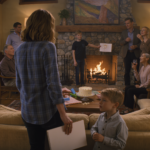
They were all already there when we arrived. My sister Trish, her husband, their kids, my parents, everyone talking too loud, smiling too wide, drinking too fast. That strange, brittle energy hung in the air like a fake Hallmark commercial—bright on the surface, tight underneath.
Jaime stood a little behind me, clutching his drawing with both hands so hard the paper curved. He’d worked on it for days, tongue between his teeth, colored pencils spread across my kitchen table. A forest scene with tiny deer under a sky full of stars. He’d even used glitter, which he normally hated. He’d said, “Grandma likes shiny stuff, right?”
I didn’t tell him she probably wouldn’t care.
“Grandma,” he said now, stepping forward. He held the drawing out with that hopeful little half-smile that still kills me. “I made this for your birthday.”
She barely glanced at it. “Oh. How nice,” she said, like he’d handed her a flyer for a store she didn’t plan to visit. She set it on the side table next to a stack of mail and a bowl of nuts, already reaching for another glass of wine.
I felt the first crack in my teeth from how hard I bit back the words.
The party moved on around us, loud and swirling. I watched Jaime’s eyes track the drawing on the table like it might slide off and disappear. It practically did.
Caleb, my sister’s twelve-year-old, sauntered over with the swagger of a kid who’s never actually heard the word no and believed it. He picked up Jaime’s drawing, squinted at it for all of two seconds, then smirked.
“What is this supposed to be?” he said.
“A forest,” Jaime answered, voice small. “For Grandma.”
Caleb snorted. “Looks like a bunch of broccoli.”
Before I could move, he crumpled the paper into a ball, turned, and tossed it straight into the fireplace.
The flames took it fast. The glitter sparked for half a second and then it was gone.
“Nobody wants his crappy art anyway!” Caleb shouted, loud enough for the music to stutter around the room.
And then—the part that will probably ring in my ears for the rest of my life—the laughter started.
Not from the kids.
From the adults.
My mother, the reason we were supposed to be there, laughed first. A sharp, delighted burst like she’d just heard the best joke of the night. Trish was wiping tears from her eyes, leaning into her husband. Even my dad gave this soft, approving chuckle.
Not one of them said a word to Caleb.
For a second, Jaime thought it was part of the party. I saw it on his face—confusion trying to rearrange itself into a smile. Then he looked at me and saw my expression, and I watched the understanding hit him like a door slamming.
He didn’t cry. My son is quieter than that. He just stood there, hands empty, staring at the place where his drawing had been.
I didn’t make a speech. I didn’t throw a drink or scream or give them the big dramatic scene they probably would have told stories about for years.
I walked over to the coat rack, took down my jacket, and said, “Jaime, shoes on. We’re going home.”
My mom blinked. “We just started dinner,” she said, like I was declining dessert instead of dignity.
I looked right at her. “I’m not sitting down with people who laugh while my kid’s work burns,” I said. “Happy birthday.”
You could feel the room shift, all that tight energy snapping an octave higher. Someone muttered that I was overreacting. Trish let out a low whistle. Caleb smirked like he’d won.
Jaime slid his sneakers on with shaking hands.
We didn’t slam the door when we left. We just disappeared. Quiet exit. No scene.
Sometimes walking away is louder than yelling.
Later that night, while Jaime was brushing his teeth in his Star Wars pajamas, my phone buzzed. A text from my dad.
You’re making things uncomfortable. Just skip Christmas.
I stared at it for a long second, then felt something in me go very still.
So does the funding, I wrote back.
My thumb didn’t even shake as I hit send.
He knew exactly what I meant.
For the past few years, December had come with a quiet ritual. My parents would mention how “tight” things were, how expensive Christmas had become, how the kids were growing and “experiences” mattered more than presents now. Ski trips. Cabins. Big things they couldn’t quite afford.
“It’s just so hard on a fixed income,” my mom would say, looking at me the way other people look at ATMs.
So when my business finally took off, I opened a small joint account in my name and my dad’s. Every December, I transferred exactly 3,000 dollars into it. No fanfare. No contracts. Just a line on my banking app and a quick text from my mom—You’re a blessing, sweetheart. We couldn’t do this without you.
They were right. They couldn’t.
After I sent that text—So does the funding—I logged in, drained the account down to zero, and closed it.
By 1:00 a.m., that’s when the twenty-seven missed calls started to stack up.
My mom. My dad. Trish. Even Trish’s husband, which would have been funny if it didn’t make my stomach twist. The voicemails came in waves, pinging while I wiped down the kitchen counter and tucked Jaime into bed.
I didn’t listen right away. I knew what they would say. Not “We’re sorry.” Not “We were wrong.” Not “What Caleb did was cruel.”
They would say the one word I’d heard my whole life whenever I tried to draw a line.
Dramatic.
The next morning, I was flipping pancakes while Jaime colored at the table when the front door opened without a knock.
I hadn’t forgotten to lock it. I never lock it during the day. That was my mistake.
My parents walked in like they still owned the place. Trish right behind them, dragging Caleb by the wrist.
“Gloria,” my mom said, already shaking her head. “What were you thinking?”
“Good morning to you too,” I said, turning off the stove. “You can leave. We’re busy.”
My dad’s jaw was tight. “We need to talk about this childish stunt,” he said. “Closing that account? Do you have any idea what you’ve done?”
Trish crossed her arms. “Mom is sick over this,” she announced. “You ruined her birthday, and now you’re trying to ruin Christmas. Over a picture.”
“A picture that your son burned,” I said. “While you laughed.”
Caleb rolled his eyes. “It was just a joke,” he muttered.
Jaime had gone very still at the table, pretending to shade a tree that suddenly looked more like a bruise.
My mom waved a hand. “Boys tease,” she said. “You can’t bubble-wrap him forever. Maybe if you didn’t make everything such a big deal…”
There it was. The familiar script.
“I’m making it a big deal because it is one,” I said. “You watched your grandson throw another grandson’s work in the fire. And you laughed. That’s not teasing. That’s cruel.”
“You always go too far,” Trish snapped. “You’ve been like this since high school. Overreacting. Making everything about you. Jaime needs to toughen up. Life’s not always nice.”
Behind her, Caleb smirked again and shouldered past me toward the table.
“Hey, Picasso,” he said to Jaime. “You drawing more broccoli?”
“Caleb,” I said sharply. “Back off.”
He stepped closer anyway, leaning over Jaime’s shoulder. Jaime pushed his chair back too fast, slipped on the rug, and went down hard.
The crack of his elbow against the floor shot straight through my spine.
He sucked in a breath, eyes wide, and I saw the skin already reddening, a scrape blooming along the bone. He tried not to cry, lower lip trembling.
That was it.
I moved without thinking, inserting myself between Jaime and everyone else.
“Get out,” I said.
My mom blinked. “Gloria, it was an accident,” she said. “He tripped.”
“He wouldn’t have if your grandson wasn’t leaning over him like a bully,” I shot back. “You marched into my house to yell at me, insult my kid, and defend Caleb again. I said get. Out.”
“Don’t be ridiculous,” my dad said. “We’re talking.”
I reached for the front door and yanked it open. Cold air rushed in, sharp and clean.
“You have five seconds,” I said quietly. “Then I’m calling the police and reporting trespass. One. Two.”
“You wouldn’t,” Trish said, but there was a wobble in it.
“Three,” I said.
They moved.
My parents grumbled their way out onto the porch, Trish hissing under her breath, Caleb muttering words I chose not to hear. I closed the door and turned the lock with a firm, final click.
That sound didn’t just seal my house. It sealed something in me.
For a moment, the silence rang.
Jaime sniffed, wiping at his eyes with the back of his good arm.
“Hey,” I said softly, crouching down. “Let me see.”
The scrape wasn’t terrible, just raw and angry, a bright red reminder. I cleaned it, bandaged it, kissed his forehead. His shoulders relaxed inch by inch.
“Are we in trouble?” he asked.
I shook my head. “No, baby,” I said. “We’re finally not.”
That afternoon, the texts started.
From my mom: Let’s not make this bigger than it needs to be. We were all just joking around.
Then: Don’t take everything so personally. Jaime needs to toughen up. Life isn’t always kind.
Not one word about the drawing. Not one word about the elbow.
From Trish: You’re being dramatic again. You’re going to ruin Christmas over a piece of paper. Mom’s heartbroken. Dad’s sick over it.
Then the kicker: And your little art prodigy will live.
I nearly threw my phone across the room.
Instead, I took a breath, set it face down on the table, and went back to helping Jaime organize his colored pencils by shade. Red to orange, yellow to green, blue to violet.
Outside, flurries tapped at the kitchen window. Somewhere in town, my parents were probably pacing in front of a half-packed suitcase, doing the math on nonrefundable deposits and ski rental fees and suddenly missing $3,000.
By evening, the voicemails started to pile up again. I finally listened to one from my dad.
His voice was tight, controlled, like he was trying to sound calm but there was a crack under every word.
“We heard you closed the account,” he said. “I want to make sure that’s not permanent. We’ve already paid for the Christmas trip. It’s nonrefundable, Gloria. The kids are excited. We bought ski gear. The resort is already charging late fees.”
He paused, and when he spoke again, his voice dropped.
“We really counted on you this year.”
That was it. Not “we’re sorry.” Not “Caleb was wrong.” Not “we love Jaime.”
Just: We counted on you.
They didn’t mean me. They meant my money.
A few days later, they came back.
This time, they knocked.
It was early evening. Jaime was upstairs, pencil scratching softly over paper. I opened the door just enough to see both of my parents standing there in their heavy coats, looking like they’d aged ten years in two days.
“We just want to talk,” my dad said.
My mom’s smile was thin. “We didn’t realize how upset you were,” she said.
I let them in because some stubborn part of me wanted to hear what story they were telling themselves.
It wasn’t an apology.
They were sorry if I felt hurt. Sorry if the “joke” went too far. Sorry I had “misinterpreted” things. There was a lot of if and not a single we did.
“We’ve always loved Jaime,” my mom said. “You know that. You’re the one keeping him away. This whole thing has gotten out of hand. Can’t you just help us this one last time?”
There it was. The real ask.
“Have you talked to Caleb at all?” I asked. “Did anyone tell him what he did was wrong?”
They looked at each other.
“We didn’t want to make a big deal out of it,” my mom said finally. “He was just being a kid. We don’t want him feeling guilty over something silly.”
Something in my chest went quiet and cold.
I didn’t raise my voice. I didn’t cry. I walked to the front door, opened it, and stepped aside.
“You have five seconds to leave,” I said. “Next time you show up here without an actual apology, I won’t open the door at all.”
My dad’s nostrils flared. My mom’s mouth pinched. They walked past me without another word.
That night, Jaime drew another forest.
No stars this time.
Just trees crowding in, a small boy standing at the edge of them, no one else in sight. He didn’t say a word as he handed it to me.
I didn’t need him to. The missing stars said enough.
Christmas crept closer anyway.
We spent the week baking sugar cookies, hanging paper snowflakes from the ceiling, making salt-dough ornaments for our little tree. No glitter. Jaime didn’t want any. “It reminds me of their house,” he said.
On Christmas Eve, my mom called.
Her voice was bright, too bright. “We’re having dinner here tonight,” she said. “Just a small group. Us, Trish and the kids, a couple of neighbors. Jaime should come see his cousins open presents. Maybe it’s time to let go of all this tension and put things in the past.”
I wanted to say no immediately. Every part of me braced.
“I’ll think about it,” I said instead.
Jaime had heard enough of the conversation to know what it was about. He hovered in the doorway of the kitchen, twisting the drawstring of his sweatshirt.
“Mom?” he said. “Can we go? I miss Grandma. Maybe… maybe everyone will be nicer this time.”
Hope is a cruelly persistent thing in kids.
I looked at him, at the bandage on his elbow that had finally peeled away to new skin, at the drawing drying on the table. The boy at the edge of the trees.
I hated the idea of walking back into that house.
But I hated the idea of teaching my kid that we never give anyone a last chance even more.
“Okay,” I said. “But if they’re not nicer, we leave. No discussion. Deal?”
He nodded hard. “Deal.”
We arrived around six. The house was dressed up like a movie set—over-the-top lights on the porch, ceramic reindeer in the yard, Bing Crosby crooning from a Bluetooth speaker by the front door.
My mom opened it like we were surprise guests on a game show. “There you are!” she cried, hugging Jaime first and me second. He stiffened, then let her.
Inside, everything felt familiar and wrong at the same time. Trish barked orders in the kitchen. Her husband held a drink the color of varnish. Caleb lounged on the couch with his phone, headphones in, eyes flicking up for half a second when we walked in and then back down.
We sat down for dinner at seven.
My mom brought out the good china, the antique porcelain plates she only used for “important” occasions. The table sparkled with candles and cloth napkins folded into little fans. Jaime sat next to me, quietly pushing mashed potatoes around his plate.
For a while, everyone played nice.
My dad cleared his throat halfway through the meal and stood up with his glass.
“I just want to say,” he began, “I’m proud of this family. We’ve been through a lot, but at the end of the day, forgiveness is what matters. We don’t hold grudges. We move on. That’s what real families do.”
Everyone nodded solemnly, like we were in a commercial for something wholesome.
Then Trish leaned forward, smile just a little too sharp.
“Let’s just hope no one throws a tantrum over paper this time,” she said.
Silence hit the table like a dropped brick.
Then the laughter started—soft at first, then rolling. My mom laughed. Trish’s husband did that quiet, unsure chuckle he always does when he wants to stay on the winning side. Even my dad’s mouth twitched.
I didn’t look at any of them.
I looked at Jaime.
He wasn’t confused this time. He knew exactly what she meant. His shoulders hunched, his fork stilled. His eyes dropped to his plate.
Something in me snapped.
I stood up, fingers wrapping around the edge of the porcelain plate in front of me. My mom’s most prized piece, the one she’d lectured us about since childhood.
“This set is older than you are,” she’d say. “One chip and I’ll lose my mind.”
I lifted the plate, held it for one second over the hardwood floor, and let it go.
It shattered. A bright, sharp crack that cut clean through the laughter.
No one moved.
I didn’t raise my voice. I didn’t apologize. I didn’t explain.
I reached for Jaime’s hand and said, “Coats. Now.”
We walked out without another word.
We didn’t put on our jackets. We didn’t say goodbye. We just stepped into the cold December night, breath fogging in the air, and got into the car.
Halfway down the block, Jaime whispered, “Are you mad at me? Did I do something wrong?”
I pulled over, turned to face him.
“No,” I said. “You did everything right. I’m proud of you. None of this is your fault.”
His shoulders dropped a fraction. “Okay,” he whispered.
We went home and curled up on the couch, Christmas tree lights blinking softly. I made us hot chocolate and let him fall asleep halfway through a movie. The house smelled like cinnamon and flour instead of tension.
I was just starting to drift off myself when a knock rattled the front door.
It was nearly ten.
My first thought was that my parents had shown up again. My second was that I’d changed the locks if they had.
Then I saw the blue and red flashes through the front window.
A police cruiser idled at the curb.
My stomach dropped.
I opened the door to an officer in a heavy winter jacket, snow dusting his shoulders.
“Evening, ma’am,” he said. “We got a call about a family dispute earlier. Report mentioned destruction of property and an angry departure from a family gathering. Just wanted to make sure everything’s okay here.”
Of course they called the cops.
Not when their grandson burned a drawing.
When I broke a plate.
I told him exactly what happened, standing there in my socks while Jaime slept on the couch behind me.
“I broke one plate,” I said. “My own mother’s. In a house where my son was mocked again. We left quietly. No one was threatened. No one was hurt. The only thing broken in that house long-term is a sense of decency.”
The officer’s ears went a little pink. “Understood, ma’am,” he said. “Sounds like this is more of a family matter than anything criminal. We just had to follow up.”
“Sure,” I said. “I get it.”
He offered a thin, sympathetic smile and left.
When I closed the door, the house felt heavier and lighter at the same time.
They didn’t call because they were scared of me.
They called because they wanted to teach me a lesson.
The next day, my old family group chat lit up with a picture from my mom.
Caleb grinned at the camera, arms wrapped around a golden puppy with a giant bow around its neck. Behind him, the living room tree sparkled. The caption read: Santa came through after all.
They knew exactly what they were doing.
That photo wasn’t about sharing joy.
It was bait.
We’re fine. He’s fine. You’re the problem.
I didn’t take it.
I left the chat.
On New Year’s Day, I found something in my mailbox.
Not a card. Not an apology. Just a single sheet of lined paper folded twice, no envelope.
I didn’t have to open it to know whose handwriting it was.
My dad’s blocky letters stared up at me when I unfolded it over the kitchen sink.
I raised you better than this. You’ve embarrassed this family long enough. You are not welcome in this house until you apologize and make things right.
That was it. No “Happy New Year.” No mention of Jaime. Just blame and control where love was supposed to be.
I crumpled it and tossed it in the trash.
Then I thought better of it, took it back out, tore it into small pieces, and tossed it again.
I should have checked the trash can later.
That afternoon, I found Jaime sitting on the bottom step of the staircase, little pieces of lined paper scattered around him like snow. He held one piece between his fingers, eyes moving over the words.
He didn’t look sad.
He looked tired.
“Mom?” he said without looking up. “So… we’re not their family anymore?”
For a second, my throat closed.
I sat down next to him on the step.
“We’re always family to each other,” I said. “That’s what matters now.”
He turned the piece of paper over, then let it fall.
That night, after he fell asleep, I packed a small bag for the two of us. Hoodies. Socks. Sketchbooks. Colored pencils. I left both our phones in the kitchen drawer, screen-down.
In the morning, I buckled Jaime into the car.
“Where are we going?” he asked.
“Somewhere quiet,” I said. “You’ll like it.”
About two hours north, tucked between a frozen lake and a stand of bare trees, there’s a tiny cabin I used to rent before I had Jaime. No TV. No Wi-Fi. Just a wood stove, creaky floors, and quiet.
We stayed two nights.
On the first morning, Jaime stepped out onto the porch, breath puffing in the cold air. Snow covered everything in a clean, untouched sheet.
“It feels like a different planet,” he said.
I watched him sit on the top step, sketchbook on his knees, pencils lined up beside him. He started drawing the trees first, spare lines reaching up to a pale sky, then the frozen lake, then the chipped red paint on the railing.
That night, after grilled cheese and soup warmed on the stove, he handed me a piece of paper folded in half.
“I made something,” he said.
I opened it carefully.
It was the two of us inside the cabin, sitting near the wood stove. My legs tucked under me on the couch, his socks half-off his feet, the little blanket I’d tossed over the armrest, two mugs on the windowsill. Outside, snow drifted past the glass. Inside, everything glowed.
At the bottom, in big block letters, he’d written: This is what family feels like.
I didn’t cry.
I folded the drawing along its crease, slid it into the front pocket of my wallet behind my driver’s license, and pressed my thumb over it.
That piece of paper was worth more than every December’s $3,000 I’d ever sent.
On the drive home, Jaime stared out the window at the passing trees.
“Are we ever going back to Grandma and Grandpa’s house?” he asked.
“Not unless they change,” I said.
He nodded once, like he’d expected that answer, and went back to counting mailboxes.
January settled in.
The snow along the sidewalks turned gray and slushy, then hardened into dirty ridges. Jaime went back to school. I went back to work. Our mornings became waffles and apples, our evenings cartoons and homework and the scratch of pencil on paper.
We didn’t hear a word from my family.
No texts. No calls. No guilt-laced photos.
For almost two weeks, it was like we’d never existed to them.
Part of me was relieved.
Part of me wasn’t.
There was a quiet ache underneath the peace, like a bruise under skin—no longer sharp, but still there when you pressed on it.
I found myself wondering if I’d done everything I could. Not for them, but for me. I didn’t want to be ten years older, lying awake, asking if there was one more conversation I should have tried.
So on a gray Saturday afternoon, I did something I never thought I’d do again.
“We’re going for a drive,” I told Jaime.
He didn’t ask where. He just grabbed his sketchbook and climbed into the car.
My parents’ driveway was half-shoveled when we pulled up, a narrow path carved through the snow to the front steps. I knocked.
My mom opened the door like I was a neighbor dropping off a package. No hug. No smile. Just a sharp, “Come in.”
Inside, everything looked exactly the same. Same candles on the mantel. Same framed photos of fake-perfect Christmases. Same heavy silence.
My dad sat in his recliner, glasses on, holding a book he clearly wasn’t reading. He glanced up, then back down.
Trish wasn’t there.
For once, I was grateful.
I stayed standing.
“I’m not here to rehash everything,” I said. “I’m not here to fight. I came because I don’t want to walk away wondering if I did everything I could. So I’m going to ask one question.”
My mom sighed dramatically and sat on the edge of the couch like she was already exhausted.
“Do you think what happened to Jaime was okay?” I asked.
She didn’t even hesitate.
“Kids fight,” she said. “That’s what they do. Caleb didn’t mean to hurt anyone. You blew the whole thing out of proportion.”
She glanced at Jaime, who sat quietly beside me with his sketchbook closed in his lap.
“We’ve always loved Jaime,” she added. “You’re the one keeping him away.”
I looked at my dad.
He didn’t look up from his book.
“It’s not about money anymore,” I said. “It’s not about the plate or even the drawing. It’s about a pattern. A long, exhausting pattern of you dismissing, ignoring, blaming. And this time, it was aimed at my kid.”
My mom rolled her eyes.
“You’ve always been sensitive, Gloria,” she said. “You overreact. You always have. You turn everything into a big production.”
There it was again.
The old story.
I’m the problem because I notice the hurt.
I took a breath and turned toward the door.
“Jaime, grab your things,” I said.
As we stepped into the doorway, my dad finally spoke. His voice was quiet, flat.
“This is what happens when you raise a boy without a real man in the house,” he said.
The words hung in the air like smoke.
For half a second, I thought I’d misheard.
Then I felt Jaime go very still beside me.
I didn’t respond.
I just looked at my father long enough for him to glance away, then opened the door and walked out.
No slamming.
No last word.
Just the soft thud of the door closing behind us.
In the car, the heater hummed. The wipers squeaked across the windshield.
Jaime didn’t say anything until we turned onto our street.
“I don’t think they know how to be sad for other people,” he said quietly. “Only for themselves.”
It wasn’t something I’d ever said out loud to him.
But he was right.
That night after dinner, he brought me another drawing.
This one was a row of houses on a snowy street. All of the windows were dark except one. In that house, a warm yellow light glowed from the living room.
“That’s ours,” he said when I asked.
“Why are the other ones dark?” I asked.
He shrugged. “Because that’s where it’s cold,” he said simply.
At the top of the page, in careful block letters, he’d written: Some doors don’t open the right way.
I taped it to our fridge, right under the faded flag magnet that used to hold my mom’s birthday invitation.
The flag stayed.
The invitation didn’t.
Later that night, I opened the bottom drawer of my nightstand and pulled out the old family photo from the previous Christmas. All of us in matching sweaters, arms linked, smiles too wide.
A performance.
I stared at it for a long time, then turned it face down and slid it to the back of the drawer.
I hadn’t lost a family.
I’d lost the performance of one.
The gap between what they showed the world and how they treated us when no one was watching had been there for years. I’d kept stepping over it, hoping love would fill it in.
It never did.
Real love doesn’t come with ultimatums and police reports. It doesn’t laugh while your child’s heart goes up in flames. It doesn’t ask for 3,000 dollars and offer zero accountability in return.
Real love looks like standing by your kid even when the whole room thinks you’re the problem. It looks like walking away with your hands shaking and not turning back. It looks like starting over with fewer people, less noise, more truth.
Now our home is quiet, but it’s full.
No forced smiles. No group chats waiting to explode. Just me and Jaime and a fridge door covered in drawings that no one will ever throw into a fire.
Sometimes, when I pay for groceries, my fingers brush against the folded page in my wallet—the cabin drawing that says This is what family feels like. When I open the fridge, my eyes land on the row of houses with one window glowing yellow and the words Some doors don’t open the right way.
And on nights when the phone stays blessedly dark and the only lights on our street are the ones shining from our living room, I remember the last time I saw twenty-seven missed calls from my father.
They were never really about me.
They were about money and control and a story where I stayed small to keep everyone else comfortable.
That story is over.
The funding is closed.
The door is, too.
But in the little house with the one window glowing warm, my son’s art is safe, my voice is steady, and—for the first time in my life—the only performance left is the one Jamie and I put on for each other when we dance like fools in the kitchen under a fridge magnet shaped like a tiny American flag.”
But life has a way of testing every line you draw, just to see if you’ll smudge it when the room gets quiet.
The first test came on a Tuesday morning in February, the kind of gray that makes the whole neighborhood look like it’s been washed in dishwater. I was halfway through answering emails when my phone buzzed with a number from Jaime’s elementary school.
My chest tightened before I even swiped to answer.
“Hello?”
“Hi, Ms. Cooper? This is Ms. Alvarez, the school counselor. Is now an okay time?”
It took effort to keep my voice steady. “Sure,” I said. “Is Jaime okay?”
“Oh, he’s fine,” she said quickly. “He’s in class. I just wanted to talk about something positive, actually.”
I didn’t realize I’d been holding my breath until I heard myself exhale.
“Okay,” I said, cautious. “Positive sounds… new.”
She laughed softly. “His art teacher, Mr. Douglas, brought him up. We’re putting together a showcase for the spring—student work, family night, that kind of thing. Jaime’s pieces are… well, they’re extraordinary. We wanted to see if you’d be comfortable with him submitting several and maybe speaking a little about them that night.”
I swiveled in my desk chair and looked at the fridge.
The cabin drawing was still in my wallet, pressed behind my driver’s license. On the door, the row of houses with one warm window sat next to a spelling test and a grocery list scrawled in Sharpie. The faded flag magnet held them all in place.
Positive. Extraordinary. Words I’d never heard attached to my kid’s art outside our own walls.
“I’d be more than comfortable,” I said. “I’d be honored.”
“We’ll send home a flyer,” she said. “And, Ms. Cooper? I know you don’t owe me an explanation, but… if there’s anything you want to share about changes at home, or family stuff, I’m here. Jaime’s mentioned drawing more because ‘it’s quieter now.’ He said it like a good thing.”
I stared at the magnet.
“It is a good thing,” I said. “For both of us.”
After we hung up, I sat there for a minute, fingers resting on the phone, watching the cursor blink on an unfinished invoice. Part of me wanted to call my parents, to say, Look what you almost snuffed out. Look what you mocked. Look what you threw in a fire.
I didn’t call.
Instead, I opened my banking app out of habit and scanned down the list of accounts.
The joint one with my dad was gone, of course. Closed. But I couldn’t help noticing the number in my savings, the one I’d never really looked at closely because I was too busy handing out $3,000 every December like emotional hush money.
It wasn’t huge by some standards, but it was solid. Hard-earned. Mine.
For the first time, the amount didn’t just look like security.
It looked like possibility.
If they could build a Christmas trip on top of my quiet deposits, I could build something better on top of the same discipline.
That afternoon, when I picked up Jaime, he practically jogged to the car.
“Mom!” he said, yanking open the passenger door. “Mr. Douglas said my drawings are going in the show. Can you come that night? It’s on a Thursday, but he said that’s okay because Thursdays are lucky for making pictures.”
I smiled. “Pretty sure Thursdays just became my favorite day,” I said. “And yes, I’ll be there. Front row.”
He buckled his seat belt and stared out the window for a second.
“Do you think Grandma will come?” he asked.
There it was.
I chose my words carefully.
“I think people go where they feel proud of who they are,” I said. “We feel proud right here. That’s enough for tonight.”
He let that sit, then nodded, already rummaging in his backpack for a pencil.
“Can I draw in the car?” he asked.
“As long as you don’t lose the pencil under the seat again,” I said.
He grinned. “No promises.”
The night of the art show, the parking lot looked like the whole town had shown up. Minivans lined up under the big buzzing lights, parents hustling kids in from the chill. The school’s front doors were propped open, warm air and the smell of cafeteria pizza spilling out.
Inside, the hallways were lined with artwork—crayon self-portraits, construction-paper collages, lopsided clay pots on folding tables. Each piece had a little white tag underneath with the artist’s name and grade.
“Look,” Jaime whispered, tugging on my sleeve. “They put mine in the middle.”
His corner of the display took up an entire bulletin board. Four pieces in a neat grid.
The first was the cabin—our couch, the wood stove, the mugs on the sill. This time he’d added faint stars outside the window, tiny white pinpricks scratched into the dark.
The second was the row of houses with only one window glowing.
The third was a forest, tall trees and a small boy in a red hoodie at the edge of them, facing away. The sky above him was empty, just gray paper.
The fourth stopped me cold.
It was a phone screen, drawn in careful detail. At the top, the time: 1:00 a.m. In the middle, a list of missed calls, the same contact name repeated over and over. At the bottom: 27 little red phone icons.
Underneath, in the caption space, he’d written: WHEN YOU MISS THE IMPORTANT THING.
My throat went tight.
“Is it okay?” he asked quickly, misreading my silence. “I didn’t put their names. Mr. Douglas said I didn’t have to if I didn’t want to. I just wanted to draw the number. It was a lot.”
“It’s more than okay,” I said. I had to swallow before the words came out right. “It’s… powerful.”
He rocked back on his heels, processing that.
“Do people draw numbers?” he asked.
“People draw everything,” I said. “Especially the things they don’t know how to say out loud.”
A woman next to us, another parent with a toddler on her hip, leaned in.
“Is this your son?” she asked.
“Yes,” I said.
“He’s talented,” she said simply. “My husband hasn’t stopped staring at that one.” She nodded toward the glowing window. “He said it feels like… you know, like when you drive through town at night and some houses just feel warm.”
I smiled, a little stunned.
“That’s exactly what it is,” I said.
Jaime’s ears turned pink. He took half a step closer to me, like he wasn’t sure what to do with praise in public.
Mr. Douglas found us a few minutes later, all corduroy blazer and enthusiastic hand gestures.
“Jaime,” he said, clapping my son gently on the shoulder. “You made a lot of people stop and stare tonight. That’s not easy to do.”
Jaime ducked his head but he was smiling.
Later, when the gym lights dimmed and the principal gave a little speech about creativity and community, Jaime’s four drawings appeared in a slideshow on the big screen. I watched people around us nudge each other, pointing.
My son’s work was being projected on the same gym wall where they hang banners for basketball championships.
For once, our story wasn’t something whispered about in kitchens with wine glasses in hand.
It was hanging in a hallway where everyone could see it.
That night, after we got home, I took the cabin drawing out of my wallet and framed it.
It went up on the wall above the couch, across from the TV.
The wallet felt strange without it, a little too light, so I slid Jaime’s new piece—the 27 missed calls—into that spot instead. It wasn’t about my dad anymore. It was about my son turning noise into something he could hold and control.
Every time I pulled out my ID after that, I saw those little red icons lined up like a warning.
Don’t ever spend another December funding people who laugh while the important thing burns.
The hinge of the story had shifted: the money had once been the leash they held. Now it was the scissors in my hand.
A few weeks later, the social consequences everyone kept warning me about finally showed up, just not in the way my family imagined.
I was in line at the grocery store, cart half-full, Jaime reading a graphic novel behind me, when I heard my name in that particular tone that says the speaker already has an opinion.
“Gloria?”
I turned.
It was Mrs. Jenkins, one of my parents’ longtime neighbors. She was in her seventies, quilted jacket, lipstick just a shade too pink, cart loaded with canned soup.
“Hi,” I said, polite but guarded.
“I heard there was some big blow-up at Christmas,” she said, skipping all pretense. “Your mother was very upset. Said you broke things and stormed out and called the police on her.”
So that was the story.
“Actually,” I said calmly, “the plate I broke was mine to break. And my parents called the police on me. I just answered the door.”
Her brows knitted.
“Well, she said you cut off their trip money. They were counting on you. Times are hard, you know. Family helps family.”
There it was again. The old script. Family helps family.
“I did help,” I said. “For years. Quietly. No questions asked. But when someone shows you they’re willing to laugh while your child is humiliated, and then call the cops when you stand up for him, you stop sending them on ski vacations.”
Her mouth opened, then closed.
Behind me, Jaime shifted his weight. I could feel his eyes on my back.
I softened my tone.
“I’m not asking you to take sides, Mrs. Jenkins,” I said. “I’m just asking you not to repeat half a story as if it’s the whole thing.”
She looked at Jaime, at the bandage still faintly visible on his elbow where the scrape had taken a while to fully heal.
“I didn’t know about all that,” she said quietly.
“I know,” I said. “They didn’t tell you.”
The cashier finished ringing me up. As I paid, Jaime slid his hand into mine.
In the parking lot, he whispered, “You didn’t yell.”
“No,” I said. “Did you want me to?”
He thought about it.
“I liked this better,” he said. “She heard you.”
That was the day I realized my son wasn’t just watching how I protected him.
He was watching how I protected myself.
In March, I found a therapist.
It wasn’t dramatic. No sobbing breakdown in the shower, no movie-style moment. I was just sitting at the kitchen table one night, bills spread out, Jaime asleep, the house humming with the quiet noises of the dishwasher and the heater kicking on.
My eyes landed on the fridge.
The glowing house. The doors that don’t open right. The spelling test with a 98% circled in red.
And the flag magnet, stubbornly holding on.
I opened my laptop, typed “family systems therapist near me,” and clicked the first listing that didn’t look like it had been designed in 2004.
At our first session, Dr. Kaplan—a woman in her fifties with kind eyes and a no-nonsense voice—listened while I poured out the whole mess. The birthday. The drawing. The laughter. The plate. The police. The money.
When I finished, she sat back.
“So,” she said. “Let’s start with this: in your family, who was allowed to be upset?”
“Trish,” I said immediately. “And my mother. And my father when they were upset.”
“And you?”
I let out a short, humorless laugh.
“I was the one who was ‘making things uncomfortable,’” I said. “The one who ‘overreacted.’”
She nodded.
“Families like yours often have roles,” she said. “The golden child, the fixer, the scapegoat. Guess who you were?”
I stared at the tissue box on the coffee table.
“The walking apology,” I said.
“And who are you now?” she asked.
I thought of Jaime’s face in the firelight, watching his drawing curl and blacken. I thought of twenty-seven missed calls. The police at my door. A single warm window on a row of dark houses.
“I’m my son’s shield,” I said slowly. “And I guess… my own.”
She smiled.
“That’s a good start,” she said. “But shields get heavy when you carry them alone. We going to work on setting them down sometimes.”
Therapy didn’t fix everything overnight.
It didn’t erase the bruise.
What it did was give me language for things I’d always felt but never quite named. Words like boundary and enmeshment and emotional labor. It gave me permission to stop reading every text from my mother like a summons I was legally required to answer.
In April, my parents tested that theory.
A long, rambling email arrived in my inbox, subject line: Let’s talk like adults.
It started with a list of ways I’d “hurt” them—closing the account, embarrassing them in front of their friends, involving the police (as if I’d dialed 911 myself). It ended with a simple sentence.
We expect you to apologize before Mother’s Day.
I stared at the screen for a long time.
Old reflexes fired up—panic, shame, the urge to fix it, to smooth things over, to be the good daughter who makes it right.
Then I remembered Dr. Kaplan’s voice.
“You can’t control their story,” she’d said. “You can only decide whether you’ll act in it.”
I opened a new email.
For twenty minutes, my fingers flew.
I wrote about the birthday party. I wrote about the fire. I wrote about Jaime slipping on the rug, about the plate, about the police. I wrote about money and silence and how they’d taught me as a child that love meant giving until I was empty.
I didn’t call names. I didn’t threaten. I didn’t even mention the words “bad parent.”
I ended with this:
I will not apologize for protecting my son. If you would like to have a relationship with us, it will require three things: a real apology to Jaime, an acknowledgment that what happened was wrong, and a commitment not to mock or dismiss him again. Until then, we will not attend family gatherings or provide financial support. This is not punishment. It’s a boundary.
Then I did something I’d never done in my life.
I let the email sit in my drafts folder overnight.
In the morning, I read it again.
Then I hit send.
I half-expected my phone to explode on the spot.
Instead, there was nothing.
No reply.
Just a read receipt.
Silence can be a tantrum too.
The social consequences of my boundary looked, from the outside, like a family drifting apart.
From the inside, it looked like my son laughing more.
In May, Jaime asked if we could invite a friend over after school.
“Ethan,” he said. “He likes drawing, too. And his mom lets him put his pictures on the wall in the hallway. Not just the fridge.”
“Ethan sounds like a smart kid,” I said. “And his mom sounds very wise.”
He rolled his eyes. “Mooom.”
Ethan came over on a Friday. He was small and wiry, with paint on his fingers and a backpack full of sketchbooks. His mom, Lena, a nurse with tired eyes and a quick smile, stood on the porch for a minute, chatting.
“If they get too loud, just text me,” she said. “Ethan forgets other people exist when he’s drawing.”
“Jaime forgets food exists when he’s drawing,” I said. “I’ll bribe them with pizza.”
We watched our boys disappear down the hall to Jaime’s room, already arguing about superheroes.
“They’re good for each other,” Lena said.
“Yeah,” I said. “They are.”
Later, when I brought in pizza slices, I heard Ethan talking.
“My cousin ripped up my sketch once,” he said. “My mom made him apologize and buy me a new sketchbook. It was awesome. He hated it.”
Jaime was quiet.
“Would your mom be mad if he didn’t?” he asked.
“Oh yeah,” Ethan said. “She said drawing is like… my brain on paper. Nobody gets to stomp on that. Not even family.”
Something in my chest unclenched.
In the doorway, Lena caught my eye and shrugged.
“Kids screw up,” she mouthed. “Our job is to teach them not to keep doing it.”
That was it.
No thesis. No debate.
Just a simple, solid truth.
The social consequence of cutting out the people who refused to protect my kid was this: we had room for people who did.
Summer came.
On what would have been the week of the family ski trip, my parents posted pictures from a modest cabin at a lake two hours away. No slopes, no fancy resort. Just a rented dock and a grill.
I know because Mrs. Jenkins mentioned it in the produce aisle.
“They said they had to scale back this year,” she said, picking over tomatoes. “Your mom said they’re being more careful with money. Hard lesson, she called it.”
I shrugged.
“Hard lessons can be good,” I said. “If you actually learn from them.”
She looked like she wanted to say more, but she didn’t.
Jaime and I made our own trip.
We went back to the cabin.
This time, we stayed three nights.
On the second day, Jaime tried to skip a rock and ended up falling right on his butt in the snow by the lake. He burst out laughing before I could even ask if he was okay.
“I’m fine,” he said, brushing off his jeans. “Slipping doesn’t always mean someone pushed you.”
The kid was starting to speak fluent metaphor.
That night, he drew the lake, the cabin, and the two of us standing in front of it. In the sky above, he added stars again. Not as many as his first forest drawing, but enough.
“Why’d you put the stars back?” I asked.
“Because we can see them here,” he said simply. “At Grandma’s house you can’t see anything but their porch light.”
In August, right before school started again, a letter arrived.
This time, it was in an envelope.
My name and address were written in my mother’s neat cursive.
Jaime was in the backyard with the hose, trying to “accidentally” spray the neighbor’s cat through the fence. I stood at the kitchen sink, envelope in hand, the flag magnet above me.
I almost threw it away unopened.
Instead, I slit it open with a butter knife.
The letter inside was three pages, handwritten. The first two were a familiar litany—how much I’d embarrassed them, how people were talking, how “hurt” they still were. The ski trip. The plate. The money.
On the third page, there was a new sentence.
Your father had a scare last week. The doctor says his heart is “tired.” He keeps saying he wants his family back together before anything happens.
Old instinct flared.
Guilt, sharp and automatic.
Then another voice cut through it.
Dr. Kaplan’s.
“Guilt can be information,” she’d said. “It can mean you’ve violated your own values. It can also mean someone else has trained you to feel bad for not obeying them. You have to learn the difference.”
I read the letter again.
Nowhere in those three pages was the word “sorry.”
Nowhere was Jaime’s name.
Not even once.
I folded the letter back up and slid it into the same drawer as the upside-down Christmas photo.
That night in therapy, I brought it up.
“If he dies and I don’t fix this, I’ll be the villain of the story forever,” I said.
“In whose story?” Dr. Kaplan asked.
“Theirs,” I said.
“And in yours?”
I thought of Jaime on the porch at the cabin, pencil moving over paper. I thought of him at the art show, cheeks pink under the gym lights.
“In mine,” I said slowly, “I protected my kid. Even when it cost me the version of family I wanted to believe in.”
She nodded.
“Then which story do you want to live in?”
The answer was simple.
Not easy.
But simple.
In September, Jaime’s teacher sent home a flyer for a “family culture night.” Parents were invited to bring food, photos, stories that represented who they were.
“Can I bring drawings?” Jaime asked.
“Of course,” I said.
“Can we bring Grandma and Grandpa?” he asked.
I paused.
“We can bring the parts of our family that feel safe,” I said. “Right now, that’s you and me. We can bring pictures of other people if you want. But we don’t have to invite everyone into every part of us.”
He chewed on that.
“Can I bring the cabin picture?” he asked finally.
“Absolutely,” I said.
Family culture night smelled like fifty different kitchens. Crockpots lined the tables, foil pans of lasagna and arroz con pollo and meatballs and dumplings. Kids ran around with construction-paper flags, faces sticky with frosting.
Jaime’s display was simple: the cabin drawing, the glowing house, and a photo of just the two of us at the lake, cheeks red from the cold, hair sticking out from under beanies.
On an index card, he’d written: OUR FAMILY LIKES ART, HOT CHOCOLATE, AND BEING NICE TO EACH OTHER.
That was it.
No last name. No list of extended relatives.
Just the truth.
One of the other moms, a woman I’d seen at drop-off but never really spoken to, stopped by our table.
“This is beautiful,” she said, nodding at the drawings. “It looks… peaceful.”
“It is,” I said. “Most days.”
Jaime beamed.
On the way home, he was quiet in the back seat, chin propped on his fist, watching the streetlights flick past.
“Do you think we’re a small family?” he asked.
“Compared to some, yeah,” I said. “Compared to others, no. Why?”
He shrugged.
“Ethan has two grandmas and three grandpas and like seventeen cousins,” he said. “We just have us.”
I glanced at him in the rearview.
“We have us,” I said. “And friends who feel like family. And neighbors. And your art teacher who thinks you hung the moon. Size isn’t what makes a family good, buddy. It’s how it feels to live inside it.”
He thought about that for a moment.
“I like living inside ours,” he said.
That hinge landed softer than the Christmas plate, but it was just as loud.
I stopped counting what we’d lost and started measuring what we’d built.
Winter rolled around again.
On my mother’s seventy-first birthday, there was no invitation on the fridge. No group text planning a menu. No phone calls about who was bringing what.
I still knew the date.
Not because of Facebook reminders or voicemails.
Because the flag magnet had started to tilt, and when I straightened it, I noticed the old birthday invitation still tucked behind it, edges curling.
I hadn’t realized I’d left it there.
I pulled it out.
The glossy cardstock showed a smiling photo of my mother from the year before, arms open wide, house behind her decked out in patriotic bunting for some backyard barbecue. The words “70 Years Loved!” curled over her head in cursive.
I stared at her face for a long moment.
Then I fed the invitation through the shredder under my desk.
The sound was loud in the quiet house.
Jaime poked his head in.
“What are you doing?” he asked.
“Recycling old stories,” I said.
He nodded like that made perfect sense and wandered back to his room.
That night, instead of singing “Happy Birthday” around my parents’ dining table, Jaime and I drove to the cabin.
We stopped at a diner on the way and ate pancakes for dinner, whipped cream and strawberries piled high.
At the cabin, we built a fire and sat on the floor with mugs of cocoa.
“Are we celebrating something?” Jaime asked.
“Yeah,” I said. “We’re celebrating that we get to choose how our family looks now.”
He thought about that while he stirred his cocoa.
“Can I draw it?” he asked.
“You don’t even have to ask,” I said.
He drew until his eyes drooped.
In the morning, he handed me a new picture.
It was the two of us dancing in the kitchen at home, the fridge in the background, covered in drawings. The flag magnet was right there, tiny but clear.
But this time, there was something new.
In the little rectangle of my phone on the counter, he’d drawn the call screen.
Zero missed calls.
At the top of the page, he’d written: WHEN YOU ANSWER YOURSELF FIRST.
“Do you like it?” he asked.
I swallowed hard.
“I love it,” I said. “This one might live in my wallet for a long time.”
I slid it in, behind the cabin, in front of the twenty-seven missed calls.
Past, present, boundary.
We drove home with the radio low, Jaime humming along to some old Sinatra song the local station liked to play on Sunday mornings. Something about flying to the moon and playing among the stars.
On our street, the houses looked the same as always. Lawns. Mailboxes. Porch lights.
But as we pulled into our driveway, the yellow glow spilling out of our living room windows looked different to me.
It didn’t look small anymore.
It looked like enough.
I don’t know if my parents will ever change.
Maybe one day there’ll be a real apology, spoken without excuses or conditions. Maybe there won’t.
What I do know is this: I no longer measure my worth by the number of times their names flash on my phone, or the balance in an account I secretly fill.
I measure it by the way my son looks at me when I show up for him. By the way he trusts that I’ll leave a room that makes him feel small. By the way he draws our life—messy and bright and warm.
The story my family tells about me now will probably always be that I walked away over a plate and some paper.
The story I tell is that I finally stopped paying for my own erasure.
Some nights, when the house is quiet and the fridge hums and the flag magnet holds our little gallery of drawings in place, I take out my wallet and unfold that cabin picture again.
This is what family feels like, it says.
And in the faint pencil lines of stars outside the cabin window, I see the shape of the life we chose when I finally let twenty-seven missed calls go unanswered and closed an account that should never have existed.
The funding is still closed.
The door to their house is, too.
But our window is bright.
And in the small, steady circle of that light, Jaime’s art is safe, my voice is steady, and the only performance left is the one we put on for ourselves, twirling in socked feet across a kitchen floor under the watchful eye of a tiny American flag that finally means something true.
News
On my birthday, my parents hosted a dinner with 100 relatives just to disown me. my dad handed me a bill, said: “every cent we wasted raising you. pay or never contact us again”. my sister grabbed my car keys from the table: “dad already transferred the title to me.” i walked out without a word — four days later, they’re calling me…50 times a day
On my birthday, my parents didn’t bring out a cake. They brought out witnesses. Nearly a hundred relatives sat shoulder…
My whole childhood I was treated like a maid. On Christmas Eve, my mother coldly said: “Your sister’s 25 friends are coming, you cook – clean – serve them properly,” I just said “Okay” then got on a plane straight to the beach; when my family came home and stepped into the kitchen, they SCREAMED, but what made them tremble the most came after that.
My parents treated me like hired help. The irony hit me every time I saw the little chipped American flag…
“You’re not family, don’t show your face here,” the whole table burst out laughing, I picked up the entire lasagna and left – 4 days later, their loan was rejected by the bank, that night, my phone lit up
My name is Jean William. I’m thirty years old, and the night I realized my family didn’t love me the…

I was serving champagne at a gallery when i saw it. a painting i made when i was 6. price tag: $150,000. ‘sir, that painting is mine,’ i said. ‘impossible,’ the gallery owner laughed. he called security to kick me out. but he forgot to check the secret message on the back of the canvas.
I was balancing a silver tray of champagne flutes when I saw it. Not the painting, not yet. First I…
“Mom texted: ‘Ice storm, Christmas is canceled, everyone stay home to be safe’ — the next morning the whole family called saying ‘we miss you so much’, I opened Instagram and saw all of them raising their glasses at my sister’s house… and that night I decided to do something that would make their fifteen years of pretending unable to go back to how they were.”
I believed my mother’s text the way I had believed a thousand small mercies before it. “Everyone’s staying home due…
My younger sister shoved me into the corner of the table, a loud “crack” rang out — my mother snatched the phone out of my hand, “It’s just a rib,” my father barked “drama queen” as if the broken bone came from my personality. That night, I walked out the door of the house I grew up in, one arm still not even inside my coat sleeve. And what I did next… didn’t need to be loud.
By the time I heard the crack, the little plastic American flag magnet on our fridge was already tilted, pointing…
End of content
No more pages to load