
By the time my phone lit up for the twenty‑ninth time that afternoon, I was standing in my mom’s kitchen in front of the fridge, staring at the tiny American‑flag magnet she’d picked up at some highway rest stop when I was a kid. A crooked grocery list was pinned under the stripes, curling at the edges, and my glass of iced tea was sweating onto the counter under the AC vent. On the screen, the same name kept glowing in angry white letters: Dad. I watched the phone buzz across the laminate like an irritated little car, listened to Sinatra croon through Mom’s battered Bluetooth speaker in the corner, and let it go to voicemail. Again. Somewhere between missed call sixteen and twenty‑nine, my father decided that the only person who could save his “reputation” was the daughter he’d tried to turn into his publicity stunt.
This is the same man who, a month earlier, had stood with a microphone at my wedding reception and introduced his twenty‑six‑year‑old wife to a room full of people as “the most wonderful mother figure” in my life. The same man who insisted I call her Mom, while my actual mother sat in the front row clutching a napkin so tightly her knuckles went white. The same man who is now furious that people are laughing at him, gossiping about him, and, worst of all in his mind, unfollowing him on Instagram.
What he wanted, according to the texts piling up under his missed calls, was simple: “Post something to defend me. Tell people to back off. Say I didn’t do anything wrong.” Translation: be my human shield again, the way I was when I was eight and he’d blown the mortgage money on a poker night. The difference now was that I’d finally learned how to say no.
I didn’t know it yet, staring at that little flag magnet and letting the phone go dark, but the next time I answered him would be the last time I let my father turn my life into his stage.
My dad’s name is Kenneth, but everyone calls him Kenny, because somehow he never really graduated out of that teenage‑boy energy. He’s fifty‑five, but if you scrolled his social media without seeing his face, you’d guess he was maybe twenty‑two and trying too hard—slang he doesn’t understand, memes from three years ago, selfies with filters that smooth his skin until he looks like a wax figure. My mom, Monica, is fifty‑three and the complete opposite: practical, dry sense of humor, the kind of woman who always knows where the important papers are and keeps a spare roll of quarters in the car for parking meters.
Growing up, my dad was an okay father and a catastrophic husband. That’s the only way I know how to put it. As a kid, I loved that he’d let me eat drive‑thru for dinner, that he’d make up ridiculous songs on the way to school, that he’d turn the living room into a fort and watch cartoons with me until midnight when Mom worked late. I remember thinking he was fun. I also remember bills stacking up on the counter, hushed arguments in the hallway, and the way my mom’s voice got that tired edge whenever the phone rang after midnight.
The older I got, the clearer the pattern became. Dad didn’t just like fun; he chased it like it was oxygen and expected everyone else to pay the tab. He bought gadgets we didn’t need, hobbies he never stuck with, clothes that still had the tags on them months later. My personal favorite was the boat. One summer when I was in middle school, he came home grinning like he’d won the lottery and announced he’d gotten “a screaming deal” on a boat so we could “make memories on the lake.” We live nowhere near a lake. That boat sat in our driveway like a monument to his impulsiveness for three years before he sold it at a loss big enough to make my mom go quiet for two full days.
If money had been the only problem, maybe my parents could have patched things up. It wasn’t. Dad liked to gamble, in casinos and online and at friendly poker games with stakes that mysteriously kept getting higher. He liked attention from women who weren’t my mother. He liked late‑night “work calls” and “business trips” that never quite added up. When Mom asked questions, he’d smile, deflect with a joke, or act offended that she didn’t trust him. If she pushed, he’d shut down completely, disappear into the garage or onto his phone until the storm passed.
By the time I left for college, their marriage felt like a slow‑motion train wreck you could see coming from miles away and still not stop. The final crash came when Mom found explicit emails between him and some woman from his gym. I remember her sitting at the kitchen table, that same American‑flag magnet holding some coupon for paper towels behind her, while he stood with his arms crossed and said, “What do you want me to do? I can’t change who I am.”
She believed him. She filed for divorce within the month and never looked back.
I was twenty when the divorce was finalized, thirty when I got married. In the ten years between, my dad dated like he was auditioning for reality television. There were women my age, women younger than me, women who looked eerily like my mom, women who clearly thought he was richer, younger, or more stable than he actually was. Most of them lasted a few months. Then he met Willow.
Willow was twenty‑four when I was first introduced to her at a barbecue in his backyard. She had long dark hair, big brown eyes, and the kind of soft, careful smile that made you want to be gentle back. She also had on sneakers that looked way too clean for my dad’s cracked driveway and was holding a salad she’d obviously made herself, because Dad doesn’t own a bowl that nice.
“Erin, this is Willow,” Dad said, slinging an arm around her shoulders like he was in a commercial. “The love of my life.”
Willow blushed. “It’s really nice to meet you. I’ve heard so much about you.”
What she’d heard, I never asked. I suspected the answer would make my teeth hurt.
I didn’t hate her. I didn’t even dislike her. Mostly, I felt a kind of secondhand embarrassment I couldn’t shake, watching my fifty‑something father try to match her energy. He started dressing in graphic tees and skinny jeans, talking about TikTok trends he clearly didn’t understand, tossing around phrases like “no cap” and “it’s giving” with the same tone he used to say “how ’bout them Yankees?” He downloaded every app she mentioned. He got on Instagram and discovered filters. He added a ring light to his Amazon cart. It was… a lot.
Mom, for her part, shrugged when I mentioned Willow. “She’ll figure it out,” she said, sticking another note under that flag magnet. “I figured it out. Took me longer than it should’ve, but eventually you get tired of being the grown‑up for someone who keeps acting like a teenager.”
Dad married Willow two years before my wedding, in a courthouse ceremony I did attend. I stood there in a dress from the clearance rack, watching them exchange vows, and felt this odd mix of hope and dread. Willow looked genuinely happy. Dad looked like a kid on Christmas morning. Mom sent flowers but didn’t come, and I didn’t blame her.
For a while, it seemed almost stable. Dad bragged that Willow made him want to be “a better man.” He talked about cutting back on gambling, about budgeting, about maybe going to therapy. I wanted to believe him, for Willow’s sake if nothing else. But experience had taught me that with my dad, the honeymoon phase was always just another prelude to the same old song.
When Charles and I finally set a date after six years together, I knew inviting my dad would be complicated. He was still my father. I still loved him, in that complicated, exhausted way you can love someone who’s hurt people you care about. I wanted him there. I just wanted him to behave.
The venue was a little event space outside Columbus, with strings of lights across the ceiling and mason jars our friends had spent an entire Saturday decorating. Mom helped me pick out my dress. Dad promised he’d wear a suit and “keep it classy.” We planned his speech together over the phone, line by line, because I didn’t trust him not to wing it and turn my wedding into another episode of “The Kenny Show.”
Three weeks before the big day, he called and said, “Hey, kiddo, I’ve got a special request. Just a little favor. You’re gonna love it.”
I was sitting on my couch with my laptop open to a spreadsheet of seating charts when he said the words that made my stomach drop.
“So, I was thinking,” he began, dragging the vowels out like he was easing into something huge, “it would mean the world to Willow if, during the reception, you introduced her as your mother.”
I actually laughed. “What?”
“Like, ‘This is my mom, Willow,’” he continued, undeterred. “Or ‘my mom Willow’ when you’re thanking people in your speech. Just something so people know she’s really part of the family. She’s been nervous about not being accepted, you know? It would make her feel respected. It’d be great optics for you, too.”
“Optics?” I repeated. “Dad, she’s twenty‑six. I’m thirty. She is literally younger than me. She is not my mother.”
He took a breath, the kind that told me he was gearing up for one of his practiced monologues. “Look, I know it’s unconventional, okay? But people don’t get nuance. They see me with a younger woman and they make assumptions. If they hear you call her your mom, it shuts down the rumors. It says, ‘We’re all good here, this is a modern family situation, no drama.’ You’re a modern woman. You get it.”
“What it says,” I shot back, “is that I’ve completely lost my mind. Also, that I’m willing to erase my actual mother—who is very much alive and who will be sitting in the front row—to make your life easier.”
“You’re being dramatic,” he said, voice tightening. “It’s not erasing anyone. You can have two moms. People do it all the time.”
“Yeah,” I said flatly, “when one of them isn’t younger than the child.”
He huffed. “You’re jealous.”
That word hit me like a slap. I actually stood up from the couch, laptop wobbling. “Jealous of what, exactly? Of you marrying someone who wasn’t even in kindergarten when you bought that stupid boat? Of your midlife‑crisis cosplay? Be serious.”
“You’re being petty,” he insisted. “You’re making this about you when it should be about family. Willow has done nothing but try with you. She’s always asking how she can bond with you. The least you can do is show her some respect. You’d rather embarrass me in front of everyone?”
“You’re going to embarrass yourself just fine,” I said. “Dad, I’m not doing it. I won’t call her my mom. I won’t pretend we have some story we don’t. It’s disrespectful to me and to Mom and honestly to Willow. If you push this at the wedding, it’s going to blow up in your face.”
“She’s my wife,” he snapped. “I have the right—”
“You have the right to introduce her as your wife,” I cut in. “Not to rewrite my entire life for ‘optics.’ And if you try anything during the reception, do not say I didn’t warn you.”
We hung up without resolving anything. For three weeks, I carried that conversation around like a stone in my chest, hoping maybe he’d heard me, knowing deep down that he hadn’t. That’s the thing about my dad: if there’s a cliff and a chance to impress somebody by jumping, he’s already mid‑air before you can yell stop.
On the day of the wedding, everything started out perfect. The weather was cooler than the forecast had predicted, the caterer showed up on time, the DJ actually pronounced all the names right. Mom looked incredible in a navy dress she’d refused to buy until I made her try it on, muttering something about being “too old for sequins” as I rolled my eyes and handed over my debit card. Charles looked like he’d stepped out of a magazine in his suit. For a few hours, it felt like we were getting the simple, joyful day we’d planned.
Dad arrived in a slim‑cut suit, Willow on his arm in a pale pink dress that made her look even younger somehow. She hugged me gently, careful of my makeup. “You look beautiful,” she said, and she meant it.
“Thank you,” I told her. “So do you.”
Dad pulled me into a hug that smelled like aftershave and expensive cologne. “You ready, kiddo?” he asked, his eyes shiny. In that moment, I let myself pretend the request three weeks earlier had never happened. I let myself be his daughter, just his daughter, for the five minutes it took to walk me down the aisle.
The reception was when it all went sideways.
We’d agreed ahead of time that his speech would be short and sweet. He’d trot out a couple of dad jokes, share one mildly embarrassing but PG story from my childhood, then toast Charles and me and sit down. I’d seen his notes. I’d edited them. We’d practiced.
He started strong. “I still remember the day Erin was born,” he said, his voice catching just enough to make half the room dab at their eyes. “She came out with this stubborn little wrinkle between her eyebrows, like she was already trying to fix whatever mess I’d made.”
People laughed. I relaxed. Maybe, just maybe, he’d prove me wrong.
Then he glanced at Willow, and I saw the shift. The same one I’d seen a thousand times before when he spotted a new audience to impress.
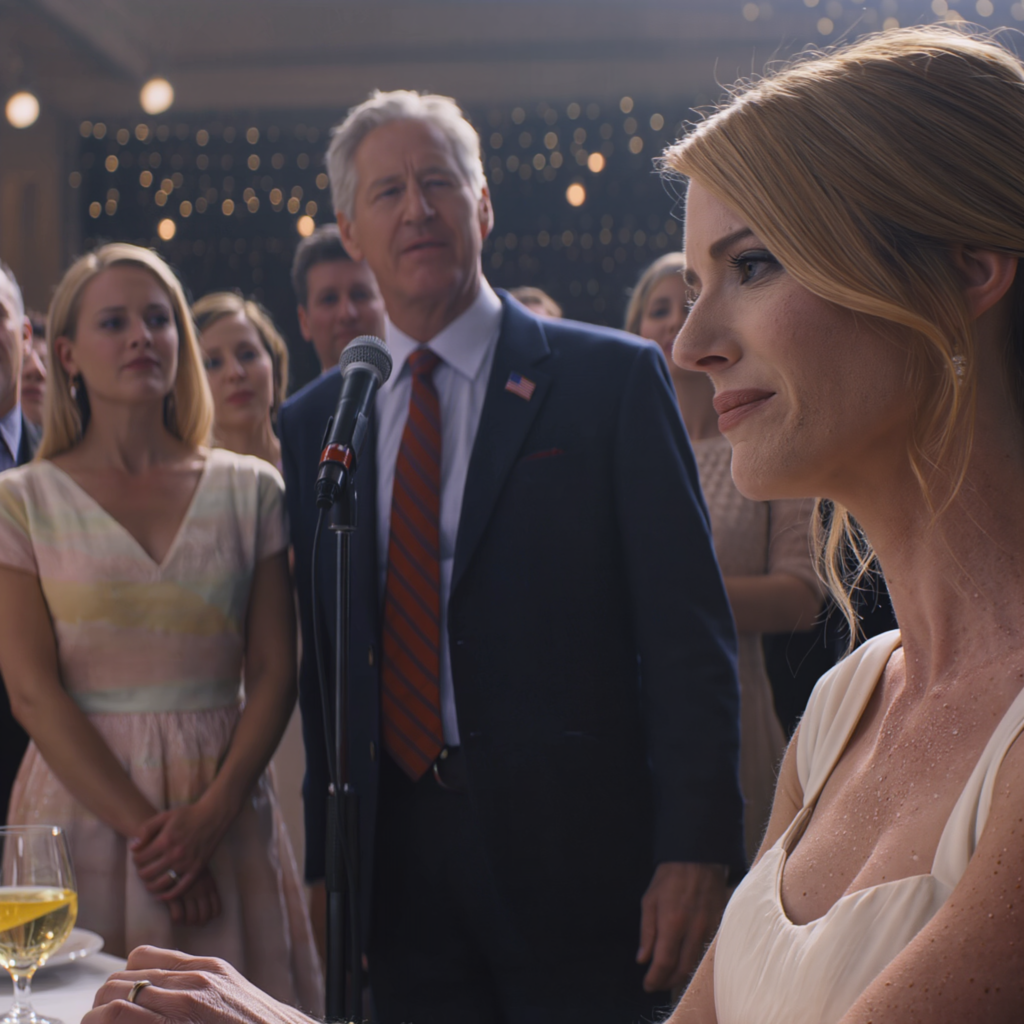
“And speaking of messes…” he said, chuckling. “I have to take a moment to talk about the most wonderful mother figure in her life.” He gestured toward Willow with his champagne glass. “How lucky is my daughter to have two moms now? Not everyone gets that blessing.”
The room went still.
From my place at the sweetheart table, I saw it all in one sweeping, stomach‑dropping panoramic. My mom, sitting next to my aunt, her smile freezing like someone had hit pause on her face. My aunt’s jaw tightening as she muttered something I couldn’t hear. Charles giving me a quick, helpless side‑eye. My bridesmaids stiffening in their seats. Willow herself shrinking into her chair, color draining from her face.
There was a smattering of awkward laughter, the kind people give when they’re not sure if something is a joke. Dad, misreading it as encouragement, barreled on.
“Seriously,” he said. “Not everybody gets two moms. I mean, talk about a modern family, right?” He winked in my direction. “You’re so lucky, kiddo. Two moms to nag you about grandkids now.”
If there had been a trapdoor under my chair, I would’ve taken my chances. Instead, I forced my lips into something that probably looked like a smile from far away and felt like a grimace from the inside. When the DJ mercifully cut him off with music, the applause was thin and uncertain.
That should’ve been the end of it. He’d made it weird, everyone had seen, we could all move on. But my dad doesn’t do subtle. He does overcorrection.
All night, as people milled around with plates of barbecue and glasses of wine, he made his own rounds. I watched him introduce Willow to my childhood friends, my college roommates, distant cousins I hadn’t seen in years.
“This is Erin’s new mom,” he’d say, with the same theatrical flourish he’d used on stage. “Isn’t she gorgeous?”
One of my friends from kindergarten actually burst out laughing the first time she heard it. When she realized he was serious, her face did this wild little flicker between amusement and horror. “Oh,” she said. “Wow. Okay.” Then she looked at me across the room with a what‑on‑earth expression and retreated to the bar.
My aunt, Mom’s sister, didn’t bother with polite. When he presented Willow with the line again, she raised an eyebrow and said, loud enough for the nearby tables to hear, “Is he for real?” Then she hugged Willow and added, softer, “You’re a lovely young woman, honey. Don’t let him drag you into his circus.”
Word travels fast at weddings. By the time we cut the cake, the whispers had started. Someone at the family table referred to Willow, not unkindly but not inaccurately, as “his midlife crisis in a dress.” Another cousin joked that if we were going full absurdity, maybe Willow should’ve been one of the flower girls. I hated every second of it and also couldn’t blame them. He’d made them part of the spectacle whether they wanted to be or not.
The worst part, for me, wasn’t the gossip. It was Willow’s face. Every time Dad rolled out the “new mom” line, she smiled on cue, but her eyes told a different story: tight, anxious, flicking toward me and then away. I saw her lean in more than once and whisper, “Kenny, please, can we not?” He brushed her off each time.
“I’m doing this for you,” he said once, loud enough that I caught the words as I passed. “Just play along. It’s good for the image.”
My mom, saint that she is, didn’t make a scene. She didn’t storm out. She didn’t throw a drink in his face, though a tiny, petty part of me almost wished she would. She just quietly excused herself to the restroom at one point, and when she came back her eyes were pink but dry. She hugged Charles a little longer than usual when they said goodnight.
Later, while the DJ played the last songs and my feet ached in my heels, Dad cornered me near the dessert table.
“You made me look like a fool,” he hissed, the smell of champagne clinging to his words.
“I warned you,” I said, too tired to sugarcoat it. “I told you this would happen.”
“You should’ve set the narrative,” he shot back. “If you’d introduced Willow right from the beginning as your mom, people wouldn’t be so confused. You set us up to fail.”
“By not lying to everyone I know?” I asked. “No. You embarrassed yourself. You embarrassed Willow. You disrespected Mom. That’s on you.”
His jaw clenched. “You’re selfish. After everything I’ve done for you.”
There it was—that old, familiar card. I didn’t bite. “Enjoy the party, Dad,” I said, stepping around him. “And maybe, for once, listen to the people who are trying to save you from yourself.”
That night, when Charles and I finally collapsed in our hotel room, my phone buzzed with texts from cousins, friends, even a couple of Dad’s golf buddies.
“Are you okay?”
“Your mom handled that like a champ.”
“I like Willow, but yikes.”
One message, from a cousin who’s known me since diapers, stuck with me: He’s turning your life into his content. Careful how much you give him.
At the time, I thought she was being dramatic. I didn’t realize she’d basically called the exact playbook he was about to run.
In the weeks after the wedding, the jokes followed him. People at his golf club started calling him “Father Time” behind his back. One guy, according to my cousin, asked if Willow was his babysitter. A few family members unfriended him on Facebook. Others stayed but muted him. Mom refused to engage, refusing even to roll her eyes when someone brought it up, which is how I knew she was really done.
Dad’s solution to all of this negative attention was not, as you might hope, to take a long hard look in the mirror. It was to double down on his new favorite identity: influencer.
“Influencer,” in this case, meant a fifty‑five‑year‑old man with 108 Instagram followers, most of whom were family, old coworkers, and people he’d gone to high school with. He’d started posting more after he married Willow—gym selfies, motivational quotes, pictures of them at brunch with captions like “age is just a number, love is eternal.” After the wedding, the posts ramped up. So did the comments, not in the way he wanted.
Three weeks after the wedding, my phone lit up while I was at my desk at work. It was Dad. I let it go to voicemail. He called again. And again. After the fourth missed call, he sent a text.
Call me ASAP. Need a favor.
I waited until my lunch break, walked out to my car, and dialed him back with the kind of resigned sigh you exhale when you know something’s on fire and you’re the one holding the extinguisher.
“Finally,” he said when he picked up. “I’ve been calling all morning.”
“I noticed,” I said. “I was working. What’s going on?”
He took a dramatic breath. “People are harassing me online.”
I blinked at the windshield. “Okay…?”
“They’re leaving nasty comments,” he continued. “DMs. Little snide remarks. It’s getting out of hand. Somebody called Willow my midlife crisis in my DMs. Another person said I looked like I was trying to be her dad and her boyfriend at the same time. It’s cruel.”
“I’m sorry people are being jerks,” I said, and I meant it. “But I’m not sure what you want me to—”
“I want you to set the record straight,” he interrupted. “Post an Instagram story. Say people need to stop bothering me, that I didn’t do anything wrong, that you support my marriage and that Willow is a wonderful mother figure in your life. Coming from you, it’ll mean something. It’ll shut people up.”
I actually checked the call timer to make sure I hadn’t accidentally skipped ahead to the part where he got to the punchline. “You’re serious?”
“Of course I’m serious,” he said. “This is my reputation we’re talking about. I’m an online personality now. I have to protect my brand.”
“Your brand,” I repeated slowly, like maybe I’d misheard.
“Yes,” he said, with the confidence of a man announcing his candidacy for president. “I’m building something, Erin. You don’t understand how this works.”
“How many followers do you have?” I asked.
“That’s not the point,” he said quickly.
“How many?” I pressed.
He huffed. “One hundred eight. But it’s quality over quantity.”
I laughed, a short, disbelieving sound. “Dad, that’s the size of a PTA meeting. You’re not exactly Mr. Worldwide.”
“You’re being condescending,” he snapped. “I’m serious. People are talking about me. It hurts Willow. It hurts me. You can help fix it with one little story. Just say I’m a good dad and people need to mind their own business. You owe me that much.”
There it was again: You owe me.
“Why exactly do I owe you?” I asked, my voice going quiet in the way that sometimes scares me a little, because it usually means something in me has snapped. “Because you worked and paid the bills like a parent is supposed to? Because Mom juggled three jobs to keep us afloat when you were busy chasing ‘business opportunities’ at the casino? Because you humiliated her and me at my wedding and are now shocked that people noticed?”
He bristled. “I put a roof over your head. Food on the table. I paid for your college.”
“Mom paid for most of my college,” I said. “You know how I know? Because Sallie Mae still emails me and she’s got her name on the paperwork. You helped. I’m grateful. That doesn’t mean I’m your publicist.”
“You’re ungrateful,” he said. “This is about family. Willow is pregnant, you know. She doesn’t need this stress.”
That hit me in the chest. “She’s pregnant?”
He paused, realizing he’d said more than he intended. “We were going to tell you soon,” he said. “It’s early. But yeah. And you’re already making it harder by refusing to support us.”
We talked a little more, or rather he talked and I listened, about how cruel people could be, how misunderstood he was, how all he wanted was “a little respect.” The longer he went on, the more the request curdled in my stomach.
“I’m not going to post anything,” I said finally.
There was silence on the line, then a slow, disbelieving, “Excuse me?”
“I’m not going to lie to people to make you feel better,” I said. “I don’t agree with what you did at the wedding. I don’t agree with you pushing this weird narrative that Willow is my mom. It was disrespectful to Mom. It was disrespectful to me. Honestly, it was disrespectful to Willow. I won’t cosign it. Not in person, not online.”
“You’re too caught up in your own world to see the bigger picture,” he snapped. “Do you know how hard it is for me? Do you know what people say to men my age married to younger women? I’m trying to build something here. I’m trying to support Willow. And my own daughter can’t be bothered to do one simple thing?”
“One simple dishonest thing,” I corrected. “No, thanks.”
He raised his voice. “You think you’re better than me.”
“No,” I said. “I think I’m done cleaning up your messes.”
We went in circles for another minute or two, him insisting, me refusing. Finally I asked, tired, “Why does it have to be me? Why can’t you make your own statement if you feel so strongly?”
“Because I’m an influencer,” he said, with zero irony. “I can’t look like I’m defending myself. It has to come from someone else. That’s how it works.”
I actually pulled the phone away from my ear and stared at it for a second, like maybe I’d dialed the wrong number. “You have one hundred eight followers, Dad.”
“Every brand starts somewhere,” he shot back.
“Then start yours by taking responsibility,” I said. “Not by using your daughter as a human shield.”
He started to say something else, something about how I’d regret this, how I was choosing sides, how after everything he’d done—
I hung up.
I sat there in my car, watching other people come and go in the parking lot, feeling both shaky and strangely calm. When I went back inside, my coworker asked if I was okay. I lied and said I was fine. The hinge in my mind, though, had already turned: I was done playing along.
Of course, Dad didn’t hear the metaphorical door closing. To him, it was just a challenge.
Over the next week, the calls increased. When I stopped picking up, he started texting. When I mutely reacted to those with nothing more than the occasional “K,” he escalated again: calling my office line, calling Charles, even calling Charles’s office when my husband didn’t pick up fast enough.
Charles, bless him, tried to be diplomatic at first. “Kenny, man, she’s at work,” I heard him say one evening, pacing our living room with his phone pressed to his ear. “This is not the time… no, I’m not getting in the middle… look, we love you, but—” He caught my eye and grimaced. “He hung up on me,” he reported.
The thing about my dad is, the louder he gets, the more I retreat. It’s self‑preservation. So I muted his calls, turned off notifications for his texts, and told myself I’d deal with it later.
Meanwhile, life went on. Work deadlines loomed. Mom and I met for lunch once a week at a little diner with American flags stuck in the sugar caddies. She’d ask how married life was treating me, and I’d deflect with stories about Charles’s terrible attempts at cooking or our neighbor’s yappy dog. Sometimes she’d ask, carefully, if I’d heard from my dad. I’d shrug and say, “He’s still being Dad.” She’d nod, like that told her everything she needed to know.
Then came the update that made everything snap into sharper focus: Willow was pregnant with twins. Not only that, but Dad had started gambling again. And cheating.
I didn’t hear it from him, of course. I heard it from Willow.
It started with a text message, a number I didn’t recognize and a cautious, Hi, is this Erin? It’s Willow.
I stared at it in my notifications for a long second before opening it.
Hey, I wrote back. What’s up?
There was a pause, the little typing dots appearing and disappearing, like she kept starting and stopping. Finally: Can I ask you something kind of personal? About your dad?
My stomach tightened. Sure.
We ended up on the phone that night, my husband in the next room watching a game, the TV murmuring in the background while my world shifted a few degrees.
“I’m thirty‑six weeks,” she said, voice trembling and exhausted. “Twins. We just had the last scan this week.” She laughed, a small, disbelieving sound. “I’m about to be a mom to two babies at once and I feel like I’m married to a teenager.”
She told me about the gambling first. How it had started small, “just for fun,” how she’d believed him when he said he had it under control, how suddenly they were behind on bills and he was borrowing from friends, swearing he had a hot streak coming any day now. Then she told me about the affairs. Plural.
“I caught him three times,” she said quietly. “Three different women. And every time he said he’d stop. He said he just got scared about being a dad again, that it made him feel old. He said he needed the distraction. Like I’m not the one carrying two human beings around while he’s out there trying to feel young.”
My throat closed. “Willow, I’m so sorry.”
“I keep thinking maybe I did something wrong,” she admitted. “Maybe I wasn’t fun enough, or supportive enough, or maybe if I’d just—”
“You didn’t do anything wrong,” I cut in, sharper than I meant to. “This is who he is. He did this to my mom for over twenty years.”
There was a silence so heavy I could hear her breathing. “Your mom,” she said finally. “I actually… I texted her. I didn’t know if it was overstepping, but I was desperate.”
I blinked. “You did?”
“She was kind,” Willow said. “She told me she couldn’t tell me what to do, but that she left because she realized he wasn’t going to change. She said I shouldn’t stay hoping for a different version of the same man. It sounded like she was trying not to cry.”
I pictured my mom, standing in her kitchen with that faded flag magnet behind her, telling the younger woman married to her ex‑husband not to make the same mistake. Somehow that image hurt and healed at the same time.
“What are you going to do?” I asked.
“I don’t know,” Willow whispered. “I’m scared. I’m thirty‑one. I’m about to have twins with a guy who keeps gambling away our money and sneaking around like he’s in some bad movie. Part of me still loves him. Part of me thinks if I just hang on a little longer, maybe the babies will change him. But then I read your mom’s texts and I look at my ultrasound pictures and I think… if he didn’t change for you, why would he change for them?”
“That’s the thing,” I said, choosing my words carefully. “He doesn’t change because other people need him to. He only changes, temporarily, when his fun runs out. Then it’s right back to the same cycle.”
We talked for over an hour. I mostly listened. She cried, apologized for “dumping” on me, apologized for the wedding (“I didn’t even want him to say that stuff,” she admitted. “I told him it was weird. He said it was ‘branding’”). I told her she never needed to apologize to me for anything Dad had done.
After we hung up, I sat at our kitchen table, staring at the grain of the wood. Charles came in, saw my face, and shut off the TV.
“Your dad?” he asked.
“Willow,” I said. “It’s bad.”
The hinge, again, moved a notch. This wasn’t just about my embarrassment anymore. There were two babies about to be born into this chaos, and a woman my age who’d gotten swept up in my father’s endless chase for fun.
A few weeks later, Willow hit her breaking point. Dad cheated again. This time, she was done.
She called me after she’d spoken to a lawyer. “I’m filing for divorce,” she said. Her voice was calmer than I expected. “I can’t have him around the babies like this. I thought maybe I was stronger than your mom. Turns out I’m just finally learning from her.”
“I’m proud of you,” I said, and meant every word.
My dad, predictably, did not take it well.
When she moved out, he melted down. The calls to me, which had actually slowed a bit while he focused his chaos inward, ramped up into something almost comical. One day, he called my cell twenty‑plus times. When I didn’t answer, he called my office. When I had the receptionist send him to voicemail, he called Charles, then Charles’s office, then my mom, then my aunt.
“You need to talk to him,” Mom texted me, attaching a screenshot of her missed calls. “If only to tell him to knock it off. He’s going to get himself in trouble.”
So there I was again, standing in her kitchen with Sinatra on the speaker and that little American‑flag magnet holding up a coupon, staring at my buzzing phone. Twenty‑nine missed calls. I took a breath, hit dial, and braced myself.
He picked up on the first ring. “Finally,” he barked. “What, you’re too busy to talk to your father now?”
“I’ve been at work,” I said. “And ignoring you, yes. You’re harassing everyone.”
“That’s rich,” he scoffed. “You know what’s harassment? Your mother and Willow turning my kids against me.”
“They’re not born yet,” I said. “And you’re doing a great job destroying your own relationships without any help.”
He plunged ahead like I hadn’t spoken. “She’s leaving me,” he said, incredulous. “Can you believe that? After everything I’ve done for her? After everything I sacrificed? She’s pregnant with my twins and she’s abandoning me. And I know it’s because you and your mother poisoned her. You never wanted her to take your mom’s place.”
“She was never going to take Mom’s place,” I said, feeling my voice sharpen. “Because she’s my age, Dad. She’s not my mother. She didn’t even want that. You pushed that narrative because it made you feel better.”
“See?” he said triumphantly, as if he’d caught me in something. “You admit you never gave her a chance.”
I closed my eyes, counted to three. “Willow had plenty of chances. With you. She caught you cheating three times. She watched you gamble away money you needed. She’s thirty‑one, pregnant with twins, and she’s finally doing what Mom did when she realized you weren’t going to change. She’s saving herself and her kids. And I’m proud of her for it.”
He made a sound somewhere between a scoff and a growl. “You’re going to side with her? Over your own father?”
“I’m going to side with the person who’s protecting two babies from chaos,” I said. “And with the person who protected me from it when I was a kid. That’s Mom. That’s Willow, now.”
He tried a different tack. “You don’t understand,” he said, his voice pitching higher. “I only gambled because I had no other way to make money. The economy’s a mess, my boss cut my hours—”
“Dad,” I said, cutting in. “You’ve been gambling since I was seven. This didn’t start last year.”
He ignored that. “And Willow? She’s not some saint. She’s been verbally abusive. She trapped me with those babies. She planned this.”
Something inside me went very still. “If you talk about her like that in court, people are going to laugh you out of the building,” I said. “Everyone knows who you are. They’ve watched this pattern for decades. If you drag her into a custody battle, I will stand next to her in front of the judge and testify about every casino trip, every late‑night mysterious ‘meeting,’ every time Mom had to pick up the slack because you disappeared with the paycheck. Are you sure that’s the road you want to go down?”
There was a long pause.
“You wouldn’t,” he said finally, but there was no conviction in it.
“I would,” I said. “And I will. And if you keep blowing up my phone, my husband’s phone, my workplace? I will file for a restraining order. I’m not a kid you can guilt into silence anymore.”
“You’re really going to cut me off,” he said slowly, like the idea had just occurred to him that people could actually walk away.
“I’m really done,” I said. “With the lies, with the guilt trips, with being your built‑in PR rep. You want to fix your life? Do it. But you’re not dragging me down with you. And you’re not dragging Willow and those babies down if I can help it.”
I hung up before he could respond. My hand shook a little, but relief flooded in right behind the adrenaline. Mom slid a plate of cookies across the counter without comment, which is her version of a standing ovation.
My dad’s next move was as predictable as it was ridiculous: he took his grievances to the internet.
Later that night, a childhood friend sent me a link with the message, “You seen this?”
I clicked and found myself staring at a video of my father, shot in vertical format, him sitting in his dim living room with his phone propped up on something. The ring light gave his face that strange, flattened look. His caption read: TELL MY SIDE #truthtime.
“Oh boy,” Charles murmured over my shoulder.
In the video, Dad launched into a rambling monologue about how his life had been ruined by “three ungrateful women”: his ex‑wife, his current wife, and his daughter. He said he’d started gambling because he had “no other way to make money,” that Willow had been “emotionally cruel” and had gotten pregnant “to trap” him, that my mom had “turned” me against him, and that he was the real victim in all of this.
“He sounds like a guy on a late‑night infomercial,” Charles said quietly. “For bad decisions.”
The wildest part wasn’t the video itself. It was the comments.
Because here’s the thing about having 108 followers, most of whom have known you for thirty‑plus years: your audience is not strangers. They’re witnesses.
“Come on, Kenny, we’ve known you since high school,” one comment read. “You’ve been chasing blackjack tables since the Riverboat opened.”
“Dude, I watched Monica bail you out of your own messes for twenty years,” wrote another. “Don’t do this.”
“Willow has been nothing but sweet every time I’ve seen her,” a third said. “You’re really going to paint her as the villain because she finally got tired?”
By the end of the day, the video had maybe a few hundred views, tops. He’d wanted to go viral. In a way, he did—just not how he pictured. Family and old friends shared it in group chats, not to support him but to shake their heads. By sunset, he’d quietly deleted the video. By the end of the week, he’d lost every single one of his 108 followers. Even the guy from his poker night who thinks the house always wins unfollowed him.
His “brand,” the thing he’d tried so hard to protect, evaporated in less than twenty‑four hours. Turns out when your whole life is built on performative charm, the audience eventually gets tired of watching the same trick.
In the fallout, he became a ghost. He stopped calling, mostly because no one was answering. The golf club started “losing” his tee time reservations. A mutual cousin mentioned that some of his old buddies had blocked his number after he started spamming them with links to his “truth videos.” Online, he was silent, forced to live in the real world again, where twin babies would soon arrive and a court would likely have opinions about support payments and custody.
Willow, in the meantime, was busy doing the hard, unglamorous work of preparing to become a single mom of two. She filed the paperwork. She found a small apartment with a landlord who didn’t blink when she said she was expecting twins and going through a divorce. She lined up a friend to drive her to the hospital when the time came.
She also kept texting me.
Can you recommend a good pediatrician?
Do you think it’s weird if I give them middle names from my side of the family? I don’t want them to feel totally disconnected from his, but…
Is it okay if I still send you baby pictures after they’re born? I don’t want to make you feel like you’re stuck in the middle.
I told her yes, yes, and absolutely yes. I wanted those babies in my life. They were innocent in all of this. They hadn’t asked to be born into a storm.
One afternoon, a week before her due date, she sent a picture of the nursery she’d put together: two cribs side by side, hand‑me‑down dresser, a mobile of little stars. On the wall above the changing table, she’d taped up a postcard of an American flag over a cornfield—one of those free ones they give you at the post office. Underneath, she’d written in loopy handwriting: HOME, NOT DRAMA.
I stared at that picture for a long time, thinking about my mom’s fridge magnet, about the flags at the diner, about the tiny, ordinary symbols that had been in the background of my life while my father staged his loud, flashy disasters. Those little flags had outlasted every one of his impulsive purchases, every girlfriend, every scheme. They were still there, quiet and steady, while he scrambled to find a new audience.
The night Willow went into labor, she texted from the hospital, fingers shaking so badly her messages came through with typos and extra spaces. Charles and I drove over after she was settled, bringing a bag of snacks and a phone charger. We weren’t there in the delivery room, but we were in the waiting area, dozing in uncomfortable chairs, when the nurse came out and told us that two healthy baby boys had arrived.
“Henry and Miles,” Willow texted later, attaching blurry photos. Tiny fists, scrunched faces, hospital blankets. “They’re perfect.”
My dad wasn’t there. He’d found out, I later heard, through a mutual friend who still checked social media enough to see Willow’s birth announcement. Whether he called, whether he tried to come by and was turned away, I don’t know. What I do know is that in the first pictures of my half brothers, the faces I saw were Willow’s, my mom’s in some strange generational echo, and my own.
Weeks passed. Life, stubborn and ordinary, went on.
Mom came over one Sunday with lasagna and a new magnet for the fridge—a little ceramic heart with red, white, and blue stripes. “It was on sale,” she said, but I saw the way her eyes flicked to the old flag magnet, now holding up a photo of Willow holding the twins, me and Charles on either side of her, all of us tired and happy.
“You okay?” she asked quietly as we stood there.
“Yeah,” I said. “I think I am.”
“Your dad called me,” she added, almost as an afterthought. “He wanted to know if I’d talk you into ‘rebuilding the relationship.’ I told him my days of refereeing his drama are over. He can talk to his lawyer and his therapist if he wants help.”
I laughed, surprised and delighted. “You really said that?”
“I really did,” she said, sounding a little pleased with herself. “Took me long enough.”
Later that night, after she’d gone home and the house was quiet, my phone buzzed with a number I recognized but no longer had saved: Dad’s. I watched it light up the screen, then go dark. Then light up again. And again. Eventually, it stopped.
I thought about all the times I’d picked up in the past, all the times I’d let his urgency become my emergency. I thought about Willow in her apartment, with two sleeping babies and a stack of bills but also, finally, a little peace. I thought about my mom dancing with Charles at our wedding in the blurry part of the night after Dad had left, Sinatra playing through tinny speakers while the string lights reflected in her eyes.
For the first time in my life, I didn’t feel guilty for choosing quiet over chaos.
My father made his choices: the boat in the driveway, the cards on the table, the secret emails, the young wife he tried to turn into a prop, the online rants where he cast himself as the misunderstood hero. He had opportunity after opportunity to step off the stage and become a decent man behind the scenes. He chose not to.
My choice, finally, was simple. I took that old flag magnet off my mom’s fridge the next time I was over, with her blessing, and put it on my own. I stuck a picture under it of Willow and the twins on my couch, Henry drooling on my shoulder, Miles asleep on her chest. On the back, in pen, I wrote a date and a sentence: The day we stopped being his audience.
Every time my phone buzzes now with a number I don’t recognize, I glance at that magnet before I decide whether to answer. Most days, I let it go to voicemail. I’ve heard my father’s story enough times to know how it ends.
I’m much more interested, these days, in helping Willow and those boys write a better one.
News
On my birthday, my parents hosted a dinner with 100 relatives just to disown me. my dad handed me a bill, said: “every cent we wasted raising you. pay or never contact us again”. my sister grabbed my car keys from the table: “dad already transferred the title to me.” i walked out without a word — four days later, they’re calling me…50 times a day
On my birthday, my parents didn’t bring out a cake. They brought out witnesses. Nearly a hundred relatives sat shoulder…
At My Mom’s Birthday, My Brother’s Son Threw My Son’s Drawing Into The Fire And Yelled, “Nobody Wants His Crappy Art Anyway.” Everyone Laughed. That Night, My Dad Texted, “You’re Making Things Uncomfortable — Just Skip Christmas.” I Replied, “So Does The Funding.” By 1 A.M., My Phone Was Melting. 27 Missed Calls.
By the time the clock on my stove blinked 1:00 a.m., my phone looked like it was about to catch…
My whole childhood I was treated like a maid. On Christmas Eve, my mother coldly said: “Your sister’s 25 friends are coming, you cook – clean – serve them properly,” I just said “Okay” then got on a plane straight to the beach; when my family came home and stepped into the kitchen, they SCREAMED, but what made them tremble the most came after that.
My parents treated me like hired help. The irony hit me every time I saw the little chipped American flag…
“You’re not family, don’t show your face here,” the whole table burst out laughing, I picked up the entire lasagna and left – 4 days later, their loan was rejected by the bank, that night, my phone lit up
My name is Jean William. I’m thirty years old, and the night I realized my family didn’t love me the…
I was serving champagne at a gallery when i saw it. a painting i made when i was 6. price tag: $150,000. ‘sir, that painting is mine,’ i said. ‘impossible,’ the gallery owner laughed. he called security to kick me out. but he forgot to check the secret message on the back of the canvas.
I was balancing a silver tray of champagne flutes when I saw it. Not the painting, not yet. First I…
“Mom texted: ‘Ice storm, Christmas is canceled, everyone stay home to be safe’ — the next morning the whole family called saying ‘we miss you so much’, I opened Instagram and saw all of them raising their glasses at my sister’s house… and that night I decided to do something that would make their fifteen years of pretending unable to go back to how they were.”
I believed my mother’s text the way I had believed a thousand small mercies before it. “Everyone’s staying home due…
End of content
No more pages to load