“We Didn’t Order For Your Son,” My Sister Said, Handing Him a Bread Basket While Her Kids Ate $100 Steaks
I didn’t go to that dinner to make a scene. I went because my eight‑year‑old son asked if he could sit next to Grandpa, because he’d spent the week practicing “restaurant manners” in our kitchen, because family—no matter how complicated—still called like a tide. I put him in a button‑down shirt he hated and told him we’d be home before bedtime. I promised there’d be fries.
The lights in the dining room were the warm, expensive kind that make glassware glitter and bad behavior gleam. Servers glided like metronomes, plates lifted at the same angle, voices set to a hush. My sister arrived late, perfume first, leaving laughter in her wake. Her kids hit their seats at a gallop and snapped open the leather menus like they were about to order justice.
When the waiter came to take orders, she did it without looking at me. “Two tomahawks medium‑rare, sides for the table,” she said, tilting her chin toward her children as if issuing royal decrees. “You’ll love the steak here, babe,” she added to her daughter, who was already filming the bread basket like it might be famous later.
My father didn’t bother with a menu. “The usual,” he told the waiter, and the man nodded with the kind of recognition that means the usual is expensive.
My son—small shoulders square, hands folded in his lap—waited his turn the way I’ve taught him. He is eight, and he is quiet and careful in rooms that echo. He knows how to say please. He knows how to be invisible when adults forget to make room.
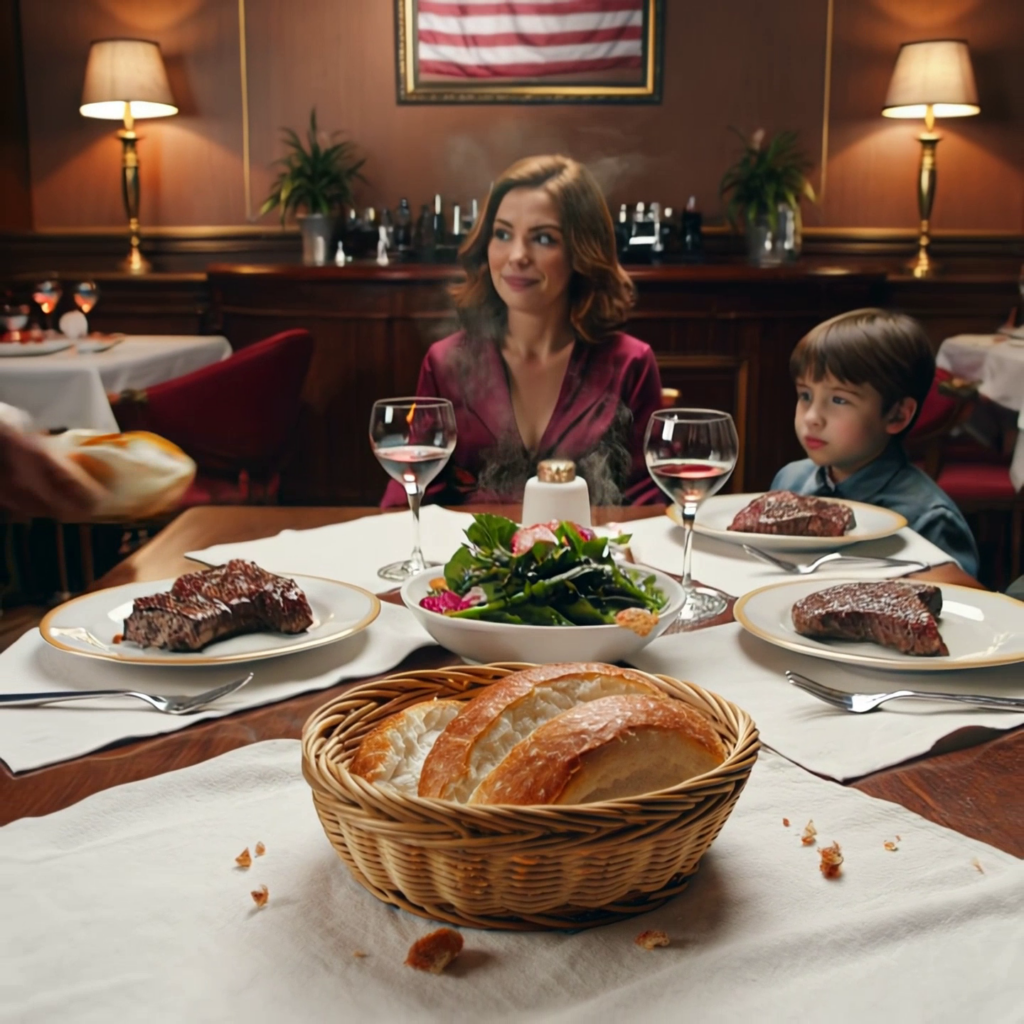
That’s when my sister slid the basket toward him like a peace offering she didn’t intend to honor. “We didn’t order for your son,” she said, a breezy cruelty that skimmed the table and cut all the same. “He can have bread. We already put in the steaks for the kids.”
My father didn’t look up from his phone. He added, almost absently, “You should have packed him something.”
The table stilled. It always does in the half‑second after an insult that pretends to be practical advice. My son’s eyes lowered to the basket like it was the last life raft on a ship that wasn’t sinking yet. He didn’t reach for it. He just studied the dark crust, the sheen of butter, the way people study fences when they realize what they’re for.
I smiled. Not the kind that reaches the eyes. “Noted,” I said.
The waiter returned—pin‑poised, tablet ready, the room’s choreography drawing him back to us—and I stood. My chair legs whispered against the hardwood. Nearby tables paused, forks hovering.
“I’ll take the private room,” I said, voice steady and even. “And whatever the chef recommends for everyone here—on me.”
My sister blinked, gears grinding behind a polished expression. “What?” she said, laugh caught halfway between mockery and surprise.
But I was already walking with the waiter.
The corridor to the back rooms smelled faintly of cedar and citrus polish. Framed prints of places that look like money—vineyards at dusk, hotel lobbies with marble the color of bone—hung in a line. The waiter glanced sideways, clocking my pace, and matched it.
“I’ll have the manager meet you in the suite,” he said softly. “We can make it right.”
“This isn’t about making anything right,” I said. “It’s about setting the table correctly.”
He didn’t ask what that meant. Good servers know when a guest is ordering more than food.
People like to pretend dinners are spontaneous. They aren’t. They’re theater. The guest list is the script, the room is the stage, the bill is the final bow. I’d been in rehearsals for months without saying a word.
Growing up, my sister wore first place like a fragrance she never had to pay for. She was sharp‑tongued and sun‑bright when it suited her, mean in a way that always sounded like a joke to people who wanted to be invited back. If there was a ladder in any room, someone was already steadying it for her. I learned not to climb the same one.
“Make your own way,” my father used to say, as if it were a blessing.
I did. Quietly. I learned the tax code and the shape of opportunity. I learned that you can be introduced to a room by a whisper if the whisper is coming from the right direction. While my sister flaunted borrowed money and glossy favors, I built the plain, durable kind: consulting contracts that weren’t advertised, real estate that appreciated when no one was looking, a portfolio inside an LLC with a name no one recognized. I kept the logo off everything.
I didn’t say no when family needed help. I paid for vacations without signing the card. I covered my father’s medical bills because there are some debts you don’t post about. When my sister’s boutique failed—polished concrete floors and racks of things she liked to call “curated”—I wired what was necessary, no lecture attached. She sent a heart emoji and a selfie with new shoes. Gratitude was beneath her; performance was not.
So when she pitched this dinner as “family bonding,” I knew it would be a stage. I just didn’t know the prop she’d pick would be a bread basket in front of my son.
What she didn’t know was that the real story hadn’t started that night. It began months earlier, in an office that smelled like paper and coffee, where the accountant—an old friend who still believes in plain language—closed the door and told me something off the record.
“Your father’s trust,” he said, thumb worrying the edge of a manila folder. “The one he keeps calling a legacy for future generations.”
I nodded, waiting for a number or a form I’d have to sign.
“It lists one beneficiary,” he said. “Your sister.”
I breathed once, evenly, the way you do when a doctor says a word you hoped would belong to other families. “Why?”
He glanced down at the notes he didn’t need. “She convinced him you weren’t responsible enough. That you’d waste the inheritance on—her word, not mine—charity work.” He looked up then. “I thought you should know.”
Charity work. That was what she called feeding my son and putting roofs over strangers when winter came early. People like my sister use the word charity like it’s a disease.
I said thank you. I left. I walked two extra blocks to my car because I needed the air to cool the anger enough to drive.
Two weeks later, a different message arrived through a more familiar channel: my father sold a property I had managed for years, quietly, behind my back. The proceeds didn’t take the route they used to. They were reinvested in my sister’s new venture—a luxury catering company that found new ways to spell old promises. I found that out by accident, too, the way people like me always find things out: by reading what other people don’t bother to hide.
The logo was on fabric napkins. Butter‑colored thread stitched into white, initials looping like a signature someone practiced in a mirror. I saw them that night at the restaurant, when the bread landed and my son did the arithmetic of hunger and manners in his head. The children at the far end—my sister’s, the steak eaters—dabbed their mouths with those initials as if wiping away evidence.
She wasn’t just eating steak. She was feeding off what she’d taken.
That’s when I decided she’d never touch another cent of that trust again. Not while I was alive. Not after.
I didn’t shout. I don’t. I didn’t storm out. I don’t. I started listening. People announce everything if you ask the right question like you’re impressed.
“How’s the business structured?” I asked her at some other table on some other night, a month before the dinner, when she’d ordered a bottle with a name she couldn’t pronounce and told the server “we’re celebrating” without an occasion. “Who handles your contracts?”
She leaned back and smiled like a person posing with a trophy. “I have investors now,” she said. “We’re scaling. We just landed a corporate events firm—massive. Recurring revenue. They adore us.”
She told me the name. She mentioned their client list, talked about conference seasons and quarterly galas like she’d invented the calendar.
What she didn’t know was that I partially owned that firm—quietly, through a shell entity built exactly for such silence. Ownership, if arranged correctly, is a dimmer switch. You can keep the lights low until you need the room to see.
I made one call. Not the kind with threats or heat. A partner who understands that the integrity of a contract is as important as the color of a logo took the call on the second ring.
“We’re reviewing vendor compliance,” I said. “Tighten the clause on financial transparency and background checks. No exceptions for existing vendors. Apply it uniformly.”
“Anything I should know?” he asked.
“Only that the standard you apply to strangers should be the same one you apply to friends,” I said. “The brand depends on it.”
He didn’t argue. He likes his brand unblemished.
Audits have a way of turning enthusiasm into arithmetic. My sister had built a company on charm and invoices. Charm doesn’t balance books. Investors who believe in story often stop believing when the story requests another check. Within a month, the firm froze new contracts pending compliance. Within two, her investors called me—not because they knew I was part of the events firm, but because they’d seen my name on other sober things and wanted to know whether they should be patient or afraid.
“Be accurate,” I told them. “Whatever you do.”
Within three, the kitchen lease she’d boasted about at Christmas was terminated. A civil notice appeared, the kind with a docket number no one reads aloud. My father called me, voice hot, lungs pumping blame.
“She’s being sabotaged,” he said. “You know people. Fix it.”
“You might want to check who her accountant is,” I said.
Silence. The kind that means a man is finally hearing the echo of his own choices.
By the time he realized, it wasn’t a family fund anymore. It was a charitable trust under my son’s name—built cleanly, legally, irreversibly. The accountant who had once closed the door to tell me the truth opened it again to watch me sign. Paper is heavy when it’s honest. No one can lift it back out of place without proof they don’t have.
If you’re looking for fireworks, you won’t find them here. Revenge is a firework if you need the crowd to look. Correction is a floodlight in an empty room. I prefer the floodlight.
I followed the waiter past the hum of the kitchen to a door with a brass handle that felt like it had a memory. He opened to a suite dressed in mahogany and thick carpet, the kind of room that turns volume into velvet. The table had been set for ten as if the place had been expecting my family for years.
“Perfect,” I said. “Give us a minute. Then send the manager.”
He nodded and disappeared. Alone in the quiet, I took out my phone and made the only call I planned to make that night.
“Make sure the private room is ready,” I told the manager when he picked up. He knows my voice because I’ve never raised it at his staff. He knows my name because my firm once sponsored his wedding reception when other vendors dropped out at the last minute and I didn’t let him feel the scramble.
“Yes, sir,” he said. “It’s waiting.”
I slipped the phone away and walked back toward the main dining room. On the way, I passed a framed photo of the restaurant’s opening night—ribbon cut, smiles bright, a snapshot of ambition turned into architecture. People think restaurants are about food. Restaurants are about how people want to be seen while eating it.
At our table, my sister had ordered another imported wine with syllables she savored more than the taste. My father scrolled past headlines that did not include the consequences he’d set in motion. My son sat very still, eyes on the napkin, a boy memorizing the rules of a game he didn’t invent.
I set my card on the linen.
“Excuse me,” I said, giving the room my voice without raising it. “Dinner’s on me. The full order. The staff will kindly move our seats to the private suite. My son deserves an actual meal.”
The waiter—new to us but not to moments like these—hesitated only long enough to confirm I meant all of it. My sister laughed, thin and high, a sound that breaks before anyone else hears the crack.
“It’s a joke,” she said, glancing around to see if anyone would applaud.
It wasn’t. And I wasn’t asking.
The staff moved like a practiced tide. The kids at the far end stared, slack‑jawed, as their plates lifted and their certainty didn’t. My sister gathered her purse like a weapon, then stood because standing was the only power left to perform.
“Private room?” she said to me as we walked, tone dipped in accusation. “Showing off?”
“No,” I said. “Feeding my family.”
In the suite, the mahogany took the sound out of her voice. Servers rolled in dishes with names she stumbled over when she tried to name them. I didn’t bother translating. My son’s eyes widened at the parade of plates, not because they were expensive, but because they were his.
When the manager arrived, he did what good managers do: he made the mechanics invisible. “We’ll course it at your pace,” he said. “If there’s anything the young man wants to try first, we can start there.”
“Fries?” my son asked, timid yet hopeful.
“From scratch,” the manager said, and smiled like a secret kept.
My sister tried to peek at the bill when it came, impulse a reflex she mistook for savvy. The manager’s hand hovered, polite and immovable.
“This meal’s already cleared by our corporate account, ma’am,” he said, not unkindly.
She frowned. “Corporate account?”
“Yes,” I said. “One of your old clients, actually—the events firm that stopped renewing your contracts.”
It took her a beat to assemble the facts into a shape she recognized. I watched her face drain of color in the reflection of a water glass. When she found her voice, it came out small.
“You—” she started.
“I own it,” I said softly. “And as of this quarter, your debt’s been acquired by the same foundation that owns Dad’s old trust.”
My father looked up then, finally seeing the table instead of the phone. “What foundation?” he asked.
I turned to my son. He was watching me the way kids watch the wind to learn what happens next.
“The fund under his name,” I said, still looking at him. “The one that makes sure kids like him never have to eat bread while others have steak.”
My sister’s voice cracked. “You wouldn’t.”
“I already did,” I said.
The silence that followed didn’t belong to any of us. It belonged to the math on the page, to the signatures that don’t smudge, to the decisions that look like destiny when they’re only discipline. I slid a folder across the table—purchase confirmations, legal transfers, tax receipts. My father picked up one page and skimmed it the way he reads the weather, convinced he can still change it.
“What is this supposed to prove?” he asked.
“That the trust is no longer in your name or hers,” I said. “It’s a charitable educational fund. For low‑income kids. For kids who know what it feels like to be handed a bread basket in a room full of steak.”
My son’s brow furrowed. He glanced from the papers to me, from the plates to his grandfather, trying to decide which world was the real one.
I put my hand on his shoulder. “It means,” I told him, “that from now on the table will be set fairly.”
He nodded once, as if making a promise to remember.
My sister stood abruptly. Her chair scraped a line across the quiet. “You’re insane,” she said.
I shrugged. “Maybe. But I’m the only one who still pays the bill.”
She left. No one followed.
Dessert arrived like a truce the kitchen offered on our behalf: a chocolate soufflé still warm, steam lifting in a ribbon when the spoon broke its surface. My son smiled, small and startled, the way kids do when kindness arrives right on time. He ate slowly, as if the taste might vanish if he hurried.
I watched him. I watched my father study the papers again, hunting loopholes that weren’t there. Outside the window, across the stretch of night that turned glass into a mirror, I could see my sister pacing by her car, phone pressed to her ear, performing urgency for the only audience she trusts—people who haven’t yet learned to check the numbers before they clap.
Revenge is easy if all you want is applause. Correction is harder. It’s patient. It’s silent. It holds the door to the private room and waits for people to understand what kind of room it is.
I didn’t raise my voice. I didn’t ask anyone to. Respect isn’t loud. It’s simply what you set down and refuse to pick back up once you’ve recognized it for what it is.
And that night, when my son looked up at me with chocolate at the edge of his smile, I understood something I should have understood sooner: that the opposite of cruelty isn’t kindness alone. It’s structure. It’s a table arranged so that bread isn’t a substitute for a meal and dignity isn’t a favor we grant to keep the peace.
Outside, my sister kept pacing. Inside, the room held.
We ate in peace.
I’ve been accused of being too calm. It’s funny until you realize calm is what people call you when you stop playing their game. My sister used to say I was “unbothered,” like I’d stumbled onto a secret that made me less human. The truth is simpler: I learned early that reacting is free, and people who trade in easy power always expect you to pay.
So I didn’t react when she tried to poke holes in what couldn’t be punctured. I let silence do what it does better than outrage. The soufflé settled, the server returned with coffee, and the room’s temperature adjusted to a new climate where my son’s hunger wasn’t the weather anymore.
My father cleared his throat—a sound I’ve heard at school plays and graduations and in waiting rooms where bad news arrives in envelopes. “You blindsided us,” he said, eyes on the neat stack of documents. “Family shouldn’t be ambushed.”
“Family shouldn’t be starved,” I said, the words light as linen. “And legacies shouldn’t be misnamed.”
He bristled, the way men do when history refuses to be edited.
“You always were dramatic,” he said, but softer than before, like he wasn’t sure the line still worked.
I could have reminded him of his own dramatics—the way he used silence as a lever, the way he mistook authority for wisdom—but I didn’t. I poured another cup of coffee and let him see my hands steady.
“Dad,” I said. “I didn’t take anything from you. I took away a mistake. You can keep calling it a legacy if you want, but legacies feed people. They don’t confuse dinner with discipline.”
He looked at my son just then. Really looked. The boy had his mother’s eyelashes and my stubborn jaw and the exact concentration of a person making a memory. My father’s shoulders shifted, like a coat coming off in a room that had warmed without his permission.
“What happens now?” he asked.
“Now?” I said. “We eat. We go home. We get some sleep. And in the morning nothing will be different except the part where you can’t forget we did this.”
The manager reappeared as if summoned by the change in air. “Gentlemen,” he said, “would you like anything else for the young man?”
My son glanced at me, then back at the dessert as if choosing a future. “Maybe…one more spoon,” he said.
“Coming right up,” the manager replied, then turned to my father. “And a decaf?”
My father surprised himself by nodding.
In rooms like this, people think power is the loudest person’s voice. But power, the kind that lasts past dessert, is almost always paperwork. It’s signatures and timing. It’s reading the clause everyone else skims. It’s a phone call you place before any of the speeches.
The clause we adjusted at the events firm was two lines long. It didn’t name my sister. It didn’t need to. It simply required what serious companies require from every vendor when they decide they care about staying serious. Background checks. Financial transparency. Compliance so basic you can teach it at a community center on a Tuesday night.
The audit did what audits do when there’s more story than structure. No arrests. No headlines. Just balances that didn’t balance, invoices that looked more like theater props than math. Investors are brave until a spreadsheet turns into a mirror.
They called me because people call the person they think speaks the language of the room they’re in. I’ve spent years making sure no one is sure which room I prefer. It’s safer that way. It’s kinder, too. It leaves room for people to be better before you decide they won’t be.
I gave them a choice without giving them a target. “Do what your policy says,” I told them. “You wrote it for a reason.”
The policy did its work. My sister’s lease evaporated the way bad terms evaporate when the people on the other side finally read the fine print they signed. The civil notice followed—not because I pushed it forward, but because gravity pushes everything down eventually.
When my father called to tell me I was cruel, I didn’t defend myself. Cruelty is calling a boy to a table and deciding he doesn’t count. Cruelty is teaching a child that hunger is a lesson and you’re the teacher who gets to grade his silence. Cruelty is disguising punishment as parenting and then daring anyone to call it by its name.
What I did had other names: fiduciary duty, compliance, the boring liturgy of adults who mean what they say when they sign their names. But mostly it was this: I refused to keep paying admission to the theater my sister directed just because the tickets were handed out at Christmas.
When the check was ready, the manager didn’t present it. He placed a folded receipt by my elbow the way a person leaves a note in a book you asked to borrow. I glanced down, saw the total, felt nothing. Numbers are just stories with different punctuation.
My sister was still out by her car, taking calls as if urgency could dial her out of a ledger. The window gave me her reflection: a person rehearsing a plea for an audience that used to applaud on command.
“Is she coming back?” my son asked.
“Maybe not tonight,” I said.
He considered that. “Will Grandpa be mad?”
“He has a right to be,” I said. “Being surprised hurts.”
“Do we have a right to be mad?” he asked, and I loved him for turning the question into a shared thing.
“We have a right to be clear,” I said. “Clarity is better than anger. Anger burns out. Clarity stays.”
He nodded, not because he fully understood, but because children understand tone before they understand thesis. The server brought fries, crisp and hot, the kind that makes ketchup unnecessary. My son ate two and saved one like a souvenir. Later, he’d ask if we could make our own at home and I’d tell him yes, and we would, and that wouldn’t be a new tradition so much as a way to remember this night without letting it own us.
My father finished his decaf. When he set the cup down, the saucer didn’t rattle.
“Does this make you feel big?” he asked me. His tone wasn’t unkind.
“No,” I said. “It makes the room feel the right size.”
He breathed out, a long exhale that let a decade go by.
“I should have seen it,” he said. “Your sister—” He stopped, revised. “Vanessa has a way of making a favor look like a fact.”
He’d never apologized to me in a sentence before. That one came close.
“Dad,” I said. “I didn’t need you to see it sooner. I needed you to stop pretending you didn’t see it when you did.”
He looked at the door to the corridor the staff used, then back at me. “You bought the trust out.” It wasn’t a question.
“Yes.”
“Clean.”
“Clean,” I said. “Legally. No shortcuts.”
“Under his name,” he said, nodding toward my son.
“Yes.”
He lifted the top page again, studied the designation. “Charitable educational fund.” He sounded out each word like a new language he might want to learn.
“For low‑income kids,” I said. “Kids who shouldn’t have to argue for a plate.”
He looked at my son then with something like recognition—of the boy, of the table, of himself.
“Do I…have any say?” he asked, an old habit trying on its shoes.
“You have all the say you’ve always had,” I answered. “You can choose who you are at this table.”
The staff began to clear, quiet and efficient, leaving the room the way they found it—except for the absence of a certain kind of tension. The manager paused at the door.
“Everything to your liking?” he asked.
“It is,” I said. “Thank you.”
He glanced at my son and smiled. “We have a small parting gift from the kitchen,” he said. “House tradition for first‑timers in the suite.”
He handed over a white box tied with a ribbon. My son took it like an heirloom.
“Open it in the car,” I told him, and he nodded with the reverence of a boy holding more than sugar.
We stood. My father rose a beat later, as if following wasn’t surrender so much as a new choreography he could learn. I gathered the folder—the one full of proof that could live on a shelf even if the people in these chairs forgot what they had said—and tucked it under my arm.
In the hallway, the lighting was softer, indirect, like the world outside hadn’t earned the brightness the dining room paid for. We walked the corridor in quiet. At the threshold to the main room, I paused.
“Dad,” I said.
He stopped.
“I won’t keep score,” I said. “But I won’t go back to pretending, either.”
He nodded once. “Don’t,” he said.
Outside, the night was cool and honest. My sister’s car door thudded shut. She didn’t look over. I didn’t wave. My son looked up at me, then over at my father.
“Can we go home?” he asked.
“Yeah,” I said. “We can go home.”
If this were the kind of story that enjoys neatness, this is where someone would apologize. A hug would end the chapter. People would clap because forgiveness photographs well.
That didn’t happen. What happened is better, if less cinematic: my father started asking questions before he formed opinions. He didn’t fix Vanessa’s problems, and she didn’t ask him to because people who have built their towers on other people’s blind spots don’t like what the view looks like when the lights come on.
The trust began doing what it was designed to do. Not loudly. Not with plaques or gala invitations. Quiet scholarships. Tuition checks that arrived on time for families who had never seen a deadline as anything but a cliff. Meal stipends that kept cafeteria trays honest. No press releases. Paperwork and relief. Two things that should meet more often than they do.
At home, my son developed a habit of setting an extra place at the table when we had guests, even if only one was coming. “Just in case,” he’d say. It wasn’t sentimentality. It was infrastructure. Kids understand architecture when you let them help build the house.
Sometimes, when the house was quiet, he’d ask me about the night in the private room.
“Was it bad that I was hungry?” he said once.
“No,” I told him. “It was bad that they forgot what family means.”
He nodded, the way he did that night, like a promise.
Another time: “Are we still family?”
“Yes,” I said. “We always will be. We just moved the table.”
There are people who will read this and think I orchestrated a humiliation. They’ll say I could have taken my sister aside, could have corrected in private what was performed in public. They’ll say this was about money, because it’s easier than seeing it was about math.
Here is the math: a boy was told he didn’t count. A man refused the premise.
Everything else is notes in the margins.
The next week, I took my son back to the restaurant—not because I wanted a victory lap, but because routine is how you teach a child that a moment wasn’t a miracle, just a new rule that will be enforced. We sat in the main room. We ordered simply. The manager pretended not to know me because that is the kindness I prefer. My son asked for fries. He got them. We left a tip that said we remembered the night and didn’t need it to be special to be grateful.
On the way out, my phone buzzed. A text from my father: Dinner soon? Just us.
I showed my son the screen.
“Should we go?” he asked.
“Yeah,” I said. “We should go.”
He thought about it. “Can I sit next to him?”
“You can sit wherever you want,” I said, and meant it.
I’ve been asked what I would have done if the events firm hadn’t been the one my sister bragged about. If the asset lines hadn’t crossed where they did. If the leverage had lived somewhere else.
The answer is unglamorous: something similar. Structure is transportable. You can pick it up and move it to whatever room requires it. The names change. The policies don’t. Due diligence is just respect dressed up for work.
People think secrets make you powerful. That’s not quite right. Secrets make you paranoid. Clarity makes you durable. It lets you sit at a table where someone slides a bread basket your way and say, with complete calm, Noted—and know that a word can be a lever if you’ve built the fulcrum in advance.
Do I wish my sister had been different? Sometimes. Do I wish my father had been braver earlier? Often. Do I wish my son had never learned certain lessons? Always. But children learn what we don’t correct. And correction, done right, isn’t cruelty. It’s a blueprint handed to the future with instructions attached: Build better.
On certain nights, when the house is still and the dishwasher hums and my son’s homework is a fortress of pencil and eraser, I open the folder with the papers and look at the signatures—not to gloat, not to relive, but to remember that all of this could have gone another way if I’d believed bread was enough.
It isn’t. Not for boys who deserve dinner. Not for families who want to pretend. Not for legacies that want to survive their benefactors.
A legacy is a table you don’t have to apologize for.
That night, I didn’t ask anyone to clap. I asked the kitchen for one last spoon. My son scraped the edge of the soufflé and smiled like he’d found a secret worth keeping. I kept it with him—safe, quiet, and real.
Outside, the night arranged itself around us. Inside, the room stayed the right size.
Respect had been ordered. It arrived. We passed it around.
On the drive home, the night felt newly measured—as if the city had swapped its rulers while we ate. Streetlights blinked a slow metronome across the windshield, and my son held the small white box from the kitchen in both hands like a fragile compass. He waited until we pulled into our spot and the engine clicked itself quiet before he asked, without looking up, “Now?”
“Now,” I said.
He peeled the ribbon, lifted the lid with the solemnity of a ceremony. Inside: two butter cookies, sand‑dusted and simple, and a card with the restaurant’s crest pressed into the paper, nothing written on it. He smiled—an eight‑year‑old’s private smile, the kind that doesn’t ask permission—and passed me one. We ate them in the car in a silence that wasn’t empty. He licked sugar from his fingertip and looked out the window at our building’s stairwell light, which had burned out last week and been replaced today. Sometimes the world fixes itself right on time.
Upstairs, I hung our coats and watched him place the box on the counter like a souvenir that would belong to the house as much as to the memory. He asked for water. He brushed his teeth without reminders, that new habit of owning small rituals. At the edge of his bed, he studied the ceiling as if words might be written there if he stared long enough.
“Dad?” he said.
“Yeah?”
“Did you know it was going to happen like that?”
“Not exactly,” I said. “I knew what I’d prepared. I didn’t know what people would do once they understood it.”
He considered that, then nodded slowly, like someone practicing agreement with the world. “The room was…quieter,” he said, searching for a word I couldn’t give him.
“That’s because the rules changed,” I said. “And real rules don’t need to shout.”
He yawned, pulled the comforter up to his chin, and closed his eyes without more questions, trusting sleep with what he couldn’t yet sort. I stood in the doorway a moment longer than usual. The night hummed with the kind of tired that builds rooms. I turned off the hall light, and the house held.
My phone buzzed on the kitchen counter. Dinner soon? Just us. The sender ID didn’t need a name. I let the screen glow until it dimmed and set the phone facedown like a promise I could keep in the morning.
At a certain age, mornings take on the shape of a truce. Coffee steam carrying a message from the rest of your life: Today will ask, and you will answer. I packed my son’s lunch while toast rose and fell in the toaster with the stately patience of small appliances. Peanut butter, apple slices, pretzels—the common currency of elementary school politics. I wrote his name on the bag like a signature that didn’t need flourish.
“Can I tell Grandpa we’re having dinner?” he asked through a mouthful of cereal.
“You can tell him we’re saying yes,” I said. “But it’ll be breakfast.”
He brightened at that, as if pancakes made honesty easier to swallow. When he left for school, backpack bobbing like a buoy down the hallway, I finally answered the message: Breakfast works. Late morning. The dots that indicate an older man writing slowly became words. See you.
The diner’s doorbell chimed the same way bells have chimed over American counters since coffee went from percolator to drip. The place smelled like maple and work. A waitress in white sneakers and a ponytail offered a smile that belonged to weekday mornings and people who remember that everyone you meet is coming from somewhere.
My father arrived exactly on time—an old habit that doubles as a statement. He sat across from me and touched a sugar packet like he might memorize its weight.
“You look tired,” he said, voice neutral.
“I slept fine,” I said. “You?”
He shrugged. “I thought about…logistics.” His lawyerly way of saying he’d replayed a night he couldn’t edit.
The waitress poured coffee, and we both said thank you in the same tone. Genetics is more than cheekbones.
“I shouldn’t have said what I said,” he started, then paused, reshaping the sentence. “I shouldn’t have let it be said at my table.”
I let the words sit where he placed them. Apologies age differently than excuses. “I appreciate you saying that,” I said.
He nodded, eyes on the coffee. “Your sister—Vanessa—called me,” he said finally. “She thinks you planned a humiliation.”
“I planned a correction,” I said. “Humiliation requires an audience. I wasn’t performing.”
He traced the rim of his mug. “She says she’s drowning.”
“There are lifeguards in numbers, Dad,” I said. “She can call a banker. Or a lawyer. Or a landlord. She has a hundred phone numbers. She’s used them all when the story favored her.”
“You won’t…let her fall?” he asked, and there was a note in his voice I recognized from childhood when he asked if I’d remembered my gloves on the first cold morning.
“I won’t let her take other people down with her,” I said. “That’s the difference.”
He took this in, nodded once like a man marking a page. “This charitable fund,” he said. “Irrevocable?” He managed to make the word both a question and a test.
“Irrevocable,” I said. “That was the point.”
“For his name,” he said, meaning my son. He didn’t say the boy’s name because he uses names carefully when he’s close to admitting something that might change him.
“For his name,” I said. “And for other names. The ones we don’t know yet.”
He looked up. “Anonymous?”
“As much as paperwork allows,” I said. “Relief doesn’t need a plaque.”
He stirred his coffee without sugar. “Your grandfather would have liked that,” he said, surprising us both. “He was a quiet man about the right things. I wasn’t him.”
“You were you,” I said. It wasn’t absolution. It was a boundary.
We ordered eggs like people do when they need to do something ordinary while thinking about extraordinary things. The waitress wrote our choices without judgment and filled our water glasses to the lip without spilling. The world, which had been threatening to tilt, held its level long enough for a plate to land.
“I thought I was teaching you to be independent,” my father said to the salt shaker.
“You were,” I said. “You just forgot to teach other people to be accountable.”
He set the shaker down. He met my eyes. “I forgot, or I didn’t want to,” he said. It was as close as he would come to a confession.
“I can work with either,” I said, because the years teach you when to accept the shape of another person’s courage.
We ate like men who didn’t want the food to be a statement. The waitress brought the check and a pen that had advertisements for a local garage. My father reached for it, then stopped.
“Would you mind if I paid?” he asked. His voice made it a favor to him, not a test of me.
“Go ahead,” I said, and meant it.
At the door, he held it for a couple with a stroller. He turned to me on the sidewalk. “I don’t know how to fix it with her,” he said. “With Vanessa.”
“You can stop mistaking requests for responsibility,” I said. “You can ask questions before you write checks. You can choose whether your name goes on a thing because you believe in it, not because you’re tired.”
He put his hands in his coat pockets. “Do I…get to be a better grandfather if I wasn’t a better father?”
“You get to start where you are,” I said. “Today is fair.”
He nodded, then surprised me by touching my shoulder the way he used to touch the mail he handed me when I was twelve—brief and claiming nothing. He walked to his car, and when he looked back, it wasn’t to see if I was watching. It was to memorize that I was still there.
At home, the folder with the papers lived on my desk on the second shelf—accessible but not displayed. Some nights I took it down and turned each page like I was checking on a sleeping child. The notary seals had a roughness under the fingertip that felt like the texture of permanence. The designation—Charitable Educational Fund—read like a sentence rewritten until it told the truth.
When the first batch of applications arrived weeks later, they didn’t carry stories we could have predicted. They carried math. Tuition figures, rent columns, meal plans, book lists. The names were blacked out at this stage of review, replaced with initials that kept the focus clean. We looked at numbers first, then the letters that explained gaps, not because narrative didn’t matter but because arithmetic is the part of a story you can fix without permission.
I kept the process close. No gala committees, no handshakes over speeches. The accountant who had closed the door months ago to tell me the truth sent updates in plain envelopes. At the end of each week, I signed what needed signing and mailed what needed mailing. Relief, it turns out, is a meeting you can run in half an hour if you start on time.
One envelope came back with a forwarding sticker and a note from the post office about temporary addresses. I put it in a new envelope and sent it again. Not because I needed it to land but because I needed to keep doing the part I could do.
When my son asked what the fund did, I said, “It pays bills that shouldn’t decide who you get to be.” That was as far as I’d go with specifics. Dignity is the privacy in how help arrives.
Sometimes, while he did homework at the kitchen table, I taught him the boring magic I wish someone had taught me earlier. We balanced the week’s expenses against the grocery receipt and the gas tank fill‑up and the school fundraiser flyer. We wrote the date next to each line, month in letters first, then numbers—March 12, 2025—because format is a kind of respect. He learned that a budget isn’t a prison. It’s the floor that doesn’t give out when you step.
He started setting the table differently, too. Forks and knives parallel like train tracks, napkins folded with an intent that made me want to salute. He didn’t announce it. He just did it, a new rule entering a house through the hands of a child.
Vanessa’s voice arrived through other people; that’s how she prefers to travel. Mutual friends said she was “processing,” a word the internet gave us to make old injuries sound like software updates. She posted photos of sunsets and captions about new beginnings, the modern language of denial. I scrolled past without comment. The algorithm doesn’t know what to do with restraint.
Once, my father forwarded me a message she’d sent him. You raised a judge, she’d written, and he loves the gavel. He didn’t add his own commentary. He let the line sit there like litter on a sidewalk I no longer walked.
I wrote back: We raised ourselves on the rules we were given. I just corrected the math. He didn’t reply. He didn’t need to.
The civil notice ran its course the way paper runs its routes through offices that smell like toner and ambition. Late fees became new fees; penalties introduced themselves to other penalties like cousins at a reunion no one enjoys. I didn’t hover over any of it. The point of building a structure is letting it stand without you pushing at every wall.
When we passed the restaurant one Saturday afternoon on our way to the art store for school supplies, my son asked if we could go in “just for a minute.” We did. The manager pretended not to know me, and I pretended to believe him. We stood in the entry, watching a new set of people learn the choreography of linen and menus and whispered recommendations. My son looked up at me the way he had in the private room and said, “It smells like fries.”
“It always does,” I said.
We didn’t stay. We didn’t need ceremony. We bought markers and glue sticks and a poster board that would turn into a volcano diagram on a kitchen floor. Later, when I found sugar on the seat of the car, I didn’t know if it was from the box or from the memory of it. Either way, I didn’t wipe it off right away.
At school, my son’s teacher sent a note home after parent‑teacher night: He’s kind without keeping score. I read it twice and put it on the fridge with a magnet shaped like a pear. Score‑keeping is useful for budgets; it rots families.
On Sundays, we started making fries at home. Russets peeled and cut into even sticks, soaked in cold water like an apology you make to starch before you heat it. I showed him how the first fry is a low‑heat patience test and the second fry is where crispness is earned. He salted them from a height because he’d seen it in the suite and because he liked the way the shaker sounded when it kept its promise.
Sometimes my father joined us. He learned to stand at the counter and ask my son about school like the answers were investments and not reports. He waited to be invited to help pour the oil. He didn’t correct the salt. He didn’t compare. He just stood in a room where the rules were different than the ones he’d built for himself and let the new ones hold.
When he left, he always asked, “Need anything?” and I always said, “We’re good,” because we were, not because I wanted him to feel shut out. He started bringing small things anyway—napkins, dish soap, a bag of good potatoes—as if he’d found a way to participate that didn’t require signing a check. Some debts you pay with presence.
One afternoon, a letter arrived addressed to the fund—typed, polite. The initials at the top matched an application number we’d moved from Pending to Approved three days earlier. The writer thanked a faceless board that was mostly me and a man who likes manila folders and a part‑time bookkeeper who insists on neatness without attention. The letter used the word dignity twice, once in a sentence about cafeteria cards, once in a sentence about textbooks. I put it back in the envelope and slid it into the folder. Not because I didn’t want to frame it, but because joy, like relief, sometimes needs to live where it was born.
I thought of Vanessa then—not out of spite, but because the universe doesn’t waste metaphors. She had always wanted her name on the menu. I had wanted a child to be able to order without fear. Those are different religions.
Spring edged its way onto our street. Lawns tried on green again. The neighbor across the hall put a flag out for a weekend and then forgot to take it down. On a Saturday morning that smelled like rain and possibility, my son asked if we could visit Grandpa at his house.
“Call him,” I said. “Ask.”
He did. The voice on the other end warmed a degree at the sound of a boy who now asked directly. We drove over, stopping only once for a red light that lasted the exact length of a traffic report about a pileup north of the city. My son read street names out loud like he was mapping a new planet. When we pulled into the driveway, my father was already on the porch, hands in pockets, a man auditioning for the role of ready.
Inside, the air had the mild museum quality of houses whose owners have aged while their furniture didn’t. My father had laid out plates and glasses in a careful array and a note that said, Make yourself at home, like he knew the line had to be offered more than once to become true. He asked my son if he wanted the “good chair,” and my son said, “Maybe later,” which made all three of us smile for different reasons.
We ate sandwiches and talked about nothing that would show up in a transcript. My father asked if my son had learned any new words. He offered amend and repair and then laughed at himself for making a vocabulary lesson out of an olive branch. When it was time to go, he walked us to the car and stood there like a man trying not to rehearse his loneliness.
“You’ll come again,” he said, not asking.
“We will,” I said, and this time I didn’t mean if it fits. I meant, we’ll make it fit.
As for Vanessa, she continued to orbit the family like a weather system that never admits it caused the rain. She kept her distance from me and expected the distance to hurt. It didn’t. Distance is sometimes the kindest measurement two people can agree on. She sent my father articles about entrepreneurs reinventing themselves after setbacks and quotes about forgiveness printed over stock photos of beaches. She did not send me anything. That was fine. The opposite of cruelty isn’t reconciliation. It’s the refusal to participate in its economics.
On a weeknight in late spring, I returned to the restaurant alone and asked for a table in the main room. The manager pretended to find a place for me though I could see at least three open tables. He set down water and a menu and then, with the discretion of someone who understands gravity, he set a small plate with two butter cookies, unsummoned. I didn’t touch them. I let them sit, their sugar flaring like tiny comets each time the overhead light found them. When the check came, I left more than I owed and less than would be a performance.
At home, my son had drawn a picture for a school project—a table with chairs, labeled in block letters. US. Four letters, two syllables, an idea. He’d colored the plates an impossible blue. He’d drawn a basket of bread and, next to it, a platter of fries. Balance and memory sharing a table without argument.
“Can I tape it to the wall?” he asked.
“You can frame it,” I said.
He did, in the way a child frames anything—by asking for tape and using more than necessary and stepping back three steps to make sure the empire of tape was holding. It was.
If you’re waiting for a scene where I deliver a final speech, there isn’t one. I learned early that speeches feed clapping more than they feed people. The closest I came was standing in the kitchen one night, my son upstairs turning pages, and telling myself out loud: No more tables set with hunger. The statement didn’t echo, because houses don’t applaud. They keep their promises by standing.
The private room at the restaurant will exist long after I stop going there. Other families will sit inside it and discover whether their rules are furniture or decoration. Some nights the soufflé will fall. Some nights it will lift. None of that will be my business.
My business is simple: a folder on a shelf, a budget that tells the truth, a boy who knows the difference between performance and care. Fries on Sundays. Names on envelopes we never post online. The quiet arithmetic of a life that no longer needs permission to be decent.
When I tuck my son in now, he sometimes asks for stories not about dragons or space but about nights in rooms where paper did what paper is supposed to do. He likes the parts with signatures. He likes the part where the manager doesn’t let someone read a bill that isn’t theirs. He likes the word irrevocable because it feels like a spell. I tell him that spells are just rules we finally respect.
And when I turn out the light and the hallway goes soft and the house holds, I think of the bread basket sliding across a table that is no longer ours. I think of the word Noted landing like a pin on a map. I think of a child breathing evenly because dinner was served, and the future, for once, looked like a room with enough chairs.
We didn’t order for your son. That’s what she said. This is what we ordered instead.
There are nights that keep their shape even after you fold them and put them away. The private room became one of those—mahogany and hush, a boy’s small smile bent over a spoon, a manager who understood that dignity is a service as much as it is a belief. Afterward, life did not leap forward so much as it settled into the grooves we cut for it: the fund paying what needed paying, the house learning its new choreography, my father and I relearning how to stand in the same frame without borrowing each other’s shadows.
People love endings, but most lives offer conclusions instead: a door that no longer sticks, a habit that learns your name, a silence that stops threatening to be a verdict. This is that kind of ending.
Spring ticked toward summer with the steady precision of a clock you no longer have to tap. On mornings when the sun sketched rectangles onto the countertop, I opened the folder with the papers as if checking the weather. The notary seals still wore their small moons of roughness. The word Irrevocable still refused to blink. Relief continued to do its work, one invoice at a time, a tide so consistent that gratitude learned to be quiet.
When the weekly summaries arrived from the accountant—plain sheets, clean columns, totals that told the truth—I signed where signatures belonged and mailed what needed mailing. No speeches. No banners. If anyone noticed the absence of performance, they mistook it for modesty. It wasn’t. It was an operating system.
At night, my son and I cooked our way into a ritual we didn’t have to name. Sundays turned into fries, yes, but there were other small sacraments. We measured potatoes with a ruler the way you measure wood before you cut. We wrote dates on masking tape—April 20, 2025; April 27, 2025—and stuck them to glass jars of oil we filtered and saved. He learned that patience has a temperature and that listening to the sizzle can be a kind of fluency. We salted from a height. We waited before we tasted. We shared the first ones like a liturgy: one for him, one for me, one for the table that had learned to hold more than its share.
Sometimes my father came. He’d bring nothing or he’d bring potatoes or he’d bring napkins that matched nothing in our kitchen because matching wasn’t the point. He learned to wash his hands at the right sink without being told. He learned to ask my son how math was going and then listen to the answer without turning it into a lesson. Once, he asked if there was anything he could fix in the apartment. I told him the hallway light had started to flicker again. He brought over a new bulb the next afternoon and didn’t make a ceremony of the ladder.
“Better?” he asked when the glow settled.
“Better,” I said. Sometimes repair is a word you say into the room so the room can say it back.
He never brought up Vanessa unless I did. I rarely did. Not because her absence had stopped mattering, but because it had found its correct size. Distance, once a threat, became a measurement we could trust.
If you want to know what the fund did, I can tell you without telling you any names. It paid meal plans in tiny, steady sums. It covered book fees that never trend on the internet. It paid a bursar who’d stopped answering a student’s emails because policy told them to. I signed disbursements that never traveled farther than a mailbox and a ledger. The thank‑you letters came rarely, which is how you know the structure is working: gratitude is a side effect, not a currency.
One Tuesday, a note did arrive, typed and neat, the kind of letter that had practiced itself before it left a kitchen table. Dignity appeared twice in it, the same way it had appeared twice in my head the night the soufflé sank slightly and my son didn’t mind because warm is still warm. I put the letter back in its envelope and slid it behind the signed forms. I did this not because I feared forgetting the words, but because I wanted them stored the way the fund itself lived—in order, in quiet, protected from the humidity of applause.
People asked, politely or nosily depending on their talent for disguising motives, whether I intended to expand. “No board?” they’d say. “No gala? No donor wall?”
“No,” I’d answer. “Just consequences.”
They’d blink, uncertain whether I meant punishment or cause‑and‑effect. Both fit. Either would do. Correction is only cruel to those who confuse attention with care.
At school, my son surprised me with the velocity at which rules become bones. He started setting an extra place at the table even when he knew no one else was coming, then explained, earnestly, that you never know who might be hungry later. His teacher wrote to say he’d started organizing the snack schedule with a fairness that removed heroics. He wasn’t a saint. He was an eight‑year‑old with new blueprints.
We framed his drawing—the table labeled US, plates an impossible blue, a bread basket drawn beside a platter of fries like rival kingdoms agreeing to borders—and hung it where sunlight could visit. Some mornings, he’d stand beneath it with his cereal and look at it as if verifying that the house still believed in itself.
Once, he asked whether the private room at the restaurant would always be there. I told him places like that are always there for someone, which is why it matters to know when you’re the someone and when you’re the person holding the door. He thought about this, then asked if we could go back “for the smell.” We did. We stood in the entry where air carries butter the way some people carry secrets. The manager didn’t announce anything. He didn’t need to. We left after five minutes with our noses satisfied and our bodies uninterested in the theater that night.
My father and I kept eating breakfast at the diner every few weeks. The waitress learned to refill our coffees when we reached the exact angle of a conversation that’s about to say something true. My father practiced a new language: he started asking questions he didn’t know the answers to. Sometimes they were small—What’s the right oil for the second fry?—and sometimes they were the size of his whole life. He learned to sit with the ones that didn’t resolve by the check.
One morning, he took a breath that tried to be a preface and then decided to be a sentence instead. “I was wrong,” he said. There was no flourish on it, no prologue, just the words where they belonged.
“About what?” I asked, not to challenge but to let him choose the door.
“About the difference between paying the bill and understanding the cost,” he said. “I liked being the man who signed. I stopped noticing what I was signing for.”
We sat there a minute, the clink of silverware from nearby tables measuring time. “There’s a difference between paying the bill and owning the table, too,” I said. “I learned that later than I wish, but earlier than some.”
He nodded. “Your grandfather—” he began, and then stopped himself, maybe because he heard the old instinct to summon authority through ancestry. “No. Me. I should have done better. I can do better.”
“Start where you are,” I said. “Today is fair.”
He smiled then, a small unpracticed thing, and reached for the sugar he wasn’t going to use.
As for Vanessa, the weather persisted. She stayed far enough away to ensure her version of the story didn’t have to meet mine in the middle of the yard. She wore new captions. She sold old captions. She reinvented the pose of being misunderstood in the way people do when losing the audience feels like losing the self. She never called me. She called my father less. When she did, she sent him quotations about family and accompanied them with photos of sunsets that weren’t ours. I didn’t answer the ones he forwarded except with the word Noted—not as a weapon now, but as a record.
Here is a thing I had to learn: not every correction requires contact. Some only require you to stop holding the part of the rope that burns your hand.
Summer arrived honest and unembellished. The air grew heavy in a way window units understand, and my son discovered popsicles the way previous generations discovered penicillin. The fund kept doing what it was supposed to do. We kept living in a house where the locks hadn’t changed but the doors had learned who they were for.
On a July afternoon, my father called to say he’d found a box in his basement labeled LEGAL—OLD and asked if I wanted to go through it “for archaeology.” I said yes and we did. It was mostly warranties for appliances that had already reincarnated as landfill, but there were also copies of documents with his father’s hand on them—the penmanship of a man who learned to write on paper before he learned to write on glass. We didn’t mythologize him. We didn’t ask him to bless us. We just looked at the way the letters carried themselves on the lines.
“Your grandfather wrote like a floor plan,” my father said. “Straight, then turn, then straight.”
“Maybe he wanted the house to stand,” I said.
We put the box away without assigning it more meaning than it volunteered. Sometimes ancestry is a museum you visit to confirm your own address.
The restaurant, too, became part of ordinary geography, no longer a battleground or a confessional. We passed it. We sometimes went in. We sometimes didn’t. The manager learned my son’s name and then pretended to forget it in front of other people because fairness has a way of looking like discretion. Once, he sent out two butter cookies again without being asked. This time my son asked if we could bring them home for after dinner. We did. They went in the box on the counter with the ribbon folded under like a secret we preferred to be discoverable.
If you are looking for a scene where Vanessa appears at the table and we forgive each other in the way movies teach forgiveness, you will not find it here. I haven’t unlearned forgiveness; I’ve recalibrated it. Forgiveness, for me, is no longer an invitation. It’s a release. It doesn’t require a chair being pulled out for anyone who once enjoyed removing chairs.
There are quiet victories I didn’t expect to feel like victories. A line item in the fund summary that once would have made me angry—Why is this even needed?—began to make me steady instead. Other people’s logistics stopped feeling like indictments and started feeling like the world doing world things while we did ours. Small numbers added up. Nothing glamorous. No headlines. Just evidence that a table set correctly stays set through the course.
One evening, while my son worked at the kitchen table and the dishwasher hushed the room, I took the folder down to file a new receipt—stamps, envelopes, the little costs that drag goodness toward the finish line. I paused at the first page again, the designation that had rewritten a portion of my family’s history without removing any of its facts. Charitable Educational Fund. Under my son’s name. Under the word Irrevocable. Under mine.
I closed the folder and put it back.
Upstairs, I tucked my son into bed. He asked for the story of the private room, again, but tonight he wanted a different part.
“Tell me about when you said Noted,” he said, eyes bright in the half‑light.
“It wasn’t a magic word,” I said. “It was a decision to be finished pretending.”
He thought about that. “Is that what rules are?” he asked. “Decisions to be finished pretending?”
“Sometimes,” I said. “The good ones, yes.”
“Then I want good ones,” he said, and rolled toward sleep like a person finding the right side of a boat.
When endings arrive, they rarely knock. They show up like a Tuesday that goes right. They assemble themselves out of choices you made when no one was clapping. If you need the stage, that will sound like a disappointment. If you need the room, it’s a relief.
Here is what the ending looked like for us.
A late summer Sunday. The kind of heat that hangs in the doorway like a relative you don’t dislike enough to ask to leave. Potatoes on the counter, peeled and cut, soaking in cold water that made their edges look kinder. Oil in the pot, patient at medium until it was time for serious. My son at the sink, washing his hands with the gravity of a surgeon. Me at the stove, waiting for the first whisper of sizzle. The drawing on the wall—US—holding its color despite the sun.
My father knocked and came in before I could answer, a habit I’d asked him to keep because sometimes people need to know they are invited even when they haven’t yet learned to ask. He had a brown paper bag with him. He took out three salt shakers: one heavy cut‑glass heirloom, one diner‑counter aluminum, one plastic with a blue cap.
“Choose,” he said to my son.
My son picked the aluminum because he likes the sound it makes when it keeps its promise. My father smiled like a man learning to show his teeth without apologizing for them. He washed his hands at the right sink. He took his place not at the head of the table—our table has no head—but at the side where the person who pours the lemonade stands.
We fried in two stages. We salted high. We tasted medium. We waited, then we didn’t. I put a plate down in front of my son first because the house had learned the alphabet of respect.
My father watched me do it. He met my eyes. He didn’t need to say anything, but he did anyway.
“I see it,” he said.
“I know,” I said.
We ate. We didn’t talk much through the first round, not because we had nothing to say but because we had finally earned the quiet. The kind that belongs to rooms that have been corrected and held.
After the plates had turned from hot to warm, my father reached into his pocket as if to retrieve a check he no longer had to write. Instead, he set down a folded paper napkin, smoothed it with two fingers, and said, “I made a list.” He looked sheepish in a way that matched the boy who used to bring me summer programs and say I signed up for this because I think it will make you proud.
“A list?” I said.
“Of rules I’m finished pretending about,” he said. “For me.”
He unfolded the napkin. The writing was small and honest.
-
Ask questions before answers.
Pay attention before paying.
Choose presence over position.
If you forget, admit it.
Don’t confuse applause with agreement.
Feed the kid first.
Repeat #6.
He looked up as if waiting to be graded.
“It’s a good list,” I said. “Frame it.”
He laughed, then didn’t. “I will,” he said. “In my head if not on a wall.”
We cleared the plates together. My son ran the tap and pretended it was a river he could direct with his hands. My father dried dishes and put them away in the wrong cabinets on purpose because he liked being corrected about something that didn’t matter. The house, which used to echo with improvised hierarchies, made a different sound. It sounded like a place with rules that worked.
On the counter, the ribboned box from the restaurant sat empty. My son touched it and then left it where it was.
“Keep it,” he said. “It’s good at remembering.”
What happened to the bread basket? Nothing. It’s where it belongs now: in a memory that knows what it is for. When people use bread to measure worth, they’re telling you which gods they worship. We’ve chosen other altars. Ours take longer to build and don’t photograph as well. They last.
I didn’t call Vanessa. She didn’t call me. If she does one day, I don’t know what the conversation will sound like. Maybe we’ll inventory what we owe and what we don’t. Maybe we’ll agree, finally, that absence can be merciful. Maybe we won’t. The rules I’ve chosen don’t require her consent to exist.
If you need a sentence to hang this ending on, you can use this one: We refused to keep eating the lesson meant for us. We wrote our own.
After my father left that Sunday, I stood at the sink with the window open to the soft noise of other families conducting their evenings. Somewhere, a television laughed. Somewhere, a dog negotiated with the air. In our kitchen, water and soap made their old pact. The plates shone. The counter reclaimed its plainness. The drawing on the wall kept saying US without growing hoarse.
I dried my hands and turned out the light. My son padded in for a glass of water and paused by the framed picture in that respectful way he’s invented for himself.
“Dad?” he said.
“Yeah?”
“Next time…can I order for us?”
“Yes,” I said. “Next time, you order.”
He smiled, full and certain, a boy who has learned the difference between permission and belonging. He went back upstairs, an eight‑year‑old climbing toward sleep.
I looked once more at the box with the ribbon, the folder on the shelf, the table that had learned to hold. I thought of the voice that once said, We didn’t order for your son, a line delivered like a gate. And I thought of all the gates that fell when the word Noted did its quiet work.
The ending is this: we set the table, we serve the meal, and no one at it has to wonder if they count. Respect is not loud. It arrives, we pass it, and we eat.
That’s the story. That’s the order. That’s the check, paid and closed.
News
On my birthday, my parents hosted a dinner with 100 relatives just to disown me. my dad handed me a bill, said: “every cent we wasted raising you. pay or never contact us again”. my sister grabbed my car keys from the table: “dad already transferred the title to me.” i walked out without a word — four days later, they’re calling me…50 times a day
On my birthday, my parents didn’t bring out a cake. They brought out witnesses. Nearly a hundred relatives sat shoulder…
At My Mom’s Birthday, My Brother’s Son Threw My Son’s Drawing Into The Fire And Yelled, “Nobody Wants His Crappy Art Anyway.” Everyone Laughed. That Night, My Dad Texted, “You’re Making Things Uncomfortable — Just Skip Christmas.” I Replied, “So Does The Funding.” By 1 A.M., My Phone Was Melting. 27 Missed Calls.
By the time the clock on my stove blinked 1:00 a.m., my phone looked like it was about to catch…
My whole childhood I was treated like a maid. On Christmas Eve, my mother coldly said: “Your sister’s 25 friends are coming, you cook – clean – serve them properly,” I just said “Okay” then got on a plane straight to the beach; when my family came home and stepped into the kitchen, they SCREAMED, but what made them tremble the most came after that.
My parents treated me like hired help. The irony hit me every time I saw the little chipped American flag…
“You’re not family, don’t show your face here,” the whole table burst out laughing, I picked up the entire lasagna and left – 4 days later, their loan was rejected by the bank, that night, my phone lit up
My name is Jean William. I’m thirty years old, and the night I realized my family didn’t love me the…

I was serving champagne at a gallery when i saw it. a painting i made when i was 6. price tag: $150,000. ‘sir, that painting is mine,’ i said. ‘impossible,’ the gallery owner laughed. he called security to kick me out. but he forgot to check the secret message on the back of the canvas.
I was balancing a silver tray of champagne flutes when I saw it. Not the painting, not yet. First I…
“Mom texted: ‘Ice storm, Christmas is canceled, everyone stay home to be safe’ — the next morning the whole family called saying ‘we miss you so much’, I opened Instagram and saw all of them raising their glasses at my sister’s house… and that night I decided to do something that would make their fifteen years of pretending unable to go back to how they were.”
I believed my mother’s text the way I had believed a thousand small mercies before it. “Everyone’s staying home due…
End of content
No more pages to load