I arrived at the holiday brunch with my kids shaking snow from their coats, leaving little puddles on the black-and-white tile. A speaker in the corner hummed some old Sinatra Christmas song, and there was a laminated print of the American flag taped crookedly near the hostess stand, right above a rack of chipped coffee mugs. On the table reserved for my family sat a small glass jar of fake cranberries and fir sprigs, with a tiny paper flag toothpick stuck in the middle like someone had tried too hard to make it festive.
If you had walked in right then, you would have seen what looked like a pretty normal December morning in Denver. Families in sweaters. Steam rising off pancakes. Servers weaving around with pots of coffee. You might have thought we were just another group grabbing one peaceful holiday meal. You definitely would not have guessed that one sentence, tossed across that table like a joke, was about to split something in my life clean in two.
My son squeezed my fingers as we walked toward the table, his palm still cold through his mittens. My daughter trotted beside us, boots squeaking, clutching her stuffed fox. Their cheeks were pink, their hair still dusted with snowflakes, their eyes searching the room the way they always did now: quietly, quickly, calculating. They had learned to read the temperature of a room long before they learned long division.
That was the part that hurt the most already: my kids knew when to brace.
Before I tell you the rest, tell me this in your own head: where are you listening from? Your car in traffic with a travel mug of coffee, your kitchen with the dishwasher humming, your earbuds in on a treadmill somewhere with a row of TV screens overhead? Wherever you are, picture a long table, the kind they push together in a chain for big parties. Picture every chair full except the three we were walking toward.
My name is Audrey, and if you had seen us walking into that Denver brunch spot that morning, you might have thought we were just a late arrival trying not to make a scene. You would not have heard the little bargain I was making with myself: if this year goes okay, if he is even a little kind, I will keep trying. One more holiday. One more shot.
That was my unspoken bet with the universe: give me one soft day, and I will swallow the rest.
Growing up, my family never needed to raise their voices to make me feel out of place. It happened in smaller ways. My father’s sigh when I entered a room, like I had let in a draft. Conversations that closed like elevator doors the second I approached. Polite smiles that hovered near people’s mouths but never reached their eyes. For years, I told myself it was in my head, that I was too sensitive, too dramatic.
Then I became a mother, and my perspective shifted like furniture in a dark room. I started seeing patterns instead of accidents. I stopped making excuses for adults who should have known better. I noticed my son flinch at certain tones, my daughter shrink when she heard my father’s footsteps. Once you see your children react to something you’ve spent a lifetime normalizing, you can’t unsee it.
Holiday gatherings were always the hardest. My dad’s side of the family loved spectacle: big centerpieces, coordinated sweaters, loud toasts that hid sharper truths. They loved a room that looked like a commercial. For years I tried to blend in, showing up with homemade dishes and carefully ironed outfits, hoping someone would notice the effort. But their warmth had borders, and I lived permanently outside the fence.
This brunch was supposed to be simple. That’s what I told myself as I woke up before sunrise to start cinnamon rolls from scratch. I rolled dough on my tiny apartment counter, the radio mumbling local news in the background. I packed extra gloves, went over reminders with the kids about please and thank you, about staying seated, about using their inside voices. I wanted them to feel included, even if I didn’t.
On the drive over, the kids watched the snow blur past the windows while I rehearsed a different kind of script in my head: be calm, don’t react, you can leave early if you need to. By the time we pulled into the crowded lot outside the restaurant, my stomach felt hollow and buzzing.
Inside, I saw my dad right away. He sat near the head of the pushed-together tables, his back straight, navy sweater crisp, a glass of orange juice lifted like a prop. He was laughing at something my cousin had just said, his shoulders shaking in that practiced way that always looked like it belonged in a staged family photo.
For a moment, I let myself believe this year could be different. Maybe the coldness was just old memory playing tricks. Maybe I had outgrown the version of myself that still wanted his approval. Maybe.
The signs arrived early, subtle as always. My mother’s eyes widened when she saw me, like I had walked into the wrong party. She recovered fast, pasting on a smile, leaning in to kiss my cheek with lips that barely touched skin. Her fingers gripped my arm a second too long, stiff as if she were steadying herself instead of welcoming me.
‘You made it,’ she said, the words light, the tone heavier than the winter coats hanging by the door.
My aunt gave a small wave and scooted a chair a few inches to make room for my daughter, but she didn’t meet my eyes. My cousin’s wife shifted her purse to the floor and forced a smile at my son. The conversation around us slowed to a murmur, then picked up again with a brightness that felt manufactured.
It was a tone I knew too well, the one that said, without saying it: You shouldn’t have come.
My kids did what they always did. They tried. My son showed his little sister how to fold the paper napkin into a triangle, then a boat, then a fan, whispering jokes to make her giggle. My daughter lined up the tiny jam packets like toy blocks. I sat there, smiling, sipping water that tasted faintly like metal, pretending everything was normal.
When my dad finally looked up, he didn’t look relieved to see us. He looked inconvenienced, like our coats and mittens and the extra place settings were clutter on a table he wanted to look perfect for a photo. Still, I stayed polite. I helped my daughter reach the fruit bowl. I asked my mom how her week had been. I even slid the butter dish closer to my dad when it was out of his reach, though he didn’t bother to thank me or even glance my way.
I thought if I kept trying, maybe the ice would crack.
That was the lie I had been living on for forty years: if I just tried harder, maybe the cold would finally thaw.
The shift started with something small: a laugh. Not a real one, but one of those clipped, controlled sounds my dad used when he wanted the room’s attention without seeming like he was asking for it. He leaned back in his chair, tapped his fork against his glass just enough to send a faint ring through the room.
Conversations softened. Heads turned slightly toward him. Even my kids paused, their napkin boat half-folded.
I was cutting my daughter’s waffle into neat, bite-sized squares when I felt it: the burn of his stare before I even looked up. My neck prickled. I lifted my eyes and found his fixed on me, that tight-lipped smile stretching across his face.
It was a smile I had spent childhood mistaking for patience, only to learn later it was irritation dressed up in politeness.
‘Everything okay?’ I asked quietly, trying to sound casual, trying to keep the morning from unraveling so soon.
His gaze drifted over the back of my chair where my thrift-store coat hung, damp from the snow. He took in my kids’ gloves drying on the chair backs, their crayons rolling near their plates, the little mess that comes with real children in a real life. Then his eyes came back to me.
The smirk started slowly, curling at one corner of his mouth. My stomach dropped, because I knew that look. It was the look that always came right before he slipped a verbal knife between my ribs and called it a joke.
‘This was meant to be a nice day,’ he said, his voice just loud enough to carry down the table and bleed into the two tables beside us. ‘Why did you come?’
The room didn’t go silent. It froze.
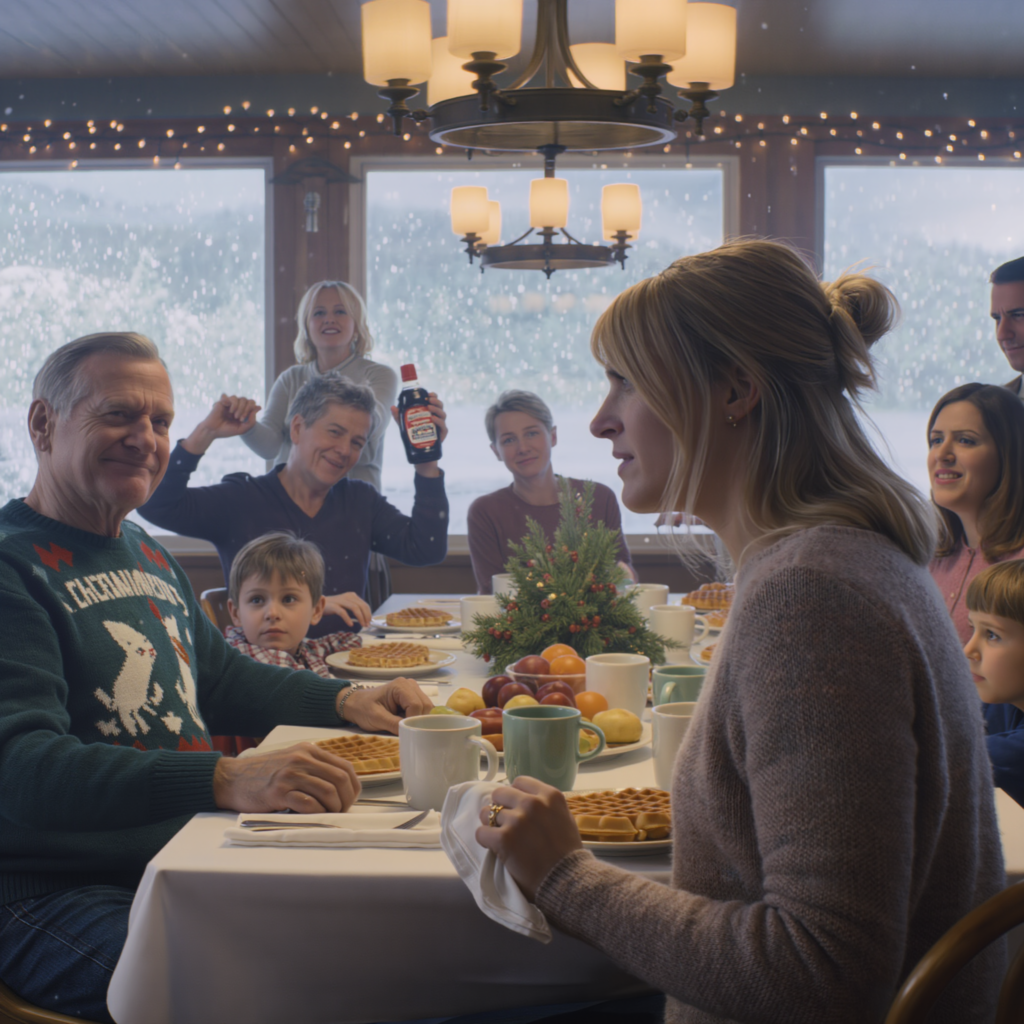
My aunt’s hand stalled over the syrup bottle. My cousin’s husband stopped mid-bite, fork suspended. Even the waitress, who had been refilling someone’s coffee, hesitated like she had just stepped into a family minefield.
His words hit me before my brain could process them. They slammed into years of smaller cuts: comments about how I made things harder, heavy jokes about how I never quite fit, remarks about my kids being a handful. This time, he didn’t bother with wrapping paper. He said it cleanly, openly, deliberately.
Why did you come?
My throat tightened around nothing. I blinked once, twice, willing my eyes not to fill. Heat climbed the back of my neck, that familiar flush of being singled out and sliced open in front of an audience.
I opened my mouth, hoping to say something measured, something that wouldn’t pour gasoline across the table, but no words came. My mother stared down at her napkin, suddenly fascinated by the pattern on the silverware. My brother cleared his throat, then took a sip of water instead of speaking. No one stepped in. No one ever did.
The only people who reacted were the smallest ones.
My son straightened in his chair, his back going rigid the way it did when he felt danger without understanding its shape. His eyes flicked between my face and his grandfather’s, confusion sharpening into something like alarm.
‘Mom,’ he whispered, barely audible over the clink of plates, ‘why is he mad?’
I swallowed hard. ‘He’s not mad,’ I lied, my voice low and tight, even as every inch of me shook.
My dad scoffed, one short, mocking sound that might as well have been a spotlight. That sound cracked something I didn’t know was still fragile.
My son leaned closer, his voice thinner this time. ‘Should we leave?’
His question sliced through the air more cleanly than my father’s insult. It wasn’t just about embarrassment. It was about safety. My son wasn’t asking if we should be polite. He was asking if we should protect ourselves.
That was the sentence that finally reached the part of me I had buried under years of shrugging things off: my child should not have to ask whether we needed to escape his own grandfather.
I looked at my boy, then at my daughter, who was twisting her napkin so tight it threatened to tear. In that instant, all the excuses I’d made crumbled. The years of shrinking myself to keep the peace, of telling myself it wasn’t that bad, of choosing silence so the room could stay comfortable for everyone but me and my kids—they all fell away.
Something inside me, something I had almost let die, stood up straight.
I didn’t answer my son right away. My heart was pounding so loudly I was sure the people at the next table could hear it over Sinatra and clinking glasses. The brunch chatter around us tried to restart, people pretending not to stare while very clearly listening.
My father had already returned to cutting his food, like nothing meaningful had happened, like he hadn’t just carved me out of the morning like fat from a roast. That, somehow, hurt more than the words themselves.
My son’s hand slipped into mine again, smaller but stronger this time.
‘Please,’ he murmured.
That single word wasn’t about saving face. It was about saving us.
I drew in a breath that trembled in my chest. The air smelled like syrup and bacon and burnt butter, but underneath it, I could taste the same disappointment I had been swallowing since I was a little girl. I was tired. Bone-deep tired.
I pushed my chair back. The legs scraped loudly against the tile, the sound slicing clean through the restaurant noise.
Heads turned. My daughter looked up, spoon frozen halfway between her plate and her mouth.
‘Yes,’ I said finally, my voice steady in a way that surprised even me. ‘Right now.’
That was the moment my life split into a before and an after.
My dad didn’t look up. That, I realized, was his last move: pretending I was not worth reacting to. If he yelled, it would mean I mattered enough to provoke him. If he stayed silent, he could pretend I was the problem walking away.
I stood and helped my daughter into her coat, looping her scarf gently so she wouldn’t feel rushed or ashamed. My son tugged on his gloves, his jaw clenched in a seriousness no ten-year-old should have to wear.
I could feel eyes on us, some pitying, some curious, a few relieved that it wasn’t their family cracking open like this. My mom lifted her hand halfway, fingers stretching like she might touch my sleeve, then curled them back to her lap.
A lifetime of standing beside my dad instead of between us kept her rooted in that chair. She would not step toward me if it meant even an inch of distance from him. She never had.
I did not wait for anyone to find words that should have been spoken years ago.
We walked out together, the three of us, past the crooked flag on the wall and the jar with its tiny paper flag toothpick standing at attention in the centerpiece. The door swung shut behind us with a soft thud that echoed louder inside my chest than any slammed door.
Outside, the cold wrapped around us, sharp and honest. The air smelled like exhaust and snow instead of coffee and pretense. My son slipped his hand into mine again.
‘Good job, Mom,’ he said quietly.
I hadn’t earned that praise yet. But I would.
An hour later, my dad would regret every word he’d said.
An hour later, he realized he was no longer the only one writing the story.
It didn’t happen with shouting, or plates shattering, or some dramatic scene out of a soap opera. It started with something much quieter, the kind of shift no one in that room could pretend not to see.
The kids and I went back to my apartment, a small place on the third floor of a brick building overlooking a Denver street where snow always seemed to pile up in the corners like dirty cotton. I hung our coats by the door and set their gloves on the heater to dry, watching the melted snow bead and vanish.
I made hot chocolate the way they liked it: too much whipped cream, a sprinkle of cinnamon, mini marshmallows bobbing like tiny icebergs. I handed them their mugs and tucked a blanket around their legs as they curled up on the couch. The TV played some holiday movie in the background, but no one was really watching.
I thought that was it. Another wound I would learn to live with. Another story my kids would tuck away in their bones, one more example of how we endured people who were supposed to love us.
Then my phone buzzed.
It was my mom. Not a call. She wouldn’t risk my dad hearing her voice soften. Just a text.
Something happened. I think you should know.
Before I could type a response, another notification appeared. Then another. My aunt. My cousin. My brother’s wife. The messages came in like a string of tiny alarm bells.
He messed up.
He went too far this time.
You were right to leave.
I stared at the screen, my heart thudding. My kids looked over, sensing the shift.
‘Is it Grandpa?’ my son asked.
‘Not yet,’ I said.
Little by little, the story unfolded through their words.
When we walked out, my dad tried to spin the moment into something else, the way he always did. He told the table I was dramatic, that I couldn’t take a joke, that I had made a perfectly nice brunch uncomfortable. He expected the same nodding heads, the same murmured agreement.
But something was different this time.
People had seen everything. They had watched his smirk, heard his words, noticed how my son’s voice shook when he asked if we could leave. For the first time, the gap between his version of events and reality was too wide to step over.
My aunt, who usually avoided conflict so hard she might as well have been allergic to it, spoke up. She told him she was embarrassed for him. Embarrassed that his grandchildren had watched him dismiss their mother in front of a room full of strangers.
My cousin’s husband, a man of few words, quietly added that what my dad had done wasn’t just being cranky. It was cruel.
And then, according to my cousin, the waitress stepped in.
The same young woman who’d hesitated with the coffee pot when my dad made his comment apparently walked over and, in a calm voice, said she couldn’t imagine talking to her own daughter that way. She said she hoped we were okay.
I pictured my father sitting there, surrounded by plates of half-eaten food and people who were no longer willing to clap for his performance. For the first time in a long time, he had no script he could rely on.
But the real turning point wasn’t the confrontation. It was what happened when the manager walked over.
My phone buzzed again. Another message, this time from my brother.
You’re not going to believe this part.
The restaurant manager came to the table holding a black leather bill folder. Holiday brunch for a party that big wasn’t cheap. The total, according to my brother’s text, was 342.75 dollars.
My dad had arranged beforehand to cover the meal. He liked doing that, not just out of generosity but because he liked the way people looked at him when the server said, ‘It’s all taken care of.’
Only this time, it wasn’t.
His card declined.
He tried another. Declined again.
The manager, keeping her voice low but firm, explained that the card had been declined twice and asked if there was another form of payment. The table went quiet. Every person sitting there, every one of the people he’d tried so hard to impress, watched his face as the illusion cracked.
My mom, flustered, reached for her wallet with trembling hands. She ended up putting her own card down to cover the bill. My brother wrote that he’d never seen my father’s face that color before, not from anger, but from something closer to exposure.
In one hour, in that same restaurant with the crooked flag and the Sinatra soundtrack, the man who had humiliated me in front of my children and a roomful of strangers lost the two things he valued most: control and appearance.
For the first time, the room didn’t adjust to make him comfortable.
The declined charge was the first time my father heard no from something he couldn’t bully.
My phone buzzed again. This time, the name on the screen made my stomach flip.
Dad.
The preview showed just two words.
Come back.
Not an apology. Not a question. A command. Reflexive, instinctive, in the exact tone he had used my whole life.
I stared at the screen until the letters blurred. My kids watched me, waiting, sensing that this moment mattered.
My thumb hovered over the message for a second, then I hit the call button. If he wanted to talk, he could hear my voice, not just type at me.
He picked up on the first ring.
‘Audrey, this is ridiculous,’ he said immediately, skipping any greeting. ‘People are making a big deal out of nothing. Just come back.’
There it was again. Just come back. As if I were a misplaced napkin he needed put back in the right spot.
‘No,’ I said.
Silence. Not the heavy, guilt-trip kind he used to end arguments, but a stunned quiet, like I had suddenly started speaking another language.
‘No?’ he repeated.
I pictured him in that restaurant, sitting at the head of the table that no longer quite felt like his. I imagined his fingers tightening around his phone, his jaw clenching, his eyes darting around to see who was listening.
‘I’m not coming back,’ I said. ‘You embarrassed me in front of my children. In front of a room full of people. And it’s not the first time. I’m done pretending it’s normal.’
He inhaled sharply.
‘You’re twisting this,’ he snapped. ‘You’re making it sound worse than it was. It was a joke. Everybody knows you overreact.’
‘No,’ I said again, and the word felt cleaner this time. ‘I’m not twisting anything. For once, I’m telling the truth without cushioning it to protect your ego.’
There was another pause. Longer.
I kept going before I could talk myself out of it.
‘My kids deserve better,’ I said. ‘And so do I. We are not coming back into a room where you treat us like we’re in the way. Not today. Not next week. Not next Christmas.’
‘You’re ruining this family,’ he shot back.
I let out a breath that felt like it had been stuck inside my ribs since I was a teenager.
‘This family has been cracked for a long time,’ I said quietly. ‘It’s just that no one ever held you accountable for the way you talk to people. Today wasn’t about me showing up. It was about you showing who you really are when you think no one will call you on it.’
He didn’t respond. Maybe because there was nothing left in his usual playbook that fit. Maybe because, for the first time, I didn’t back down or explain myself into a smaller shape.
Maybe, for the first time, he realized his words had actually cost him something he couldn’t immediately buy back.
I ended the call before he could regain his footing.
Behind me, my son sat cross-legged on the couch, his mug of hot chocolate cradled in his hands.
‘Was that Grandpa?’ he asked.
‘Yeah,’ I said, sitting beside him.
‘Are we going back?’
‘No,’ I said. ‘We’re not.’
He studied my face for a second, searching for the wobble that usually lived in my answers about my family. When he didn’t find it, his shoulders relaxed.
‘Good,’ he whispered. ‘Because he made you sad.’
Kids don’t need a dissertation. They need clarity.
Leaving that brunch wasn’t weakness. It was the first real boundary I had ever set with my father.
That night, as Denver’s lights flickered against the snow outside our windows, I felt something shift inside me. It wasn’t a fireworks kind of change. More like the quiet creak of a door that had been stuck for years finally opening an inch.
Before bed, I tucked my kids in and sat on the edge of my son’s mattress, smoothing his hair back from his forehead.
‘Hey,’ I said softly. ‘I want you to remember something.’
His eyes were already heavy with sleep, but he nodded.
‘Love shouldn’t make you feel small,’ I said. ‘Not from family. Not from anyone. If it does, you’re allowed to step away. Even if people tell you you’re wrong for it.’
He nodded again, the words soaking in deeper than he could show yet.
In the kitchen, as I rinsed out mugs, my phone buzzed a few more times. My mom checking in. My aunt apologizing for not speaking up sooner. A cousin sending a single heart emoji and nothing else.
Nothing from my dad.
Strangely, that silence felt less like punishment and more like confirmation. The line had been drawn. I was not the one who crossed it.
The next morning, the city was wrapped in that particular kind of winter calm where everything feels softer around the edges. I made pancakes while the kids argued playfully about who got the bigger one. Their laughter filled the apartment in a way our house had never felt after family gatherings. There was no tightness in my chest, no rehearsed explanation forming in my throat about why someone had treated me poorly.
After breakfast, I dug around in my purse for some lip balm and my fingers brushed something small and stiff. I pulled it out.
The tiny paper flag toothpick.
Somewhere between cutting waffles and gathering coats, my daughter had plucked it from the restaurant centerpiece and slipped it into my bag.
I turned it between my fingers, the little stars and stripes slightly bent. It was such a small thing, but it felt like a reminder: I didn’t need anyone else at that table to stamp my life as valid, worthy, American enough, good enough. I could define my own little patch of ground.
‘Can I have it?’ my daughter asked, appearing at my elbow.
‘Sure,’ I said, handing it to her.
She stuck it carefully into the top of her leftover pancake on the plate.
‘Now it’s mine,’ she said simply.
Later that afternoon, we walked to the park down the street. The path was icy, but the kids moved with the kind of confidence that comes from knowing who you’re walking beside matters more than where you’re going. They kicked snow into the air, took turns sliding down a small hill, their shouts bright against the pale sky.
I watched them and realized that leaving that brunch table hadn’t broken my family. It had stopped them from breaking me in front of my children.
Walking away hadn’t destroyed anything worth keeping. It had just ended the habit of sacrificing myself to keep the picture looking whole.
That night, after the kids were asleep, I sat by the window with a mug of tea in one of my own chipped cups. No restaurant logo, no crooked flag on the wall, no audience. Just the quiet, the glow of a streetlamp on the snow, and the hum of the heater.
If this story feels familiar, if you’ve ever sat at a table where the cost of keeping the peace was your own self-respect, I want you to hear this part clearly.
You are allowed to leave.
You are allowed to choose the small, warm safety of a tiny apartment over the cold performance of a big family gathering. You are allowed to draw a line, even if people on the other side act shocked that it’s finally there.
If you want more stories like this, real stories about standing up, speaking out, and reclaiming your place at your own table, support us on Flex Revenge by subscribing. You’ll get notified the moment a new story goes live.
And if you’ve lived something like this yourself, tell it. Share it. Type it out in the comments, whisper it to a friend, record it into your phone while you’re sitting in your car in a grocery store parking lot. Your story matters, even if the people at the old table pretended it didn’t.
Because sometimes, the bravest thing you can do in a room full of people is push your chair back, stand up, and walk toward the door with the people who are watching you closely, learning from every step.
Sometimes, love looks a lot less like staying and more like finally leaving.
I wish I could tell you that was the neat, simple end of it. Door closes, credits roll, new life unlocked. But if you’ve ever pulled away from someone who’s been in charge of the narrative for decades, you know it never ends with one walkout and a mug of tea.
The first week after brunch, my phone turned into a scoreboard.
Five missed calls from my dad.
Nineteen text messages from various relatives.
Seven long voicemails from my mom, all starting with, “I don’t want to be in the middle, but…”
The number that stuck in my head the most wasn’t any of those, though. It was a number I hadn’t thought about in years: 7,000.
Seven thousand dollars.
That was the amount my dad had written on a check ten years earlier when I was newly divorced and clinging to the edge of a life I didn’t recognize. It was the money that kept me from losing the first apartment I rented after leaving my ex, the one with the peeling linoleum and the view of the back alley. The one place that was mine.
He’d handed me that check at his kitchen table, sliding it across the wood like a contract.
“There,” he’d said. “Now you can stop making a mess of things.”
I had thanked him, genuinely. My hands shook as I folded the check and tucked it into my purse. I promised myself I’d pay him back.
“Don’t worry about it,” he’d replied. “Just remember who helped you when nobody else would.”
That was the part that had really been written in ink.
For ten years, he had treated that 7,000 dollars like a permanent stamp on my forehead. Any time I pushed back, any time I disagreed, any time I dared to have a boundary, he reminded me.
“Funny way to talk to the man who kept you off the street, Audrey.”
“You’d be out on your ear without that check, you know that, right?”
“You’re welcome for the roof over your head.”
Money, with him, had never been just money. It was leverage. It was spotlight. It was a scoreboard only he got to read out loud.
So when my brother texted me about the 342.75 dollar brunch bill he couldn’t cover, that 7,000 popped into my mind like a ghost.
For years, my father’s power came from being the one person who stepped in when things were about to fall apart. The one who swiped his card, wrote the check, picked up the tab. It gave him the right, in his mind, to say whatever he wanted. Criticism was part of the package. Humiliation was the fine print.
The day his card declined in front of everyone, a crack ran right through that power.
He couldn’t buy the room anymore.
The first voicemail from him arrived the next afternoon.
“Audrey. It’s your father.” As if that were a title, not a relationship. “This has gone on long enough. I’m not going to apologize for a joke that got blown out of proportion. But I don’t want this… situation… to drag on. Call me back.”
I played it on speaker as I sorted laundry, my son sitting at the kitchen table working on math homework, my daughter drawing little flags on a piece of notebook paper. I watched their faces carefully.
They both went still when they heard his voice.
“Are you going to?” my son asked.
“Not right now,” I said.
My daughter tapped her marker against the table. “He sounds mad,” she said.
“He’s not mad,” I answered slowly. “He’s… not used to not getting his way.”
Another hinge in my mind clicked.
For most of my life, my dad’s anger had felt like a weather system—something I just had to live around. That week, for the first time, I started seeing it for what it was: a reaction to losing control.
The second voicemail came the day after.
“This is ridiculous, Audrey. Your aunt is making comments, your cousin’s husband is giving me looks like I’m some kind of monster. You know I’ve done a lot for this family. I won’t be painted as some villain because you can’t take a joke. Call me back so we can straighten this out.”
There it was. The word he was really fighting: villain.
My son slid another folded worksheet toward me.
“Mom?” he said. “Why does he keep saying it was a joke?”
I sat down across from him, the math problems blurring in my vision for a second.
“Some grown-ups don’t like to admit when they’re wrong,” I said carefully. “So they say things were ‘just a joke’ to make the person they hurt feel like they’re overreacting.”
He frowned. “But if everyone saw it and no one laughed, then it wasn’t a good joke.”
I almost laughed, because there it was, in kid logic: the truth.
“You’re right,” I said. “It wasn’t.”
He thought for a second. “If I said something that made someone cry, and I said it was a joke, would that make it okay?”
“No,” I said. “It wouldn’t.”
“So why is it different for him?”
It was a fair question. One I’d been dodging my whole life with complicated explanations about generation gaps and different communication styles.
This time, I didn’t dodge.
“It’s not different,” I said. “And that’s why we left.”
Every answer I gave my kids that week rewrote something in me.
On Thursday, my mom finally called in real time instead of leaving a voicemail. I stared at her name on the screen for a full minute before picking up.
“Hi, Mom.”
Her sigh came through the line like static.
“Oh, Audrey. Finally.”
There was no “How are the kids.” No “I’m sorry about what happened.” Just that one, exasperated word.
“Have you talked to your father?” she asked.
“Yes,” I said. “Once.”
“And?”
“And I told him we’re not coming back to things until he can speak to me with basic respect.”
She went quiet, and for a moment I thought the call had dropped.
“Audrey…” she started, then trailed off.
I waited. I had spent my life filling silences for other people. I was done doing that.
“I know he shouldn’t have said what he said,” she finally whispered. “But you know how he is. He was under a lot of pressure. The bill, the holiday, all the eyes on him. You walking out like that… it made him look bad.”
There it was.
The hierarchy.
His image hurt more than my actual feelings.
“Mom,” I said softly, “he made me feel small in front of my children. He’s done that my whole life. I’m not doing it anymore.”
“You’re being dramatic.”
I closed my eyes, letting the word pass through me without latching on.
“I’m being clear,” I said. “There’s a difference.”
She exhaled, a shaky sound.
“He’s talking about changing his will,” she said quietly, like that might be the spell to snap me back in line. “He said if you’re going to act like this, maybe he should rethink who gets what. I’m just trying to warn you.”
There it was again: the numbers.
The 7,000 from the past. The unspecified sum of some future inheritance. The financial leash he’d always assumed would keep me in orbit.
I looked around my small apartment as she talked, taking in the chipped countertop, the thrift-store dishes stacked in the drying rack, the tiny paper flag toothpick now stuck in the soil of a plant on the windowsill. My life was not glamorous. It was not luxurious. But every square foot of it was built on ground where I could breathe.
“Mom,” I said, and my voice surprised both of us with how steady it was. “I don’t want anything from him.”
She went silent again.
“You don’t mean that,” she said finally.
“I do,” I replied. “I’m not going to trade my self-respect for a line in his will. I’ve spent enough years paying interest on that 7,000 dollar check. I’m paid up.”
“You’re throwing away your future,” she whispered.
“No,” I said. “I’m building a different one.”
When we hung up, my hands were shaking. Not from fear this time, but from something that felt a lot like release.
Later that night, after the kids went to bed, I pulled an old shoebox from the back of my closet. It was full of the kind of things you don’t think of as important until suddenly they are: school pictures with stiff smiles, a hospital bracelet from the night my son was born, a dried-out corsage from some long-ago dance.
At the bottom of the box was a folded piece of paper. The carbon copy of the deposit slip from when I’d put that 7,000 dollars into my bank account.
I unfolded it and stared at the faded numbers.
Seven thousand.
I did some quick mental math. In the ten years since that deposit, I had probably spent twice that amount on holiday flights, hotel rooms, and gas to show up for gatherings where I left feeling smaller every time. That was just the financial cost. The emotional cost? Uncountable.
I took a pen and, right above the old printed number, I wrote a new one in blue ink.
Zero dollars owed.
Zero apologies for leaving.
Zero tolerance for being humiliated in front of my children again.
The next day, I called a therapist I’d seen once, years ago, and made an appointment. It felt, in a small way, like adding another digit to a different kind of account.
“Tell me what brings you back,” she said when I sat on her couch the following week, a mug of herbal tea warming my hands.
I told her about the brunch. About the smirk. About my son’s question.
“Should we leave?” I repeated out loud, feeling the weight of it again.
She nodded slowly.
“What did that question mean to you?”
“It meant he could feel the danger,” I said. “Even if no one was yelling. Even if no plates were flying. He could feel that something about the way his grandfather talked to me wasn’t safe.”
“And what did your answer mean to you?” she asked.
“Yes,” I said. “Right now.”
I stared at a spot on the carpet, fighting tears.
“It meant,” I whispered, “that I chose them. For the first time, I chose them instead of him.”
We sat in the quiet for a moment.
“Sometimes,” she said gently, “the most powerful thing a parent can do is break a pattern instead of passing it on.”
I thought about my father’s father, a man I had only met twice, both times when he was already frail and mostly silent. The stories about him were not kind. They were full of slammed doors and long nights and a bottle that was always half-empty and always in reach.
My dad never drank the way his father did. He was proud of that. But he had found another way to stay intoxicated: power, control, the rush of being the one everyone else adjusted around.
What I had done at that brunch, small as it might have looked from the outside, was refuse to take my place in the line of people adjusting.
Breaking a pattern doesn’t always look dramatic. Sometimes it looks like standing up from a table when your legs are shaking.
A few days later, a letter arrived in the mail.
Not an envelope. A certified mail slip, the kind that makes your stomach dip even when you haven’t done anything wrong. I signed for it while the kids were building a fort out of couch cushions.
Inside was a single sheet of paper on my father’s accountant’s letterhead.
It stated, in formal language, that I was being removed as a beneficiary from certain accounts and assets. The phrase “per client’s request” was underlined.
At the bottom was a handwritten note in my father’s tight, slanted script.
“If you don’t want to be part of this family,” it read, “that includes the benefits.”
There was a time, not long ago, when that letter would have gutted me. Not just because of the money, but because of the message underneath: you are being erased. Again.
This time, something else happened.
I laughed.
Not because it was funny. It wasn’t. But because the move was so on-brand, so exactly what I would have predicted if someone had asked, “What will he do when he realizes he can’t shame you back into line?”
He’d go for the numbers.
I folded the letter and slid it into the shoebox with the old deposit slip, right next to the zero I’d written.
Then I pulled out my phone and texted my therapist a single sentence.
“Got the financial punishment in writing today. Still okay.”
She wrote back: “That’s big. Let’s talk about it next session.”
That night, my son padded into the kitchen as I was making grilled cheese for dinner.
“Mom?” he said.
“Yeah, bud?”
“Are we going to see Grandpa on Christmas?”
The question landed gently, but it still landed.
I set the spatula down and turned to face him.
“No,” I said. “Not this year.”
His shoulders tense-then-release motion was almost imperceptible, but I saw it.
“Okay,” he said.
“Is that… disappointing?” I asked.
He thought for a moment.
“A little,” he admitted. “Because you know… presents. And Grandma makes the good cookies.”
I smiled. “She does.”
“But also…” He chewed on his bottom lip. “Also I don’t like it when he makes you sad. Or when you pretend you’re not sad and I can tell you are anyway.”
I walked around the counter and pulled him into a hug.
“How do you feel about us making our own Christmas?” I asked into his hair.
He leaned back to look at me.
“Like here? Just us?”
“Maybe some friends. Maybe a movie. Maybe pancakes for dinner.”
He grinned. “With the little flag?”
I glanced toward the windowsill, where the paper flag toothpick now stood in the plant, a tiny, bent symbol of the day everything shifted.
“Yeah,” I said. “With the little flag.”
Word got around the extended family, of course. People called. People texted. My aunt invited us to a “small, no-drama Christmas Eve” at her house, clarifying three times that my parents wouldn’t be there.
“We’d love to have you,” she said. “But I understand if you need space.”
She paused. “For what it’s worth,” she added quietly, “I should have spoken up a long time ago. I’m sorry it took the whole restaurant watching for me to finally say something.”
The old me would have rushed to make her feel better, to say it was fine, that I understood, that it wasn’t her fault.
The new version of me took a breath.
“Thank you for saying that,” I replied. “It means a lot.”
We did go to her house on Christmas Eve. It was… normal. Small. There were board games and mismatched ornaments and kids running around in socks. My dad’s empty chair in my aunt’s living room felt less like a missing piece and more like extra space to breathe.
At one point, as my son was explaining the rules of a card game to my cousin’s little girl, my aunt sat down beside me.
“He looks happy,” she said, nodding toward him.
“He is,” I said. “I think we all are. It’s… different, but it’s good.”
She hesitated.
“He’ll come around, you know,” she said softly. “Your dad. He won’t say it out loud, but he knows he crossed a line.”
“Maybe,” I said. “But I’m not waiting around for that to happen to decide how we live.”
She nodded slowly.
“That’s fair.”
On New Year’s Eve, as fireworks popped faintly in the distance, I sat with my kids on the couch watching a movie. My daughter had the paper flag stuck into a lump of modeling clay on the coffee table now, like a tiny, lopsided monument.
“Can we make a rule?” my son asked suddenly, during a quiet part of the film.
“Sure,” I said. “What kind of rule?”
“A family rule,” he replied. “Like a real one. Like we always do this.”
“Okay,” I said. “What do you want it to be?”
He looked at me with a seriousness that made him look briefly older than his ten years.
“If someone talks mean to us over and over,” he said, “we don’t have to keep hanging out with them just because they’re family.”
I felt my throat tighten.
“That’s a good rule,” I said. “I like that rule.”
My daughter chimed in.
“And also,” she added, “if someone makes Mom cry, they don’t get to eat our pancakes.”
We all laughed, the sound spilling out into the room like warm light.
“Deal,” I said. “Pancakes are a privilege.”
Sometimes, the laws of a new life are written in therapy offices and serious conversations. Sometimes, they’re written in living rooms over cartoons and maple syrup.
Months later, when Denver’s snow finally melted into slush and then into clear sidewalks, I ran into my parents at the grocery store.
It was a Saturday morning. The kids were at a friend’s house. I was alone, pushing a cart with a wobbly wheel past a display of red, white, and blue paper plates and plastic cups for Memorial Day.
I saw my mother first, standing in front of the produce section, choosing apples one by one. My father was beside her, leaning on the cart handle, his posture as straight as it had been at the brunch table.
For a moment, I considered ducking into the cereal aisle and pretending I hadn’t seen them. Old habits are hard to break.
But then my mother’s eyes lifted and met mine.
She froze.
Then she smiled. A real one, surprisingly. Her eyes crinkled at the corners.
“Audrey,” she said.
My father turned.
His face changed in the space of a heartbeat: surprise, annoyance, something like discomfort, and then that familiar tightness settling in.
We stood there, three points of a triangle among piles of lettuce and oranges.
“Hi,” I said.
For a long moment, no one spoke.
My mother stepped forward.
“How are the kids?” she asked.
“They’re good,” I said. “They’re at a friend’s right now.”
“Good,” she repeated. “Good.”
My father cleared his throat.
“So,” he said.
Just that. So.
I waited.
“You’ve been busy, I hear,” he added. “Telling stories about me on the internet.”
There it was. Word travels, especially in families with cousins who follow revenge-story accounts and aunts who screenshot everything.
I took a breath.
“I told the truth about something that happened to me,” I said. “If you recognized yourself in it, that’s not my fault.”
His jaw tightened.
“You made me look like a monster,” he said.
“No,” I replied calmly. “You did that part yourself. I just stopped hiding it.”
My mother shifted her purse on her shoulder, eyes bouncing between us.
“Please,” she said under her breath. “Not here.”
I thought of all the times I had swallowed my words “not here,” “not now,” “let’s not make a scene.”
I thought of my son’s voice asking, “Should we leave?”
I thought of the declined card, the folded slip with 7,000 dollars on it, the little flag now sitting in my kitchen like a reminder.
“This is exactly where it happens,” I said quietly. “In public. In front of people. You just liked it better when I was the only one who left feeling small.”
My father looked at me for a long moment. His mouth opened, then closed.
Finally, he said, “You’re really not going to apologize, are you?”
Something in me almost laughed again at the upside-down logic.
“No,” I said. “I’m not.”
He shook his head and pushed the cart past me.
“Come on,” he said to my mom.
She hesitated. For the first time in my entire life, she hesitated.
“I’ll catch up,” she said.
He stared at her, thrown off. Then he turned and rolled the cart away, the wobbly wheel rattling against the linoleum.
My mother looked at me.
“I can’t change him,” she said quietly. “You know that.”
“I know,” I said. “I stopped trying.”
She nodded.
“I should have stood up for you,” she whispered. “At that brunch. Years before that.”
The apology I’d wanted from my father arrived from a different mouth.
“I can’t go back,” she said. “But I… I can do better now. If you’ll let me.”
I studied her face. The lines around her eyes. The way her shoulders sloped, like she’d been carrying invisible weight for decades.
“Doing better,” I said slowly, “means not asking me to put myself back in front of him to keep the peace.”
She nodded.
“I won’t,” she said. “I promise.”
It wasn’t a full repair. It wasn’t a movie-scene reconciliation. But it was a crack in a different wall.
As we parted ways in the aisle, my cart rolled past the Memorial Day display again. I glanced down.
On the shelf, among the plastic cups printed with flags, was a pack of toothpick flags.
I picked one up and put it in my cart.
A tiny thing. Cheap. Easy to miss.
Later, at home, my daughter stuck one more flag into the top of a stack of pancakes we made just because it was Saturday and because we could.
“Now it’s like our restaurant,” she said proudly.
Our restaurant.
Our table.
Our rules.
If this story feels familiar—if you’ve ever had to choose your own peace over someone else’s approval—know this: you are not alone, and you are not ungrateful, and you are not dramatic for wanting basic respect.
You are building a different kind of inheritance.
Not one written on an accountant’s letterhead, but one that lives in the way your kids’ shoulders relax at the breakfast table. In the house rules that say, out loud, that love doesn’t get to come bundled with humiliation.
If you want more stories like this—real stories about standing up, speaking out, and reclaiming your place at your own table—support us on Flex Revenge by subscribing. You’ll get notified the moment a new story goes live.
And if you’ve lived something like this yourself, tell it. Share it. Type it out below, or whisper it to your reflection in the bathroom mirror, or record it into a voice memo on your phone while you sit in a grocery store parking lot, staring at a display of plastic flags.
Because sometimes the bravest thing you can do in a room full of people is not to stay and prove how much you can endure.
Sometimes, the bravest thing is to push your chair back, pick up your kids’ coats, and walk toward the door.
And sometimes, love looks a lot less like staying—and exactly like finally leaving.
News
On my birthday, my parents hosted a dinner with 100 relatives just to disown me. my dad handed me a bill, said: “every cent we wasted raising you. pay or never contact us again”. my sister grabbed my car keys from the table: “dad already transferred the title to me.” i walked out without a word — four days later, they’re calling me…50 times a day
On my birthday, my parents didn’t bring out a cake. They brought out witnesses. Nearly a hundred relatives sat shoulder…
At My Mom’s Birthday, My Brother’s Son Threw My Son’s Drawing Into The Fire And Yelled, “Nobody Wants His Crappy Art Anyway.” Everyone Laughed. That Night, My Dad Texted, “You’re Making Things Uncomfortable — Just Skip Christmas.” I Replied, “So Does The Funding.” By 1 A.M., My Phone Was Melting. 27 Missed Calls.
By the time the clock on my stove blinked 1:00 a.m., my phone looked like it was about to catch…
My whole childhood I was treated like a maid. On Christmas Eve, my mother coldly said: “Your sister’s 25 friends are coming, you cook – clean – serve them properly,” I just said “Okay” then got on a plane straight to the beach; when my family came home and stepped into the kitchen, they SCREAMED, but what made them tremble the most came after that.
My parents treated me like hired help. The irony hit me every time I saw the little chipped American flag…
“You’re not family, don’t show your face here,” the whole table burst out laughing, I picked up the entire lasagna and left – 4 days later, their loan was rejected by the bank, that night, my phone lit up
My name is Jean William. I’m thirty years old, and the night I realized my family didn’t love me the…

I was serving champagne at a gallery when i saw it. a painting i made when i was 6. price tag: $150,000. ‘sir, that painting is mine,’ i said. ‘impossible,’ the gallery owner laughed. he called security to kick me out. but he forgot to check the secret message on the back of the canvas.
I was balancing a silver tray of champagne flutes when I saw it. Not the painting, not yet. First I…
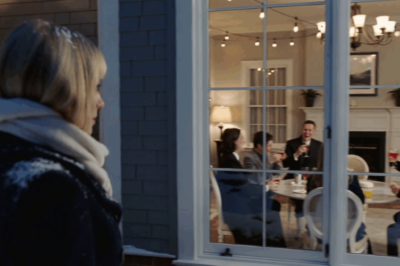
“Mom texted: ‘Ice storm, Christmas is canceled, everyone stay home to be safe’ — the next morning the whole family called saying ‘we miss you so much’, I opened Instagram and saw all of them raising their glasses at my sister’s house… and that night I decided to do something that would make their fifteen years of pretending unable to go back to how they were.”
I believed my mother’s text the way I had believed a thousand small mercies before it. “Everyone’s staying home due…
End of content
No more pages to load