
By the time the sun crested the ridge, my stainless-steel coffee mug was still warm in my hand.
I stood on a narrow overlook just outside Denver, my boots planted in red dust, watching the city wake up below. A pickup with a faded American flag decal was parked crooked at the trailhead, tiny as a toy from up here. The air tasted like pine and cold metal, the kind of clean quiet you only get when you’re above the noise. My phone was on airplane mode in my pocket. No email. No Slack. No family group chat buzzing because someone “had a tiny favor.”
I lifted the mug, took a sip, and let the heat burn the tip of my tongue just to prove I could still feel something.
It had been three months since my sister Madison laughed into a wedding microphone at the deed to a fully paid four-hundred-twenty-thousand-dollar condo and called it “off-brand.”
That was the day I stopped being the family bank.
If you’re listening to this on your drive down I‑25 or walking your dog past a row of little houses with flag magnets on the mailboxes, picture me on that overlook. I’m Eve. I’m thirty-seven. And before I was the villain of my family group chat, I was exactly what they needed me to be: the responsible one.
I’m an M&A attorney. My office sits on the fiftieth floor of a glass tower where the air conditioning is always too cold and the coffee in the break room is always already lukewarm by the time I get to it. I live in billable hours and redlines. I know what it means to keep a company alive by rewriting two words and moving a comma.
Madison, my little sister, is twenty-nine. If you scroll through social long enough, you’ll probably find her. She’s the one in the linen matching set, holding an oat-milk latte with latte art shaped like a leaf, talking about boundaries and nourishment into a camera on a tripod. “Wellness,” “authenticity,” “living your truth.” That’s her product line.
My parents call her sensitive. Creative. They say it like a medical condition that exempts her from the rules everyone else has to follow.
They call me strong.
They said it at every barbecue, every Thanksgiving under that lopsided plastic turkey centerpiece, every time my dad carved a dry turkey while Sinatra played too loud from the Bluetooth speaker on the counter.
“Eve’s just so responsible,” my mother Jessica would say, patting my hand. “She always lands on her feet. She’s our rock.”
“And you, Maddie,” she’d coo, turning to my sister, “you’re our creative. So sensitive. The world is just too harsh for you sometimes.”
It sounds harmless, doesn’t it? A compliment and a compliment.
It wasn’t. It was a sentence.
My responsibility became a life sentence of quiet obligation. Madison’s creativity became a lifetime hall pass.
Here’s the evidence. I keep receipts. It’s what I do.
Exhibit A: The luxury high-rise apartment Madison lived in long before she married Joshua. Two bedrooms, floor-to-ceiling windows, a rooftop pool she could film on at golden hour. Three thousand five hundred dollars a month in rent. The day the lease was signed, Mom called me.
“Just for a year,” she said. “Until her brand really takes off. She needs a beautiful space, honey. You can afford it. You’re the strong one.”
I opened my banking app between conference calls, set up a recurring transfer, labeled it TEMP SUPPORT in all caps, as if yelling at myself in the memo line could make it temporary.
It ran every month for three years.
Every time I hit send on a wire for a client, I hit send on Madison’s rent.
Exhibit B: The Tesla Model X she drove to the wedding.
She’d called me crying from a strip-mall parking lot.
“I can’t keep building a sustainability brand while driving a four-year-old gas guzzler, Eve,” she sobbed. “It’s literally destroying my credibility. People notice these things. Do you know how many DMs I get about it?”
“You have a perfectly functional car,” I said, my eyes on a draft merger agreement. “You don’t need—”
“This is my job,” she cut in. “This is my business. You have no idea what it takes to build a platform. I thought you supported me. I thought you believed in me.”
That was always the checkmate. Not “help me,” but “prove you love me.”
So I moved another comma in another contract, made another phone call, and signed for the down payment on a Tesla. The loan went in my name. The insurance in my name. Madison got the key fob and a new set of Instagram stories about “aligning your life with your values.”
Exhibit C: The miscellaneous.
Five-thousand-dollar “business coaching” weekends in Scottsdale.
Three-thousand-dollar wellness retreats in Costa Rica she “had to do” to gather content.
Professional photo shoots. Branded merch. A ring light that cost more than my first car.
Whenever my stomach tightened at the numbers, my mother’s voice followed, syrupy and weaponized.
“You’re so lucky, Eve. Not everyone has a career like yours. It’s just money. Family is forever.”
My generosity wasn’t love. It was the price of admission to my own family.
And then came the wedding.
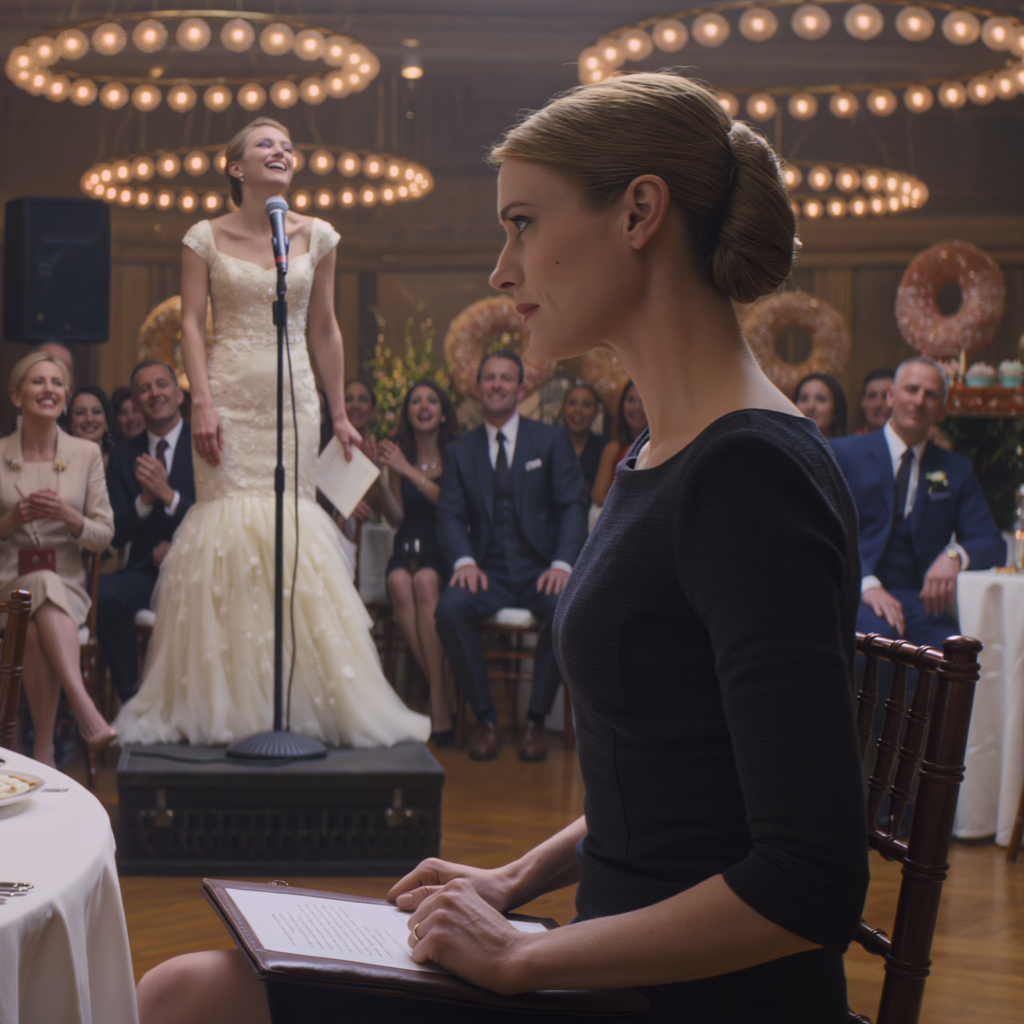
Madison’s big day was held at a country club just outside town, the kind with a perfectly manicured lawn and a row of American flags fluttering politely by the circular drive. White chairs. White roses. A donut wall because, of course, it was “whimsical.”
I was exhausted before I even put on my dress. The week before, I’d closed a deal that had me in the office until 2:00 a.m. three nights in a row. My coffee mug lived on my desk, the dregs cold and oily by the time I remembered to drink them.
But the condo had been the one project that didn’t feel like work.
It was a two-bedroom unit in a solid, quiet building near a major hospital and a decent grocery store, in a neighborhood Zillow probably would not describe as “aspirational.” It wasn’t the glittering downtown tower Madison had pinned on her vision board, but it had sturdy bones, a new roof, and an HOA that actually fixed things.
I’d run the numbers like it was any other acquisition. Property taxes. Resale potential. Crime stats. Walkability. I’d toured the unit twice, pressed my palm against the cool glass of the balcony door, imagined Madison filming some earnest sunrise meditation out there.
It was stable. It was safe. It was paid for.
Four hundred twenty thousand dollars wired out of my tired fingers into a brick-and-mortar something she could never lose to an algorithm.
My promise to myself was simple: this would be the last big rescue. The last giant check written out of guilt. After this, I’d draw a line.
That was the wager I made with myself walking into the ballroom.
The reception was beautiful in the way Pinterest boards are beautiful: curated, impersonal, a beige dream. Mason jars with fairy lights. Gold-rimmed plates. A Sinatra playlist crooning softly between toasts.
I sat at the family table, the leather folio with the deed tucked under my chair like contraband.
When the DJ called my name for speeches, I wiped my palms on my dress, took a breath, and walked up to the microphone. Madison and Joshua stood under an arch of flowers, backlit and perfect.
“I’m Eve,” I said. “Madison’s older sister.” A few polite chuckles. “There are a lot of stories I could tell about growing up with this one, but I’ll spare you.”
I kept it short. A joke about her stealing my sweaters. A line about always knowing she’d do big, bold things. Then I picked up the folio.
“As my gift,” I said, feeling a tremor in my voice I hoped only I heard, “I wanted to give you both something…solid. A foundation.”
I opened the folio, slid the deed out, and handed it to her.
“It’s a condo,” I said. “Fully paid. In your names.”
For one shining second, the room seemed to hold its breath.
Madison’s eyes flicked down the page. Her mouth moved silently as she read the address, the unit number, the legal description. I could see the moment she realized what it was.
Then she laughed.
She tilted her head back and laughed into the microphone. Not a surprised giggle, not a tearful little gasp.
A full, ringing laugh.
“Eve,” she said, drawing my name out like taffy, “this is not the location I wanted.”
Laughter rippled through the crowd, eager and nervous.
“I’m not living in that cheap part of town,” she continued, still smiling, still performing. “It’s completely off-brand. Joshua and I have clients. People follow us. I can’t be filming content over, like, a parking lot.”
Someone actually clapped.
The microphone squealed. My hand, still half-raised from handing her the deed, felt suddenly heavy. I made myself smile. My M&A smile. The one I use in rooms where people are about to lose their jobs and don’t know it yet.
Inside, something iced over.
In that moment, the four hundred twenty thousand dollars I’d wired out of my account flickered in my mind like a neon sign spelling out one word: sucker.
The speeches blurred after that. The beef was dry, or maybe it wasn’t. I couldn’t taste it. I drank water I didn’t want just to have something to do with my hands. My coffee mug back at home would be ice cold on my counter by now, I thought absurdly.
Every so often, my mother’s hand would land on my arm, a reassuring pat for anyone watching.
When the music swelled and the DJ invited everyone to the dance floor, I decided to leave.
I wasn’t making a scene. I wasn’t going to yank the microphone away and scream. I just gathered my clutch and the leather folio, stood up, and started toward the exit.
I almost made it.
“Eve.”
Her voice knifed through the music.
I turned.
Madison stood by the donut wall, a ring of frosting on her wrist like a sticky bracelet. Her veil was slightly askew, giving her the look of a very glamorous, very annoyed child.
“What was that?” she hissed, stepping closer. “Were you trying to embarrass me? At my own wedding?”
“It was a gift,” I said. My voice sounded distant to my own ears. “A fully paid condo, Maddie. A house.”
“A gift,” she repeated, incredulous. “That neighborhood is a dump. It’s off-brand. Did you even think about my brand? My clients? Joshua’s clients? There isn’t even good natural light in those units. I checked the listings.”
My jaw tightened. “You checked the listings.”
“Of course I did,” she snapped. “You think I don’t vet where I would be living? I can’t believe you did this. You’re jealous. You have your boring office and your boring life, and you wanted to make my day about you.”
“Madison, dear, lower your voice.”
My mother appeared at her shoulder, all pearls and practiced smile, a champagne flute in one hand. She slid the other hand around my arm, nails digging in just enough to hurt.
“Eve, darling, don’t be so rigid,” she said, the sugary edge in her tone belying the pressure of her grip. “You know how Madison is. She’s a creative. She just means… well, you can just sell it and help them with a down payment on something nicer.”
It was reflex. The script we’d been running all my life.
You know how Madison is.
You’re the strong one.
You’ll fix it.
I tried to pull my arm back. “I’m not being rigid, Mom. I’m leaving.”
Her smile didn’t move, but her eyes hardened.
“You will not,” she hissed, her face inches from mine, her teeth barely parting. “We all have our roles. This is not the night to be dramatic. Your sister needs this for her business. Your father and I can’t help. You know we can’t. Don’t be selfish just because your feelings are hurt.”
There it was.
Don’t be selfish because your feelings are hurt.
The line that had smoothed every boundary I’d ever tried to draw. The justification for every check, every favor, every last-minute rescue.
I wasn’t a daughter. I was a role.
In mergers, you eventually learn to stop listening to the story a company tells you about itself and start reading the documents. The balance sheet never lies.
Standing there between the donut wall and the dance floor, my mother’s nails in my arm, my sister’s eyes blazing, I finally read the balance sheet of my own family.
The numbers did not add up.
“Roles,” I repeated, letting the word sit on my tongue, flat and bitter. “Got it.”
I turned to Madison.
“The keys to the Tesla. Now.”
She blinked. “What?”
“The keys,” I said. “The loan is in my name. The insurance in my name. The registration in my name. It’s my car. I’ll arrange for a flatbed on Monday. For tonight, I want the keys.”
“You’re being dramatic,” she snapped. “It’s my wedding.”
“Eve,” my mother said sharply. “You will not do this. You will not embarrass this family.”
I looked at her, really looked at her, not as my mother but as the senior partner in a very bad deal.
“I’m not the one embarrassing this family,” I said quietly. “You already took care of that.”
I lifted my hand and signaled to the valet through the glass doors.
Madison saw it. Something in her face cracked. This wasn’t a brand negotiation. This was a creditor calling in a note.
Her hands shook as she dug in her tiny beaded clutch. She slapped the key fob into my palm so hard it stung.
“You’re cruel,” she whispered. For the first time all night, the tears looked real. “You’re actually cruel.”
“No,” I said, closing my fingers around the warm plastic. “I’m just clear. And I have the paperwork.”
I turned and walked out.
Not fast. Not flouncing. Just a steady walk across the polished floor, past the curious stares and half-frozen smiles.
Outside, the air was cold and sharp. The valet stand lights buzzed. I stood under a row of gently flapping flags and felt nothing but a strange, hollow calm.
In one hand, I held the Tesla key fob. In the other, the deed to a four-hundred-twenty-thousand-dollar condo.
For the first time in thirty-seven years, I had taken something back.
By the time I got home, it was just past midnight.
My apartment was dark, the city lights bleeding in around the edges of the blackout shades. I kicked off my heels, dropped the folio on the kitchen counter, and leaned my forehead against the stainless-steel fridge, next to a magnet shaped like a tiny American flag I’d picked up at a tourist trap years ago.
I took a shower so hot it turned the bathroom mirror to fog. I stood under the water until my skin prickled, trying to wash off the smell of buttercream and champagne and whatever perfume Madison wore that night.
When I stepped out, toweling my hair, I saw it.
A plain white envelope, slid under my front door.
No return address. Just my name on the front. Eve, written in a rushed, blocky hand.
For a second, exhaustion told me to leave it. To crawl into bed and deal with it later.
The lawyer in me picked it up.
Inside was a short handwritten note and a few folded printouts.
Eve,
This is from me, not Madison.
I didn’t know about the rent. Or the car. Any of it. She told me you just helped out sometimes. I found this in her phone drafts while she was in the shower. I don’t know what to do.
I’m sorry for tonight.
– Joshua
I set the note down and unfolded the printouts.
My blood turned to ice, then something harder.
It wasn’t a text thread. It was a screenshot of a shared note from an iPhone. At the top, the title:
Eve’s Budget.
Next to the title, the small gray icons showing who had access.
Madison.
And Jessica.
My sister.
And my mother.
I read the bullet points.
Q4 brand investment – ask Eve by October – $15,000.
G-Wagon upgrade – trade in Tesla, Eve covers difference – est. $30,000.
Down payment for “real house” post-sale of “cheap” condo – $75,000.
It went on. Line after line of planned withdrawals from an account I hadn’t agreed to open.
This wasn’t a series of emotional asks. This was a business plan.
My mother wasn’t smoothing things over. She was managing her asset.
And the asset was me.
I laid the pages out on my spotless kitchen counter, next to my abandoned coffee mug from that morning, a brown ring dried along the inside.
All the guilt, the “don’t be selfish,” the “you’re the strong one,” burned off like mist under a blowtorch.
I wasn’t walking away from a family.
I was exiting a fraudulent partnership.
I slept for six hours straight.
When my alarm went off at 7:00 a.m., my first thought wasn’t about Madison’s hurt feelings or my mother’s indignation.
It was about the balance sheet.
I got up, made a fresh pot of coffee, and poured it into my stainless-steel mug. I took one careful sip.
Still hot.
I carried it to my home office, set it next to my laptop, and opened a blank email.
This wasn’t rage. Rage is messy, impulsive. This was something colder, cleaner.
This was divestiture.
Step one: 7:01 a.m.
I emailed my attorney. Subject line: Repayment agreement – Madison.
I attached a spreadsheet I’d been keeping almost without realizing it. Every transfer. Every loan payment. Every retreat and seminar. The Tesla down payment. The cost of insurance. Three years of $3,500 rent payments.
“Please draft a formal demand for repayment,” I wrote. “We’ll discuss terms.”
Step two: 7:03 a.m.
I logged into my bank.
I scrolled to the automatic transfer labeled TEMP SUPPORT – $3,500. It had run like clockwork on the first of every month.
I clicked Cancel.
A pop-up appeared.
Are you sure you want to cancel this recurring payment?
I clicked Yes.
Step three: 7:05 a.m.
I called my insurance broker.
“Good morning, this is Eve Archer,” I said. “I need to remove a vehicle from my policy and take a driver off entirely.”
The Tesla came off. Madison’s name came off. My premiums dropped.
Step four: 7:10 a.m.
I went through every account, every quiet place Madison and my mother had slipped into my life. The family cell plan. The shared Netflix login. The Amazon account. The alarm code to my building. Any shared password, any connected access.
Click. Change. Remove.
By 7:30 a.m., the Madison brand’s cash flow from Eve, Inc. had been reduced to zero.
By 7:31, my coffee was still warm.
That was my hinge point.
I sat back, took another sip, and let myself feel it. Not triumph. Not even satisfaction.
Just…space.
At 8:00 a.m., my phone lit up like a slot machine.
First, Madison in the family group chat.
ARE YOU SERIOUS RIGHT NOW????
You canceled my rent?? Our honeymoon is TOMORROW.
Aunt Lisa chimed in.
Eve, your mother is beside herself. How could you do this at a time like this?
Then Madison again.
You stole my car. I’m calling the police. This is theft.
I didn’t answer.
Instead, I opened my photos, selected the screenshot of the Eve’s Budget note Joshua had printed, and dropped it into the group chat.
No caption.
The typing bubble appeared.
Then disappeared.
Then nothing.
Silence.
Nothing kills a performance faster than flipping on the work lights.
At 8:15 a.m., my office landline rang.
Not my cell. My direct line. The one reserved for senior partners and high-value clients.
A power move.
“Eve Archer,” I answered.
“What did you do?”
My mother didn’t bother with hello.
“Good morning, Mom,” I said, swiveling my chair so I could look out at the skyline. Tiny flags on tiny buildings fluttered in the distance.
“You have humiliated your sister,” she snapped. “You have humiliated this family. The car, the rent, those screenshots—do you know what your aunts are saying? Do you know how this looks?”
“I didn’t create anything,” I said. “I just stopped paying for the production.”
She sucked in a breath. I could hear the pivot coming.
“Eve, baby,” she said, the rage dissolving into a practiced tremor. “We’re family. You can’t just— you know how Madison is. She’s sensitive. She didn’t mean any of it. You wouldn’t do this to me.”
I let the silence stretch.
“I saw the note,” I said finally.
Silence on her end too. A different kind now. Heavy. Real.
“The shared note,” I continued. “Eve’s Budget. Q4 brand investment. G-Wagon upgrade. Seventy-five thousand dollars for the ‘real’ house after you sold the ‘cheap’ condo I paid for. That note.”
“I— that was just… planning,” she stammered. “You know how your sister dreams big. I was just helping her organize.”
“You were managing an asset,” I said. “I just didn’t realize the asset was me.”
“Don’t say that,” she whispered. “You’re my daughter.”
“M&A lawyers go under all the time,” I said, almost conversationally. “Do you know why? They let emotion keep them in bad deals. They let one toxic asset drag the whole company under because they’re too attached to walk away.”
“Eve—”
“I won’t be one of them, Mom,” I said. “I’m not going to be my family’s bad investment.”
She was crying now, or trying to.
“You’re going to regret this,” she said. “When we’re gone, when your sister is struggling, you’re going to wish you were kinder.”
“I was kind,” I said. “For a decade. What I’m being now is clear.”
I glanced at the stainless mug on my desk. A thin ribbon of steam curled up from the top.
“I have to go,” I added. “I have a call with Tokyo.”
That part was even true.
“Eve, wait—”
I pressed End Call.
The quiet click was the most satisfying sound I’d heard in years.
It’s been a month since that conversation.
The family group chat has stayed silent. I assume there’s a new one, somewhere, buzzing without me. Holidays are approaching. I’m sure there are narratives being built in living rooms I won’t see.
That’s fine.
I didn’t sell the condo.
Instead, I called one of the partners at my firm, a woman whose daughter is a surgical resident at the hospital near the “cheap” neighborhood.
“She’s drowning,” my colleague said. “Thirty-six-hour shifts. Crummy call rooms. She and her partner can’t find anything safe they can afford.”
I sent over photos of the condo. The quiet street. The modest lobby. The little balcony that looks out over a city park.
They moved in two weeks later.
I rented it to them well below market.
The first night they stayed there, the partner’s daughter texted me a picture from the balcony. The sky was streaked pink and gold.
This place is saving our lives, she wrote. Thank you.
Funny word, saving.
The Tesla sits in my building’s garage now. I drive it on Sundays, just far enough to keep the battery healthy. The coconut-vanilla scent Madison loved is fading. It smells more like nothing these days. Just a car. Just a thing I can sell if I choose.
I didn’t delete the Eve’s Budget file. Lawyers don’t delete evidence. I renamed it Lessons Learned and dropped it into an archive folder.
On my balcony, there’s a chair that used to be more symbolic than comfortable. I’d sit in it on Sunday mornings scrolling through emails, coffee going cold in my hand, waiting for the next emergency.
Today, it’s just a chair.
This morning, like that morning on the mountain, I sit with my stainless-steel mug wrapped in both hands, watching the city wake up. Somewhere, Sinatra is probably playing in someone’s kitchen while a daughter clears plates and a mother says, “We’re just so lucky to have you.”
I take a sip.
The coffee is still hot.
That’s my symbol now.
I don’t know where you’re listening from—maybe stuck in traffic on I‑70, maybe walking through a quiet neighborhood where a dog is sleeping on a porch beside a flag-striped doormat. Maybe you’re the strong one, the fixer, the emergency contact whose name is always listed first on every form.
If you are, here’s the only thing I can offer you from the other side of my own line in the sand.
No is a complete sentence.
You are not a role. You are not a walking budget line. You are not a brand investment.
You are allowed to close the account.
You are allowed to let your coffee stay hot long enough to drink it.
That was my four-hundred-twenty-thousand-dollar lesson.
And I’m finally, blessedly, done paying for it.
Three weeks after I rented the condo to the surgical resident and her partner, my inbox pinged with an email that had nothing and everything to do with my family.
Subject: Podcast inquiry – boundaries & burnout.
I almost deleted it. My assistant had started filtering media requests after a deal last year turned my name into a bullet point in some business newsletter, and most of what made it through was fluff. But this one had been forwarded twice, once from my assistant and once from a junior associate who added three exclamation points.
Thought of you, she’d written. Especially after the… wedding.
I hadn’t realized the story had gotten that far.
I clicked the email.
A woman named Harper hosted a mid-level podcast about corporate burnout and boundaries. She’d seen my name in an article about high-stakes women in law and wanted to talk about “the emotional labor of being the strong one.”
She didn’t know anything about Madison. Or the Tesla. Or the note.
She just knew my face from a photo where I was standing in a navy suit, arms folded, city skyline behind me, the kind of photo firms use when they want to look modern and brutal at the same time.
I stared at the email while steam curled off my mug.
A year ago, I would have deleted it.
That morning, I wrote back.
Thank you for reaching out. I’d be happy to talk.
When Harper and I finally spoke two weeks later, I dialed into the studio from my office. The Denver skyline sat behind me like a green-screen backdrop. The stainless mug was in its usual place on my desk.
She started with the easy questions—how I became a lawyer, what drew me to mergers instead of, say, litigation or tax.
“I like puzzles,” I said. “I like taking things apart and deciding whether they’re better together or apart.”
“And outside the office?” she asked, in that warm, practiced tone of people who know dead air is a mortal sin. “We’ve heard you’re ‘the strong one’ in your circles too. How does that play out?”
The words landed like a joke delivered by the universe.
I could have lied. I could have said something glossy about being a good friend.
Instead, I told the truth.
“I grew up in one of those families where everyone has a role,” I said. “You know the type—the funny one, the sensitive one, the strong one.”
She laughed in recognition. “Absolutely.”
“I was ‘the strong one,’” I continued. “Which sounded like a compliment. It wasn’t. It was a job description.”
I didn’t name Madison. I didn’t say Tesla or condo or four hundred twenty thousand dollars.
But I talked about the invisible ledgers we keep in our heads. The way some of us are raised to believe our worth is measured in what we give and how quietly we give it.
Harper was silent on the other end in a way that told me I’d said something useful.
“That must be exhausting,” she said finally.
“It is,” I said. “And it’s unsustainable. In law, if a deal is draining value and the other side has no intention of making it fair, you walk. It took me a long time to apply that logic at home.”
We wrapped the episode. She thanked me. I hung up and checked the time.
My coffee was still warm.
That small fact anchored me as much as any NDA I’d ever signed.
The episode went live a week later. I forgot about it until my LinkedIn inbox exploded.
It wasn’t the usual connection requests from strangers with “crypto” in their headline. It was message after message from women—and a few men—who wrote some version of the same thing.
I thought I was the only one.
I’ve been paying my brother’s mortgage for five years.
I’m the one everyone calls when there’s an emergency.
I didn’t realize I was allowed to say no.
I answered as many as I could, short notes squeezed in between redlines and client calls.
You’re allowed to close the account, I wrote to one.
No is a complete sentence, I wrote to another.
The irony wasn’t lost on me. For years, my mother had used my strength as a reason to keep taking.
Now strangers were using the same word as a reason to step back.
Strength, it turned out, wasn’t about how much you could carry.
It was about what you finally put down.
The first real ripple in my own family came on a Tuesday afternoon, in the form of a text from my father.
He is the ghost in this story, I know. Not because he wasn’t there, but because he let silence be his signature.
Growing up, he worked two jobs—daytime at a car dealership, nights managing inventory at a warehouse. He’d come home smelling like motor oil and cardboard, collapse into his recliner, and let my mother narrate our lives.
“Your father works so hard,” she’d say. “Don’t bother him with your little problems.”
When Madison crashed the family minivan into a mailbox at sixteen, my mother sat us both down at the kitchen table, the little flag magnet on the fridge catching the fluorescent light.
“She’s sensitive,” she whispered. “You’re strong. You’ll understand. Your car fund can help cover the repairs.”
My father sat in his chair in the next room, eyes closed, baseball game humming from the television.
He did not object.
That was his role.
On that Tuesday, my phone buzzed with a message from his number.
Can we talk?
Three words from a man who had never once asked to talk about anything that wasn’t a utility bill or a leaky roof.
I stared at the screen for a full minute, then typed back.
About what?
The dots appeared. Disappeared. Appeared again.
About your mother. About Madison. About… everything.
It would have been easy to ignore him. To let him stay the ghost.
Instead, I texted back.
Tomorrow. 6 p.m. My office.
He showed up ten minutes early, wearing a button-down shirt I recognized from my parents’ anniversary dinner five years ago. The collar was slightly frayed.
He turned in a slow circle in the marble-and-glass lobby before the security guard called me.
“Ms. Archer,” the guard said. “Your father is here.”
My father looked small against the wall of windows when I walked out to meet him. He held his baseball cap in his hands, turning the brim over and over.
“Hey, kiddo,” he said.
I hadn’t been kiddo in years.
We rode the elevator up in silence. He stared at the floor numbers ticking by like they were altitudes in a small plane.
In my office, he sat carefully on the leather chair across from my desk, as if worried he might break something.
“It’s a hell of a view,” he said finally, looking at the city spread out below.
“It is,” I said.
He cleared his throat.
“I heard your… podcast,” he said, stumbling over the word. “Your aunt Lisa sent it to your mom. Your mom didn’t listen. She shut it off after two minutes. I… didn’t.”
I felt my shoulders tighten.
“Okay,” I said.
“You were talking about being the strong one,” he said. “About how people… put weight on you because you can take it.”
“That’s what happens,” I said.
He turned the cap in his hands.
“We did that to you,” he said.
It wasn’t a question.
I waited.
He took a breath that sounded like it hurt his chest.
“Your mother,” he began, then stopped. “No. That’s not fair. Me. I let her. I let her set it up that way because… it worked. For me. For the house. For the bills.”
He looked up at me, and for the first time I saw something like shame in his eyes.
“When your sister needed something, Jess would look at me and say, ‘Eve can help. She’s strong. She’ll be fine.’ And I’d nod, because it meant I didn’t have to figure it out. Because I was tired. Because it was easier.”
He grimaced.
“That’s the truth,” he said. “It’s not heroic. It’s lazy.”
“Why are you telling me this now?” I asked.
“Because you stopped,” he said simply. “You pulled the plug, and Jess is walking around the house like someone stole the sun. Madison is furious. Your aunts are taking sides like it’s some reality show.”
He rubbed his forehead.
“And because I realized something when I heard you say it out loud… that line about not letting a bad deal sink the whole company.”
“That’s standard practice,” I said.
“You’re the company,” he said. “You. Not us. Not the family. You.”
I didn’t know what to do with that.
“This isn’t an apology,” he added quickly. “I mean—it is. I’m sorry. I’m sorry we took and took and slapped a gold star on your forehead and called it love. I’m sorry I didn’t stop your mother sooner. I’m sorry I sat in that chair and let you be the one who always fixed it.”
He set the cap down on his knee.
“But I didn’t come here to convince you to turn the money back on,” he said. “I came to tell you… I get it. I get why you stopped. And you shouldn’t turn it back on. Not like it was.”
Something in my chest loosened I hadn’t even realized was clenched.
“You know Mom would say you’re betraying the family,” I said.
He gave a humorless little snort.
“Your mother thinks family is a credit line,” he said. “I’m starting to think it’s something else.”
He looked up at the view again.
“I don’t know how to fix what we did,” he said. “I can’t pay you back four hundred grand. I don’t have it. I can’t go back in time and tell your mother to stop calling you strong every damn time she wanted something from you.”
He looked back at me.
“But I can say this. If you ever decide to talk to her again, don’t do it because you feel guilty. Don’t do it because you think we’re entitled. Do it because you want to. Or don’t. That’s… your call.”
For a man who had lived his life avoiding emotional weather, it was the closest thing to a manifesto I’d ever heard from him.
I nodded once.
“Okay,” I said.
“Okay,” he echoed.
We sat in silence for a moment. He glanced at my mug.
“Coffee still hot?” he asked.
“Yeah,” I said. “It is.”
He smiled, small and crooked.
“Good,” he said. “You always let it go cold when you were running around after everybody.”
That sentence, more than the apology, lodged somewhere deep.
After he left, I stood at the window and watched him cross the lobby, shoulders slightly hunched, cap back on his head. He looked like any other tired man walking toward a parking garage.
For the first time, I didn’t feel like his silent, invisible retirement plan.
I felt like his daughter.
A week later, Madison called.
Not a text. Not a performative Instagram story subtweet about “energy vampires.”
A phone call.
Her name flashed across my screen while I was reviewing a fifty-page stock purchase agreement. I let it go to voicemail.
She called again.
And again.
Finally, on the fourth ring, I picked up.
“Eve,” she said. No hello.
“Madison,” I replied.
There was noise in the background—traffic, a siren, the thump of bass from a passing car.
“You ruined my life,” she said.
“So we’re skipping small talk,” I said.
“You think that’s funny?” she snapped. “Our honeymoon was a disaster. The hotel wouldn’t take my card. Joshua had to call his parents. They think I’m some kind of… user.”
I didn’t touch that word.
“The condo was supposed to be our safety net,” she continued. “We had a plan. We were going to sell it and put that money toward a house in Cherry Creek with actual trees and decent schools and light, and now you’ve rented it to some random doctor.”
“Surgeon,” I corrected automatically. “And not random. She works very hard.”
“So do I,” Madison shot back.
I let the silence sit.
“You made a podcast episode about me,” she accused.
“I didn’t use your name,” I said.
“Everyone knows,” she said. “You made me sound like some spoiled brat who just takes and takes and doesn’t care about anyone.”
I thought of the Eve’s Budget note. The word “cheap” in parentheses next to the condo.
“If the shoe fits,” I said.
She went quiet, then.
“I’m trying,” she said finally, and there was something raw in her voice I hadn’t heard since we were kids. “I’m trying to build something. I know it doesn’t look like a real job to you. But it is. Brands are… it’s a lot. You have to look a certain way. Live a certain way. People expect things.”
“I know,” I said. “They expect you to have a G-Wagon.”
She sucked in a breath.
“So you saw that,” she said.
“I saw all of it.”
“That was Mom,” she said quickly. “She was just brainstorming. She knows how to manifest. She says you have to write things down—”
“Madison,” I cut in. “Stop.”
She did.
“This isn’t about whether what you do is a ‘real job,’” I said. “It’s about the terms of the deal. For five years, I’ve been your silent investor. Rent. Car. Retreats. Seminars. You never called them loans. You called them support. When I tried to say no, Mom said I was selfish. When I gave more, I was the good sister.”
“Isn’t that what family is?” she asked, her voice small.
“No,” I said. “Family is not an unlimited line of credit with no consent and no end date.”
She was breathing hard on the other end.
“So what, you’re just… done?” she asked.
“Yes,” I said. “I’m done paying for your brand. I’m done being the villain in Mom’s stories every time I set a boundary. I’m done watching you laugh at four hundred twenty thousand dollars because it doesn’t match your aesthetic.”
“You humiliated me,” she whispered.
“You humiliated yourself,” I said, my tone softer than my words. “I handed you a deed in front of a room full of people. You called it cheap. That wasn’t about me.”
“People laughed,” she said.
“I know,” I said. “I was there.”
We sat in the static.
“I miss you,” she said suddenly.
The words startled me.
“What do you miss?” I asked. “Me? Or the bank?”
“That’s not fair,” she said.
“It’s honest,” I replied.
More silence.
“I don’t know who I am to you if I’m not… helping,” I admitted, the confession surprising me as much as it did her.
“Eve,” she said slowly, “you’re my sister.”
“I don’t know what that means in your language,” I said. “To me, it has to mean more than ‘the person who pays the invoices.’”
“I can’t do this without you,” she blurted.
“That’s also not true,” I said. “You can. You might have to get a roommate. You might have to drive a car that doesn’t double as PR. You might have to get a part-time job that doesn’t involve a ring light. But you can.”
She let out a choked laugh.
“You’re really not going to change your mind,” she said.
“I’m really not,” I said.
“Mom says you’re brainwashed,” she added. “By therapy podcasts and Manhattan people.”
“Mom thinks ‘no’ is a sign of possession,” I said. “She can think what she wants.”
Another beat.
“Are we… done, then?” she asked. “Like, as sisters?”
I thought of us as kids, the two of us on the attic floor under the one small window, sorting through a box of old Christmas ornaments. Madison had always liked the glass ones, the delicate, glittering things. I’d gone for the unbreakable plastic globes, the ones that could survive being dropped.
“We’re not done,” I said slowly. “We’re just… not transacting anymore. If you ever call me and it’s not about money, I’ll pick up.”
“That’s harsh,” she muttered.
“It’s a boundary,” I said. “You talk about those a lot on your channel.”
She snorted despite herself.
“Touché,” she said.
We said goodbye without saying anything like I love you.
When I hung up, my hands were shaking, but not from guilt.
From relief.
That night, alone in my apartment, I opened the file formerly known as Eve’s Budget.
I scrolled to the bottom and added one last line.
Final payment: zero dollars.
Terms: non-negotiable.
Status: closed.
Then I saved it and closed my laptop.
On the balcony, the city hummed below. Somewhere, a siren wailed, distant and thin. A dog barked. My stainless-steel mug was warm against my palm.
I thought of the girl I’d been at eighteen, packing boxes for college in a too-hot bedroom while Madison sprawled on the couch downstairs, complaining about the heat and asking when dinner was ready.
Mom had stood in my doorway, hands on hips.
“You’re going to do great things,” she’d said. “You’ll always land on your feet. You’re my strong one.”
I’d glowed under the praise.
I wished I could go back and tell that girl that strength is not how quietly you go without. It’s how loudly you say enough.
I raised my mug in a small, private toast to her.
To the condo.
To the Tesla.
To every quiet ledger I’d ever kept.
To the accounts I would never open again.
The coffee was still hot when I finished.
That’s how I knew I was finally living a life that belonged to me.
News
On my birthday, my parents hosted a dinner with 100 relatives just to disown me. my dad handed me a bill, said: “every cent we wasted raising you. pay or never contact us again”. my sister grabbed my car keys from the table: “dad already transferred the title to me.” i walked out without a word — four days later, they’re calling me…50 times a day
On my birthday, my parents didn’t bring out a cake. They brought out witnesses. Nearly a hundred relatives sat shoulder…
At My Mom’s Birthday, My Brother’s Son Threw My Son’s Drawing Into The Fire And Yelled, “Nobody Wants His Crappy Art Anyway.” Everyone Laughed. That Night, My Dad Texted, “You’re Making Things Uncomfortable — Just Skip Christmas.” I Replied, “So Does The Funding.” By 1 A.M., My Phone Was Melting. 27 Missed Calls.
By the time the clock on my stove blinked 1:00 a.m., my phone looked like it was about to catch…
My whole childhood I was treated like a maid. On Christmas Eve, my mother coldly said: “Your sister’s 25 friends are coming, you cook – clean – serve them properly,” I just said “Okay” then got on a plane straight to the beach; when my family came home and stepped into the kitchen, they SCREAMED, but what made them tremble the most came after that.
My parents treated me like hired help. The irony hit me every time I saw the little chipped American flag…

“You’re not family, don’t show your face here,” the whole table burst out laughing, I picked up the entire lasagna and left – 4 days later, their loan was rejected by the bank, that night, my phone lit up
My name is Jean William. I’m thirty years old, and the night I realized my family didn’t love me the…

I was serving champagne at a gallery when i saw it. a painting i made when i was 6. price tag: $150,000. ‘sir, that painting is mine,’ i said. ‘impossible,’ the gallery owner laughed. he called security to kick me out. but he forgot to check the secret message on the back of the canvas.
I was balancing a silver tray of champagne flutes when I saw it. Not the painting, not yet. First I…
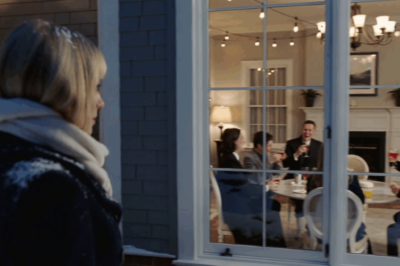
“Mom texted: ‘Ice storm, Christmas is canceled, everyone stay home to be safe’ — the next morning the whole family called saying ‘we miss you so much’, I opened Instagram and saw all of them raising their glasses at my sister’s house… and that night I decided to do something that would make their fifteen years of pretending unable to go back to how they were.”
I believed my mother’s text the way I had believed a thousand small mercies before it. “Everyone’s staying home due…
End of content
No more pages to load