I believed my mother’s text the way I had believed a thousand small mercies before it. “Everyone’s staying home due to the ice storm. Christmas dinner is canceled. Stay safe.” I looked out my Nashville window anyway, as if the sky could be wrong about itself. The light lay clear over the neighborhood, the air cold but bright, the kind of December day that leaned toward blue instead of gray. I set my mug down next to the fridge where a faded little American flag magnet held up my grocery list, one corner peeling away from the metal. The flag didn’t move, because nothing outside was—no wind, no storm, no reason. I made hot chocolate, turned on an old movie, and told myself that staying in could be peaceful, that quiet could be a gift. It was the kind of lie I’d gotten good at telling myself—clean, small, easy to swallow.
I was thirty‑two and good at other kinds of tidy, too: spreadsheets, reconciliations, ledgers that clicked closed like a puzzle solved. I was an accountant at a mid‑size firm off West End, the dependable one who stayed late and kept promises. In my family, I was the quiet sister, the one who ironed the rough edges out of other people’s mistakes. Anna, two years younger, was the sparkle—the child my parents swore had sunlight in her bones. Any room she entered adjusted its furniture to make more space. I learned early how to fold myself smaller, how to hold a tray, how to applaud.
The house smelled like cinnamon and cocoa. The Christmas playlist shuffled to Elvis and then to Ella. Around three, with the movie murmuring in the background, I picked up my phone to scroll. I don’t know why I tapped on Instagram. Habit, I guess. Hunger, maybe. The first image filled the screen before I could brace for it: my cousin Nia had posted a carousel of photos—“Perfect family Christmas at Anna’s. So blessed.”
I didn’t breathe for a few seconds. I touched the glass like I could smudge the image away. There was my mother, the red cardigan she wore when she wanted pictures to pop. My father stood beside the turkey, carving knife lifted like a conductor’s baton. Aunts, uncles, cousins, my grandmother with her pearls, even the neighbor from two doors down who always brought ambrosia salad. They were arranged around Anna’s reclaimed‑wood table, lit by a golden chandelier she’d found at a market in Franklin. The windows behind them were a mirror of the day outside my own: clear and sun‑washed. No ice. No storm.
In the second photo, my mother placed her signature snowflake cookies in a perfect ring on a cake stand. In the third, my nieces and nephews tore at wrapping paper, their faces bright with the high sugar of joy. In the fourth, Anna, hair in a glossy knot, blew out the candles on a chocolate torte while everyone leaned in to be part of her air. There were strings of white lights looped around the banister and a sprig of mistletoe hung with a shiny red bow. In none of the photos was there an empty chair where I was supposed to be. The caption said “family traditions.” I stared and tried to locate myself anywhere in the frame: a plate set for me, a napkin with my initial, a glass that waited. There was nothing.
My hot chocolate went a skin on top. That wordless minute, before the meaning lands with both feet, can feel like standing on a porch and realizing the step is one lower than you expect. My stomach lurched. I scrolled again, and again, because we negotiate with truth the way we negotiate with weather—maybe it will change by the next hour. It didn’t. The ice storm had never existed. The cancellation was not mercy; it was choreography.
When my mother called the next morning, she made her voice soft, the “we tried” voice she wore to bridge over other people’s feelings. “Honey,” she said, “I hope you had a nice quiet Christmas. We missed you.”
I set the phone on speaker and looked at the laptop where Nia’s post still glowed like a bruise. “Did you,” I said, and was proud my voice didn’t shake, “miss me at Anna’s?”
Silence is a shape. On the other end, I could hear my mother rearranging the furniture of her story. “Well,” she said lightly, “Anna pulled it together last minute. And you know how you are at gatherings—so quiet. We thought it might be… less awkward this way.”
“Away from me,” I said. “Less awkward away from me.”
“Don’t be dramatic,” she sighed, and the mask slipped just enough to show the bone underneath. “Anna wanted everything perfect.”
All the little unremarkable unkindnesses—every “canceled” brunch that wasn’t, every game night I learned about from photos posted later, every shift of plans that left me pretending I preferred the silence—arranged themselves into a pattern so obvious I almost laughed. It was like the moment a Magic Eye poster resolves into a dolphin: once you see it, you can’t unsee. “How many,” I asked softly. “How many other times have you lied to me?”
“You’re being oversensitive,” she said, quick as an old reflex. “This is exactly why—”
“Why what?” I asked. “Why you cut me out unless you need me? Why Anna is the hero of every story and I’m the problem to fix?”
“That’s not fair,” my mother said, and her voice went stern, maternal, like I was twelve again and had risked the good dishes. “We love you both. But Anna makes the effort to be part of the family. You’re always so busy with work.”
“Busy paying your mortgage when Dad’s consulting dried up,” I said, and kept my voice even. “Busy taking three weeks off to drive Dad to appointments when he had his surgery while Anna took selfies and left for a yoga retreat. That busy?”
“If you’re going to be like this,” she said, brittle as icicles, “maybe it’s better if we give each other some space. Call me when you’re ready to be reasonable.”
The line clicked. The apartment felt suddenly like it belonged to me. Thirty‑two years re‑sorted themselves in the quiet—the honor‑roll certificates I’d stuck with magnets on the side of the garage fridge because the front was full of Anna’s ballet photos; the day we toured art schools and my father frowned ceiling‑ward and said, “Accountants don’t starve,” and I believed him enough to reroute my whole life; the Thanksgiving last month when I brined the turkey and chopped onions until my eyes stung and watched my mother praise Anna, who had sprinkled parsley over the potatoes like confetti. It was all there, a map I’d refused to read.
When I typed the email to my entire family, my fingers didn’t hesitate. I am an accountant. I am good with receipts.
I attached screenshots: my mother’s “stay safe” text and Nia’s bright carousel. I wrote plainly, the way a ledger lists what is and is not: You did not forget. You invented a storm. You did not spare my feelings. You arranged them. You did not cancel Christmas. You canceled me. I hit send.
The replies came fast. My aunt Marie said I misread the situation and should let the Lord work on my heart. Uncle Robert suggested I was overreacting, a word families use like a rag to blot out any stain that threatens the sofa. Nia deleted her post, then messaged me to say I was “causing unnecessary drama.” Anna wrote three paragraphs about energy and harmony and how she wanted one perfect evening for once, which she claimed I do not understand how to give. My father did not email; he texted a single sentence that smelled like the boardroom: “Family matters are not for public display.” My mother called mutual friends to suggest I was fragile. By sunset, I was the villain of a play I had not auditioned for.
I put my phone face down and made tea. The kettle sang. The city moved beyond my window, clean and ordinary. Somewhere in me a rope snapped free of a mooring and coiled home. I wasn’t angry in the way that sets fires. I was done in the way that builds new houses.
Rachel Parker messaged me a week later. She had been my parents’ financial advisor for years before she retired; I remembered her voice from my childhood as the calm one in rooms where men competed to be loudest. “Catherine,” her text read. “I’ve seen the posts. There is something you don’t know. Can we meet?”
We chose a quiet coffee shop off 12th Avenue South, the kind with a chalkboard menu and succulents in mismatched pots. Rachel wore a navy sweater and the kind of expression people wear when they are about to do the right thing late. She slid a manila envelope across the table and kept her fingers on it for a second before letting go. “Your father swore me to keep this confidential,” she said. “But I’ve carried the weight of it long enough.”
Inside the envelope were bank statements, trust documents, tax returns, and a copy of a power of attorney I recognized by my own quick teenaged signature at the bottom. I remembered the day I signed it: at eighteen, at the kitchen table, my mother setting a glass of orange juice beside the paper and telling me it was for emergencies, a routine thing families did to be prepared. We were leaving for my freshman year move‑in the next morning; my father had hugged me so hard my collarbone hurt. The signature was neat, the way I wrote when I wanted to be seen as good.
Rachel’s voice threaded through the thrum of the café. “Your grandfather, William Blake, set aside funds for your education and for your start in life. $300,000, placed in a trust with your father as trustee. He intended for you to have access at twenty‑five. These statements show that shortly after your twenty‑third birthday, your father began moving those funds—first into an account in his name, then into your sister’s accounts, labeled as ‘investments.’ He also sold two small properties your grandfather left to be split between you and Anna, signing for you under the power of attorney.”
I traced the dates. The first transfer happened the same spring I took a second job at a bookstore to cover rising tuition. The second aligned with the summer I moved back home to save money and paid my parents rent I couldn’t afford because “we’re all tightening belts.” I remembered my mother’s hand on my shoulder as she told me I was sensible. I felt the earth tilt a fraction.
“I didn’t want to believe it,” Rachel said softly. “But every audit trail ends in the same place: Anna’s lifestyle—the studio leases, the retreats, the flights to Bali, the marketing packages—was funded by your inheritance. I have emails from your father pressuring me to make the transfers. I told him it wasn’t what the trust specified. He told me I didn’t understand family.”
I turned the pages. The numbers stacked like a translation of a language I didn’t know I was speaking. I hadn’t imagined it: the thinness I had been asked to live inside so someone else could wear the world like a robe.
“Why now?” I asked.
Rachel met my eyes. “Because the posts about you being unstable made me ill. Because he made me complicit. Because if your grandfather were alive, he would be standing next to you in court.” She folded her hands. “What they did isn’t just ugly; it’s unlawful.”
I walked home with the envelope inside my coat. The sky had that pale winter look like it was saving its strength for evening. I put the papers on my dining table and did what I do when chaos knocks—I built a file. I labeled tabs: TRUST. TRANSFERS. PROPERTIES. POA. CORRESPONDENCE. Then I opened my laptop and built a timeline. Each entry was a date laid on a blade. The work steadied me. I enlarged numbers until they filled the screen and sat with them until they stopped being snakes and became rope I could pull. When I reached a place I couldn’t pull alone, I called a lawyer.
Sarah Chen’s office overlooked the Cumberland, glass that caught light all afternoon. She wore her hair in a sleek bob and spoke in the clean sentences of someone who preferred facts to theater. She paged slowly through my binder, asked precise questions, and ran a finger along the margin of the POA. “This is overly broad for an eighteen‑year‑old,” she said. “And unconscionable when used to transfer assets you didn’t consent to.” She closed the binder. “We have a strong claim for civil recovery and, if you choose, grounds to refer for criminal charges—fiduciary abuse, conversion, fraud.”
I thought of my grandmother’s pearls shining in Anna’s dining room. I thought of my father’s text about privacy. I thought of the moment Anna placed her palm on my shoulder at Thanksgiving and whispered, “Relax your energy, Cat,” like my usefulness was to absorb the heat so she wouldn’t sweat. I didn’t crave spectacle. I craved the feeling of a door clicking shut on a room where I had never been welcome. “We’ll do this by the book,” I said. “We’ll give them a chance to make it right. And then we’ll do it by the law.”
On a Saturday morning that smelled like coffee and floor cleaner, I arranged three folders on my dining table. Each one contained copies: the trust statements, the transfer records, the emails Rachel had printed, the property deeds filed without my knowledge, and a letter on Sarah’s letterhead that explained their options with the unheated tone paperwork uses—return the remaining funds with interest, sign a confession, or face civil and criminal proceedings.
My parents arrived together, my mother in a coat the color of holly berries, my father in the navy blazer he wore like a uniform. Anna trailed them, wrapped in a cream sweater, the same glossy knot against the curve of her head. My mother opened her mouth to begin a speech about healing. I slid the folders across the table.
“Before you say a word,” I said, “please read.”
The silence then was different from the silence after my mother’s phone call; this one had weight, like snow coming down heavy. My father’s eyes moved across lines. The color drained from his face in stages—sternness, surprise, calculation, fatigue. My mother’s fingers fluttered at her pearls. Anna’s mouth pressed into a thin line, the expression she wore when the mirror showed her something she couldn’t rearrange into beauty.
“This is ridiculous,” my mother said finally, brittle. “You’re blackmailing your own family.”
“I’m offering a choice,” I said quietly. “Return what’s left with interest. Sign the confession. Or the police will explain the rest.”
“Rachel should be ashamed,” my father said, edges of fury sharpening his words. “What we do with our money—”
“It was my money,” I said. The rage in me was not hot. It was precise, a scalpel instead of a torch. “Grandfather left it for me. You were the trustee. You used a power of attorney you told me was for emergencies to sell property I didn’t consent to sell. You routed funds through your accounts to Anna’s. You lied, and you watched me work extra shifts and take on loans and help you pay bills I wouldn’t have needed to pay if you’d honored the trust.”
Anna’s eyes filled. “I didn’t know,” she whispered. “They said it was from their savings.”
“The transfers are labeled,” I said, and I placed a page in front of her where her name sat beside numbers that looked obscene under fluorescent kitchen light. “You knew when you signed the lease for the second studio. You knew when you booked Bali that spring I moved home. You knew when you posted ‘self‑made’ under a photo of your hands in prayer at sunrise.”
My mother switched tactics. “Sweetheart,” she said, voice syruping, “think about what this will do to the family. To your father’s reputation. To your sister’s business. To the church.”
“I did,” I said. “For a very long time. For your entire convenience. You have forty‑eight hours.”
They left in a disordered hush. My father took his coat from the chair back with a little jerk, as if the fabric had wronged him. Anna walked down the hall like the floor might dissolve. My mother looked back at me at the door, as if she could retrieve the old version of me with a look. I returned her gaze and did not move.
By evening, the family group thread throbbed. Aunts declared me ungrateful. Cousins used the word toxic the way you use a spray bottle on a stain. My grandmother did not text; she never learned how. I turned my phone off and cooked myself an omelet with chives and ate it slowly, as if food could teach memory a new lesson.
At hour forty‑nine, Sarah filed the civil action and sent the criminal referral. By afternoon, a detective called to say the warrants were approved. I went to work because that’s what I do. I put my hair up, wore my navy blazer, and reconciled a set of accounts for a client who needed his cash flow to look like a river instead of a clogged pipe. At three, I stepped into the break room for water and saw the local news flicker on the wall‑mounted television. I did not recognize my father at first. He looked smaller being led across a parking lot by two officers, his blazer bunched at the shoulder. My mother stood near the open door of the house, her hands pressed together, the neighbor’s ambrosia salad maker watching from her front yard as if the sidewalk had finally grown interesting. A camera panned to the yoga studio as a woman taped a notice to the glass.
I did not feel vindicated. I felt something ease in my ribs, like the space grief had been renting out was suddenly vacated. When my phone buzzed with the news alerts, I turned it face down again. In the stairwell, where no one at the office could see me, I cried once, quickly. Then I washed my face and went back to my desk.
The fallout unfolded in the predictable choreography of public shame: headlines, speculation, the temporary fame of outrage. People whose censure had once controlled me scurried to safer positions. My father’s colleagues who shook his hand at church looked down at their bulletin programs. Anna posted a blank square about “taking time to heal” and then disappeared from the apps. The ones who had called me dramatic fell briefly silent before rehearsing a new script in which they had always had concerns.
Rachel texted: You did the right thing. Your grandfather would be proud. I believed her. Pride wasn’t the sensation, exactly. It was a clean floor under bare feet, cool and solid.
The legal process ate months the way a machine eats paper—no flourish, just steady intake. My parents accepted plea deals. Restitution was ordered. The yoga studios closed. The houses sold. The family photo wall in Anna’s entryway came down in a hush. My grandmother, who had put her pearls back in their velvet box, called me on a landline that still clicked when picked up. “Are you eating enough?” she asked. “Do you have a warm coat?” She did not apologize for the others; she never had that power. She only loved me in a way I could feel, a bowl of soup set down in front of my hurt.
I didn’t stay in Nashville. I tried. I walked the dog‑friendly streets and learned which coffee shop made a latte that didn’t taste burned and which bakery overcooked its scones. But every lane had a memory at the end of it. In August, when the heat rose off the asphalt like an argument, I packed my car and drove west, then north, landing in Denver with the certainty I wanted—clean edges of mountains, air that asked lungs to be brave, light that made windows honest.
I found an apartment in a neighborhood that put children’s chalk drawings on the sidewalks and flags on porches on the Fourth of July. At work, I moved into a senior role and cleared a backlog that had made smart people panic. I bought a coat that made me look like someone who knew where she was going. On Sundays, I walked where the city ends and the foothills consider their options, and I learned the names of clouds.
One afternoon, almost a year to the day after the Christmas that stood me up, Rachel flew out to visit. She wore hiking shoes that made her laugh at herself and claimed the altitude made the coffee taste better. We sat at my small table by the window while flakes of the first snow turned the world outside into careful lace. She set an old photo album down, the kind with black corners holding images like promises. “I found this when I closed out a storage unit,” she said. “Your grandfather would want you to have it.”
I turned the pages slowly. There we were at the lake—the tiny version of me with a gap‑toothed smile that had not learned yet how to close; my grandfather in a flannel shirt, his hat brim shading a face lined from outside work and soft at the eyes. In one picture, he was teaching me to cast a line, his hands cupped over mine on the rod. I remembered the motion suddenly—the way you had to let your wrist remember the timing, not your brain. In another, we stood beside a sign we made together for a lemonade stand, the paint crooked and perfect.
“He knew,” Rachel said, and she meant the favoritism, the friction, the way love had been measured out like flour with a cup whose bottom no longer squared with its sides. “He couldn’t change your parents’ hearts. But he tried to build you a bridge.”
I closed the book. “It took me a while,” I said. “But I found the other side.”
There are some stories that want vengeance to be fireworks—loud, brief, glorious, and then a smell in the air that makes dogs nervous. Mine wasn’t that. Mine was the steady work of saying no to the room I had been told to stand in and yes to the door that had always been there. When people online asked me if it felt good to watch the handcuffs click, I told the truth: Justice feels like a clean balance sheet, not a parade. Freedom feels like the quiet after the machine turns off.
On a Saturday in late January, a snowstorm began around noon and made good on itself by evening. I walked to the corner market and bought milk and bread and the expensive butter because a person can decide she’s worth it. On the way home, two kids were making a snow fort and asked if I wanted to help pack the walls. I knelt and showed them how you can use a metal loaf pan for perfect bricks. Their mother laughed from the porch and said, “Where did you learn that?” and I said, “A man who knew about building the right way,” and it felt like both a history and a hope.
That night, I made hot chocolate with the good cocoa, not the grocery store kind that tastes like someone tried to remember chocolate from a dream. I opened the window a sliver and let the cold in to make the warmth honest. Snow powdered the streetlamps. I sent Rachel a photo of the mug and the weather and wrote: No ice storms invented. Only the real kind. She wrote back a snowflake and a heart.
I did not hear from my parents for a long time. When a letter arrived, months into the Denver spring, it was my mother’s handwriting on the envelope. Inside were three pages and no apology. She spoke around consequences like a subway that will not stop at certain stations. She said she hoped that someday we could be a family again. She asked if I might consider calling at the holidays. I folded the letter and placed it in a drawer with my health insurance forms and my lease, things I keep because they exist.
Anna texted once—a blurry photo of a receptionist’s desk with a vase of daisies and a caption that said, “Starting over.” I typed and deleted a dozen responses. I settled on: “I hope you’re well.” It was true. That was what I hoped. Not the performance of contrition, not the optics of humiliation. I wanted her to learn a new measure, to feel the good weight of earning what you keep.
Sometimes justice looks like a courtroom and a ledger. Sometimes it looks like a woman standing alone in her living room in a city she chose, holding a photo of a man who loved her without an audience and saying out loud, to no one and to everyone, “I am not an afterthought.”
Summer came and then the gold of fall that Denver does with such confidence you forget other cities try. I made friends who did not need me to be the quiet one to feel louder. We met for hikes and trivia nights and, once, a trip to a tiny mountain town where the diner still served pie from recipes older than our grandparents. I dated a man who worked in environmental engineering and knew the names of birds; when he told me my laugh sounded like it had decided to stay, I wrote it down so I wouldn’t forget that someone had said it and meant it.
On the anniversary of the Christmas that never happened for me, I woke early, made cinnamon rolls from scratch because I could, and set the table for one with my grandmother’s plate, the one with the thin blue band. I ate slowly, poured a second cup of coffee, and let the radio play low. I texted my grandmother’s neighbor—she’d become my informal update line—and asked her to tell my grandmother I loved her. She sent back a photo of Grandma at the window, pearls on even in her robe, her hand held up like a blessing.
I do not believe pain makes us better. I do not believe forgiveness is a trick we perform to make other people comfortable. I believe in inventories—honest ones, the kind that count what is there and what is not, the kind that name losses and still find a way to say “enough.”
The day I moved to Denver, I pulled off at a rest stop in Kansas and stood under a sky that went all directions at once. I took a deep breath and said out loud, “I’m free.” It sounded smaller than the sky. It sounded exactly right. Freedom, I’ve learned, is like a well‑kept ledger. It doesn’t sing. It balances. It says, with a calm that can look like quiet to outsiders, Here is what I had. Here is what I have. Here is what I deserve to keep.
The year ended, as years do, with people counting down and kissing strangers in bars and promising themselves impossible things. I bought a plant I thought I could keep alive. I learned how to make a perfect omelet every time. I stopped answering questions I didn’t want to answer. I remembered how to draw, a little, alone at my kitchen table after work, pencil smudges on my fingers like I had stolen back a piece of a life. On a page I didn’t mean to keep, I drew a table with space enough for me and wrote underneath it: no invitations required. Then I tore the page out and taped it to the inside of my cabinet door where I keep the good cocoa, a reminder waiting above every cup I make.
On some mornings, Nashville is a far country where a different girl learned hard lessons. On others, it’s a place I pass in my mind like a town off the interstate where you know a good diner and a gas station with clean bathrooms, and that’s enough. I built a life in the same careful way I built that file on my dining table—a tab for work, a tab for friends, a tab for rest, a tab for joy—and I stopped handing the keys to people who don’t know the value of the rooms.
If you want there to be a moral, it’s only this: sometimes the storm is a rumor others tell so they can enjoy their picture without you in it. Sometimes you have to step out into the actually cold air, feel your own breath, and walk toward a weather that will not lie. I did. It was brighter than I expected. It was mine.
That could have been the end of it. A clean moral, a balance sheet closed, a woman walking into better weather. If life were a movie on my TV, that’s where the credits would roll—my Denver window full of real snow instead of rumors and me with my hot chocolate made from the good cocoa, the faded little flag magnet on my own fridge holding up nothing but a grocery list I chose. But movies end where life keeps going.
Months passed in a way that looked ordinary from the outside. I went to work. I learned the shortcuts on our new accounting software and taught them to the junior staff. I joined a trivia team that met Thursday nights at a bar where the bartender remembered my order after the second week. I went to church sometimes, sat near the back where nobody knew my last name, and listened to sermons that didn’t require me to perform a part.
Inside, another kind of counting was happening. Not the money kind—the kind where your body tallies what it’s survived. Some nights I woke at 3:00 a.m., my heart kicking at my ribs the way it had the moment I saw that caption “Perfect family Christmas at Anna’s. So blessed.” My brain would replay the old tapes: you’re oversensitive, you’re dramatic, you’re the problem to fix. It’s hard to overwrite a story you’ve heard for thirty‑two years with one court document and a new zip code.
One afternoon in March, our HR director forwarded a flyer about the company’s counseling benefit and wrote, Just in case this is useful. She didn’t mention the news stories or the office whispers; she didn’t have to. I sat at my desk and stared at the line that said 10 covered sessions per year. Numbers I knew how to trust. Ten hours to see whether my mind could learn a different language.
Dr. Harper’s office was on the fifteenth floor of a downtown building with glass that reflected the sky so completely it was hard to tell where city stopped and weather started. Inside, the waiting room had mid‑century chairs and a small American flag folded into a triangle on a shelf, a military burial triangle, the kind you only see on TV unless you’ve lost someone in uniform. I stared at it until my name was called.
She was in her fifties, hair silver at the temples, eyes the kind that didn’t flinch. There was no tissue box theatrically centered on the coffee table; it sat off to the side, like she trusted her clients to reach for what they needed. “What brings you in?” she asked once we were settled.
I had rehearsed a tidy summary in the car—financial betrayal, legal proceedings, family estrangement—but when I opened my mouth what came out was, “My family invented an ice storm so they could have Christmas without me.”
She didn’t laugh. She didn’t wince. She just nodded. “That sounds… exquisitely lonely.”
Something in my chest unlatched. “It wasn’t just that one time,” I said. “It’s like I’ve been edited out of my own life and just now got the uncut version.”
We talked about gaslighting, a word I’d rolled my eyes at when I saw it overused online and now heard as a clinical term, not a meme. We mapped out a childhood in Nashville where my accomplishments were expected and my sister’s were celebrated, where my work paid the bills and my sister’s dreams were funded, where my feelings were something to be managed so the story stayed pretty.
“What’s the first time you remember feeling… erased?” Dr. Harper asked in our third session.
I closed my eyes and let the memory choose itself. “Fifth grade,” I said slowly. “School play. I got the lead because I knew all the lines. Anna was in second grade and had one song as a dancing snowflake. My parents brought flowers—for her. They said they didn’t think I’d care.”
“Did you?”
“I told myself I didn’t,” I said. “I told myself flowers die anyway and someone had to make sure Anna didn’t trip on the hem of her costume and I was good at being useful.”
“Useful is not the same as loved,” she said. “Though some families prefer to pretend it is.”
Every session was like that: a small fact placed on the table between us, examined, re‑labeled. The honor‑roll certificates. The power of attorney. The rent checks that shouldn’t have existed. The day my grandfather sat me down on his porch swing and told me, You don’t have to shrink to be good. He’d given me a mug of hot chocolate that day too, made with the good cocoa he bought in bulk from some catalog, not the instant packets my parents used. I’d forgotten that detail until Dr. Harper asked, “Was there anyone who saw you clearly?” and the memory arrived with the smell of real chocolate and sawdust.
“You keep coming back to that,” she said when I mentioned hot chocolate for the third time in as many sessions. “The good cocoa, the mug, the way it felt.”
“It was the first time I remember being given something just because,” I said. “Not because I’d earned it, not because someone needed me to do something in return. Just… because I existed.”
“There’s your hook,” she said. “The difference between earned and inherent. Between conditional and given.”
By our sixth session, Dr. Harper suggested something that made my stomach clench. “You might consider writing it all down,” she said. “Not for them—for you. You’re an accountant. You like ledgers. This is just a different kind of ledger. Call it your inventory of truth.”
I thought of the email I’d sent my family from my Nashville apartment, the one that said You did not cancel Christmas. You canceled me. That had been the first time I’d set the record down in black and white. “What if writing it down makes it all louder?” I asked.
“It might,” she said. “But it also might make you the narrator instead of the evidence.”
So I wrote.
I started with a Word document on my laptop one Friday night when the city outside was busy with people who hadn’t had their Christmas canceled. I titled it “Ice Storm, Revised.” Then I listed scenes like entries in a general ledger: Date, Event, What I Was Told, What Was True, What It Cost Me. December 25: Ice storm text, fake. Reality: Sunny. Cost: one more illusion shattered, the last one, maybe. Age 23: Took second job to cover tuition. Reality: $12,000 siphoned from trust that year to fund Anna’s first studio lease. Cost: exhaustion, credit card debt at 19.99% APR. Age 18: Power of attorney signature. Reality: legal transfer of consent I didn’t understand. Cost: two properties sold without my knowledge.
When I was done with the first pass, the document was sixteen pages long. Sixteen pages of small and big betrayals, each one numbered like any other transaction. On page seventeen, I wrote: Total: one childhood, one early adulthood, one person cut out of the picture. Balance due: my life, reclaimed.
I didn’t plan to show it to anyone. But the internet has a way of sniffing out heat.
It started with a private Facebook group that Dr. Harper mentioned—a community for adult children of difficult families, 29,000 members scattered across time zones. I joined under my first name and a middle initial I hadn’t used since high school. For weeks, I just read. Stories about holidays gone sideways, wills rewritten, siblings pitted against each other like gladiators, parents who chose image over truth so often that truth moved out and forgot to leave a forwarding address.
One night in June, after reading yet another post from someone asking, “Am I crazy for feeling hurt?” I copied and pasted one small section of my ledger—the ice storm, just that—with identifying details scrubbed out. I didn’t mention the trust, the lawsuit, the handcuffs. Just the text: Everyone’s staying home due to the ice storm. Christmas dinner is canceled. Stay safe. And the Instagram carousel that said Perfect family Christmas. So blessed.
Within an hour, my post had over 500 reactions and 200 comments. By morning, there were 1,950 comments and 73 private messages in my “Other” folder.
“Same,” one person wrote. “My mom told me the oven broke and then posted photos from my sister’s baby shower.”
“My dad did this with a ‘COVID scare’ three years in a row,” another said. “Meanwhile, there are pictures of them at packed restaurants.”
“Thank you for writing it out,” someone messaged privately. “I thought I was imagining the pattern. Seeing your words made it click. They didn’t forget me. They chose around me.”
It was overwhelming, all that “me too” in my notifications. But there was something else under the flood: proof that the storm was never about my worth. It was a tactic, a script families used like a template downloaded from somewhere dark. Mine wasn’t special. It was just… exposed.
A week later, an editor from a mid‑size online magazine emailed me. She’d seen my post screenshot in the group (with my permission, a moderator had asked if she could share it anonymously) and wanted to know if I’d be willing to write a longer essay. “We’re doing a series on family myths,” she wrote. “Your ice storm story is… devastating and clarifying.”
The idea of putting my story on a site where strangers could read it made my stomach do something between a flip and a warning. But Dr. Harper’s words echoed: narrator instead of evidence. So I said yes—with conditions. No real names. No identifiable details. Just the pattern, the ledger, the way it felt to be canceled like a meeting that never mattered.
I worked on the essay in the evenings, my laptop balanced on my kitchen counter, my mug of hot chocolate made with the good cocoa leaving a faint ring on a legal pad where I jotted down phrases. I wrote about the flag magnet on my Nashville fridge, the way it held up grocery lists and overdue notices and the power of symbols in small spaces. I wrote about the neighbor’s ambrosia salad, the church bulletins, the quiet child who ironed everyone else’s messes. I wrote about the trust—but only in broad strokes, the way you sketch a landscape without drawing every tree.
When the essay went live in November, the editor texted me a link and a simple “Here she is.” I clicked, skimmed, winced at seeing my life turned into paragraphs and pull quotes. Then I closed the tab and went for a walk because if I stayed inside refreshing the page I might never come back.
By the time I returned, my inbox had 29 new messages from strangers.
Some were brief—Thank you, I needed this, I feel less alone. Others were whole essays in themselves, detailing Christmases canceled, weddings skipped, graduations “forgotten” because a sibling needed the spotlight unobstructed. One message stood out. It was from a woman in her sixties in Ohio. “My granddaughter sent me your article,” she wrote. “She thinks I’m the grandmother in your story. I’m not. But I could have been. I’m calling my lawyer tomorrow to make sure my will cannot be twisted the way your grandfather’s was. I wanted you to know your courage is contagious.”
I sat at my little table by the window and cried in that messy way that bypasses dignity. Not because of my parents or Anna or the lawsuit. Because for the first time, the story wasn’t just something that had happened to me. It was something I was using.
Of course, not everyone received it that way.
Two days after the essay went up, my father’s text appeared on my phone like a ghost. “Saw your article,” it read. “This is beneath you. Family matters are not for public consumption.”
I stared at the words. Once, they would have sent me spiraling—shame, doubt, frantic mental accounting of whether I’d gone too far. Instead, I noticed the same old tactic in a slightly different wrapping: silence me to keep the image intact.
I typed, erased, retyped. Settled on: “My story is mine to tell. I wish you well.” Then I blocked his number. The ledger didn’t need more entries under “explaining myself to people committed to misunderstanding me.”
Anna reached out next. An email this time, long, unpunctuated in places like she’d been typing faster than honesty could keep up. She said the article had made her look bad at church. She said people were asking questions about the studios. She said she wished I’d kept things “between us.” Then, at the end, almost as an afterthought, she wrote, “I really didn’t understand how much Granddad meant for you to have that money. Mom and Dad always said it was ‘for the family.’”
I stared at that line—Mom and Dad always said—and felt something shift. It was possible, I realized, that Anna had been lied to too. Different lies, tailored for the favorite child, but lies all the same.
I didn’t excuse what she’d done. But I adjusted my categories. There were architects of harm and there were tenants in the house of harm and sometimes people were both.
I wrote back: “I hope you find people around you who tell you the whole truth. I’m working on that for myself.” Then I closed my laptop and went to make another mug of hot chocolate, the good cocoa whisked into milk until it went glossy, the smell of it filling my small Denver kitchen. The ritual had become my way of telling my nervous system: You’re safe now. You don’t have to earn this.
The years didn’t magically soften my parents. Plea deals took care of what the law required; they did not turn people who prioritized image into people who prized truth. They moved to a smaller house in a neighboring county, changed churches, started over socially with people who didn’t know what restitution meant on a balance sheet. I knew this not because they told me but because my grandmother’s neighbor still lived across the street and her idea of a good afternoon was watching the comings and goings on that block.
“Your mama got a new wreath for the door,” she told me once on the phone, the landline clicking in my ear. “Big ol’ thing with fake magnolias. Looks like she’s trying to convince the world nothing happened.”
“Maybe she’s trying to convince herself,” I said.
“Baby, some folks will hang a wreath on a burned‑out house and call it home,” she replied. “You just keep your own place warm.”
I kept it warm.
The second Christmas in Denver, I hosted a small dinner. Nothing fancy. Just a few friends—a coworker whose family lived in Portland, a neighbor whose boyfriend was deployed overseas, my trivia teammate who refused to fly in December because the airports made him feral. I bought a tablecloth in a deep midnight blue and set out my grandmother’s plate with the thin blue band at the center of the table as if her presence could ripple out from it.
I baked my own version of my mother’s snowflake cookies, using a recipe I found online and adjusting the sugar down because my taste had changed. At the last minute, I used the old cookie cutter my grandmother had mailed me—one of the few items she could smuggle out of the house without starting a war. The snowflakes that came out of my oven were imperfect, a few edges browned, one slightly cracked.
“Whoa,” my neighbor said when he walked in, shrugging off his coat and taking in the candles, the food, the smell of butter and cinnamon. “We stumbled into a Hallmark movie.”
“DIY edition,” I said. “Low budget, high carbs.”
We ate until we couldn’t. We played a card game I’d loved as a kid and no one made fun of me for knowing the rules by heart. At midnight, after they’d all gone home and the apartment was quiet except for the hum of the heater, I stood in my tiny kitchen and rinsed plates. The good cocoa sat in its container behind the cabinet door, the piece of paper taped there curling at the edges: no invitations required.
I thought of that girl in Nashville a few years back, standing at her window, staring at a sky that had refused to lie for her family. I wanted to reach back through time, put a mug of real hot chocolate in her hands, and say, You’re never going to be on their kind of Christmas card. That’s a gift. You get to make your own picture.
The call about my grandmother came in late spring, when the Denver air was soft enough to sit outside with a book and an iced tea sweating on the railing. My grandmother’s neighbor was crying. “It’s her heart,” she said. “They’ve got her in the hospital. She keeps asking for you.”
I booked a flight for the next morning. The old me would have checked with my parents first, worried about their feelings, their version of what my presence might mean. The newer me checked my work calendar, arranged coverage for my clients, and texted my boss a simple, “Family medical thing, I’ll be out three days.”
Nashville smelled the same when I stepped off the plane—jet fuel and humidity and barbecue smoke from some stand that had been there since forever. The hospital was off I‑65, one of those sprawling complexes where you can’t tell if you’re approaching healing or loss until you reach the right floor.
Grandma looked smaller in the hospital bed, her pearls absent for once, her hair flattened on the pillow. But her eyes were sharp. “There’s my girl,” she said when I walked in. “Come here and let me see what freedom looks like.”
I laughed, the sound catching in my throat. “Hi, Grandma.”
She reached for my hand, her skin papery and warm. “They’re mad at you, you know,” she whispered, conspiratorial. “Mad you told the truth.”
“I know,” I said.
“Good,” she said. “Means you hit the right nerve.”
We talked for an hour—about Denver, about the photo album Rachel had given me, about the lemonade stand sign she remembered painting crooked. She dozed off mid‑sentence once; when she woke, she squeezed my fingers. “I read your article,” she said. “Rachel printed it for me. I’m sorry, baby. I didn’t see as much as I should have.”
“You saw enough to try,” I said. “You saved that money for me. You left a bridge. They took the wood, but I still found my way across.”
Tears gathered at the corners of her eyes. “Stubborn,” she said. “Just like my daddy. He’d be proud.”
As I left the room, I saw my parents down the hall. My father in a worn sport coat, my mother in a cardigan I recognized from a hundred holidays. For a moment, none of us moved. We might as well have been in one of Anna’s carefully curated Christmas photos—frozen, framed, everyone holding a position.
Then my mother took a step toward me. “Catherine,” she said. No honey, no sweetheart. Just my name, like she was testing whether it still fit in her mouth.
“Mom,” I said.
Her eyes flicked to the door to my grandmother’s room and back. “She was so happy you came,” she said. “Thank you for that.”
“You’re welcome,” I said. Small talk with someone who had once rerouted my entire life with a single text felt surreal.
My father cleared his throat. “We heard about your article,” he said. “People talk.”
“They do,” I agreed.
He shifted, uncomfortable. “We… we’ve been through a lot,” he said. “Losing the house. The case. The church.”
“You didn’t lose the truth,” I said quietly. “You gave it away.”
He winced. For a heartbeat, I saw something like regret flicker across his face. Then the old defensiveness slammed back into place. “We did what we thought was best for the family.”
“The family,” I repeated. “Or the picture of the family?”
He didn’t answer. My mother looked at me like there was a script I was supposed to feed her so we could all get back to the version where I was the quiet one and they were misunderstood protagonists.
“I’m not here to fight,” I said. “I’m here for Grandma. I’m glad you’re both taking care of her.”
My mother’s eyes filled. “Catherine, someday you’ll understand how hard it is to be a parent,” she said. “You make choices you think are right.”
“Maybe,” I said. “But if I ever have kids, I hope I remember that lying to them so someone else can have a prettier picture is not one of those choices.”
It wasn’t a mic‑drop moment. No one gasped. No one applauded. A nurse pushed a medication cart down the hall, the wheels squeaking. Somewhere, a monitor beeped steadily. I stepped past them, back toward the elevators, my heart both heavy and light. I wasn’t walking away from them; I was walking toward myself.
Grandma died two weeks later. I couldn’t fly back for the funeral; work was in quarter‑end crunch and the flights were astronomical. Instead, I watched the service on a grainy live stream the church set up for distant relatives. My parents sat in the front pew, Anna beside them, all of them in black. The pastor talked about faithfulness and legacy and how Grandma had been the kind of woman who set extra plates at the table. I smiled through my tears, thinking, That part’s true. She would’ve made room for me if the house had let her.
After the service, my grandmother’s neighbor sent me a photo of the reception. On the folding table in the fellowship hall, between the ham biscuits and the deviled eggs, sat a tray of snowflake cookies. “I made them from the recipe you sent,” she texted. “Felt right.”
I zoomed in on the picture. The cookies were a little uneven, some edges browned. Perfect.
Back in Denver, the weight of grief and relief sat side by side in my chest like two people who didn’t know whether to shake hands. Dr. Harper and I talked about complicated mourning—how you can miss a person and still be glad certain dynamics are over, how you can love someone and never again let them near the levers of your life.
“Closure is overrated,” she said one day. “What you have is clarity. That’s better. Closure implies the book is shut. Clarity means you know what chapter you’re in.”
“What chapter is this?” I asked.
She smiled. “The one where you build.”
Building turned out to look less like grand gestures and more like small, repeated choices. I signed up to teach a financial literacy workshop at a local community center—Saturday mornings, twenty people at folding tables, learning how to read pay stubs and avoid predatory loans and understand what a trust is supposed to do. The first time I wrote the word fiduciary on the whiteboard, my hand shook a little.
A woman in the front row raised her hand. “So basically, if someone’s in charge of your money, they’re supposed to act in your best interest,” she said.
“Exactly,” I said. “And if they don’t, there are ways to hold them accountable.”
After class, she lingered. “My uncle manages our family land,” she said. “Lately he’s been pushing my mom to sign things she doesn’t understand. Reading your article made me wonder… Does your lawyer take referrals?”
I gave her Sarah Chen’s number. As she walked away, I felt that now‑familiar hum—the sense that my story, ugly as parts of it were, could be repurposed like reclaimed wood. Not a monument to what I’d lost, but a table where someone else could sit and be seen.
By the time another Christmas rolled around, Denver had started to feel less like an escape and more like a home I’d chosen on purpose. My plant was still alive. My trivia team had won a $150 bar tab. The man who knew the names of birds was now the man who had a toothbrush at my place.
On Christmas Eve, he brought over a little gift bag. Inside was a ceramic mug—deep blue with tiny white snowflakes, handmade, the glaze imperfect where a thumb had pressed. “Thought it might go with your hot chocolate thing,” he said, a little shy.
I laughed, that laugh he said sounded like it had decided to stay, and turned the mug in my hands. Snowflakes, again. But this time, they weren’t a brand of cookie someone else got praised for. They were mine.
We stood at my fridge while I pulled down the good cocoa, the flag magnet holding up a new grocery list—milk, eggs, butter, cocoa, plus a small sticky note that said, in my own writing, Remember what you deserve. I made us hot chocolate on the stove the way my grandfather had taught me: whisk first, then heat, keep stirring so nothing sticks to the bottom.
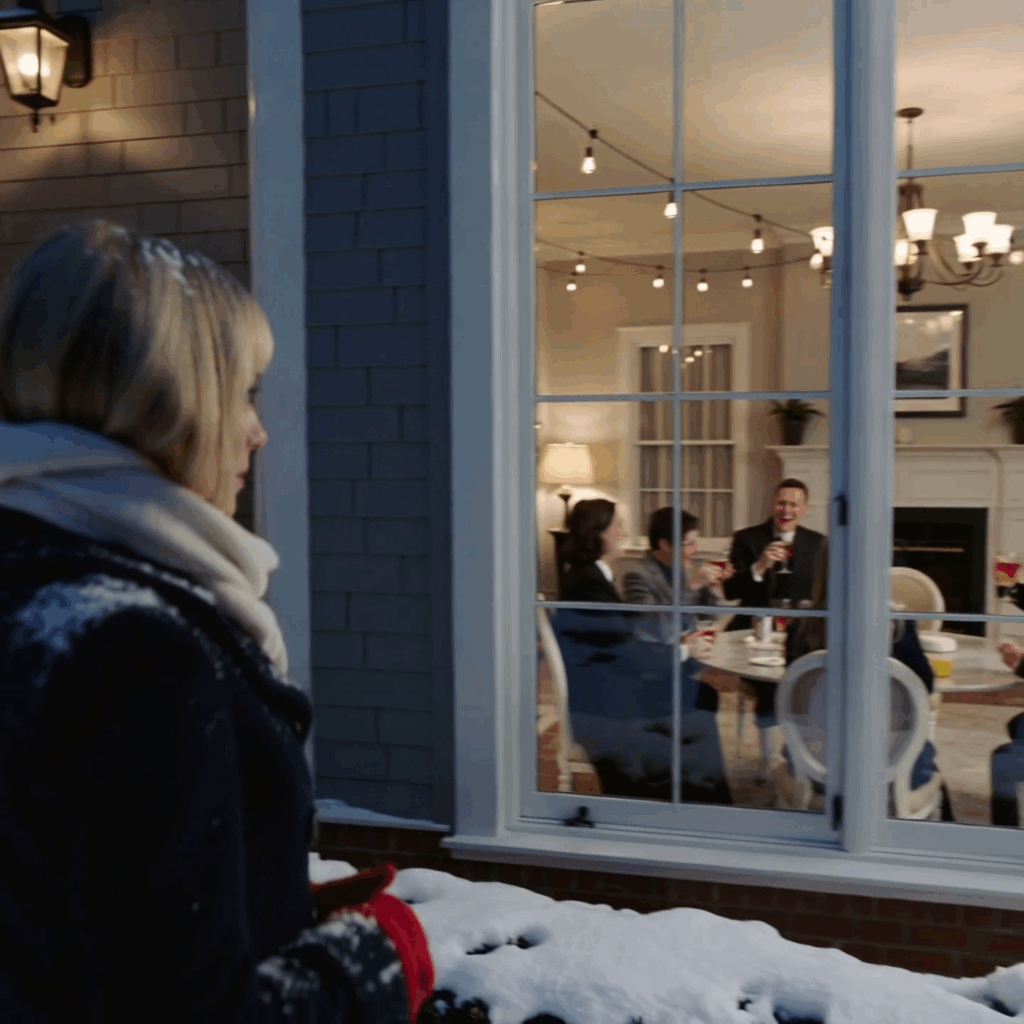
As we curled up on the couch, the tree lights blinking softly and Sinatra crooning from a cheap Bluetooth speaker, my phone buzzed on the coffee table. A text preview lit the screen: a photo from my grandmother’s neighbor. The Blake house, my parents’ old place, now owned by a young family who had strung mismatched lights along the porch. There was a big, cheap wreath on the door, and through the window I could see silhouettes moving around a crowded table.
“Looks like somebody finally figured out how to use that dining room,” her text said. “Merry Christmas, honey.”
I smiled, saved the photo, and set the phone back down without replying. The storm my parents once invented so they could toast without me was a memory now, a footnote in a ledger that had a lot more on the “assets” side than it used to.
If you still want there to be a moral, maybe it’s this: you can’t control who invites you to their table, or whether they lie about the weather to keep their picture neat. You can control whether you keep standing in the yard, waiting. Or whether you go home and make yourself something warm with the good cocoa, set your own table with the one plate that always should have had a place, and open the door to people who know better than to cancel you.
The sky outside my Denver window was clear that night. No ice. No storm. Just cold air that told the truth when I opened the window a crack and let it in. I lifted my mug, took a long, slow sip, and let the warmth spread from my hands to the rest of me, a simple, steady proof of life I no longer had to justify.
News
On my birthday, my parents hosted a dinner with 100 relatives just to disown me. my dad handed me a bill, said: “every cent we wasted raising you. pay or never contact us again”. my sister grabbed my car keys from the table: “dad already transferred the title to me.” i walked out without a word — four days later, they’re calling me…50 times a day
On my birthday, my parents didn’t bring out a cake. They brought out witnesses. Nearly a hundred relatives sat shoulder…
At My Mom’s Birthday, My Brother’s Son Threw My Son’s Drawing Into The Fire And Yelled, “Nobody Wants His Crappy Art Anyway.” Everyone Laughed. That Night, My Dad Texted, “You’re Making Things Uncomfortable — Just Skip Christmas.” I Replied, “So Does The Funding.” By 1 A.M., My Phone Was Melting. 27 Missed Calls.
By the time the clock on my stove blinked 1:00 a.m., my phone looked like it was about to catch…
My whole childhood I was treated like a maid. On Christmas Eve, my mother coldly said: “Your sister’s 25 friends are coming, you cook – clean – serve them properly,” I just said “Okay” then got on a plane straight to the beach; when my family came home and stepped into the kitchen, they SCREAMED, but what made them tremble the most came after that.
My parents treated me like hired help. The irony hit me every time I saw the little chipped American flag…
“You’re not family, don’t show your face here,” the whole table burst out laughing, I picked up the entire lasagna and left – 4 days later, their loan was rejected by the bank, that night, my phone lit up
My name is Jean William. I’m thirty years old, and the night I realized my family didn’t love me the…
I was serving champagne at a gallery when i saw it. a painting i made when i was 6. price tag: $150,000. ‘sir, that painting is mine,’ i said. ‘impossible,’ the gallery owner laughed. he called security to kick me out. but he forgot to check the secret message on the back of the canvas.
I was balancing a silver tray of champagne flutes when I saw it. Not the painting, not yet. First I…
My younger sister shoved me into the corner of the table, a loud “crack” rang out — my mother snatched the phone out of my hand, “It’s just a rib,” my father barked “drama queen” as if the broken bone came from my personality. That night, I walked out the door of the house I grew up in, one arm still not even inside my coat sleeve. And what I did next… didn’t need to be loud.
By the time I heard the crack, the little plastic American flag magnet on our fridge was already tilted, pointing…
End of content
No more pages to load