By the time my phone started its frantic buzzing against the scrub pocket over my heart, the flag magnet on the med fridge at County General had already slipped sideways for the third time that day. I straightened it with one hand, charted a blood pressure with the other, and tried to ignore the way the little red, white, and blue rectangle clung on like it understood gravity better than the rest of us. Twelve-hour shifts blur, but that vibration pattern was one I could have recognized in my sleep—Mom, then Dad, then my sister, back to back. Emergencies in my family never came as one clear voice. They arrived as a chorus.
I stepped into the med room, hit accept on the third call, and braced. “Please, we need you here this instance. It’s urgent,” my mother panted into my ear. She didn’t ask if I was free. She never did. “Come now, Sarah.”
The word urgent did what it always did—it reached straight past my adult life, wrapped a hand around my twelve-year-old spine, and squeezed.
I got a float nurse, handed off a half-finished med pass, and told charge I had a family emergency. In a hospital, nobody asks which kind. People here know some of the worst heartaches don’t arrive by ambulance.
County General’s automatic doors sighed me out into late afternoon air that smelled like rain and cut grass. Emma’s white cane lay in the passenger footwell of my car like a small question mark, the rubber tip still damp from the preschool hallway she’d navigated that morning. I drove on autopilot through neat little streets lined with mailboxes and flags, telling myself it could be anything—Dad’s blood pressure, Mom fainting, one of Madison’s loud breakups with a boyfriend I’d never met. My brain tried to stay reasonable; the part of me that was a mother cataloged worst-case scenarios anyway.
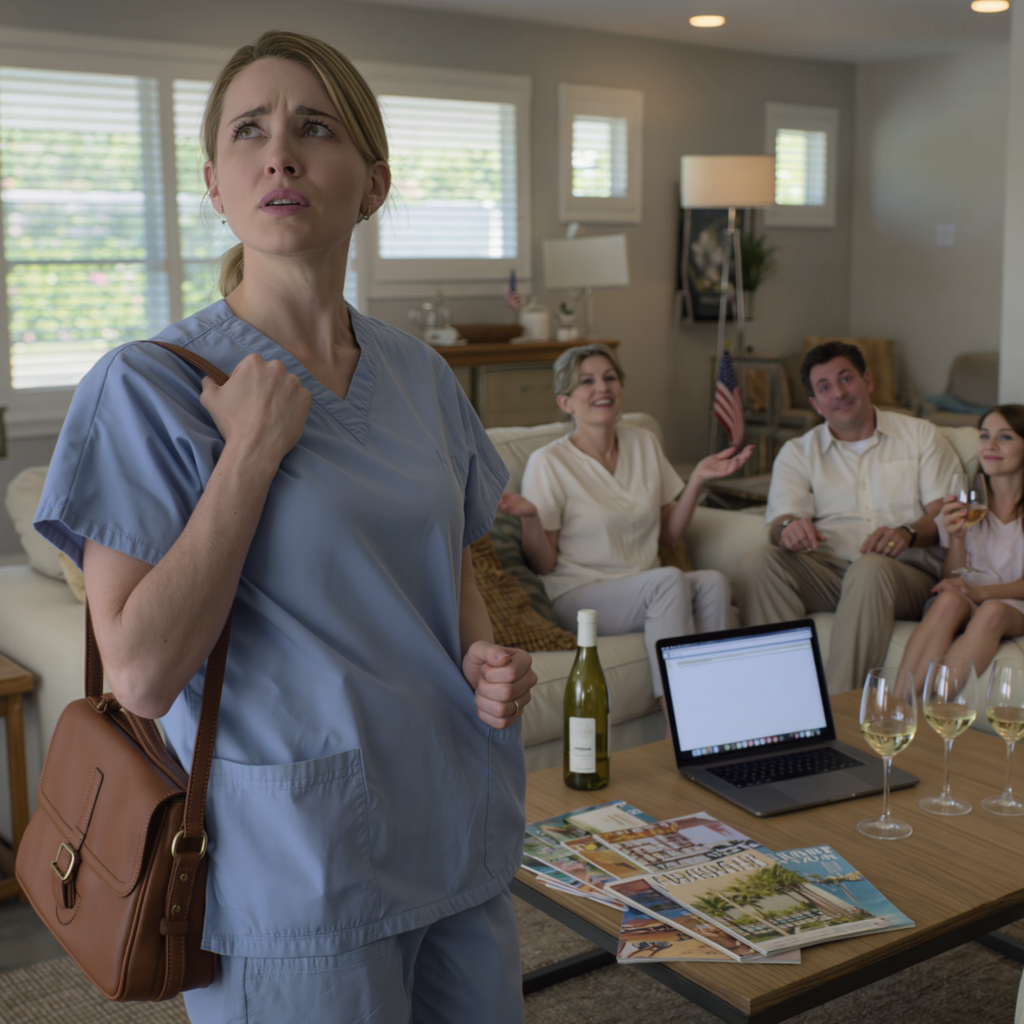
Their front yard was immaculate, every blade of grass disciplined into place. Inside, the house smelled like lemon cleaner and Chardonnay. The TV murmured a daytime talk show with the volume low. My parents were not only fine—they were laughing.
Madison was there too, hip against the kitchen island, pouring wine into stemless glasses like she owned the deed and the air between sips. Sun had kissed her just enough to show off the kind of life where your biggest decision is which gym mirror has the best lighting. She glanced up, flashed me a smile I knew too well—the one that meant, Now watch me.
“What happened?” I asked, still in scrubs, badge tucked out of sight, hospital smell clinging to my skin. My heart was still beating ER-fast. “You said urgent.”
Mom patted the couch cushion beside her like she was calling a dog. “Tell us, honey, how much money you need so we can all go on a holiday.”
For a heartbeat, the words didn’t stick. They skated over me, too smooth to grab. “I just came from the hospital,” I said carefully. “What’s going on?”
Mom laughed, that practiced little trill that had charmed neighbors and PTA committees and church brunches for years. “Who said ‘we’? Only us. Just hand over the emergency savings to your sister.”
“No,” I answered before I even knew I was going to speak. “That fund is for Emma.”
Dad adjusted his reading glasses, like better focus would make me more tolerable. “Stop whining, Sarah. A trip is more important than a useless kid’s eyes.”
I’d heard ugly things in my life, but never laid out that neatly. “Don’t talk about my daughter like that.”
“She’ll never see anyway,” he said flatly, the way he used to read lab results when I was a kid pretending to study at the kitchen table. Not a sentence—just a value he’d decided was out of range.
Madison took a sip, watching me over the rim. “She won’t hand it over this way,” she sang. Then she set the glass down and crossed the room in a handful of bright, quick steps.
What she did next is what lawyers and officers and judges later called an assault. What I remember is the sound in my own head when the world narrowed to a single point beneath my left sneaker.
One second she was in front of me with a hammer and a nail, all glossy hair and wine breath. The next, the nail punched through rubber and fabric and skin and the tender architecture of tendon and bone, pinning me to their perfect hardwood floor. The pain was a white flare at the edges of my vision, sharp enough to cut, hot enough to brand. Years in the ER had taught me what real pain was, and what it wasn’t. Pain was information. Pain was data. Pain meant, This is serious; move carefully.
I didn’t scream. I inhaled. I tasted copper and something older—humiliation that had been waiting its whole life for this exact moment.
Blood welled around the metal and began to stain the pale planks. Mom tilted her head, checking angles like this was a lighting problem. Dad leaned forward, more interested in me than he’d been in years. Madison took a step back to admire her work.
In that frozen, absurd second, something in me clicked into place. It wasn’t shock. It was clarity.
“Madison,” Mom said, as if we were planning brunch. “Grab the checkbook from her purse. She keeps it in that ugly brown bag.”
My purse sat on the entry table where I’d dropped it in my rush. Madison bounced over, pawed through, already eyeing the zipper of my wallet.
“The checkbook won’t help you,” I said, keeping my voice level because that was the only thing in the room I could still control. “The emergency fund isn’t in checking.”
Dad’s face darkened like a storm rolling over the lake near their old cottage. “Where is it, then? That money was for family emergencies, and your sister’s mental health requires a vacation to Cancun. The doctor said so.”
“Which doctor?” I asked. “The one who prescribed her anxiety meds she sells at her gym?”
Madison whipped around, color rising high in her cheeks. “You can’t prove that.”
“I’m a registered nurse,” I said evenly. “I know what street value looks like. And I know your clients aren’t carrying prescriptions for the Xanax you’re dealing.”
Mom set her glass down a little too hard. “How dare you accuse your sister? She’s going through a difficult time. That’s why we need the money. All $37,283.19. You’ve been hoarding that fund for years. Time to contribute to this family.”
She knew the number. Somehow, she knew. People like my parents always know the numbers that matter to them.
I had built that fund stubbornly since Emma’s diagnosis—Leber congenital amaurosis—when she was two. Every extra shift, every holiday bonus, every tax refund went where it needed to: into a trust account labeled only with her initials and the words MEDICAL FUTURE. The team in Boston offered something real—not a miracle, not a guarantee. A chance. That money was the weight behind my promise.
“That money is for Emma’s treatment,” I said. My pulse was in my mouth. “She has an appointment with Dr. Richardson in three weeks. The procedure could restore partial vision.”
“Partial,” Dad repeated, like the word itself insulted him. “So she’ll still be mostly blind. What’s the point? You’re throwing good money after bad when your sister actually needs help.”
The nail shifted when I instinctively tried to adjust my weight. A hot streak of pain raced up my leg. Blood ticked off the edge of my shoe and puddled on their perfect floor. I let it. If this house was going to remember me, it could start by keeping a stain.
“Lost cause,” I said, tasting the phrase he’d just placed on my child. “You’re calling my daughter a lost cause.”
“She is,” Madison cut in, bright and sure. “Everyone knows it. You’re just too stubborn to admit it. That kid will never have a normal life, never drive, never see her own wedding day—if she even finds someone desperate enough to marry her. But me? I have potential.” She smiled like a mirror. “I could still turn things around with the right opportunities.”
Madison had never held a job more than eight months. She’d been fired from a jewelry store for conveniently misplaced inventory and currently called herself a wellness influencer to forty-three Instagram followers, most of them bots. But in this room, to these parents, she was still the sun.
“The nail,” I said quietly. “Pull it out.”
“Not until you transfer the money,” she replied, inspecting a thumbnail. “Or better, give me the login. I’ll handle it.”
“That account requires two-factor and my fingerprint,” I lied smoothly. “You’ll need me conscious and cooperative.”
Mom brightened like I’d just agreed to host brunch. “See? We can work together. Authorize the transfer and we’ll drive you to the ER.”
Something inside me, something that had spent years trying to keep this family from tipping over, finally sat down. A decision that had been assembling piece by piece since childhood locked into place.
“I need my phone,” I said. “It’s in my purse.”
Madison dumped my bag out like a raccoon—keys, wallet, Emma’s medical cards, a worn picture of my daughter laughing up at the sky she couldn’t see. She handed me only the phone, keeping everything else just out of reach. If she thought that left me harmless, she hadn’t been paying attention for the last thirty-five years.
I unlocked the screen, aware of three sets of eyes. My foot was on fire; I could feel my heartbeat in the nailed-down bones. I needed a tetanus booster, antibiotics, maybe surgery. But I needed something else first.
Documentation.
I opened my banking app and navigated to the emergency fund so the screen showed one clear number: $37,283.19. Then I tilted the phone slightly on my thigh, just enough for the front-facing camera to catch the room. The new wide-angle lens did the rest.
Next, I opened my Messages app.
“Mom, Dad, Madison,” I said clearly, lifting my head a little so the audio would be crisp. “Just to confirm before I make this transfer, you want me to give you my daughter Emma’s medical fund—the money set aside for her vision treatment—so Madison can go on a vacation to Cancun?”
“Yes,” Mom said, already annoyed. “We’ve covered this. Stop being dramatic.”
“And you’re refusing to let me leave or seek medical care for my foot until I comply?”
“Finally,” Madison muttered, rolling her eyes. “She gets it.”
“And Dad, you said Emma will never see and called her a useless kid.”
He scoffed, the sound ugly and small. “I said she’s not worth throwing money at. There’s a difference.”
“Just making sure,” I said, fingers moving faster now.
On the screen, it looked like I was about to move money. What I was actually doing was sending two texts.
To Rachel, my best friend and fellow nurse: Emergency. My parents’ house. They’ve hurt me and won’t let me leave. Call 911. Keep Emma safe.
To Derek, my ex-husband and Emma’s father: At my parents’ place. They want Emma’s fund. I’m recording. Call your brother now.
Send. Send.
Only then did I tap back into the banking app.
“Okay,” I said, angling the phone so they saw the balance again, making sure the camera still caught their faces. “Here’s the account. But you need to understand something. The bulk of this money is in a medical savings trust. If I pull it for non-medical reasons, that’s fraud. There are penalties.”
It was half true. Most of it was in that trust, the rest in a high-yield savings. The complete truth was less important in that moment than the record.
Madison moved in close, crowding my personal space, breath warm with wine. “You’re lying. Transfer it now or I find another nail.”
“Another nail?” I repeated, letting my voice carry in the quiet room. “You’re threatening to drive another nail into my body if I don’t commit financial fraud and deny my blind daughter medical treatment?”
Dad made an impatient little motion with his hand, batting at the air. “Stop making it sound terrible. We’re family. Family helps.”
“Family,” I said softly, feeling the last of the word dissolve. “Got it.”
At first, the sirens were just a rumor in the distance, the kind of sound your brain files under imagination. Then they grew louder until even Madison’s bravado flinched.
Her head snapped toward the window. “Did you call the cops?” she shrieked, lunging for my phone.
Despite the nail in my foot, instinct took over. I twisted, let pain scream through me, and flicked the phone under the entertainment center. It skittered out of reach and locked itself.
“You’re crazy—” she started.
The knock took over. Heavy, practiced, not a neighborly tap. “Police! Open the door!”
Dad stood up like a man caught in the wrong hat. For a second, I watched their practiced synchronization light up—the same choreography they’d used for years to make Madison’s mistakes disappear.
“It was an accident,” Mom hissed. “She stepped on a nail. We were having a family discussion about money.”
“A civil conversation,” Dad added quickly. “She got upset, paced, hurt herself. We were just about to drive her to the ER.”
Madison pasted on her pageant-queen smile. “We even called her to help with Emma’s bills as a surprise.”
The door opened to three officers and, behind them, two paramedics with a stretcher. The lead cop—a tall Black woman with a gaze like a ruler, straight and unforgiving—took in the room in a single sweep.
“Ma’am, are you Sarah Chen?” she asked.
“Yes,” I said. “Registered nurse at County General.” I lifted my injured foot as much as I could. “And I’ve been hurt and kept here against my will.”
“That’s not true!” Madison shouted. “She’s lying!”
The officer raised a hand without looking at her. “Everyone stay where you are.” She turned back to me. “We received a 911 call reporting an injury and possible unlawful restraint. Tell me what happened.”
I told her. Clean, chronological, the way I give report at shift change. While I spoke, another officer spotted my phone, fished it out from under the entertainment center, and held it up.
“The passcode is 081516,” I said. “Emma’s birthday.”
The paramedics crouched by my foot. One of them—Kelly, who I knew from joint drills between fire and hospital—met my eyes and shook her head very slightly, like she could rewind this whole scene through sheer disapproval.
“You’re going to need surgery,” she murmured as she worked. “Tendon involvement. Maybe a bone nick. We’ll get you there.”
The lead officer watched the video I’d captured. I saw her jaw tighten at Madison’s bright, bored voice, at my mother’s casual cruelty, at my father’s accountant-flat dismissal of my child. When she looked up, her eyes were colder.
“This shows a deliberate injury and attempted extortion,” she said. “We’re detaining your family.”
Mom folded like tissue, then snapped back to furious. “You can’t arrest us. She’s our daughter. This is a private family matter.”
“Ma’am,” the officer said, already reaching for the cuffs, “intentionally hurting someone and demanding money is not a private matter. Turn around.”
Chaos is paradoxical. It’s loud and it’s quiet. Madison made it halfway to the front door before another officer intercepted her. Dad started talking about rights and lawyers. Mom clutched her chest in a performance any ER doc could read and ignore.
Kelly and her partner worked my foot free from the floor. The nail came out with a cartoonish pop that made my stomach flip. Blood followed, dark against white bandages. They wrapped, elevated, started an IV, turned the living room into a triage bay.
As they loaded me onto the stretcher, Madison twisted to throw one last line over her shoulder. “You’ll regret this. We’re family. You can’t do this to family.”
“You did it to yourselves,” I said. “And to my daughter, when you called her useless.”
They were guided into separate cruisers: Madison still performing for a camera that wasn’t there, Mom demanding a supervisor like the world was customer service, Dad suddenly small in a way I’d never seen.
The officer came back to the stretcher. “We’ll need a full statement at the hospital,” she said. “But I want you to know—the video is strong. Your sister’s looking at serious charges. Your parents too.”
“Good,” I said, and for the first time since I’d answered that phone, I meant every syllable.
The ambulance hummed. The ceiling lights marched past like little moons as we rolled down familiar streets now bearing new weight. Pain meds softened the edges of everything. Questions came; I answered. In triage, familiar faces waited.
Rachel’s brows were knitted so tightly it looked like they hurt. The charge nurse who’d taught me how to survive my first year of night shifts stood at the foot of the bed with a softness I’d never seen in her eyes.
“They called the hospital for you an hour ago,” Rachel said, squeezing my hand while the surgeon examined my foot. “Said Emma got hurt. We told them you’d already left for a family emergency. I’m sorry, Sarah. I should have guessed.”
“This isn’t on you,” I said. “If they hadn’t used you, they would’ve used someone else.”
Derek arrived with Emma on his hip just as they were wheeling me to the OR. Emma’s hand slid down until her fingers found mine, small and sure. She tipped her head toward my voice at that angle every parent of a blind child knows.
“Mommy,” she said. “Miss Rachel says you got hurt.”
“Just a little accident,” I lied gently. “The doctors are going to fix it.”
“Are we still going to Boston?” she asked. That question held her whole world.
“Absolutely,” I said, squeezing back. “Nothing is stopping us.”
Surgery took three hours. The nail had torn through a tendon and cracked two small bones. The surgeon was good. I would walk. Maybe with a limp in bad weather. In the list of losses I’d seen, that one felt survivable.
In the days that followed, the case built itself like a chart you can read from across the room. The video. The texts. The pictures of the injury. My statement. Rachel’s 911 call. Derek’s brother Marcus, a defense attorney with a soft spot for justice and for his niece, agreed to represent me on the civil and helped the DA’s office on the criminal.
The clip of my calm voice and my family’s answers leaked online sooner than anyone wanted. Someone at the courthouse forwarded it to someone’s group chat; the internet did the rest. The caption wrote itself: Family Tries to Take Blind Child’s Medical Fund, Hurts Nurse Mom When She Refuses.
Neighbors were interviewed. Former coworkers. Old classmates. People Madison had wronged shrugged and said, “Yeah, that tracks.” My parents’ finances, subpoenaed and sorted, told their own story: comfortable retirement accounts, no contributions to Emma’s care, regular transfers labeled “gift” and “help” anytime Madison overdrew her accounts.
The police dug into the prescriptions I’d mentioned in that living room. The doctor quietly padding her script counts got charged. Madison’s side hustle unraveled like cheap thread.
Marcus prepped me for court like a nurse preps a patient for a hard procedure. “They’ll try to make you look vindictive,” he warned, sliding a legal pad across his desk. “They’ll say you set them up.”
“I left my shift because my mother said there was an emergency,” I said. “That’s not a setup. That’s history.”
We practiced cross-exams in his cramped office. Rachel played the opposing counsel, meaner than she’d ever be in real life, poking at every crack she could find. Derek sat in the corner, watching my shoulders, reminding me to drop them when they crept toward my ears.
Emma’s therapist, Dr. Feldman, helped me separate what was mine from what wasn’t. “You will see them in court,” she said. “Talk to the part of you that wants to look away. Tell her you’ll handle it.”
So I did. Over and over. Eventually, the part of me that still wanted my parents’ approval sat down and stayed seated.
The defense tried to keep the recording out. Claimed privacy. Claimed I’d been under too much stress to consent. The judge—a woman with silver hair, steady hands, and eyes that had clearly seen everything twice—denied the motion almost before they’d finished speaking. “She recorded herself in a common area on her own device,” the judge said. “Admissible.”
Madison’s lawyer, shiny suit and gasoline-colored tie, suggested I was unstable. He pulled my medical records looking for anything—a diagnosis, a prescription, a note—he could wave around. All he found was a handful of therapy sessions after my divorce.
My parents’ attorney went for reputation. Church attendance. Taxes paid. Volunteer hours. She insisted one bad afternoon shouldn’t define a life.
The prosecutor, a methodical man named Daniel, was ready. He queued up emails where my mother called Emma “Sarah’s problem.” He played a voicemail of my father telling me that putting money toward blindness was throwing good money after bad. One bad afternoon, it turned out, was just the loud chapter in a long, quiet book.
When it was my turn, I told the story the way nurses tell the truth—no extra drama, no missing details. I explained the fund, the surgery, the nail, the texts. At the prosecutor’s request, I took off my shoe and sock and showed the jury the scar, a puckered comma that still ached when the weather changed.
The jury watched the video twice. The second time, I watched them instead of the screen. I saw the flinch when my father said useless. I saw a woman in the front row of the box press her lips together hard when Madison joked about another nail.
They didn’t deliberate long. Guilty on all counts. Madison got eighteen years. My parents each got six. The judge used words like “reprehensible” and “calculated” and “cruelty toward a vulnerable child.” She said Emma’s name out loud in that courtroom, and for the first time in my life, I heard power on my daughter’s side.
It didn’t feel like triumph. It felt like finally exhaling after holding my breath for three decades.
Life rearranged around the empty space where my birth family used to sit. I learned to walk without favoring the injured foot, one slow repetition at a time in physical therapy. James, my PT, called me stubborn in a way that sounded like admiration. I went back to work. I hung my badge on my locker next to a tiny flag sticker Emma had pressed there, crooked and proud.
Patients came, were admitted, were discharged. I taught a heart patient how to use an incentive spirometer and celebrated like he’d summited Everest when the little blue marker rose to the line we’d picked. I argued with an insurance case manager until she relented and approved one more day for a woman who had nowhere safe to go.
The ER gave me something my family never had: a place where my instincts were trusted.
Meanwhile, the fund I’d built for Emma changed shape. Donations came in from strangers who’d watched that video on their phones in grocery store lines and living rooms. Five dollars here, twenty there, a hundred from someone who signed only, From another grandparent who believes in second chances. It added up.
By the time we were ready to fly to Boston, the number in that account looked nothing like the one my mother had hissed at me across her living room. It wasn’t $37,283.19 anymore. It was just over $90,000, every cent marked for Emma’s vision and future.
Dr. Richardson performed the procedure on a bright Tuesday in October, seven months after the nail. The surgical suite smelled like antiseptic and quiet resolve. I held Emma’s hand until anesthesia folded her features into soft lines. Derek stood on the other side and traced circles on my shoulder like he used to when the world felt too loud.
When they peeled the bandages back days later and shined a light toward her face, Emma sucked in a breath like the room had shifted.
“It’s like…lights,” she whispered. “Colors.”
She could see shapes now, contrasts, the blurred oval of my face. She reached out and, guided by both memory and new input, put her hand exactly where my cheek met my smile.
I cried the kind of tears that don’t feel like breaking, but like something finally fitting. Derek did too. Dr. Richardson cleared his throat and pretended he had dust in his eye until he gave up pretending.
My birth family saw none of it. Prison schedules don’t include pediatric miracle rounds. Letters came—long, self-pitying pages from my mother, thinner, more strategic paragraphs from my father, a two-sentence demand from Madison insisting we talk because “this has gone too far.” I returned or shredded them all. Closure, I’d learned, is often just paperwork.
Aunt Carol, my mother’s older sister who’d been estranged for years, reached out. We met for coffee near the hospital. She told me stories that rewired some of my old memories—my mother getting engaged to a wealthier man and blowing it up herself, getting fired for petty theft and spinning it into persecution, choosing Madison as a mirror and me as a stand-in for the grandmother she’d never forgiven.
“Nothing you did would have made her different,” Carol said gently. “She liked the version of herself that needed rescuing. You didn’t fit that story.”
It hurt and healed at the same time. I walked out of that café lighter, not because anything was fixed, but because I finally understood the equation had never been mine to balance.
Emma thrived. With partial vision, she learned to move through the world a little differently. She kept her white cane—no procedure was going to magic away reality—but now it was less a question mark and more an exclamation point at the front door, a tool she chose instead of a fate she’d been handed. She read large print alongside braille. She came home from school with a notebook full of observations: the way afternoon light made a stripe on our hallway carpet, the shape of the clouds over the playground, the fact that her teacher’s shoes squeaked even when she stood still.
Derek remarried a kind woman named Jennifer who never tried to replace me and never treated Emma as anything less than the center of the room. We built a working version of family out of dinners and shared calendars and holidays negotiated with grace instead of guilt.
The scar on my foot softened from angry red to pale silver. It ached when it rained, then only when storms threatened, then mostly when I stood too long on cold floors. It stopped being just a reminder of the worst day in that living room and became a line in a map—a point we’d passed through on our way somewhere better.
People sometimes asked if I regretted pressing charges. If I wished I’d tried family therapy, or accepted tears in visiting rooms, or made space for an apology.
I don’t argue with hypotheticals. I know the look in my sister’s eyes when she raised that hammer, and the way my parents laughed while my blood darkened their hardwood. I know what my daughter’s face looked like when she tilted it toward the sun in Boston and saw more than light for the first time. Between those two images, all the moral math I will ever need resolves itself.
Emma has another procedure scheduled for next year. It’s on the calendar in black marker. Under it, in purple, she’s written: See more. We’ll fly back to Boston, stay in the same hotel, walk the same river path. She’ll see the fall colors better this time, the red against the brick, the curve of the bridges. My foot will probably complain. I’ll wear the good sneakers and listen without letting it run the show.
The emergency fund still exists. It grows slowly with each paycheck. It’s no longer protected by my ability to keep the peace in a house that never loved me right. It’s protected by law and by the fact that the worst thing my family could think to do has already been dragged into the light.
At night, when the house settles and the dishwasher hums and the furnace coughs, I sleep. Not like the dead. Like the living. When I wake to Emma’s whisper down the hall, “Mom? Are you there?” I answer the way I always promised I would.
“I’m here,” I call back into the dark that isn’t as dark for her as it used to be. “Right here.”
Sometimes the scar throbs out of nowhere and, for a breath, I’m back in that lemon-scented living room, staring at a nail in my shoe and my parents’ faces above it. When that happens, I breathe the way I teach my patients to breathe—count of four in, hold, count of four out—and I look at the life we built on the other side of that door. Emma on the couch, head bent over a book with her magnifier. A flag magnet on our own fridge, crooked and stubborn. Her white cane by the door, waiting for wherever she decides we’re going next.
The word urgent still exists in my world. It just belongs to different things now. Emma’s laughter when she realizes she can follow a kite’s path against a blue October sky. Rachel’s text that says, You free? I’m outside with coffee. A call light blinking over a patient who needs me right now and trusts that I’ll come.
If a number I don’t recognize ever flashes on my phone and a familiar voice says, “Please, we need you here this instance—it’s urgent,” I know exactly what I’ll do. I’ll look at the thin silver line on my foot, at the cane by the door, at my daughter tracing the outline of a world she can almost see, and I’ll remember what that word cost us and what it gave us.
Then I’ll hang up.
And I’ll walk toward the only emergencies that have ever really mattered—the ones that build a life, not the ones that try to borrow it.
The longer I live on the far side of that decision, the more I understand that the real story didn’t end with guilty verdicts or bandage changes or even with the first time Emma traced my scar with careful fingers and called it our map. The real story settled in the quiet months after the headlines scrolled on and the internet found something else to be outraged about. It’s measured in the tiny, unremarkable choices I make on days when no one is watching.
Spring turned into summer the way it always does in our town—flag bunting on porches, kids racing bikes around cul-de-sacs, someone on my street overdoing it with Sinatra on a Bluetooth speaker during a barbecue. Ordinary life strutted on, almost rude in its continuity. I went back to early shifts because my foot liked mornings better. Pain, I’d learned, was a patient tutor but a cranky one after noon.
At County General, nothing had changed and everything had. The med fridge still hummed in the corner of the nurse’s station, still wore that tiny American flag magnet clinging sideways to its door. On my first day fully cleared for duty, I straightened it again without thinking. This time, my fingers paused an extra beat on the cool metal. I’d left this building once because someone used the word urgent like a crowbar. Now, walking back in under my own power, I made myself a quiet promise in front of that crooked flag.
No more crowbars.
If I ran, it would be toward dangers I chose: crashing patients, code blues, families who needed someone to translate the language of monitors and meds. Not toward people who had proven, conclusively and on camera, that my pain was just a tool to them.
Rachel watched me reset the magnet and smiled into her coffee. “You look different,” she said.
“Older?” I joked.
“Steelier,” she said. “In a good way. Like you’ve stopped apologizing for existing.”
“I didn’t realize I was doing that,” I said.
She lifted an eyebrow. “Sure you did. You don’t spend your whole life walking into the room already explaining yourself unless someone taught you to.”
She wasn’t wrong. The hinge of that moment clicked softly. Every time I brushed that flag magnet straight after that, it felt less like habit and more like a reset button.
At home, our world stayed small on purpose. Groceries, school, work, Boston follow-ups, a new physical therapy schedule that had me doing calf raises while dinner simmered. James, my PT, would have been proud of how aggressively I rolled my ankle over a frozen water bottle during Netflix shows. Emma made it a game—who could hold a balance longest, her on one foot with eyes closed, or me on my bad foot with eyes open. She almost always won. That felt exactly right.
One evening, months after the trial, I caught Emma standing in front of our own fridge, head tilted in a familiar way. The tiny flag magnet she’d insisted on buying at the hospital gift shop before Boston—“to match the one at your work,” she’d said—was holding up one of her crayon drawings. It was a lopsided rectangle for a house, a circle for the sun, and two stick figures with a single line between their hands.
“Is that us?” I asked.
She nodded. “The line is the way to the hospital,” she said. “It’s like a road. But we always come back here.”
Her fingers found the magnet and pressed. “This keeps it from falling,” she added, as if she were explaining physics.
“Yeah,” I said, swallowing around the lump in my throat. “It does.”
Every four hundred words of my life, it seemed, there was another little hinge like that—tiny, decisive sentences I could have missed if I’d been moving too fast. The night Emma came home with a permission slip for a field trip downtown and the box already checked We will provide whatever support she needs. The morning I noticed I’d gone a full six hours without thinking about the trial. The afternoon I stood in front of a whiteboard at a hospital committee meeting and argued, calmly and relentlessly, that we needed a better protocol for staff who were called away for “family emergencies” by people who might mean them harm.
“You want us to tell nurses they can’t leave if their kid is in an accident?” an administrator asked, skeptical.
“I want you to give them backup,” I said. “A social worker who can call back and verify details. A policy that says, if the story sounds like manipulation, the hospital will help, not just shrug and say, ‘Family’s complicated.’ Because we’re really good at believing strangers in crisis. We should be at least that good at believing each other.”
The room went quiet in that way that means people are rearranging their internal furniture.
Rachel, sitting in the back, texted me under the table: You’re kind of terrifying. In a hot way.
I texted back: HR is going to make you take a class.
She sent three laughing emojis and then a thumbs-up. The policy passed in a softened form, but it passed. Now, when a nurse gets a panicked call from home, someone from social work is looped in. Urgent doesn’t just mean drop everything. It means, Who’s this really urgent for?
That’s what social consequences looked like up close, I realized. Not just headlines and sentences and think pieces, but a quiet new line in a policy manual and one less woman driving home with a stomach full of dread because her mother knows exactly which buttons to push.
The first anniversary of the nail crept up on me in the form of a date on a wall calendar I’d almost stopped glancing at. One night, I was packing Emma’s lunch and saw the square coming up: a small penciled note I’d written months before—Nail day. Not because I wanted to celebrate. Because I didn’t want to wake up blindsided by my own history.
The morning of, Rachel texted: Diner?
It had become our ritual without either of us saying so. We sat in a red vinyl booth at the twenty-four-hour place across from the hospital, where the coffee is bad and the pancakes are too big, and we toasted not to what had been done to me but to what we’d done about it.
“To the call,” she said, raising her mug.
“To the answer,” I said, clinking mine against hers.
We didn’t talk about blood or nails or courtroom oxygen that felt too thin. We talked about a ridiculous patient complaint from the week before and James’s latest torture device in PT and the way Emma had declared herself the official taste-tester of all hospital cafeteria Jell-O. The hinge sentence of that breakfast came when Rachel wiped syrup off her thumb and said, “You know, if they called today, you wouldn’t even need me to tell you to stay put.”
“I know,” I said. “I’d tell myself.”
There was a freedom in that realization that felt bigger than the booth we were in.
Emma’s world widened, one small bravery at a time. She had a mobility specialist now who met her at school once a week, walking her through crowded hallways and across bus loops, teaching her to trust her cane and her eyes working together. The first time she insisted on walking from the car to the front door of the school without holding my hand, I stood on the sidewalk for a full minute after she went inside, hands useless at my sides, heart pounding like I’d just run a code.
“You did great,” the security guard said kindly, misreading my nerves.
“So did she,” I said.
That became another hinge sentence. So did she.
The social fallout from the video took a stranger path. Once in a while, I’d be in line at Target or the post office and catch someone looking at me a beat too long, a flash of recognition sparking in their eyes. Sometimes they’d approach.
“Are you…?” they’d start.
“Probably,” I’d say with a wry smile.
A woman in the bread aisle once gripped her cart like it was the only thing keeping her upright. “I left my parents’ house with two kids and a diaper bag last year,” she said. “No nail. Just words. I kept thinking about you standing in that living room and how you still made the call.”
“I’m glad you left,” I said. It felt inadequate and exactly right.
The grocery store fluorescence made her look more tired than I suspected she usually did. “I didn’t call the cops,” she confessed, eyes darting away.
“You don’t owe anyone that,” I said. “Leaving is plenty brave.”
She nodded, a little cry-smile slipping through, then grabbed a loaf of wheat bread and rolled away. Ordinary life, right there in front of the Wonder Bread, making room for tiny revolutions.
Not every encounter was touching. A man outside a Little League field once muttered something about “airing dirty laundry” as I passed, as if pointing a camera at abuse was somehow ruder than causing it. I didn’t stop. I’d already wasted enough of my life explaining to people why pain deserved to be believed.
The letters from prison kept coming for a while. Mom’s were long and dramatic, full of phrases like “the daughter I thought I knew” and “the worst mistake of my life,” all of which somehow positioned her as the main character in my trauma. Dad’s were shorter, more like business memos, as if we could negotiate a new contract if I’d just be reasonable. Madison’s first note was two sentences—“This has gone too far. We need to talk”—and carried the same entitlement as her demand for the bank login.
I didn’t answer any of them. Sometimes I didn’t even open them. I’d flip them over, read the return address, and feed them directly into the shredder. The sound the blades made became, weirdly, one of the most soothing noises in my house.
When I mentioned the letters to Dr. Feldman, she asked, “Do you feel guilty not reading them?”
“Less and less,” I said. “At first, I felt like I was breaking some sacred daughter rule. Now it feels like flossing. Boring, necessary maintenance to keep rot from setting in.”
That line made her laugh out loud. “Put that on a poster,” she said. “Or at least on a sticky note for the next time you hesitate.”
I did, in fact, put it on a sticky note. It lives in the file folder with my restraining order template and a copy of my victim impact statement. A tiny, yellow, handwritten reminder that I’m allowed to keep my own brain cavity clear.
Emma’s school year marched forward. At her IEP meeting in the fall, I sat at a long table with her teacher, the vision specialist, the school psychologist, and a district representative who looked like she’d seen every version of worried parent there was. The table was covered in paper cups of coffee and folders with Emma’s name on the tab.
“What do you want to work on this year?” the vision specialist asked Emma directly, not looking to me for permission. That alone made me like her.
Emma swung her feet under the chair, thinking. “I want to read faster,” she said. “And pour milk without spilling.”
Two goals, equal weight.
“We can do that,” the specialist said.
As they talked accommodations and minutes and goals, I watched my daughter advocate for herself in tiny, age-appropriate ways—asking for larger print on handouts, explaining that she liked to sit near the front of the room but not dead center because that made her feel like a specimen. Every time she spoke up, the twelve-year-old version of me who used to sit silently in parent-teacher conferences shrank a little further into the background.
After the meeting, in the parking lot, Emma said, “They listened like I mattered.”
“You do,” I said. “Even when they forget. And you’re allowed to remind them.”
It was another hinge sentence, one I wished I could mail back in time to the girl who’d learned to make herself small at that pristine kitchen table.
Life didn’t stop being complicated just because one branch of my family tree had been pruned by the justice system. Money still got tight sometimes. I still picked up extra shifts, still did math in my head in the cereal aisle, still lay awake some nights wondering if we were doing enough, being enough, saving enough for a future that insisted on arriving one day at a time.
But now, when my phone buzzed with a number I didn’t recognize, I let it go to voicemail unless I was expecting a delivery or a call back from Dr. Richardson’s office. The old reflex—the one that used to have me dropping everything at the first hint of someone else’s crisis—slowly rewired itself. Urgent, in my house, now meant smoke detectors beeping, a fever that wouldn’t drop, a call light over a patient’s bed. Not someone else’s discomfort with their own choices.
In the winter before Emma’s second procedure, Aunt Carol wrote again. This time, her letter was shorter. She told me she’d started volunteering at a community center library, shelving donated paperbacks and helping teenagers fill out job applications.
“I used to think family was an unbreakable thing,” she wrote. “Now I think it’s more like a library card. You renew it by showing up and taking care of what you borrow.”
She didn’t ask for forgiveness for all the years she’d stayed away. She didn’t pretend my childhood hadn’t happened. She just kept telling me the truth as she knew it. That, I realized, was its own kind of renewal.
I invited her to come to one of Emma’s school concerts. She sat two rows behind me in the folding chairs, clutching a program and dabbing her eyes every time Emma’s class sang, even when the song was about recycling. Afterward, in the chaos of kids and parents in the hallway, Emma squinted up at her.
“Are you Nana?” she asked.
Carol’s breath caught. “No, honey,” she said softly. “I’m your Aunt Carol.”
Emma nodded like that answer fit into her understanding just fine. “Okay,” she said. “Do you want to see my classroom?”
“Yes,” Carol said. “More than anything.”
As I watched them walk down the hall together—Emma with her cane tapping a steady rhythm, Carol keeping step a half pace behind—I felt something inside me loosen that I didn’t even know had been clenched. Family wasn’t a single, disastrous house anymore. It was a set of rooms we were building, carefully, with people who knew how to hold walls up instead of knocking them down.
When it was time to prepare for Boston again, we packed like we were moving across town: deliberately, with a map in our heads for where everything would go when we reached the hotel. Emma made her own checklist on a piece of notebook paper—cane, favorite hoodie, the stuffed dog she always slept with before big days, the tiny flag magnet to put on the hotel mini-fridge.
“Why the magnet?” I asked, folding jeans into my suitcase.
“So the fridge knows us,” she said, as if that were the most obvious answer in the world.
At the airport, she insisted on walking the moving walkway without holding my hand, arms out for balance, giggling as the floor carried her forward. A businessman in a suit smiled as he stepped aside to give her room.
“She’s braver than I am,” he said.
“Me too,” I admitted.
On the plane, as we buckled in and the safety briefing droned on, Emma leaned her head against my shoulder. “Do you think it will help a lot this time?” she asked.
“I think the doctors will do everything they can,” I said. “And whatever happens, we’ll figure it out. Like we always do.”
It was the only honest promise I could make. It turned out to be enough.
Boston in October looked different to her now. She described the way the leaves against the brick weren’t just colors but shapes, the way the Charles River glittered in patches, not as one long smear of light. We walked across the same little footbridge as last time, and she stopped halfway, gripping the railing.
“It’s sharper,” she said.
“What is?”
“Everything,” she answered.
Hinge sentence.
The second procedure went like the first in some ways and entirely differently in others. The staff greeted us like old friends. The pre-op nurse had the same dry humor; the anesthesiologist drew the same smiley face on Emma’s hand where the IV went in. I held her fingers until her eyelids fluttered, then stood back and let them wheel her away, trusting a team of strangers with the most precious thing I had.
Waiting the second time, I noticed that my body was less electric with fear. The nerves were still there, buzzing under my skin, but they were braided with something steadier—a kind of muscle memory of having already walked this hallway and survived.
When Emma woke up, groggy and annoyed at the scratch in her throat from the breathing tube, her first words were, “Did I snore?”
“Like a truck,” Derek said solemnly.
“No I didn’t,” she muttered, but the corner of her mouth twitched.
Days later, when the bandages came off again, she blinked under the gentle light and then grinned so wide I thought her face might split.
“I can see your eyes better,” she said, reaching up. “They’re brown and kind of tired.”
“That tracks,” I said, laughing through tears.
She turned her head toward Derek. “And your nose is bigger than I thought.”
He clutched his chest theatrically. “Brutal.”
In the hotel that night, she sat cross-legged on the bed with a notebook, writing down everything new she could make out. Lamp. Curtain. Exit sign. The way the steam from the shower fogged the bathroom mirror. She underlined that one three times.
“It’s like the room breathes,” she said.
“Yeah,” I said softly. “It is.”
On the flight home, she pressed her forehead to the window and narrated the patchwork of fields and rooftops and roads below. I watched the reflection of her face in the plexiglass and thought about how, a year earlier, I’d been pinned to a floor listening to sirens and thinking my world was collapsing. Now, here we were, thirty thousand feet up, bound to the same world, but looking at it from a height I hadn’t believed I’d ever reach.
Back at home, life resumed its ordinary rhythm. School, work, therapy, dinners. The scar on my foot still spoke up on rainy days, but its voice had softened. It was less a shout and more a reminder: You walked through fire once. You can walk through drizzle.
I made lists, because that’s who I am. Not just grocery lists and med schedules, but quiet, private checklists for the life I wanted to keep building: keep the fund growing; keep the appointments; keep the boundaries; keep laughing with Rachel in fluorescent hallways; keep saying yes to Aunt Carol’s invitations and no to prison mail; keep doing the PT exercises even when no one is watching; keep taking Emma to the art museum where she stands two inches from canvases and describes them in a language that’s half color and half feeling; keep answering her questions about what happened that day with as much truth as she’s ready for and not a teaspoon more; keep the flag magnet on our fridge a little crooked, just enough to remind me that perfection was never the goal—staying put was.
Sometimes, late at night, when the house has settled and even the refrigerator seems to breathe more quietly, I think back to the moment in the med room when I straightened the hospital flag and answered my mother’s call without thinking. I picture the other version of my life—the one where I had transferred the money, swallowed the insult, told myself family is family, and let Emma’s future bleed out for the sake of keeping the peace.
That version of me is still out there somewhere, in a universe I’m grateful I don’t live in. She’s exhausted in a way no amount of sleep can fix. She’s broke in more than one currency. She’s still explaining herself to people who don’t deserve a single syllable.
The version who exists here is tired too, some days. Being a nurse and a single mom and the designated adult in every room will do that. But she’s also steady. She knows where the exits are. She knows which calls to answer and which to let go.
When my phone rings now and the screen flashes County General, I answer. When it flashes the school, I answer. When it flashes Derek or Rachel or Aunt Carol, I answer. When it flashes a number I don’t recognize with a city I haven’t visited in years, I let it roll over to voicemail and then I decide later, if at all, whether it deserves my time.
The last time a blocked number left a message, it was someone from a true-crime podcast wanting to “give me space to tell my side.” I deleted it halfway through the word exclusive. My side of the story is already in a court transcript and in my daughter’s eyes when she looks at me and knows I chose her. That’s all the record I need.
Every so often, when thunderheads pile up over the neighborhood and the air goes metallic, my foot throbs and the house gets that same held-breath feeling it had the night after sentencing. On those evenings, I make tea I might not drink and stand at the back door watching the rain start. Emma usually wanders in, sensing my mood the way kids do.
“Does it hurt?” she asks, glancing down at my foot.
“A little,” I admit.
She presses her hand to my arm. “We can sit,” she says, like she’s writing her own orders.
So we sit. Sometimes we talk. Sometimes we don’t. Sometimes she traces the outline of my scar through my sock with one fingertip, following the raised line like it really is a map.
“Where does it go?” she asked once.
“Here,” I said, touching her hand. “It goes right here.”
If you’d told me, in that bright, lemon-scented living room with a nail through my foot and blood on the floor, that this is where the line would lead—to a small house with a crooked flag magnet and a kid who can see my face well enough to roll her eyes at my jokes—I would have said you were cruel for dangling impossible hope.
It turns out hope wasn’t the impossible part. The impossible part was believing I was allowed to say no to the people who tried to make my daughter’s future their vacation fund.
Now, when I teach new nurses how to chart or mentor a student through her first ugly family situation at a bedside, I tell them the same thing I tell Emma when she worries about asking for what she needs.
“You’re not being difficult,” I say. “You’re being clear.”
Clarity is the quiet superpower I carried out of that house along with my scar. It’s the reason I can stand in a hallway under humming fluorescent lights, phone in my hand, and decide which emergencies truly belong to me.
That’s the thing about the word urgent. In the wrong mouth, it’s a tool of control. In the right one, it’s an invitation to pay attention to what really matters. These days, the only urgencies I rush toward are the ones that build the life Emma and I are still, every ordinary day, stubbornly choosing.
And every once in a while, at the end of a long shift, I pass the med fridge at County General, feel the familiar buzz of my phone, and glance down. When I see Rachel’s name and the text that always makes me smile—Lobby in two minutes? I have coffee—I straighten the flag magnet, slip the phone back in my pocket, and walk toward a door I actually want to open.
News
On my birthday, my parents hosted a dinner with 100 relatives just to disown me. my dad handed me a bill, said: “every cent we wasted raising you. pay or never contact us again”. my sister grabbed my car keys from the table: “dad already transferred the title to me.” i walked out without a word — four days later, they’re calling me…50 times a day
On my birthday, my parents didn’t bring out a cake. They brought out witnesses. Nearly a hundred relatives sat shoulder…
At My Mom’s Birthday, My Brother’s Son Threw My Son’s Drawing Into The Fire And Yelled, “Nobody Wants His Crappy Art Anyway.” Everyone Laughed. That Night, My Dad Texted, “You’re Making Things Uncomfortable — Just Skip Christmas.” I Replied, “So Does The Funding.” By 1 A.M., My Phone Was Melting. 27 Missed Calls.
By the time the clock on my stove blinked 1:00 a.m., my phone looked like it was about to catch…
My whole childhood I was treated like a maid. On Christmas Eve, my mother coldly said: “Your sister’s 25 friends are coming, you cook – clean – serve them properly,” I just said “Okay” then got on a plane straight to the beach; when my family came home and stepped into the kitchen, they SCREAMED, but what made them tremble the most came after that.
My parents treated me like hired help. The irony hit me every time I saw the little chipped American flag…
“You’re not family, don’t show your face here,” the whole table burst out laughing, I picked up the entire lasagna and left – 4 days later, their loan was rejected by the bank, that night, my phone lit up
My name is Jean William. I’m thirty years old, and the night I realized my family didn’t love me the…
I was serving champagne at a gallery when i saw it. a painting i made when i was 6. price tag: $150,000. ‘sir, that painting is mine,’ i said. ‘impossible,’ the gallery owner laughed. he called security to kick me out. but he forgot to check the secret message on the back of the canvas.
I was balancing a silver tray of champagne flutes when I saw it. Not the painting, not yet. First I…
“Mom texted: ‘Ice storm, Christmas is canceled, everyone stay home to be safe’ — the next morning the whole family called saying ‘we miss you so much’, I opened Instagram and saw all of them raising their glasses at my sister’s house… and that night I decided to do something that would make their fifteen years of pretending unable to go back to how they were.”
I believed my mother’s text the way I had believed a thousand small mercies before it. “Everyone’s staying home due…
End of content
No more pages to load