My parents treated me like hired help.
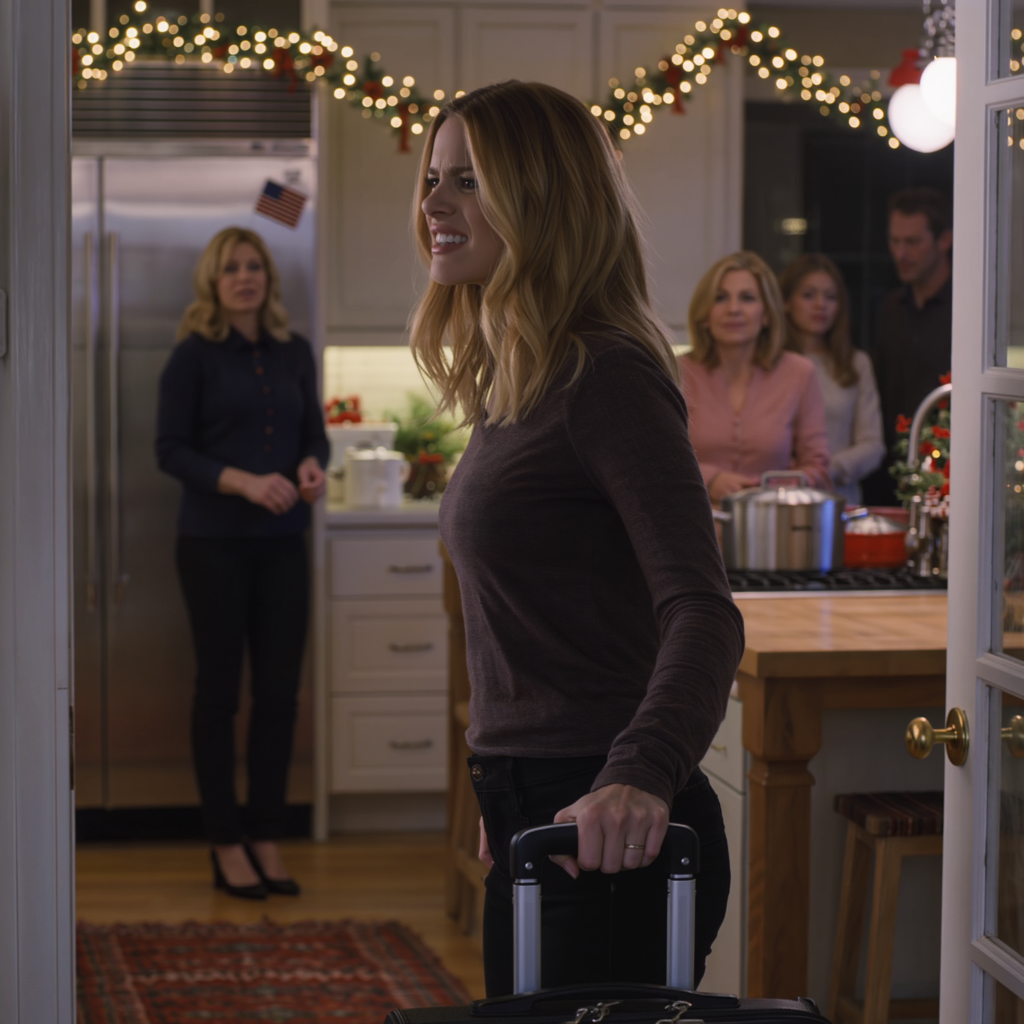
The irony hit me every time I saw the little chipped American flag magnet on my mom’s stainless-steel fridge. It held up a crooked legal pad covered in her handwriting—lists of chores, menus, and names. That December, the paper was so crowded it looked like a battle plan. Twenty-five guests. Appetizers. Entrées. Desserts. Times. Temperatures. My responsibilities were underlined three times.
Outside, a neighbor’s front porch glowed with red, white, and blue Christmas lights wrapped around a flagpole. Frank Sinatra crooned from the TV in the living room. The whole house looked like a postcard version of the holidays in the United States—festive, patriotic, perfectly staged.
Inside the kitchen, I was the one thing nobody bothered to decorate.
I didn’t know it yet, but that crooked flag magnet and the list beneath it were about to blow my entire life open.
“‘The day before Christmas, my mom scoffed and said, ‘Your sister’s friends are coming for Christmas—only twenty-five people.’” I can still hear the way she said only, like twenty-five human beings could be folded and stacked like napkins if you planned correctly.
She didn’t even turn around when she said it. She was standing at the stove, stirring a pot of marinara that I had chopped the onions for, her hair pulled back in a tight bun that said she meant business.
“Make sure everything is perfect,” she added, pointing at the list without looking at me. “You know how Chloe gets embarrassed when things aren’t done properly.”
I stood there with a dish towel in my hand and this strange, quiet buzzing in my ears. “Twenty-five people, Mom? That’s not a family dinner. That’s an event.”
She scoffed, finally glancing over her shoulder at me. “Oh, don’t start. You’re here to help, aren’t you? Cooking is the least you can do. The house also needs a deep clean. And remember—serve appetizers by six.”
There was no please. No thank you. No eye contact that said I was her grown daughter, not a line cook she’d hired by the hour.
Just expectation.
I felt the familiar sting in my chest but forced a steady smile. “Of course,” I said, because that was what I had always said.
It wasn’t the first time I’d played this role. I grew up in that house in Asheville, North Carolina, learning to read grocery store receipts before I knew how to calculate a tip. By the time I hit middle school, I could prep a holiday meal for ten without breaking a sweat. By high school, ten had quietly become fifteen. In my twenties, fifteen became twenty.
Now, at thirty-two, we were at twenty-five.
The number kept going up. My worth stayed exactly the same.
Chloe, my younger sister, drifted into the kitchen in fuzzy socks and a cream-colored sweater that probably cost more than my entire outfit. She leaned against the counter, thumbs scrolling lazily over her phone.
“Em, did Mom tell you my friends from Charlotte are coming?” she asked, not looking up.
“Yes,” I said. “She mentioned it.”
“They’re super picky,” Chloe added. “No mushrooms. No olives. And can we keep everything kind of…you know, elevated but still cozy? People always rave about your food.”
It sounded like a compliment, but somehow it landed like a command.
Patricia—my mom, but almost never “Mom” in my head these days—was obsessed with appearances. My dad, George, worked long hours and had perfected the art of staying out of the way. And Chloe? Chloe was the golden child. If she burned toast, the toaster must be broken. If she forgot a birthday, she was just “so overwhelmed.”
If I messed anything up, it was because I hadn’t tried hard enough.
I watched Chloe open the fridge and grab a can of sparkling water, the flag magnet wobbling under the weight of the legal pad as the door shut again.
“Careful,” I murmured, automatically steadying the pad. “If that falls, I’ll lose the schedule.”
“Relax,” she said lightly. “You always have everything under control.”
Then she breezed out as if she hadn’t just said the quiet truth out loud.
That night, when the house was finally quiet, I climbed the narrow stairs to the guest room, my shoulders aching from scrubbing floors and marinating meats that wouldn’t even be cooked for another twenty-four hours. The guest bed was made with crisp patriotic sheets—tiny flags scattered across white cotton—because of course my mother owned a Christmas set and a Fourth of July set and a “winter neutral” set.
I lay on my back and stared at the ceiling fan turning slowly overhead.
You’re here to help, aren’t you?
Cooking is the least you can do.
You always have everything under control.
For years, I’d told myself it was easier this way. Easier to come home, do the work, let everyone be happy, and then go back to my small apartment and quiet life. Easier to be the responsible one than to argue. Easier to swallow the bitterness than to spit it out and watch it explode.
But something about the way my mom said only twenty-five people had snapped something inside me that I couldn’t glue back together.
A single, sharp thought cut through the noise in my mind: I don’t have to do this.
It felt like a secret and a dare at the same time.
That was my first real bet with myself: if I walked away from their expectations, would anybody even know how to stand on their own two feet?
The question scared me—and thrilled me.
My phone buzzed on the bedside table. A promotional email. Then another. Then Chloe’s group chat lighting up with messages about outfits and Secret Santa gifts and “Can’t wait for Carter Christmas!!”
Nobody checked in with the person who was about to cook and clean for twenty-five people.
I sat up slowly.
In the dim glow of the lamp, the decision didn’t come as a dramatic lightning bolt. It arrived like a steady tide rolling in.
I opened my banking app. I’d been saving quietly for a “someday” trip, a place I could breathe. The number at the top of the screen wasn’t huge, but it was enough. Enough for a cheap flight, a modest rental, and a few days where nobody expected me to iron napkins or refill glasses.
I typed in “Asheville to Miami,” then “Asheville to Tampa,” then finally “Asheville to Fort Lauderdale.” Florida sounded like freedom—sun instead of fluorescent overhead lights, sand instead of crumbs on hardwood floors.
There it was: a last-minute round-trip ticket leaving just after midnight. I stared at the total.
$428.
Four hundred twenty-eight dollars to buy myself out of one more Christmas as the unpaid staff.
My thumb hovered over the “Purchase” button.
You’re thirty-two, I told myself. Are you really going to sneak out of your parents’ house like a teenager?
Another voice answered, quieter but fiercer.
You’re thirty-two. Are you really going to keep pretending this is normal?
I hit Purchase.
My heart pounded, but it wasn’t panic. It was something else—adrenaline mixed with a thin, unfamiliar thread of hope.
I packed a small suitcase with jeans, sundresses, my camera, and the paperback I’d been too tired to finish for six months. No one heard the zipper. No one heard the soft click of the guest room door.
In the kitchen, the list still clung to the fridge under the chipped flag magnet, full of orders written in my mother’s hand.
I stood there for a long moment, barefoot on the cool tile, the glow from the microwave clock painting the room in a faint green light.
If I walked out right then, they would scramble, maybe be annoyed, maybe talk about how “overdramatic” I was.
But this wasn’t about punishing them.
This was about finally taking myself seriously.
I opened the pantry.
I didn’t clear it out in a rage. I moved methodically, the way I always did. Pots and pans into boxes from the garage. The knives I had bought with my own money into my trunk. The spices I’d collected, the baking sheets, the slow cooker—all mine, I realized, and all leaving with me.
Cabinet by cabinet, I emptied out every tool and ingredient I had ever brought into that kitchen. The expensive stand mixer I’d gotten on Black Friday? That went into the backseat. The cutting boards? Those, too.
I left what my parents had owned before: the old chipped plates, the warped baking tray, the dented aluminum pot my dad used for chili back when he still cooked.
By the time I was done, the clock over the stove read 11:37 p.m.
The kitchen looked naked.
The flag magnet still held up the legal pad, but the list now floated over blank counters and hollow cupboards.
For the first time, the list seemed ridiculous. Twenty-five names, five courses, and not a single mention of who I was outside of that labor.
I took a photo of the fridge—not to send to anyone, not yet, just for me. Proof that I had finally stepped out of the role I’d been cast in.
Then I grabbed my suitcase, my car keys, and my courage.
By midnight, I was buckled into a window seat, watching the small cluster of runway lights fall away beneath me as the plane lifted off toward Florida.
I didn’t leave a note. Not yet.
I left something else instead: an empty kitchen and twenty-five hungry expectations waiting to collide with reality.
Two days later, those expectations walked through the front door.
Patricia’s scream echoed through the house so loudly that the neighbors’ holiday lights might have heard it.
“WHERE IS EVERYTHING?”
George, still in his work slacks and a Christmas sweater with a blinking reindeer, stepped into the kitchen, his mouth falling open. The counters were bare. The spice rack gone. The knives missing from their magnetic strip. Even the coffee maker had vanished.
It looked like someone had broken in and robbed them, but only of the things that made the place function.
Chloe clattered in on heeled boots, her phone pressed to her ear. “Guys, relax, my friends will be here in—”
She stopped.
“What the— Mom, is this a joke?” She spun around, wild-eyed. “My friends are arriving in forty minutes! Where’s dinner?!”
Patricia’s face had gone a strange shade of gray. “This isn’t funny,” she muttered, as if someone else might step out and say Surprise, just kidding, the turkey’s in the oven.
George opened cabinets, each hollow slam echoing through the house.
“The pots are gone,” he said slowly. “The pans. The casserole dishes. Half the pantry.” He grabbed the fridge handle. The door swung open to reveal a lonely carton of eggs, a block of aging cheddar, and three sad looking condiments.
On the outside of the fridge, the little American flag magnet bravely clung to the legal pad. The list still shouted APPETIZERS BY 6:00 PM in my mother’s looping handwriting, but now it looked less like a plan and more like evidence.
Patricia pulled out her phone and called me—five times in a row.
No answer.
Then she opened the family group chat.
At the bottom sat a single message from me, sent early that morning once I’d settled into my rental in Fort Lauderdale.
I’m spending Christmas somewhere peaceful this year.
The house is yours to manage.
Merry Christmas.
Attached was a photo: me on a sunny Florida beach, sunglasses on, hair whipped by the wind, a coconut drink with a tiny paper umbrella in my hand. Behind me, palm trees swayed and someone’s Bluetooth speaker played faint Top 40.
Chloe snorted, though there was an edge of panic in it. “Wait… she left? Like actually left?”
Patricia stared at the screen as if sheer willpower could make the message unsend itself. “She wouldn’t dare.”
But I had.
While the Carters scrambled, their guests began to arrive one by one, then in clusters—twenty-five carefully curated friends in sweaters and boots, carrying bottles of wine and store-bought pies. They stepped into a house that smelled like nothing: no roasting turkey, no cinnamon, no garlic and butter.
“Hey, where’s the food?” someone joked.
Patricia pasted on a brittle smile. “Just a slight delay! We’re…uh…trying a new timeline this year.”
In the kitchen, she hissed at George, “Order something. Anything. Just make it fast.”
They frantically scrolled through delivery apps, only to find wait times of ninety minutes, then one hundred twenty. Twenty-five people meant twenty-five orders, and the math did not care about my mother’s pride.
As the oven stayed cold and the microwave beeped only for reheated leftovers, Chloe’s friends started whispering—not about the missing roast or the fact that dinner was now a chaotic mix of takeout containers, but about me.
One girl, a soft-spoken redhead in a green velvet dress, leaned toward Chloe. “Your sister usually does all this by herself?”
“Yeah,” Chloe said, still half defensive, half dazed. “She’s really good at it.”
“Why didn’t you guys just…help her?” the girl asked gently. “I mean, twenty-five people is a lot.”
Another friend chimed in, “Honestly, it kind of seems like she’s been running the show every year.”
Chloe opened her mouth and then closed it. For once, she had no snappy answer.
The disaster they’d always quietly avoided exploded in real time: paper plates sagging under mismatched food, guests apologizing when they saw Patricia’s thin smile crack, George sweating as he tried to carve a store-bought rotisserie chicken into something that resembled a centerpiece.
In a single night, my absence did what years of quiet resentment never had—it made the imbalance visible.
Meanwhile, in Florida, I woke up on Christmas morning to the sound of waves tapping against the shore like a patient knock.
The apartment I’d rented was small and simple—a narrow balcony, a tiny kitchen with exactly four plates and four glasses, a faded couch that faced a flat-screen TV.
I brewed coffee in silence, watching the sunrise pour gold over the water. The air smelled like salt and sunscreen instead of bleach and roasted garlic.
I half expected guilt to creep in, thick and suffocating. But it didn’t.
Instead, a different feeling settled over me: a calm, steady certainty that stepping away had been the healthiest decision I had ever made.
I walked the beach barefoot, my camera hanging from my neck. I took photos of children building lopsided sandcastles, couples walking dogs in Christmas sweaters, a man jogging with an American flag bandana tied around his wrist. The world felt bigger than my parents’ kitchen for the first time in a long time.
That night, sitting on the balcony with a cheap glass of red wine, my phone lit up on the table beside me.
1 missed call: Dad.
1 missed call: Mom.
1 missed call: Chloe.
27 unread messages in the family group chat.
Twenty-seven. A new number, one that said more than any apology had so far.
I didn’t open them.
Not yet.
On the third day, just as the afternoon light started to soften, my screen lit up again.
Dad: Emily, please call when you can. We need to talk. We owe you an apology.
I stared at the message. My father had never used the word apology with me before. Not when I missed school to help my mom prep a fundraiser. Not when my college roommate called to say they hadn’t seen me on campus in days because I was home basting hams.
Something had cracked open on their side, too.
I took a slow breath, the Florida sun warm on my shoulders.
Maybe I would call.
But not yet.
Because the real transformation—for me and for them—had only just begun.
I went home on December 28th.
Not because I felt obligated. Not because I was ready to slide back into my old role.
I went home because, for the first time, I felt strong enough to face them on my own terms.
When I stepped through the front door, the house was strangely quiet. No TV blaring, no music playing. Just the low hum of the heater and the faint smell of pine from the tree in the living room.
My family was waiting there, not standing tall and lecturing, but sitting on the couch like people who weren’t quite sure how to begin.
Patricia—Mom—looked exhausted in a way that had nothing to do with makeup or lighting. George’s hands were clasped tightly together. Chloe, who was usually the most put-together person in any room, was twisting a ring around her finger.
“Emily,” my dad said, rising halfway before thinking better of it. “Hey.”
“Hey,” I answered.
For a moment, no one spoke.
Then George cleared his throat. “We…didn’t realize how much we relied on you. Or how unfair we’ve been.”
Chloe swallowed hard. “My friends kept asking why we treated you like staff,” she said quietly. “I didn’t have an answer. I’m…sorry.”
I didn’t rush to fill the silence. For once, I let it hang there, heavy and honest.
Finally, my mother lifted her gaze. Her eyes were red-rimmed, stripped of the sharp superiority she usually wore like eyeliner.
“I thought I was keeping the family together by making everything perfect,” she said. Her voice shook. “I pushed you because I thought you could handle it. I didn’t see what I was doing to you. I should have. I’m sorry.”
It wasn’t a grand speech. There was no dramatic background music, no slow clap from an invisible studio audience.
But it was real.
I nodded slowly. “Thank you for saying that. But things have to change. I won’t spend holidays doing all the work. I won’t be the family servant anymore. If we’re a family, we share responsibilities. Respectfully.”
No one argued.
That alone told me something might actually be different.
In the kitchen, the emptiness had been partially filled in. New pots and pans, a new coffee maker, a fresh set of knives still in its box. My parents had tried to replace what was missing.
But when my dad reached for his wallet, I shook my head.
“I didn’t take things to punish you,” I said. “I took them because I finally took myself seriously. I’m not asking you to buy that back.”
My mother looked at the bare spot where the spice rack used to hang, then at the lone survivor on the fridge door: the chipped American flag magnet, now holding nothing.
It fluttered slightly in the draft from the hallway.
Weeks passed.
Change didn’t arrive like magic. It came in small, sometimes awkward adjustments.
Chores got divided onto a new list taped beneath the same flag magnet: George—trash and breakfast on Saturdays. Patricia—laundry and vacuuming. Chloe—grocery runs and setting the table. Emily—cooking sometimes, when she wanted to, not because she had to.
There were slip-ups. Old habits resurfaced. Once, my mom nearly called from the living room, “Em, can you—” and then stopped herself mid-sentence, walked into the kitchen, and took over the sink full of dishes without a word.
Another night, she knocked on my bedroom door.
“Can I talk to you?” she asked.
I hesitated, then nodded.
She sat on the edge of my bed, fingers twisting the bracelet on her wrist. “I’ve been thinking about what you said,” she began. “About the way we’ve treated you.”
Her voice trembled. “I didn’t realize how deeply ingrained my expectations were. I thought mothers were supposed to hold things together. And I put that pressure on you because Chloe never handled responsibilities well.” She managed a weak smile. “You were reliable, so I leaned on you. Too hard.”
I listened, feeling the scars and fresh skin inside me pull.
“I’m learning,” she said. “I know I hurt you. And I’m trying to understand how to be better. Not just for holidays—but always.”
It was raw and unpolished, but it was honest.
“I appreciate that,” I said. “But rebuilding trust takes time. I need space to grow, too.”
She nodded, eyes shining. “I know.”
So I took that space.
I poured my energy into things I’d long put aside. I took my camera into downtown Asheville on weekends, capturing buskers playing under fairy lights, dogs tethered to benches, the way sunlight hit the Blue Ridge Mountains just right at golden hour. I signed up for a community photography class at the rec center. I started posting my work online, not for likes, but because it felt good to share something that came entirely from me.
With each new experience, I felt pieces of myself returning—pieces I hadn’t realized I’d handed over one chore at a time.
Meanwhile, the house evolved around me.
George started making simple breakfasts on Saturdays—scrambled eggs, toast, bacon more often than not a little too crispy. Patricia asked my opinion on small household decisions instead of announcing them. Chloe left Post-it notes on the fridge: Thanks for making dinner last night. I’ll clean up. Or Got groceries—check the freezer for ice cream.
Slowly, a new kind of warmth seeped into the corners of the house. Less staged, less polished, more real.
And then, just when life finally started feeling steady, something unexpected landed in my inbox.
It started with a single email.
I opened my laptop at the dining table one afternoon, the winter light soft and thin through the sliding glass door. I sipped lukewarm coffee from a mug that said WORLD’S OKAYEST SISTER—Chloe’s attempt at humor, and, strangely, affection.
New message: Pacific Horizons.
I blinked twice, sure it was spam.
Pacific Horizons was a travel magazine I’d adored since college, when their photos of far-off beaches and mountain towns were my only escape during late-night study sessions. They were the kind of publication real photographers got into.
I clicked.
Dear Emily Carter,
We came across your photography on social media and were struck by your eye for detail and sense of place. We are currently working on a feature highlighting emerging hobbyist photographers from across the United States and would love to discuss including your work. As part of this feature, we offer a week-long workshop and interview opportunity in California…
My heart thudded so hard I could feel it in my fingertips.
They didn’t just want a couple of photos.
They wanted to fly me out. Put me in a workshop. Interview me.
For a second, the old voice in my head jumped back in: Are you sure they meant to send this to you? Are you good enough?
Then another image rose up—the Florida beach, my bare feet in the sand, the realization that I had bought my own freedom with $428 and a backbone.
Maybe I was more capable than I’d ever been allowed to believe.
I reread the email twice, then clicked Reply.
When I shared the news at dinner that night, the reactions came fast.
Chloe’s fork clattered onto her plate. “You’re kidding,” she said, eyes huge. “Emily, that’s incredible! You have to go.”
George leaned back in his chair, a slow smile spreading under his salt-and-pepper mustache. “I’m proud of you,” he said. “Truly.”
Patricia’s expression shifted through a storm of emotions—surprise, admiration, something like fear. Fear, maybe, that her eldest daughter was stepping into a life no one could control or schedule.
Finally, my mother cleared her throat. “You deserve this,” she said quietly. “Every part of it.”
Something inside me loosened.
“Thank you,” I answered.
The weeks that followed were a blur of preparation—requests for time off from work, researching the workshop’s location on the California coast, making sure my camera gear was up to the task. I made lists, but they were my lists now: lenses, memory cards, comfortable shoes, a notebook just for this trip.
On the morning of my flight, my family drove me to the airport.
Chloe hugged me so tightly my ribs protested. “Send pictures,” she demanded. “Like, a million of them.”
George insisted on carrying my bag all the way to the check-in counter. Patricia didn’t fuss over my outfit or my hair. She just wrapped me in a hug that lasted longer than any hug from her ever had.
“Be safe,” she murmured. “And…have fun. Real fun. For you.”
“I will,” I said.
The workshop was everything I’d hoped for and more.
On the California coast, the Pacific crashed against rugged cliffs, and the air tasted sharp and clean. I spent mornings in classrooms learning from photographers whose names I’d only ever seen in bylines, and afternoons on location shoots—fog-draped piers, neon-lit boardwalks, sunlit alleys painted with murals.
On the last night, as the sun melted into the ocean, I lingered on a bluff with my camera, chasing the way the light slid across the water.
“You don’t shoot like a hobbyist.”
I turned to see one of the instructors, Marcus Hale, standing a few feet away, his camera hanging from a worn leather strap.
I laughed softly. “I’m not sure what I shoot like.”
“You shoot like someone who’s finally claiming something,” he said. “You ever thought about doing this professionally?”
The question hit me harder than the wind.
“I don’t know,” I admitted. “I’ve always been taking care of other people. I never really thought about what I wanted. Not seriously.”
Marcus nodded, as if he’d heard that a thousand times before. “Then maybe it’s time you did.”
His words followed me home.
Back in Asheville, jet-lagged but buzzing, I sat at my desk with an open notebook and wrote three words across the top of a blank page:
What if now?
Beneath that, I sketched out a simple plan. Not a drastic overnight reinvention. Just a start. A portfolio website. A goal to book one paying photography gig in the next three months. A promise to myself that I wouldn’t downgrade my dreams to fit anyone else’s comfort.
When I was done, I tore a sheet from the notebook and walked into the kitchen.
The fridge waited, humming quietly. The chipped American flag magnet still held the chore chart we’d made months earlier, edges worn from use.
I slid the chart down an inch and tucked my new page beneath it: EMILY’S PHOTOGRAPHY GOALS. Three bullet points. Nothing fancy.
The magnet snapped back into place, holding both lists together.
Family and future.
Obligation and choice.
This time, they sat side by side.
In the months that followed, I stumbled and learned and tried anyway. I sold my first print to a tourist who fell in love with a shot of the Blue Ridge Mountains. I shot a small engagement session for a couple Chloe knew from college. I got invited to display three photos at a local gallery night, my name printed—Emily Carter, Photographer—on a card beneath the frames.
Every small yes pushed back against years of unspoken no.
At home, we weren’t perfect. Voices still rose sometimes. Old patterns lurked in the corners. But apologies came more quickly now. Responsibilities stayed shared, not silently pushed onto my shoulders.
My mother even apologized again, once, in the quiet of the kitchen.
“I used to think keeping the family together meant controlling everything,” she said, wiping her hands on a dish towel. “Now I see it means cheering each other on.” She looked at me, eyes soft. “I’m cheering for you, Emily. I really am.”
For the first time, I believed her.
New Year’s Eve rolled around with little fanfare. No over-the-top party, no twenty-five-person guest list. Just the four of us, takeout Chinese food, and a muted countdown on TV.
At midnight, we clinked glasses—sparkling cider instead of champagne, by my dad’s request. Fireworks bloomed outside, reflecting in the sliding glass door.
I caught my reflection in the glass: older than the girl who used to stand at the stove alone, but lighter somehow.
Gone were the anxious mornings and tense gatherings that left me drained for days. In their place was something quieter but so much stronger—a sense of ownership over my own life.
I wasn’t the unpaid help anymore.
I was the woman who had walked out, cleared the kitchen, and flown to Florida with $428 and a spine.
I was the woman who’d stood on a California bluff, camera in hand, and heard someone say, You don’t shoot like a hobbyist.
Most importantly, I was the woman who had finally given herself permission to choose peace over pressure.
The little American flag magnet on the fridge caught my eye one more time. It now held three layers of paper: a simple grocery list in George’s handwriting, the shared chore chart in Patricia’s neat script, and my photography goals—new lines added in my own looping pen.
It wasn’t just a magnet anymore.
It was proof.
Proof that you can love your family and still walk away from the versions of yourself they’re most comfortable with.
Proof that twenty-five guests and twenty-seven unread messages can be the push you need to rewrite the story.
Proof that sometimes the real shock isn’t the empty kitchen they find when you’re gone.
It’s the person you become when you finally come back on your own terms.
And for me, that was exactly what this was:
Not an ending.
A beginning.
If there’s one thing I’ve learned since that first Florida flight, it’s this: beginnings don’t arrive with marching bands. They show up on ordinary Tuesdays when you’re rinsing coffee cups or answering emails, and they ask quietly, So…what now?
For me, the answer came in layers.
A few weeks after New Year’s, Pacific Horizons published the feature. My photos—my photos—sat beside three other photographers’ work, each spread like a small universe. Mine focused on the Blue Ridge Mountains and the Florida shoreline, side by side. Home and escape sharing the same page.
The editor had sent me a PDF ahead of time, but holding the physical magazine in my hands felt different. The pages smelled like ink and possibility.
“It’s really you,” Chloe whispered, flipping through the issue for the third time at our dining room table. “Emily Carter, Asheville, North Carolina.” She grinned and nudged my arm. “The Emily Carter. Should I start charging for autographs by association?”
“Please don’t,” I said, but I was smiling.
George cleared his throat. “How much did they pay you?” he asked, not rudely, just practically.
“Seven hundred and fifty dollars,” I said, trying to keep my voice neutral.
My mother blinked. “For photos you already took?”
“Yes,” I answered. “And they said they might commission more later this year.”
There it was: another number, another marker that this wasn’t just a fragile dream I’d made up after one good workshop. This was real enough to show up on a check in black ink: $750 for seeing the world the way I did.
Patricia ran her fingers along the edge of the magazine. “I used to think photography was just…you taking pictures to relax,” she admitted. “I didn’t realize it could be…”
“A career?” Chloe supplied.
“A path,” Mom finished. “A path that belongs to you.”
We weren’t a family that said I’m proud of you easily, but the way she held that magazine, the way my dad carefully tucked the extra copy into a plastic sleeve “so it doesn’t get ruined,” said enough.
Word spread faster than I expected.
A neighbor came by with a casserole one afternoon, ostensibly to drop off a recipe but really to ask, “So is it true? You’re in a magazine?”
My aunt in Ohio texted a photo of the issue open on her kitchen table, next to a mug printed with the U.S. flag. My cousins liked and reshared my online posts. People who had come to our disastrous Christmas dinner left comments on Pacific Horizons’ social media: We know her! Her cooking is amazing too!
The irony wasn’t lost on me.
You never know who’s watching when you finally stand up.
Of course, not every reaction was simple.
One Sunday after church, Patricia came home quieter than usual. She set her purse down, shrugged off her coat, and leaned against the counter.
“What happened?” I asked, rinsing out the coffee pot.
She sighed. “A few people asked about Christmas,” she admitted. “Apparently word got around that we served takeout to twenty-five guests.” She gave a humorless laugh. “Mrs. Duffy said she never realized how much you did until she heard the whole story.”
I could imagine the looks, the sympathetic shakes of the head. The murmured, Poor Emily, her parents worked her to the bone.
“How did you respond?” I asked.
Mom hesitated. “I told them the truth,” she said. “That we took you for granted. That you finally did what you should’ve done years ago and chose yourself.”
The admission hung in the air like a bell tone.
“I’m not proud of how we got here,” she continued, “but I’m glad we didn’t push you so far you never came back.”
That sentence lodged itself in my chest like a bookmark.
We didn’t push you so far you never came back.
It was the opposite of what I’d been afraid of my whole life—that if I drew a line, I’d be the one abandoned.
Instead, stepping away drew a different kind of line: not between me and them, but between who we had been and who we could still become.
As winter thawed into a muddy, hesitant spring, my days filled up in new ways.
I worked my regular nine-to-five at the insurance office, but evenings and weekends were mine. I shot senior portraits in city parks, engagement sessions at overlooks, even one small wedding in a backyard strung with Edison bulbs and paper lanterns.
I screwed up plenty. Once I forgot to charge a backup battery. Another time I underestimated how quickly mountain fog could eat the light. But every mistake was mine. Every fix, mine too.
My favorite sessions happened close to home.
One Saturday in March, Chloe poked her head into my room. “Hey. Got a weird request,” she said.
“Those are always the best kind,” I answered, looking up from my laptop.
She stepped in, twisting a strand of hair around her finger. “My friend Maya’s parents are celebrating their thirtieth anniversary next month,” she said. “They’ve never had real photos taken. She saw your stuff online and asked if you’d consider doing a family session for them. They can pay. Not a lot, but…”
I didn’t let her finish.
“I’d love to,” I said.
We met Maya’s family at a local park. Her parents wore worn-in jeans and matching navy sweaters; their two kids chased each other around the picnic shelter with sticky hands and wild laughter. I snapped shot after shot as they piled onto a blanket, as the kids crawled into their parents’ laps, as Maya’s mom wiped dirt from her son’s cheek and then pulled him close anyway.
When I delivered the gallery a week later, Maya’s mom called me with tears in her voice.
“We’ve never seen ourselves like this,” she said. “Thank you. You don’t know what this means.”
But I was starting to.
I was starting to understand that photography, for me, wasn’t just about escaping. It was about witnessing. About saying, I see you, to others—and, finally, to myself.
At home, the little American flag magnet kept doing its quiet job.
Grocery lists. Appointment reminders. A flyer for a local art walk where one of my pieces was displayed in a coffee shop window.
One evening, I came home to find something new under it: a clipped-out square of my Pacific Horizons spread, trimmed carefully and taped to a piece of cardstock.
At the bottom, in my father’s careful handwriting, were four words.
“Don’t forget who started.”
I traced the letters with my thumb.
The younger version of me—the one who thought her value lived entirely in casseroles and sparkling countertops—would have broken down sobbing.
The current me smiled through a sting of tears and whispered, “I won’t.”
Because I hadn’t just started the cooking or the cleaning or the endless lists.
I’d started this.
The shift.
The boundaries.
The life that finally felt like my own.
Still, growth rarely shows up without a new test tagging along behind it.
Mine arrived in late summer, in the form of an opportunity that looked suspiciously like a fork in the road.
It began, once again, with an email.
This time, the subject line read: FOLLOW-UP FEATURE OPPORTUNITY.
My heart did its now-familiar lurch as I opened it.
Dear Emily,
We’re working on a longer piece about everyday Americans who’ve redefined their lives after major turning points. Your initial story—leaving home for Florida, pursuing photography—caught our attention. Would you be willing to share more about that experience for a written profile alongside additional images? We’d conduct a formal interview and, if you’re open to it, visit Asheville for an at-home shoot.
The irony of being asked to let a camera crew into the very kitchen I’d once cleared out to escape was not lost on me.
I read the email three times, then set my phone down and stared at the ceiling.
A profile.
An article that would spell it all out, not just in the soft gloss of artful landscape shots, but in words. In my words.
The girl who flew to Florida instead of cooking for twenty-five people. The family that had mistaken her labor for love.
Was I ready for that story to become public? For the Carters’ private mess to be printed in black and white?
That night at dinner, I brought it up.
“So,” I said casually, pushing a piece of broccoli around my plate. “Pacific Horizons emailed again.”
Chloe’s eyes lit up. “Oh my God, already? What do they want this time, your soul?”
“Something like that,” I said with a half smile. “They want to do a written profile. About…everything.”
Patricia paused mid-bite. “Everything?” she repeated.
“The Florida trip. The workshop. The magazine. How things have changed.” I looked at her steadily. “They’d want to do some photos here. At the house.”
Silence dropped like a stone.
My dad set his fork down slowly. “And you?” he asked. “What do you want?”
I’d been waiting for that question my whole life.
“I don’t want to humiliate anyone,” I said. “I don’t want to paint you as villains. Because you’re not. We all played our parts. But…if my story helps someone else realize they can step away from something that’s hurting them, maybe that’s worth it.”
Mom looked down at her plate, then back up at me.
“Will people know it’s us?” she asked quietly.
“Probably,” I said. “Names can be changed, but…Asheville isn’t that big.”
She exhaled, a long, slow breath that seemed to deflate years of pride.
“Then let them know,” she said.
My head snapped up.
She straightened her shoulders. “We acted badly,” she said. “We leaned on you in ways we shouldn’t have. If people talk, they talk. Maybe they’ll also see that we’re trying to do better.” She glanced at my dad. “Right?”
George nodded once. “Right,” he said. “If this is what you want, we’re behind you.”
I hadn’t realized how tightly I’d been gripping my napkin until I felt it loosen between my fingers.
“Okay,” I said softly. “Then I think I’m going to say yes.”
The interview took place on a humid afternoon in September.
A writer named Jenna showed up with a small crew—just one photographer and a sound tech. She wore jeans, boots, and a T-shirt that said SUPPORT LOCAL ARTISTS in faded block letters.
We sat at the dining room table, the same one where so many lists had been made and boundaries ignored. Her recorder clicked on.
“Take me back to that night in December,” she said. “When did you know you were really going to go?”
I told her about the flag magnet, the legal pad, the $428 ticket. I told her about the emptiness in the cupboards and the fullness in my chest as the plane lifted off.
“How did your family react?” she asked.
I didn’t sugarcoat it. But I didn’t sharpen it into something cruel, either.
“They panicked,” I said honestly. “They were shocked. And then they learned. And so did I.”
Patricia and George each agreed to be interviewed too. Watching my mother sit where I’d sat, fingers folded tightly in her lap, was surreal.
“I thought I was protecting the image of our family,” she told Jenna, voice low. “I didn’t realize I was sacrificing my daughter’s peace to do it.”
Chloe spoke as well.
“I always thought Emily liked doing it,” she confessed. “The cooking, the planning. I told myself that because it made me feel better about letting her do everything. Turns out, just because someone is good at something doesn’t mean they should be the only one doing it.”
The photographer—different from Marcus, but just as perceptive—took candid shots as we moved through the house. Me at the fridge, rearranging the papers under the flag magnet. My parents cooking together, side by side at the stove. Chloe and I laughing over a stack of old family photos spread across the counter.
At one point, the photographer asked, “Mind if I get a shot of you all in the kitchen doorway?”
We lined up: my parents in the middle, Chloe on one side, me on the other.
“On three,” she said. “One, two—”
I reached up and, without thinking, straightened the crooked flag magnet.
“Three,” she finished, snapping the photo.
Later, when they sent us a preview, that was the shot they chose for the article.
Four people. One doorway. A tiny, stubborn magnet holding a story together in the background.
The article went live online first.
I braced myself as I clicked the link.
“From Holiday Help to Headliner: How One Woman Rewrote Her Family’s Script,” the headline read.
The piece was kinder than I’d feared and more honest than I’d imagined they’d dare. It didn’t shy away from the imbalance, from my exhaustion, from the social fallout after that infamous takeout Christmas. But it also highlighted my parents’ willingness to own their mistakes, Chloe’s growth, and my decision to build something new instead of burning everything down.
The comment section surprised me the most.
There were trolls, of course—there always are—but they were drowned out by something else.
“I feel this so deeply,” one person wrote. “I’m the eldest daughter too. This gave me courage.”
“My mom treated me like the family manager for years,” another said. “Thank you for reminding me I’m allowed to rest.”
“I showed this to my parents,” someone else added. “We had a hard conversation. It went better than I expected.”
I scrolled until my eyes blurred, seeing the same themes over and over—pressure, expectation, gender, culture, obligation—but also: change, boundaries, healing.
The number at the top of the screen told its own story.
Over 19,500 shares in the first week.
I stared at that number until it blurred.
Nineteen thousand five hundred people had cared enough to pass my story along.
That was more than seven hundred and fifty dollars. More than twenty-five guests. More than twenty-seven unread messages.
That was impact.
That was a ripple.
At home, things remained…normal. Messy. Human.
Mom still over-seasoned the green beans sometimes. Dad still forgot where he put his glasses. Chloe still borrowed my sweaters without asking.
But now, when someone started to slip into old patterns, there was a new kind of accountability.
One night in November, as the next holiday season crept closer, I walked into the kitchen to find Patricia standing in front of the fridge, legal pad in hand, pen poised.
She was making a list.
I froze for half a second.
Appetizers. Entrees. Desserts. Times. Temperatures.
It looked like history repeating itself.
Then I noticed the columns.
Mom. Dad. Chloe. Emily.
Under each name, she’d written tasks. Not all equal on every line, but shared. Distributed.
When she saw me, she stepped aside.
“I thought we could decide together this year,” she said. “No more surprises. No more onlys.”
I moved closer.
Under Emily, she had written: “Bring one dish you enjoy making. Nothing else required.”
The words hit me harder than any apology.
“Is that okay?” she asked.
I smiled. “It’s a good start,” I said.
Christmas Eve came quietly.
No twenty-five-person guest list. Just immediate family and a few close friends—eight people in total. We cooked together, bumping into each other in the narrow kitchen, trading jokes and spatulas. At one point, my dad put Sinatra on the speaker, and we all groaned, then laughed, then sang along anyway.
I made one dish: lemon-garlic roasted potatoes, the way I liked them. Crisp edges, soft centers, extra herbs.
No one asked me to do more.
After dinner, I slipped into the hallway and grabbed my camera.
I snapped a photo of my mother laughing as Chloe tried to steal a piece of pie. My father rinsing dishes while humming under his breath. Our guests, full and happy, curled up on the couch under throw blankets.
Finally, I turned the lens on the fridge.
The flag magnet held up the shared chore chart, the grocery list, my photography goals, and a small handwritten recipe card: EMILY’S POTATOES.
Four layers of paper. Four people learning how to stand shoulder to shoulder instead of stacked on top of one another.
I clicked the shutter.
Later that night, lying in bed, I scrolled through the images from the day.
They weren’t perfect. Someone’s eyes were half closed in one; the kitchen light cast a yellow tint in another. But the emotion in them was unmistakable.
We weren’t the same family we’d been a year before.
And I wasn’t the same woman.
Before you scroll past this in your own mind, I’m genuinely curious—have you ever walked away from something everyone expected you to tolerate? Or had a moment where you finally chose peace over pressure and watched the whole script change?
Because if you have, you know what I learned standing in that Florida sand, staring at my phone with twenty-seven unread messages and the ocean at my back:
Sometimes the bravest thing you can do is put down the dish towel, pick up your own life, and walk out the door.
Not to punish anyone.
But to give everyone—including yourself—a chance to come back different.
And when you do, when you stand in a kitchen that used to feel like a prison and realize it’s finally just…a room, with a fridge and a magnet and a stack of lists that actually make sense?
That’s when you’ll know.
The real shock was never the empty shelves.
It was this.
The quiet, steady, ordinary miracle of finally living a life that belongs to you.
A beginning, after all.
Still.”}]}
News
On my birthday, my parents hosted a dinner with 100 relatives just to disown me. my dad handed me a bill, said: “every cent we wasted raising you. pay or never contact us again”. my sister grabbed my car keys from the table: “dad already transferred the title to me.” i walked out without a word — four days later, they’re calling me…50 times a day
On my birthday, my parents didn’t bring out a cake. They brought out witnesses. Nearly a hundred relatives sat shoulder…
At My Mom’s Birthday, My Brother’s Son Threw My Son’s Drawing Into The Fire And Yelled, “Nobody Wants His Crappy Art Anyway.” Everyone Laughed. That Night, My Dad Texted, “You’re Making Things Uncomfortable — Just Skip Christmas.” I Replied, “So Does The Funding.” By 1 A.M., My Phone Was Melting. 27 Missed Calls.
By the time the clock on my stove blinked 1:00 a.m., my phone looked like it was about to catch…
“You’re not family, don’t show your face here,” the whole table burst out laughing, I picked up the entire lasagna and left – 4 days later, their loan was rejected by the bank, that night, my phone lit up
My name is Jean William. I’m thirty years old, and the night I realized my family didn’t love me the…
I was serving champagne at a gallery when i saw it. a painting i made when i was 6. price tag: $150,000. ‘sir, that painting is mine,’ i said. ‘impossible,’ the gallery owner laughed. he called security to kick me out. but he forgot to check the secret message on the back of the canvas.
I was balancing a silver tray of champagne flutes when I saw it. Not the painting, not yet. First I…
“Mom texted: ‘Ice storm, Christmas is canceled, everyone stay home to be safe’ — the next morning the whole family called saying ‘we miss you so much’, I opened Instagram and saw all of them raising their glasses at my sister’s house… and that night I decided to do something that would make their fifteen years of pretending unable to go back to how they were.”
I believed my mother’s text the way I had believed a thousand small mercies before it. “Everyone’s staying home due…
My younger sister shoved me into the corner of the table, a loud “crack” rang out — my mother snatched the phone out of my hand, “It’s just a rib,” my father barked “drama queen” as if the broken bone came from my personality. That night, I walked out the door of the house I grew up in, one arm still not even inside my coat sleeve. And what I did next… didn’t need to be loud.
By the time I heard the crack, the little plastic American flag magnet on our fridge was already tilted, pointing…
End of content
No more pages to load