
On my birthday, my parents didn’t bring out a cake.
They brought out witnesses.
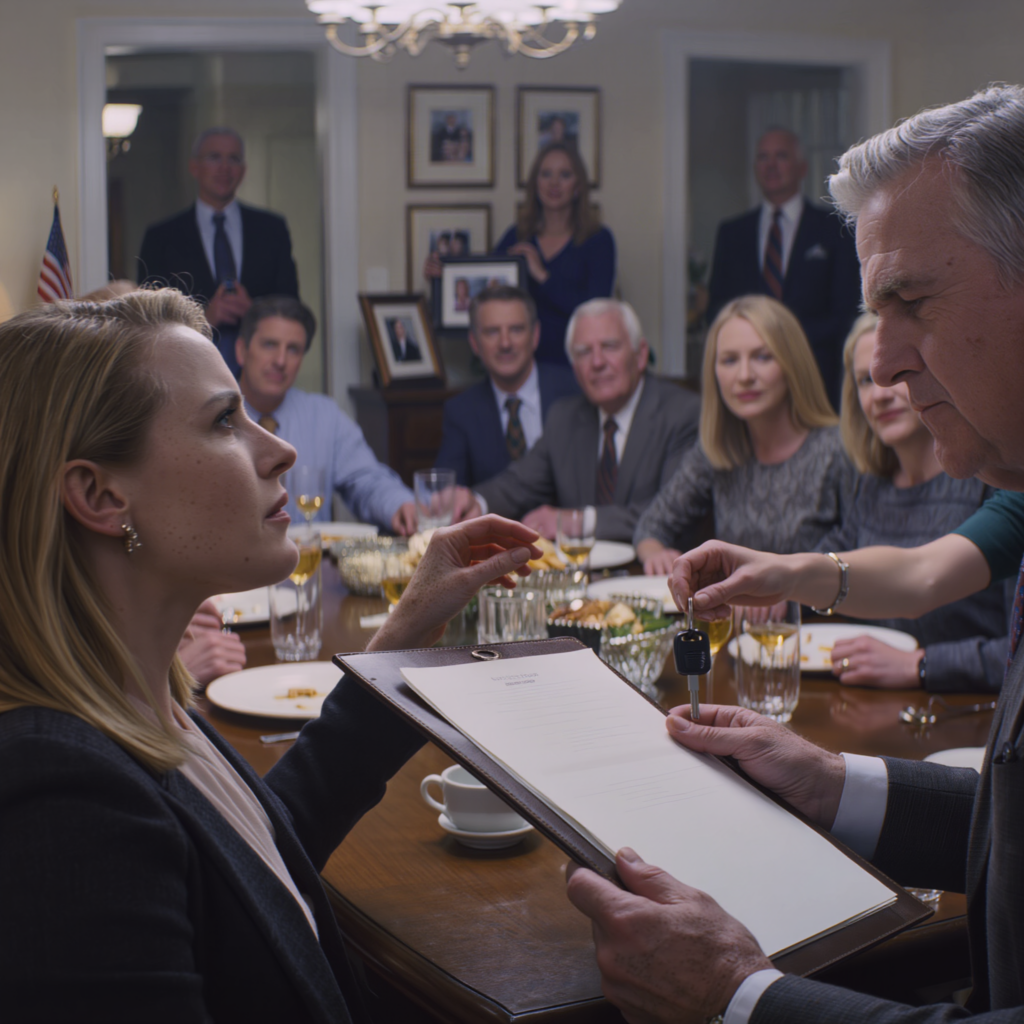
Nearly a hundred relatives sat shoulder to shoulder in my parents’ dining room, silverware aligned like it was a photo shoot, voices lowered the way they got when my father wanted the room to listen. The only “birthday” detail in sight was a paper flag stuck in a mason jar of iced tea on the buffet—red, white, and blue, cheerful in the kind of way that felt accidental. Somewhere in the kitchen, an old Sinatra playlist hummed through a speaker, soft enough to pretend this was warm.
Then my dad slid a leather folder across the table to me like we were closing on a house.
The hinge of it clicked.
And I understood I wasn’t being celebrated.
I was being audited.
Before I tell you how my silence that night turned into something they never expected, I want you to picture the room the way it really was: not festive, not familial—just staged. Rows of faces. Familiar smiles held in place. People who’d known me since I was a toddler suddenly looking at me like I’d been invited to my own trial.
My name is Amanda. I’m in my early thirties, and for most of my life, I was the child my family didn’t quite know what to do with.
I wasn’t loud enough to be impressive. I wasn’t fragile enough to be protected. I learned early that in our house, love was quiet, conditional, and usually came with a receipt.
From the outside, my family looked flawless. Big house in a tidy suburb outside Philadelphia. Long driveway. Holiday dinners that felt more like PR events. Neighbors said we were “so close” because they saw my mom on the porch waving and my dad handing out those tiny American flags every Fourth of July like he’d personally invented patriotism.
Inside, everything ran on unspoken rules.
My father—Richard—believed money was proof of worth. My mother—Elaine—believed silence was the same thing as peace. And my younger sister Lena learned very young that being adored was a skill.
She mastered it.
Growing up, I was the reliable one. The one who fixed things. When the Wi‑Fi went down before a party, I handled it. When bills piled up or passwords got forgotten, I quietly sorted them out. I never asked questions. I never asked for credit.
I told myself that was what being part of a family meant—showing up even when no one noticed.
But the photos on the wall told a different story.
Lena’s smile was everywhere. Graduation. Vacations. Framed moments frozen in gold. My pictures were fewer, tucked into corners, easily replaceable. I noticed, but I trained myself not to flinch.
Independence became my version of safety. I paid my own rent. I drove my own car. I built my own career. And every time my father tried to remind me of what he’d “provided,” I’d nod and swallow it, because swallowing things was what I’d gotten good at.
That’s why I didn’t question the dinner invite.
Elaine had texted two days before: Birthday dinner Sunday. Family’s coming. Wear something nice.
No heart emoji. No “we’re proud of you.” Just an instruction.
I showed up straight from work, still in my blazer, sensible flats, hair pinned back like I didn’t have time for softness. I remember pausing in the entryway, adjusting my bag on my shoulder, listening to the hum of conversation spill into the hall.
Laughter. Glasses clinking. My name floating through the air once or twice, followed by polite smiles.
My mother barely looked at me when I walked in. She was busy smoothing her dress, making sure everything looked perfect. My father was in host mode, shaking hands, telling stories with that confident, booming tone that made strangers think he was generous.
Lena stood near the center of it all, glowing like she belonged there in a way I never quite did.
She wore a fitted cream dress and the kind of smile that made people lean in. When she saw me, she didn’t hug me. She just lifted her chin a fraction.
“Hey,” she said, like I was a coworker she’d run into in the break room.
“Hey,” I answered.
“Cute jacket,” she added, then turned back to my aunt without waiting for my reply.
That was the first sign.
The second sign was the place setting.
Everyone had a name card. Neat script. Little gold leaf accents. Even my uncle’s girlfriend of three months had one.
Mine just said AMANDA in block letters, like it had been written by someone in a hurry.
I sat anyway.
Because for years, my survival strategy had been the same: don’t make it harder. Don’t take up space. If you keep your hands folded and your voice level, maybe you won’t give them anything to use.
Dinner began the way these things always did—perfectly timed, perfectly staged.
Plates appeared all at once. Wine was poured without anyone asking. Conversations overlapped just enough to sound warm, but not enough to feel real.
My father told a story about “family values.” Someone laughed at the right place. My mother smiled without showing teeth.
Across from me, my cousin Tara leaned over and whispered, “Happy birthday,” like she was slipping me contraband.
“Thanks,” I whispered back.
She squeezed my wrist under the table, quick and secret.
That tiny squeeze felt like the only real thing in the room.
And then my mother stood.
She didn’t tap her glass. She didn’t make a speech.
She walked behind me to the wall where the framed photos hung in a neat grid. Family trips. Holiday mornings. Lena at every milestone.
And without a word, she reached up and lifted one frame off the hook.
It was a photo of me—just me—sixteen, sunburned, laughing at something out of frame.
The sound it made wasn’t loud. A soft scrape. Paper against drywall.
She set it face down on the sideboard.
Then she lifted another.
And another.
One by one, my pictures came down like a slow, quiet erasure.
No one reacted.
That was the moment my stomach went cold.
My father cleared his throat.
The room quieted—not because he asked for attention, but because he was used to being obeyed.
He smiled the way he did when he thought he was being generous.
“Amanda,” he said, pushing back his chair slightly, “we’ve been meaning to talk.”
His hand slid the leather folder across the table toward me.
It was heavy—too heavy for paper alone.
I stared at it.
A few relatives shifted in their seats. Someone’s fork clinked against a plate. Sinatra drifted through the air like background wallpaper.
My mother sat back down and folded her napkin with methodical care.
“Amanda,” my dad repeated, like I hadn’t heard him.
I opened the folder slowly, aware of every eye in the room.
Inside was a single sheet.
Itemized. Neat.
Columns of numbers.
Years tallied into one final total, rounded but precise enough to sting.
At the bottom, in bold, it read: $249,772.18
Just under a quarter-million.
My ears rang.
My father’s voice stayed steady. “This is the cost of raising you,” he said, as casually as if he were discussing a car payment. “School. Food. Housing. Activities. Everything.”
I blinked at the paper.
Someone laughed nervously. I couldn’t tell who.
“This isn’t punishment,” my dad added. “It’s accountability. You’re an adult. Adults settle their debts.”
I looked up.
My father’s eyes were calm, almost kind, like he expected me to thank him for the lesson.
My mother stared at her plate.
Lena didn’t look surprised at all.
“If you can’t,” my dad continued, lowering his voice just enough to sound reasonable, “then we should probably take some space. No more contact until this is resolved.”
No more contact.
Until I paid them back for existing.
That’s when it clicked: this wasn’t about money.
It wasn’t even about control.
It was about erasing me and calling it responsibility.
Turning love into a ledger.
And in that instant, a quiet promise formed in my chest—sharp, clean, and oddly calm: if they wanted to live by numbers, I could speak their language better than they ever guessed.
I closed the folder.
My hands were steady.
My heart wasn’t.
I didn’t say a word.
I didn’t have time to, because my sister leaned forward.
Lena moved like she was onstage—slow, deliberate, practiced. Her fingers brushed something cold and metallic on the table.
My key ring.
It had a tiny American flag charm on it from a summer street fair years ago, the kind of cheap enamel you’d buy without thinking. I’d kept it because it made me feel anchored, like I belonged to something bigger than whatever my family decided I was.
Her hand slid across the polished wood.
Clink.
The sound of metal was louder than any toast that night.
She didn’t look at me right away.
She turned the key ring once, watching the charm catch the light, then smiled like she was doing me a favor.
“Dad already transferred the title this morning,” she said. Calm. Almost bored. “It’ll be in my name by tomorrow.”
I stared at her.
“That’s my car,” I said, finally.
Lena shrugged. “It was always the family’s car. You just… used it.”
My dad didn’t correct her.
He nodded like this was reasonable.
“You weren’t really using it the way the family intended,” he said, like my commute was a misuse of property.
I looked around the table.
A hundred faces.
No one spoke.
No one said, That’s not right.
No one said, It’s her birthday.
The room was quiet in a way that felt rehearsed.
Then my father gestured toward the far end of the table.
“That brings us to the last point,” he said, like he was wrapping up a meeting.
I followed his gaze.
And saw my manager standing near the doorway.
Mark.
His hands were clasped too tight in front of him, eyes darting anywhere but at me.
I felt my stomach twist.
“What is he doing here?” I heard myself say.
Mark swallowed.
“Amanda,” he began, voice unsteady, “based on some concerns that were brought to my attention tonight, we’ve decided to… let you go. Effective immediately.”
No paperwork.
No HR.
No warning.
Just a sentence delivered over dinner like an afterthought.
A few people gasped—not out of empathy, but out of entertainment.
Someone whispered, “Oh my God.”
I waited for the wave—tears, rage, begging.
The kind of scene they could replay later to justify everything.
But nothing came.
I felt hollow for exactly three seconds.
Then something else settled in.
Heavy. Solid. Clear.
I stood up slowly.
My chair scraped the floor.
I pushed it back in with care, as if manners still mattered.
I picked up the folder.
I slipped it into my bag like it was nothing more than mail.
I looked at my father.
He was smiling, relieved, like he’d finally cut a bad deal.
I looked at my mother.
She was smoothing her napkin like she could iron out what she’d done.
I looked at Lena, dangling my keys from one finger, already victorious.
I didn’t raise my voice.
I didn’t defend myself.
I didn’t say goodbye.
I walked out.
And that was the first time in my life I chose silence on purpose.
The gravel crunched under my shoes as I crossed the driveway alone.
No one followed.
No one called my name.
By the time I reached the street, the house behind me was already closing ranks, lights glowing warm against the dark like it hadn’t just swallowed me whole.
I didn’t go somewhere dramatic after I left. No airport. No friend’s couch. No sobbing in a parking lot.
I walked.
Three miles, give or take.
Past quiet houses with porch lights on. Past sprinklers ticking like metronomes. Past couples laughing inside kitchens that smelled like dinner and normal lives.
The longer I walked, the more the shock drained out of my body and left something colder behind.
By the time I reached my apartment, my feet hurt and my hands were steady.
I didn’t turn on the lights.
I dropped my bag on a chair, set the folder on my desk, and stared at it like it might start talking.
My phone buzzed.
Once.
Twice.
I didn’t pick it up.
I already knew who it was.
I made tea because that’s what my body knew how to do when my life tilted—boil water, steep something, pretend routine still existed.
Then I opened my laptop.
The screen blinked to life.
That familiar dark background and blinking cursor.
This was the only place that still made sense.
I’m a cybersecurity analyst. My job isn’t revenge.
It’s pattern recognition.
It’s finding what doesn’t belong.
It’s following trails people assume are invisible.
And my family had always been terrible at hiding their trails.
I started with what I already had access to. Nothing shady. Nothing I wasn’t allowed to see.
Just records I’d helped manage over the years because Richard liked to call me when he didn’t want to look incompetent in front of his own spreadsheets.
“Can you just check something for me?” he’d say.
“Can you make this look clean?”
“Can you fix the formatting?”
I used to think he trusted me.
Now I understood he used me.
I opened old files.
Family “investment club” reports.
Shared accounts.
Statements relatives had emailed me because I was “good with computers.”
My hands moved fast, not frantic—focused.
Within an hour, the first pattern appeared.
Monthly transfers.
Neat repeated amounts.
Not chaotic.
Not accidental.
Money coming in from relatives who believed they were investing in something stable, something Richard was “managing” because he understood finance.
I recognized the names immediately.
Uncle Paul.
Aunt Helen.
Cousin Derek.
People who still mailed birthday cards with handwritten notes.
The money didn’t go where the reports claimed it went.
It landed, paused, then moved again—out, always out—into expenses that had nothing to do with investing.
Luxury rentals.
Flights.
Hotels.
Designer charges.
Payments tied to Lena’s lifestyle.
My stomach didn’t drop.
It hardened.
I leaned back in my chair and stared at the ceiling.
This wasn’t just favoritism.
This wasn’t just cruelty.
This was a machine.
And I had been the unpaid mechanic keeping it running.
I heard my father’s voice in my head—Adults settle their debts.
I whispered into the empty room, “Okay.”
And I made my bet real.
If they wanted a ledger, I would give them one.
Just not the one they expected.
My phone buzzed again.
I flipped it over.
The screen lit up with missed calls stacked like a staircase.
My mother.
My father.
Lena.
Mark.
I didn’t answer.
Because the more I looked at the numbers on my screen, the more I realized: the only power they’d ever had was my participation.
So I stopped participating.
I built a timeline.
I matched amounts.
I labeled transactions the way they actually functioned, not the way my father described them.
On one tab, I tracked incoming contributions. On another, outgoing payments. On a third, the “reporting” Richard had been sending to relatives.
The gaps weren’t subtle.
There were months where $7,000 came in and $6,982 went out to a travel company within forty-eight hours.
There were “investment fees” that looked suspiciously like monthly car payments.
There were deposits that lined up perfectly with Lena’s social media posts—weekend trips, designer bags, hotel balconies with captions like blessed.
Around 2:00 a.m., I found the transfer that made me sit up straighter.
A lump sum.
$19,500.
From Uncle Paul.
Labeled in Richard’s notes as “college fund consolidation.”
Then moved out the same day to a dealership account.
The dealership name was printed in the memo line like the system couldn’t help telling the truth.
My throat tightened.
Because I didn’t just recognize the pattern.
I recognized the timing.
That payment was made the same week Lena had shown up with her “new” SUV and told everyone she’d gotten a “great deal.”
I stared at the line item until my eyes burned.
Then I opened my bag.
I pulled out the leather folder.
And I looked again at the bill for raising me.
$249,772.18
The number felt different now.
Not because it was less cruel.
Because it was a distraction.
A magician’s hand waving in front of the audience while the other hand emptied their pockets.
My phone buzzed.
I ignored it.
And I kept working.
By the time the first pale light crept through my blinds, the story was complete.
Ugly.
Clear.
Documented.
I backed up the files twice—one encrypted drive, one secure cloud folder. I wrote a summary in plain English, no tech jargon, so no one could dismiss it as “Amanda being dramatic.”
Then I finally checked my voicemail.
I didn’t listen.
I just looked at the count.
Forty-nine.
Forty-nine times they’d called me while I was building the map that would lead straight back to them.
And that was the moment the whole night flipped on its axis.
Because four hours earlier, they’d disowned me like I was disposable.
Now they were trying to reach me like I was the only thing keeping them from falling.
Mark’s message came through as a text.
Amanda, please call me. I didn’t know what else to do. They were there. Your dad—he said—please.
I didn’t respond.
Instead, I searched my contacts for the number I’d been hoping I wouldn’t need.
My regional director.
Monica Patel.
She’d approved my last project. She’d stayed calm while everyone else panicked during a security incident the year before. She valued process. She valued documentation.
She answered on the second ring.
“Amanda?” Her voice was careful. “It’s early.”
“I know,” I said. “I’ll be quick. I was terminated last night. Not through HR. Not through any formal process. It happened at a private family event.”
Silence.
Then, “Explain.”
“My manager delivered it in front of witnesses,” I said. “Based on personal claims made by my parents. No verification. No report. No opportunity to respond.”
Another pause.
“I’m going to need details,” Monica said.
“I have them,” I replied.
“Email me,” she said. “Now.”
I sent the timeline. The message from Mark. The names of the witnesses. The exact words.
Then I waited.
Not for long.
Five minutes later, a new email arrived.
Access restored.
Termination reversed.
A second email followed—formal and precise.
Mark was being placed on administrative leave pending review.
I was instructed to take the day off and return the following week.
I stared at the screen.
One pillar down.
My phone buzzed again.
This time I answered.
“Fix this,” my father snapped before I could even say hello.
No greeting.
No apology.
Just an order.
“Fix what?” I asked.
“You sent something,” he said. “People are asking questions. You need to correct it. Immediately.”
“I didn’t send anything,” I said.
He inhaled sharply. “Don’t play games, Amanda.”
“I’m not,” I replied. “I organized information.”
“You have no idea what you’ve done,” he hissed.
I looked at the leather folder on my desk.
At the bill.
At the clean columns.
“I do,” I said. “I finally do.”
There was a beat of silence that felt like he was trying to decide which version of me he was talking to.
Then he changed tactics.
“We can talk,” he said, voice smoothing out. “This doesn’t have to go any further.”
“That depends,” I said.
“On what?”
“On whether you’re willing to tell the truth,” I replied.
He scoffed. “Truth? You want to talk about truth after what you pulled?”
“What I pulled,” I said quietly, “was a spreadsheet.”
He didn’t like that.
Because he couldn’t argue with it.
He hung up.
I didn’t feel victorious.
I felt… clear.
Later that afternoon, someone knocked on my apartment door.
Hard.
I didn’t have to look through the peephole to know who it was.
I opened it a crack.
Richard stood too close, jaw tight, eyes red like he hadn’t slept.
Behind him, Lena hovered near the stairwell.
No confidence now.
No glow.
Just fear she couldn’t quite hide.
“Open the door,” my dad said.
“I am,” I replied.
He tried to smile, but it came out like a grimace.
“We did this for the family,” he said quickly. “For stability. For legacy.”
“You invoiced me,” I said, keeping my voice even. “In front of a hundred people.”
“That was a lesson,” he snapped. “You needed perspective.”
“My perspective,” I said, “is that you used other people’s money and blamed me for existing.”
His eyes flicked away.
Lena spoke then, voice smaller than I’d ever heard it.
“You didn’t have to involve everyone,” she said.
I looked at her.
“You mean the people you’ve been billing in the background?” I asked.
Her cheeks flushed. “You don’t understand—”
“I understand perfectly,” I cut in.
My dad leaned in, lowering his voice like we were sharing secrets.
“Please,” he said. “Just stop. You’ve made your point.”
I held his gaze.
For the first time in my life, I wasn’t trying to earn his approval. I wasn’t trying to explain myself in a way that would make him treat me gently.
“You taught me every action has a cost,” I said.
He swallowed.
“This is yours.”
He reached for the door.
I stepped back and shut it.
The click of the latch sounded louder than I expected.
And in that click, something broke that had been holding me in place for years.
My phone rang again.
I expected my father.
It was Uncle Paul.
His voice was tired, but steady.
“Amanda,” he said, “I got your message.”
“I’m sorry,” I began.
“Don’t be,” he interrupted. “I’m not calling to yell.”
I held my breath.
“I’m calling to thank you,” he said.
My throat tightened.
“You didn’t tear the family apart,” Uncle Paul continued. “You showed us where the cracks were. We just didn’t want to see them.”
In the background, I heard a murmur—other voices, other relatives.
Questions happening without my parents at the center of them.
My dad had built his whole identity on being the one everyone deferred to.
Now they weren’t deferring.
That alone was a kind of earthquake.
The fallout didn’t arrive with sirens or headlines.
It came quietly, the way real accountability usually does.
Relatives froze contributions.
Banks asked for clarifications.
An accountant my aunt trusted started requesting documentation.
The “family investment club” that had been treated like a cozy tradition suddenly looked like what it was: a business arrangement with missing pieces.
Lena’s social calendar collapsed first.
The weekend trips stopped.
The shopping stopped.
People who used to orbit her found other places to be.
She took a job she’d once joked was beneath her. I didn’t celebrate it.
I just noticed the silence where entitlement used to live.
Mark tried to call again.
I didn’t answer.
My mother sent one message.
I can’t believe you did this.
No “Are you okay?”
No “Happy birthday.”
Just disbelief that I’d broken the rule of staying quiet.
I didn’t respond.
At work, things settled into a new normal. My access stayed open. Projects moved forward. Colleagues treated me the same, which was its own kind of relief.
I took the day off like Monica told me to.
I slept.
I cooked something simple.
I sat in my living room and let the quiet be quiet.
Four days after the dinner, my phone wouldn’t stop vibrating.
Calls stacked up.
Voicemails.
Texts.
I finally turned the screen over and stared.
Forty-nine missed calls.
The number looked almost ridiculous, like a glitch.
But it wasn’t.
It was desperation.
My father wasn’t calling because he missed me.
He was calling because he missed control.
Lena wasn’t calling because she regretted taking my keys.
She was calling because her ride was over.
Elaine wasn’t calling because she wanted her daughter.
She was calling because the story had escaped the frame she’d tried to keep it in.
I didn’t listen to the voicemails.
I didn’t need to.
I could hear the shape of them without sound: anger first, then bargaining, then that panicked softness people use when they realize the person they dismissed is the person holding the flashlight.
I set the phone face down on the table and watched it buzz itself tired.
Then I opened a drawer.
Inside was my spare key fob—the one my father never knew existed because I’d had it made the day I paid off the car, quietly, without ceremony.
The fob was plain.
But on the ring was the same little American flag charm, chipped at the edge from years of use.
I rolled it between my fingers.
The enamel felt cool.
Once, I’d kept it because it made me feel like I belonged.
Now I kept it because it reminded me I didn’t need permission.
I walked out to my parking lot.
My car wasn’t there.
Of course it wasn’t.
The empty space looked like a missing tooth.
I stood there for a second, breathing in the cold December air, and waited for the grief.
It didn’t come.
What came was clarity.
I pulled out my phone.
Not to call my father.
Not to argue.
Not to plead.
I opened a rideshare app.
And I went to a dealership.
Nothing fancy.
Just a place with rows of used cars and fluorescent lighting and a salesman who didn’t care who my father was.
I picked a sedan in a sensible color.
I signed papers with money I’d earned myself.
No family discounts.
No strings.
When the salesman handed me the keys, he smiled.
“Happy birthday,” he said, reading the date on my license and making it casual, like it wasn’t a loaded phrase.
I blinked.
“Thanks,” I managed.
In the car, I clipped the little flag charm onto the new key ring.
This time, it wasn’t a symbol of a family I was trying to fit into.
It was a symbol of a life I actually owned.
That night, my phone buzzed again.
I flipped it over.
Forty-nine missed calls.
Same number.
Different meaning.
Four days earlier, they’d used my birthday as a stage to disown me.
Now they were calling like I was the emergency contact for their consequences.
I didn’t answer.
Not out of spite.
Out of clarity.
Because I finally understood what had really shifted.
They no longer controlled the narrative.
They no longer controlled me.
I wasn’t disowned.
I was released.
And for the first time in my life, the space around me felt like my own.
Here’s what I learned.
Family isn’t the place where you’re priced, audited, or threatened into obedience.
Love doesn’t come with invoices.
And silence—when chosen—can be stronger than any argument.
If this story hit close to home, if you’ve ever had to protect your future from the people who were supposed to protect you, I hope you know this: the moment you stop doing their emotional bookkeeping, they will call you “selfish.”
Let them.
It’s just the sound of a system noticing it can’t run without you anymore.
I wish I could tell you that was the end.
It wasn’t.
Because when you stop being someone’s supply, they don’t just get sad.
They get strategic.
That’s the hinge you don’t see coming.
The next morning—Monday—I woke up with the weird, floating feeling you get after a car accident you didn’t know you were in. My body kept waiting for the impact. My phone lay on the coffee table like a live wire. I didn’t touch it. I made eggs because my hands needed something simple to do, something that couldn’t be argued with.
While the pan heated, my mind replayed the dinner in tiny clips: Elaine’s fingers lifting my photo off the wall, the soft scrape; Richard’s smile when he said “accountability”; Lena’s nails tapping my keys like she was testing a prize; Mark’s face by the doorway, pale like he’d stepped into the wrong movie.
I kept hearing the sound of that folder closing.
Click.
Adults settle their debts.
Okay.
I sat at my desk and opened my laptop again, but this time my brain wasn’t chasing a puzzle. It was asking a different question: what else did they take that I never noticed because I was busy being “the reliable one”?
That question changed everything.
By 9:00 a.m., my inbox had messages I didn’t remember signing up for—calendar invites from relatives I barely talked to. “Quick call.” “Need clarity.” “Please.”
I didn’t respond.
Not yet.
Instead, I opened the family group chat I’d muted months ago.
The last thing in it was a photo Lena had posted from the dinner—before the folder, before the keys—her glass raised, a caption that said FAMILY FIRST.
Under it, my aunt wrote: Happy birthday, Amanda!
And then nothing.
Because the real celebration had happened in person, where they could control the audience.
I scrolled up through old messages—holiday logistics, baby pictures, passive-aggressive jokes about who “showed up” for what. Richard’s messages were always directives. Elaine’s were always polite and vague. Lena’s were mostly selfies and emojis.
My own messages were the same two words, over and over.
Sounds good.
That’s when I realized I’d been speaking in consent my whole life.
And I stopped.
Around 10:30, my phone rang again.
Unknown number.
I let it go to voicemail.
Then it rang again.
Same number.
I let it go.
Then my building buzzer sounded.
I froze.
Nobody buzzes my apartment unless they’re carrying a package or a problem.
I didn’t answer. I waited, heart steady, listening.
The buzzer sounded again.
Then my phone lit up.
Tara.
My cousin.
I answered.
“Amanda,” Tara said, breathy like she’d been running, “don’t freak out. Your mom’s downstairs.”
I stared at my front door.
“What?”
“She’s in the lobby,” Tara whispered. “She brought a tote bag. She’s asking the front desk to call you. I’m here too. I came because—because last night was insane. And I’m not letting her do it alone.”
I felt a sharp, surprising warmth toward Tara.
“What does she want?” I asked.
Tara exhaled. “She keeps saying, ‘Amanda needs to come home. We need to talk privately.’ But she’s smiling the whole time like this is… like this is a misunderstanding about a seating chart.”
I pinched the bridge of my nose.
“Tell her I’m not home,” I said.
Tara hesitated. “Amanda—”
“Please,” I added. “Tell her.”
There was a pause. Then Tara said softly, “Okay.”
The call ended.
I sat in the quiet after, the kind of quiet that feels like someone closed a door inside your chest.
Elaine had come to my building.
Not to apologize.
To retrieve control.
That was the hinge.
Two hours later, Tara texted: She left. She’s mad. Also… she had your pictures.
My throat tightened.
My pictures.
Elaine had taken them off the wall like she was erasing me, and now she’d brought them in a tote bag like they were items from a return counter.
Tara added: I took the tote. I’ll bring it later.
I stared at the screen until my eyes blurred.
The day kept moving.
At 1:15 p.m., Mark called.
This time, I answered.
“Amanda,” he said immediately, voice cracking, “I’m sorry. I’m so sorry. I didn’t know what to do. Your dad was there and he—he said things. He said you’d compromised the company. He said you were a liability. He said he had documents.”
I leaned back in my chair.
“Did he?” I asked.
“No,” Mark admitted. “I didn’t see anything. I just—there were so many people watching. He made it sound urgent. And then your sister—she said you’d been… I don’t even know, she made it sound like you were stealing.”
I closed my eyes.
It wasn’t enough that they humiliated me.
They needed to contaminate the one place I’d built without them.
“Mark,” I said, keeping my voice calm, “why didn’t you call HR?”
“I should have,” he whispered.
“Yes,” I said. “You should have.”
He swallowed. “Monica called me this morning. I’m on leave. They’re reviewing everything.”
I didn’t gloat.
I just let the truth sit between us.
“Do you want to meet?” Mark asked. “Let me explain. Let me fix it.”
“I’m not the person who can fix your choices,” I said.
“I know,” he said, voice small. “I just… I didn’t think your family would do that.”
I laughed once—dry, humorless.
“That’s the thing,” I said. “They’ve been doing it. They just did it in front of you.”
Mark went quiet.
Then he said, “Are you okay?”
The question landed strangely, like a foreign coin.
“I’m functional,” I said.
He whispered, “I’m sorry,” again.
“I know,” I replied.
And I ended the call.
Because if I stayed on the line, I would either start crying or start explaining myself.
And I was done explaining.
That night, Tara came by with the tote bag.
She didn’t knock like a stranger.
She knocked like someone who was afraid of spooking me.
When I opened the door, she held the tote out like an offering.
“I’m not staying long,” she said. “I just… I couldn’t leave them with her.”
I took the bag.
It was heavier than it should’ve been.
Inside were frames.
My frames.
The photo of sixteen-year-old me, sunburned and laughing, sat on top, face up now.
I swallowed.
Tara’s eyes were shiny. “I saw your mom take them down,” she said. “I didn’t know what to do. Nobody did anything. And then later, when she brought them to your building, she acted like she was doing you a favor. Like, ‘Here, take your little memories.’”
I stared at the photo.
“I’m sorry,” Tara added.
I looked up. “Thank you,” I said.
Tara let out a breath like she’d been holding it for years.
Then she leaned in and whispered, “You didn’t deserve any of that.”
My throat tightened.
I nodded.
Tara lingered in the doorway. “They’re calling everyone,” she said. “Your dad is furious. He’s telling people you’ve ‘lost it.’ He’s saying you’re trying to destroy the family.”
I laughed again, softer this time.
“I didn’t build his house of cards,” I said. “I just turned on the lights.”
Tara’s mouth twitched like she wanted to smile but didn’t think it was allowed.
Then she said, “Be careful. He’s not used to losing.”
“I know,” I replied.
After she left, I set my photo on my bookshelf.
It looked strange in my apartment, like a piece of a former life.
I stared at it until my eyes stopped stinging.
Then I turned back to my laptop.
Because the next hinge was waiting.
On Tuesday morning, Uncle Paul called.
Not like my father.
No shouting.
No demand.
Just a tired voice with something brittle underneath.
“Amanda,” he said, “can I talk to you?”
I sat down slowly.
“Yeah,” I said. “Of course.”
There was a pause, then the sound of paper rustling.
“I got a statement from the bank,” he said. “One I didn’t recognize. Richard said it was normal. He said it was just how the investment club worked.”
My stomach tightened.
“How much?” I asked.
Uncle Paul inhaled. “Nineteen five,” he said.
$19,500.
The number landed like a stone.
“I thought it was for the kids’ college,” he added, voice cracking slightly. “He told me he was consolidating accounts to get a better rate. He said he was doing me a favor.”
I closed my eyes.
“I found where it went,” I said quietly.
Uncle Paul went silent.
Then he whispered, “Where?”
“A dealership,” I replied.
His breath hitched.
“Amanda,” he said, “are you sure?”
“I’m sure,” I said. “I can show you.”
Another pause.
Then, “Okay,” he said. “Okay. I need you to show Helen too. And Derek. And—” He stopped himself. “People are scared. Not of you. Of what it means if this is true.”
“I know,” I said.
Uncle Paul’s voice softened. “You always were the one who fixed things,” he said.
A bitter laugh rose in my throat.
“I’m not fixing it,” I said. “I’m telling the truth about it.”
“That’s fixing it,” he replied.
He was wrong.
But he wasn’t entirely wrong.
That was the hinge.
We met that afternoon at a diner off the highway—one of those places with cracked vinyl booths and a pie case that glowed like a little shrine. Uncle Paul arrived first, cap pulled low, shoulders hunched like he’d aged ten years in forty-eight hours.
Aunt Helen came in behind him, eyes sharp, posture straight. She’d always been the kind of woman who wore lipstick even to the grocery store, and today it looked like armor.
Cousin Derek showed up last, jittery, phone in hand.
They slid into the booth across from me like we were conducting a business deal.
“Show us,” Aunt Helen said.
No greeting.
No small talk.
Just the need for reality.
I pulled out my laptop.
I didn’t talk like a tech person.
I talked like a niece who wanted them to understand.
“Here’s what came in,” I said, turning the screen toward them. “Here’s what went out. Here’s what the report said. Here’s what actually happened.”
Uncle Paul leaned closer.
Derek’s mouth fell slightly open.
Aunt Helen didn’t blink.
I scrolled.
Monthly contributions.
“Management fees.”
Transfers.
Travel charges.
And there it was.
$19,500.
Same day.
Same memo.
Same dealership.
Uncle Paul’s face drained of color.
He gripped the edge of the table like he needed to anchor himself.
Aunt Helen exhaled slowly through her nose.
“That son of a—” she began, then stopped herself, eyes flicking to the waitress walking by.
Derek whispered, “Is this… is this fraud?”
The word hung there, ugly and heavy.
I kept my voice steady. “It’s misrepresentation,” I said. “It’s misuse of funds. It’s… it’s not what you were told.”
Uncle Paul swallowed hard. “He’s my brother,” he said.
“I know,” I replied.
Aunt Helen’s eyes narrowed. “And that’s why he thought he could do it,” she said.
Silence.
Then Derek said quietly, “Lena posted a picture with that SUV the same week.”
Uncle Paul’s jaw clenched.
Aunt Helen’s hand trembled once, then stilled.
“I want my money back,” she said.
Uncle Paul looked at me. “What do we do?”
I held his gaze.
“I’m not your attorney,” I said. “But I can give you documentation. And you can decide what to do with it.”
Aunt Helen nodded once, satisfied by the clarity.
Uncle Paul looked like he might cry.
Derek stared at the table.
Then Aunt Helen leaned forward.
“And Amanda,” she said, voice low, “your father did this to you on purpose. That invoice wasn’t just cruelty. It was a distraction. He wanted everyone looking at you while he kept his hands in everyone else’s pockets.”
I felt my stomach twist.
Because hearing it out loud made it real in a new way.
I nodded.
Uncle Paul rubbed his forehead. “He always said you were… too sensitive,” he murmured.
Aunt Helen’s laugh was sharp. “No,” she said. “He said that because he needed her to doubt herself.”
I swallowed.
For years, I’d thought maybe I was imagining the imbalance.
Maybe I was ungrateful.
Maybe I was dramatic.
Now I watched my aunt and uncle stare at numbers on a screen like they’d never met my father at all.
That was the hinge.
By Tuesday night, the family group chat wasn’t a group chat anymore.
It was an arena.
It started with Uncle Paul.
He posted one sentence: Richard, where did the $19,500 go?
Aunt Helen followed: I want a full accounting of every contribution I made.
Then Derek: I have statements. They don’t match your reports.
There was a long stretch of typing bubbles.
And then Richard entered like he always did, confident and offended.
Richard: What is this? Why are you doing this in public?
Public.
A hundred relatives at my birthday dinner was “private.”
But questions in a chat thread were “public.”
I watched the hypocrisy unfold like a slow-motion spill.
Elaine wrote: Let’s not tear the family apart.
Lena wrote: This is so toxic. I can’t believe you’re attacking Dad.
Uncle Paul replied: We’re not attacking. We’re asking.
Aunt Helen added: Answer the question.
Then Richard wrote: Amanda has manipulated you. She’s angry. She’s unstable.
My chest tightened.
There it was.
The pivot he always used.
If he couldn’t control the facts, he’d control the story.
I didn’t respond.
Not because I was afraid.
Because I had something better than a comeback.
I had receipts.
So I did what I’d always done.
I fixed the formatting.
I posted one file.
A PDF.
No commentary.
No accusation.
Just a clean timeline of transactions with annotations: incoming, outgoing, mismatch.
At the bottom, I wrote one sentence.
These are bank statements and internal reports side by side. If I’m wrong, show the records that prove it.
Then I muted the chat again.
Because I refused to become entertainment.
That was the hinge.
Wednesday morning, I got an email from an unfamiliar law firm.
The subject line was polite.
Re: Demand for Retraction.
My stomach didn’t drop.
It steadied.
Of course Richard went there.
In the email, an attorney wrote that I had disseminated “false and damaging information,” that I had “interfered with family financial operations,” and that I was to cease and desist.
The wording was clean.
The intent was messy.
It wasn’t about legality.
It was about intimidation.
I read it twice.
Then I forwarded it to Monica with a short note: FYI. Family situation escalating. No company systems involved.
Monica replied within minutes.
Understood. Do not engage alone. HR and Legal are aware. You’re protected.
Protected.
The word made me exhale.
Then I did something I’d never done before.
I called a lawyer.
Not because I wanted a fight.
Because I wanted a boundary with teeth.
My friend Jess from college had gone into consumer law. We hadn’t talked much in years—adult life does that—but she answered like no time had passed.
“Amanda?” she said. “Hey. What’s up?”
“I need advice,” I said.
Jess got quiet in that focused way that told me she’d already switched modes.
“Okay,” she said. “Tell me everything.”
So I did.
The dinner.
The invoice.
The keys.
The termination attempt.
The statements.
The email.
When I finished, there was a pause.
Then Jess said, “First: you didn’t do anything wrong by organizing your own records. Second: don’t reply emotionally. Third: if he’s threatening you legally, you respond legally. Not as his daughter. As a person with rights.”
“Okay,” I said.
Jess exhaled. “Also,” she added, “the fact that he tried to fire you through your boss at a family dinner is… wild. That’s not a man who wants peace. That’s a man who wants domination.”
My throat tightened.
Jess continued, “Send me the email. Send me your documentation. I’ll draft a response.”
I blinked.
“You’d do that?” I asked.
Jess snorted. “Amanda, I’ve seen you carry other people’s nonsense since you were nineteen. Yes. I’ll do that.”
My eyes burned.
“Thank you,” I whispered.
“Don’t thank me,” Jess said. “Start expecting people to show up for you.”
That was the hinge.
On Wednesday afternoon, Richard called from a blocked number.
I didn’t answer.
He called again.
I didn’t answer.
Then he left a voicemail.
This time, I listened.
“Amanda,” his voice said, tight and furious, “you are going to regret this. You think you’re smart? You think you can ruin us and walk away? You have forty-eight hours to correct what you posted. Forty-eight hours.”
He sounded like he was issuing an eviction notice.
My hands didn’t shake.
I played it again.
Not because I needed to hear it.
Because I wanted a record.
Then I saved the file.
And I went back to making dinner.
Because the point of power is not letting it rearrange your whole life.
That night, Lena posted on social media.
I didn’t follow her, but Tara texted me screenshots.
A photo of Lena in the mirror, eyes watery, captioned: When your own family turns on you because you set boundaries.
Under it: Please respect my privacy.
The comments were split.
Some people wrote heart emojis.
Others wrote, What happened with your dad’s “investment club”?
Someone else wrote, Didn’t your sister just get “disowned” at her own birthday?
Lena deleted the post within an hour.
Because once the narrative cracks, people start looking for the truth.
That was the hinge.
By Thursday morning, the calls started coming like clockwork.
Not one or two.
Not a handful.
Fifty.
Fifty calls in a single day.
My phone would stop vibrating for maybe ten minutes, then start again.
Richard.
Elaine.
Lena.
Unknown numbers.
Voicemail boxes filling up.
Texts that swung from rage to softness so fast it made my head spin.
PLEASE ANSWER.
YOU NEED TO FIX THIS.
THIS IS OUT OF CONTROL.
AMANDA, I’M YOUR MOTHER.
I watched the screen light up and go dark again like a heartbeat.
And I didn’t answer.
Because now I knew exactly what was happening.
They weren’t calling because they missed me.
They were calling because other people had stopped picking up.
Banks don’t respond to charm.
Accountants don’t respond to guilt.
Relatives don’t respond to “family first” once they see the math.
So they came back to the only person who had ever smoothed things over.
Me.
That was the hinge.
Around noon, there was another knock at my door.
Not a neighbor knock.
A purposeful knock.
I looked through the peephole.
A uniformed officer stood in the hall, not aggressive, not dramatic—just neutral.
My stomach tightened anyway.
I opened the door carefully.
“Ma’am,” he said, polite, “are you Amanda Parker?”
My last name still felt strange in someone else’s mouth.
“Yes,” I said.
He glanced at a notepad. “We got a call about a possible unauthorized access issue,” he said. “It’s not an emergency. I just need to ask you a few questions.”
My chest went cold.
Richard.
Of course.
I kept my face calm.
“Okay,” I said. “From who?”
The officer hesitated, then said, “Your father.”
I nodded like I’d expected it.
“I didn’t access anything illegally,” I said. “I didn’t access anything I’m not authorized to access. I compiled records that were already shared with me by family members over the years.”
The officer listened.
I stepped to the side. “Would you like to see the documentation?” I asked.
He blinked, surprised by the lack of panic.
“Yes,” he said.
I walked to my desk and pulled up the files.
I didn’t overshare.
I didn’t brag.
I simply showed timestamps, email chains, the fact that the records came from my relatives, not from breaking into anything.
The officer nodded slowly.
“Do you have the attorney email?” he asked.
“Yes,” I said, and pulled it up.
He took a breath. “Okay,” he said. “This sounds like a civil dispute. If your father wants to pursue something, he’ll need to go through the proper channels. Right now, I don’t see evidence of a crime on your end.”
My shoulders loosened a fraction.
The officer closed his notebook.
Then he looked at me—not unkindly.
“I’m sorry,” he said quietly, like he was acknowledging something bigger than paperwork. “Family stuff can get… messy.”
I swallowed.
“Yeah,” I said. “It can.”
After he left, my hands finally shook.
Not from fear.
From rage.
Richard had used a uniform like a prop.
Just like he’d used a dinner.
Just like he’d used my boss.
He was trying to make me feel hunted.
Instead, he made himself look desperate.
That was the hinge.
An hour later, Jess emailed me a draft response to the attorney.
Short.
Clean.
Sharp.
It stated that I denied any false statements, that my documentation was based on bank records and internal reports, and that any further harassment—including frivolous reports—would be documented and addressed.
Then Jess added one line at the bottom for me, not the attorney.
You are not required to keep being the peacekeeper.
I stared at that sentence for a long time.
Then I sent the response.
Not because I thought it would magically stop them.
Because boundaries only work if you enforce them.
That was the hinge.
By Thursday evening, Tara texted again.
They’re at the house with a forensic accountant.
I read it twice.
Forensic.
Accountant.
The words felt surreal, like a TV show.
Tara added: Aunt Helen brought him. Uncle Paul is there. Derek too. It’s tense.
I stared at my kitchen counter.
A small part of me wanted to drive there.
To watch.
To witness Richard’s face when he realized he couldn’t talk his way out of math.
But I didn’t go.
Because this wasn’t my job anymore.
I’d shown them where the cracks were.
Now they were choosing what to do with the earthquake.
That was the hinge.
Late that night, I got a text from Elaine.
It was the first time she’d used my name.
Amanda. Please. Come home. You’re hurting people.
Hurting people.
Like I’d lit the match.
I stared at the message.
Then I typed one sentence.
I’m not hurting people. I’m refusing to lie.
I didn’t send it.
Because even that felt like participation.
Instead, I put my phone face down.
And I went to sleep.
On Friday morning, my phone had 50 missed calls.
Exactly 50.
I stared at the number.
It felt like a dare.
Like they wanted it to look dramatic.
Like a crisis.
Because in my family, attention was currency.
And I had stopped paying.
That was the hinge.
I went to work the following Monday.
Walking into the office felt like stepping into sunlight after being underwater.
People nodded.
Someone asked if I wanted coffee.
My badge worked.
My account worked.
No one looked at me like I was entertainment.
That normalcy almost broke me.
Monica asked me into her office.
She didn’t waste time.
“I’m sorry you were put in that position,” she said. “It should never have happened. Mark never should have engaged with anyone about your employment outside process.”
I nodded.
“He told me he was pressured,” I said.
Monica’s eyes narrowed slightly. “Pressure doesn’t excuse misconduct,” she replied. “But it explains it. There are lessons here. For all of us.”
She paused.
Then she added, “Are you safe?”
The question was direct.
Not polite.
Not vague.
Safe.
I swallowed.
“Yes,” I said. “They’re loud. Not violent. Just… relentless.”
Monica nodded. “If that changes, you call security. You call us. You call 911 if you need to. You do not handle it alone.”
My throat tightened.
“Okay,” I said.
Monica leaned back. “And Amanda,” she said, voice softer, “if anyone tries to use our company as a stage again, they’ll find we don’t have an audience for that.”
I nodded.
I walked out of her office feeling… steadier.
That was the hinge.
Mark emailed me two days later.
Not to ask for forgiveness.
To take responsibility.
He wrote that he’d been wrong, that he’d allowed personal pressure to override policy, that he’d accepted “documents” without verification because he wanted to look decisive.
He asked if I’d meet him for coffee.
I almost said no.
Then I realized something.
I didn’t owe him comfort.
But I could reclaim my own voice.
So I agreed.
We met in a café near the office.
Mark looked smaller than I remembered.
He couldn’t hold eye contact.
“I’m sorry,” he said immediately.
I sipped my coffee.
“I know,” I said.
He flinched.
“I thought your dad was… I don’t know,” Mark admitted. “He sounded so confident. He made it sound like a compliance issue.”
“He made it sound like whatever he needed it to sound like,” I replied.
Mark swallowed. “He said he’d call your director. He said he’d go public. He said he’d sue the company if we kept you.”
I stared at him.
“Did you verify any of that?” I asked.
Mark shook his head, ashamed.
“No,” he whispered.
I nodded.
Then I said the thing I’d needed to say.
“My family doesn’t get to touch my career,” I told him. “Not through you. Not through anyone.”
Mark’s eyes were wet.
“I understand,” he said. “I didn’t understand before.”
I set my cup down.
“Learn,” I said. “Because someone else’s father will try it again. And you’ll have to decide who you are when it happens.”
Mark nodded slowly.
“I will,” he said.
I stood up.
And I left.
Not angry.
Just finished.
That was the hinge.
Meanwhile, the family fallout kept unfolding without me.
Uncle Paul called once a week for a while.
Not to update me on drama.
To update me on reality.
“They froze the account,” he told me one Friday.
“Who did?” I asked.
“The bank,” he said. “They flagged discrepancies. They said they need documentation for everything.”
I exhaled.
“What did Richard say?”
Uncle Paul’s voice was tired. “He said it’s your fault,” he said. “He said you ‘made it look suspicious.’”
I laughed softly.
“That’s like blaming a thermometer for a fever,” I said.
Uncle Paul chuckled once, humorless.
Then he got quiet.
“Amanda,” he said, “I owe you an apology.”
I went still.
“For what?” I asked.
“For watching him treat you like that for years,” Uncle Paul said. “For laughing when he made jokes about you being ‘too serious.’ For letting him make you the family IT person while he took credit.”
My chest tightened.
Uncle Paul continued, “I didn’t know. Not all of it. But I knew enough to ask questions, and I didn’t. I’m sorry.”
I swallowed.
“Thank you,” I said.
Uncle Paul exhaled. “Your father’s not sleeping,” he added. “He keeps saying he’s being betrayed. He keeps saying, ‘After everything I’ve done.’”
I closed my eyes.
“After everything he’s taken,” I corrected.
Uncle Paul didn’t argue.
That was the hinge.
Elaine tried a different approach.
She started sending messages that sounded almost… human.
I made your favorite casserole.
Your room is still here.
We can talk.
Each one was a hook.
Not an apology.
A lure.
Because Elaine’s idea of peace was always the same: pretend nothing happened, and punish anyone who refuses to pretend.
One Saturday, I got a message from her that made my blood run cold.
We should discuss the car. Lena needs it for work.
Work.
Lena hadn’t worked a day in her life without an audience.
I stared at the message.
Then I opened my DMV portal and checked the status of my registration.
And there it was.
A title transfer attempt.
Pending.
Flagged.
My name was still on the record.
Richard had tried to transfer it without my signature.
The system hadn’t allowed it.
For the first time, I felt grateful for bureaucracy.
That was the hinge.
I forwarded the screenshot to Jess.
She replied within minutes.
If he signed for you, that’s a problem for him. Keep the record.
I stared at her text.
A problem for him.
Not for me.
I hadn’t heard those words enough in my life.
That night, Lena called from a new number.
I recognized her voice the second I answered.
“Finally,” she said, breathless. “Amanda, you have to stop.”
I blinked.
“Stop what?” I asked.
“Acting like you’re some hero,” Lena snapped. “You’re destroying Dad.”
I leaned against my kitchen counter.
“Lena,” I said, calm, “Dad destroyed Dad.”
She made a frustrated sound. “You’re so dramatic.”
I almost laughed.
“You took my keys at my birthday dinner,” I said. “You smiled while you did it. And now you’re calling me dramatic?”
Lena’s voice tightened. “It wasn’t personal. It was business.”
Business.
The same word Richard used when he turned love into a ledger.
“Okay,” I said. “Then let’s talk business.”
Lena went quiet.
“The $19,500 Uncle Paul gave Dad,” I continued. “Was that business too?”
Her silence stretched.
Then she said, “You don’t know what you’re talking about.”
“I do,” I replied. “And other people do now too.”
Lena’s voice cracked. “If you don’t fix this, we’re going to lose everything.”
Everything.
She didn’t mean me.
She meant the lifestyle.
The image.
The ease.
I let the truth land.
“Lena,” I said softly, “you already lost me.”
There was a breath on the line.
Then she whispered, “You’re so selfish.”
I smiled without warmth.
“No,” I said. “I’m finally not.”
And I hung up.
That was the hinge.
Weeks passed.
The calls slowed.
Not because they found peace.
Because they found consequences.
Richard was asked to step down from the neighborhood association’s finance committee.
The church treasurer role he loved—gone.
The country club membership that had been his social oxygen—“under review.”
He called it humiliation.
I called it accountability.
Elaine stopped hosting brunches.
Because when people show up with questions instead of compliments, the table stops being fun.
Lena’s brand deals dried up.
She started posting less.
When she did post, the comments weren’t hearts.
They were question marks.
And in the middle of all that, something quieter happened.
Relatives started reaching out to me—not for drama.
For connection.
Cousin Tara invited me to a movie night.
Aunt Helen sent me a recipe with a note that said, You deserve better.
Uncle Paul called just to ask how my week was.
Normal questions.
Normal kindness.
I didn’t realize how starved I’d been until I tasted it.
That was the hinge.
One afternoon in early December, Tara texted me again.
Dad’s packing up his office.
I stared at the message.
“What do you mean?” I typed.
Tara replied: Uncle Paul and Helen hired an accountant. They’re taking over. Dad’s furious. Mom’s crying. Lena’s… I don’t know. Quiet.
I sat on my couch, staring at the wall.
For years, Richard had stood at the center of the family like a pillar.
Now the family was learning it could stand without him.
That wasn’t my victory.
It was their awakening.
And it cost me my birthday to get there.
That was the hinge.
On the day my parents finally stopped calling fifty times, Elaine left a voicemail.
I listened because curiosity is a stubborn thing.
Her voice was soft, almost gentle.
“Amanda,” she said, “I don’t know how we got here. I don’t know why you hate us. But you have to understand… we did what we thought was right. Your father… he was trying to teach you. He loves you.”
She paused like she expected me to feel something.
Then she added, “Call me. Please. People are talking.”
People are talking.
There it was.
Not “I miss you.”
Not “I’m sorry.”
People are talking.
I deleted the voicemail.
And I went for a walk.
Because movement helps when your past tries to grab your ankle.
That was the hinge.
On my walk, I passed a holiday market set up in the town square.
Little booths.
Strings of lights.
A vendor selling enamel charms.
Tiny flags.
I stopped without meaning to.
The seller smiled. “Looking for something?” he asked.
I looked at the tray.
My fingers hovered over a little American flag charm, identical to the one on my key ring—same cheap enamel, same optimistic colors.
For a second, I saw the old version of me.
The girl who bought symbols to feel like she belonged.
Then I saw the new version.
The woman who understood belonging isn’t purchased.
It’s chosen.
I smiled at the vendor.
“I already have one,” I said.
And I kept walking.
That was the hinge.
A week later, I got one more email from that law firm.
Short.
We have been instructed to discontinue contact.
No apology.
No retraction.
Just retreat.
Richard had finally realized intimidation didn’t work when the other person wasn’t begging.
And that was the payoff.
Not because he suffered.
But because I didn’t.
I didn’t fold.
I didn’t grovel.
I didn’t scramble to prove I was worthy of being treated like a human.
I just… stopped.
Stopped making myself smaller.
Stopped translating their cruelty into “concern.”
Stopped confusing endurance for love.
And the strangest part?
The moment I stopped managing their mess, my life got quieter.
Not empty.
Quiet.
Like the kind of quiet where you can hear your own thoughts without someone rewriting them.
On my next birthday, I didn’t go to a dinner.
I took the day off.
I drove my own car to the ocean.
I parked near the boardwalk, rolled down the windows, and let the cold salt air slap my face awake.
When I pulled my keys from my pocket, the little flag charm clinked softly against the ring.
Not a reminder of them.
A reminder of me.
I sat on a bench with a paper cup of coffee warming my hands and watched strangers laugh with people who actually liked them.
My phone stayed silent.
No fifty calls.
No demands.
No invoice.
Just space.
And in that space, I finally understood the real lesson.
Family isn’t the place where you’re priced, audited, or threatened into obedience.
Love doesn’t come with invoices.
And silence—when chosen—can be stronger than any argument.
If you’re hearing this from a kitchen table, a night shift break room, a commuter train—wherever you are—just know: if your family ever tried to break you like this, your words might help someone more than you know.
Because the moment you stop doing their emotional bookkeeping, they will call you selfish.
Let them.
It’s just the sound of a system noticing it can’t run without you anymore.
News
At My Mom’s Birthday, My Brother’s Son Threw My Son’s Drawing Into The Fire And Yelled, “Nobody Wants His Crappy Art Anyway.” Everyone Laughed. That Night, My Dad Texted, “You’re Making Things Uncomfortable — Just Skip Christmas.” I Replied, “So Does The Funding.” By 1 A.M., My Phone Was Melting. 27 Missed Calls.
By the time the clock on my stove blinked 1:00 a.m., my phone looked like it was about to catch…
My whole childhood I was treated like a maid. On Christmas Eve, my mother coldly said: “Your sister’s 25 friends are coming, you cook – clean – serve them properly,” I just said “Okay” then got on a plane straight to the beach; when my family came home and stepped into the kitchen, they SCREAMED, but what made them tremble the most came after that.
My parents treated me like hired help. The irony hit me every time I saw the little chipped American flag…

“You’re not family, don’t show your face here,” the whole table burst out laughing, I picked up the entire lasagna and left – 4 days later, their loan was rejected by the bank, that night, my phone lit up
My name is Jean William. I’m thirty years old, and the night I realized my family didn’t love me the…

I was serving champagne at a gallery when i saw it. a painting i made when i was 6. price tag: $150,000. ‘sir, that painting is mine,’ i said. ‘impossible,’ the gallery owner laughed. he called security to kick me out. but he forgot to check the secret message on the back of the canvas.
I was balancing a silver tray of champagne flutes when I saw it. Not the painting, not yet. First I…
“Mom texted: ‘Ice storm, Christmas is canceled, everyone stay home to be safe’ — the next morning the whole family called saying ‘we miss you so much’, I opened Instagram and saw all of them raising their glasses at my sister’s house… and that night I decided to do something that would make their fifteen years of pretending unable to go back to how they were.”
I believed my mother’s text the way I had believed a thousand small mercies before it. “Everyone’s staying home due…
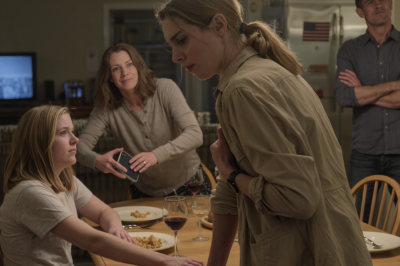
My younger sister shoved me into the corner of the table, a loud “crack” rang out — my mother snatched the phone out of my hand, “It’s just a rib,” my father barked “drama queen” as if the broken bone came from my personality. That night, I walked out the door of the house I grew up in, one arm still not even inside my coat sleeve. And what I did next… didn’t need to be loud.
By the time I heard the crack, the little plastic American flag magnet on our fridge was already tilted, pointing…
End of content
No more pages to load