
My name is Jean William. I’m thirty years old, and the night I realized my family didn’t love me the way I loved them, the air in my mother’s dining room went cold enough to crack glass.
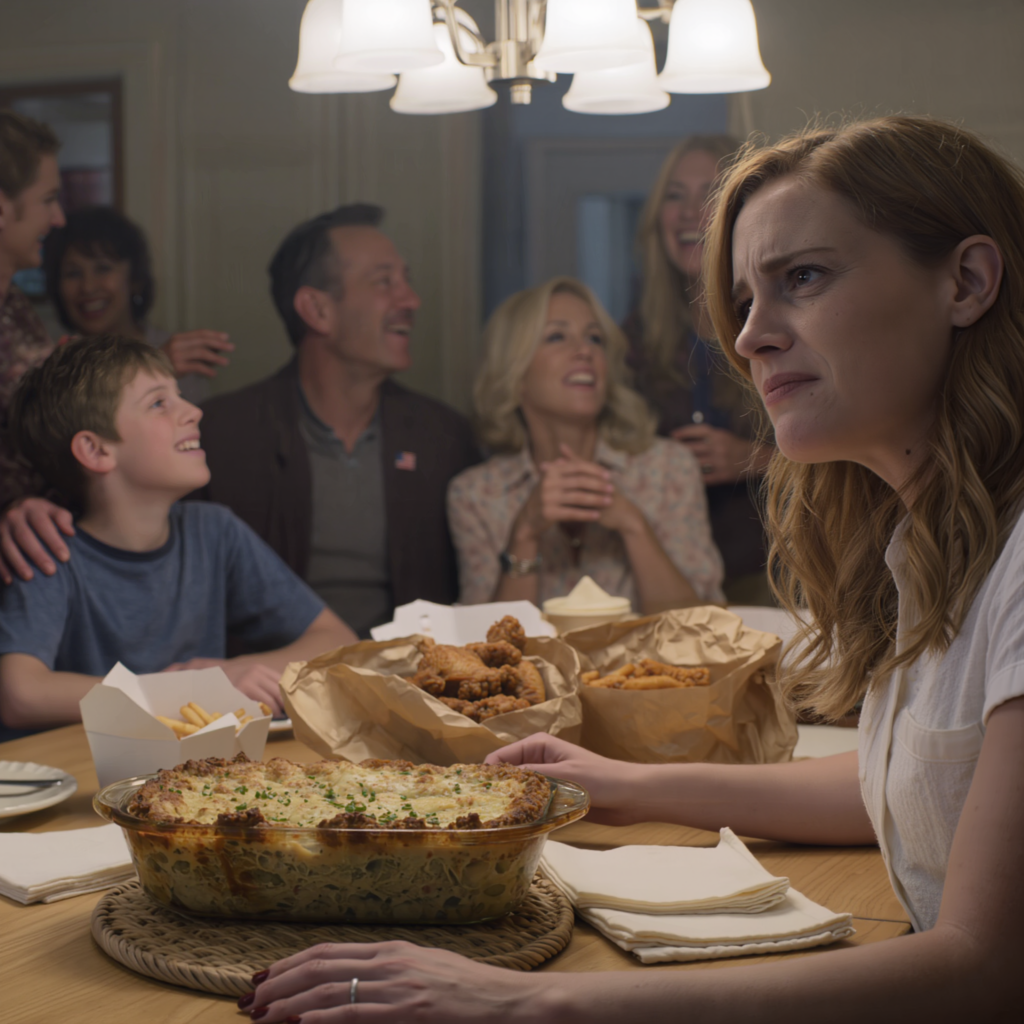
It was supposed to be a soft Sunday evening in North Carolina, the kind they put on postcards. My lasagna was still steaming on the sideboard, garlic butter glistening on the bread. A cheap bottle of Merlot I couldn’t really afford sat breathing beside the sugar caddy covered in faded American flag magnets. Sinatra hummed low from Mom’s Bluetooth speaker, “Fly Me to the Moon” fighting with the commentary from the muted Braves game on the living room TV. A sweating pitcher of sweet iced tea left pale rings on her good tablecloth. I hadn’t just brought food; I had brought dessert, wine, and what I thought was my place at the table. Only one of those survived the night.
My mother did her small distracted smile, the one she saves for polite neighbors and delivery drivers.
“Thanks, honey,” she said, already turning away.
Then she pointed at the plastic bags of takeout my brother Derek had dropped in the middle of the table like a flag. Wings and limp fries, grease bleeding through the paper.
“Real food,” she said.
Laughter skittered across the table. Derek smirked, already popping open a Styrofoam box. My dad slapped his hand over the iced tea like he was protecting something worth saving.
I smiled back like a person who doesn’t feel the splinter until later.
They talked flights and hotel blocks and group chats I’d never seen. Names of cousins and lake cabins and a resort upstate. I sat there with my lasagna and my quiet, waiting for a pause other people might have stepped into.
When it finally came, I cleared my throat and said as calmly as I could, “Just tell me when the reunion is. I’ll book early this time.”
Derek didn’t even look up from his wings.
“You’re not family. Don’t show up.”
He didn’t shout. It was worse than shouting—casual, practiced cruelty, delivered in a voice that knew it would be protected.
The table erupted. My father actually slapped his knee, wheezing with laughter. My mother’s mouth tried not to smile and failed. I stared at each of them long enough for one person—any person—to say it was too far.
No one did.
I didn’t throw the wine. I didn’t flip the table. I stood, slid on my coat, and picked up my still-warm lasagna dish. For one long second I stared at my empty chair, pushed in neatly between my parents, and realized I’d been paying rent on that spot my entire life.
Then I walked out of my mother’s house like a guest who’d overstayed, carrying my own dinner like a person leaving a party with the coat hanger still in the sleeve.
There are moments when something doesn’t break but rearranges. The world shifted two inches to the left, and I saw the outline of a door I didn’t know I could close. Somewhere between the kitchen with the flag magnets and the driveway with the oil stain shaped like Texas, I made a quiet promise to myself: the next time they made me choose between my dignity and their approval, I’d choose myself—and send them the bill.
The next four days, my phone was a museum of absence. No texts, no missed calls from “Mom,” no little gray dots in any chat. Somewhere, a group thread I wasn’t in kept humming without me.
On the fourth day, my screen finally lit up.
Hey, weird question. Did your bank maybe block the transfer? Loan payment didn’t go through.
I read it twice. My hands didn’t shake.
My brother had borrowed money for his latest “can’t-miss” business idea—some combination of gym, bar, and vape shop he swore would print money. I’d wired the last chunk of his down payment myself. Apparently, the loan payment was due again.
I typed four words.
Not family, not funded.
I hit send, watched the bubbles stop, then blocked his number.
People think changing your life feels like fireworks. For me, it felt like inhaling after years of holding my breath. Quiet, shocking, almost painful.
Before dawn the next morning, the pounding started. Not knocks—pounding. Walls shuddering, picture frames clinking, my cheap apartment door jumping in its frame. My father’s rhythm, Derek’s temper.
“Jean! Open up!”
I stood on the other side holding a mug of tea, the steam ghosting over the peephole. The thing about boundaries is that people who feed off your lack of them call you cruel when you stop bleeding for them.
I let the pounding pass like weather. Ten minutes of thunder, then the familiar grind of my dad’s silver SUV pulling away.
Then came the calls. Mom. Dad. An unknown number. One text from a woman I barely knew—Carly, my brother’s girlfriend.
Under a lot of pressure right now, she wrote. Please be reasonable. He’s just stressed.
Reasonable is the word people use when your no finally means no.
I put my phone face down on the counter, packed an overnight bag, and drove two hours west to my grandmother’s house—a small white cottage she calls “my retreat from the circus.” A plastic wind spinner in red, white, and blue turned slowly in her front yard, clicking softly in the evening breeze.
She opened the door before I knocked, wiping her hands on a dish towel.
“Took you long enough,” she said.
She says I love you in languages I didn’t understand until my thirties.
Soup was already on. Grandma always cooks like she knows the future is going to be hungry. Chicken and rice simmered on the stove, the whole house smelling like thyme and childhood. We didn’t talk until my bowl was empty and my shoulders had stopped riding my ears.
When I finally told her about the dinner, the laughter, the “you’re not family,” she didn’t look surprised.
“They’ll always take you for granted if you’re on the ground,” she said, ladling more broth. “Stand up and they’ll call you tall like it’s an insult.”
Then softer, “The first time you say no to people who lived off your yes, they call it betrayal. It’s not. It’s a correction.”
I slept on her couch under a blanket that smelled faintly of cedar and laundry soap and a life where no one banged on my door for money. Her old floor fan hummed in the corner like a lullaby.
In the morning, I drove back to my apartment to find a plain white envelope on my doormat. No return address. Inside: twenty crisp $20 bills. Four hundred dollars. No note.
A guilt payment. A hush fee. Rent on the empty chair they thought I still owed them.
I let it sit under my coffee table until sunset, the edges curling slightly, then slid it into the trash with the slow grace of a ceremony. I didn’t recycle it. Guilt burns better than it decomposes.
That night my father called again. On the fourth ring, I answered.
I didn’t say hello.
“Why?” I asked.
He spoke quickly, the way people do when the story has to outrun the truth. The missed payment had messed up a supplier deal. There were late fees, then penalties, and a garnish of “serious consequences” he wouldn’t name.
“Jean,” he said, “it’s not like we used you. You’re taking this too personally.”
I hung up—not out of anger, but because the conversation had ended two years ago and I’d only just realized it. Somewhere around the first time I’d transferred money so Derek’s lights wouldn’t be shut off while my own rent was late.
It was strange, the calm that followed. I opened my banking app and scrolled. Not doom-scrolling—truth-scrolling.
Every “emergency” transfer. Every wire “just until Friday.” Every takeout order somehow charged to my card when Derek “forgot” his wallet. Every late-night Venmo. The $800 washing machine for my parents’ house that broke in a month like it had a timer set for regret.
Two years of “I’ve got you” turning my stomach to stone.
Twenty thousand dollars.
I printed statements until my printer made that gasping sound of things that have done enough. I highlighted each bailout in yellow—neon bright, like daylight in my hands. Then I slipped everything into a manila envelope and stuck a sticky note on the front.
This is who I’ve been. Ask yourself who you’ve been.
At the post office, the clerk asked if I wanted tracking.
“No,” I said. “If it gets lost, it means it’s done its job.”
She smiled at me the way people smile at women who say strange things in a steady voice.
On the drive back, my boyfriend Jonah called. He works odd hours in construction management and has hands that carry quiet more easily than words.
“You okay?” he asked.
“I’m not bleeding anymore,” I said, surprising myself.
“That counts as okay,” he replied, and let the line fill with the kind of silence that holds you rather than punishes you.
Almost as an afterthought, he added, “Ran into Mara today.”
His ex. A name that used to make my chest tighten.
“At that coffee shop near the site,” he said. “She asked about you.”
In my family, exes had a way of becoming audiences—witnesses for the prosecution when the next character assassination went live. I filed it away without judgment, just a pin on the board.
When I got home, the evening lay over my apartment like a soft coat. I made tea, opened my mail, and found an old utility bill I didn’t remember paying. My signature looked off—too neat, as if someone had traced it through glass.
I held the page up to the lamp. The J in “Jean” curled wrong, too perfect, like a font pretending to be human.
A tiny, skittering thought crawled up my spine.
How many times have I signed without being in the room?
I told myself it was fatigue, set the paper down, and locked every door and window more carefully than habit required.
The next day, the weather shifted in that way you can’t see, only feel. Flowers arrived from Derek. Gas station daisies trying very hard to be a bouquet. No note.
My mother left a voicemail in the tone of someone suggesting I bring a side dish to Sunday lunch.
“Jean, sweetheart, things just got a bit out of hand. Why don’t you come for lunch Sunday? I’ll make that roast you love.”
I deleted it halfway through.
By midnight, a second voicemail appeared, timestamped 12:07 a.m. Her voice cracked on cue.
“Family gets through things, Jean,” she said, stacking the word family four times in fifty-eight seconds. “You know Derek’s been under so much pressure. Maybe just… see it from his side.”
I set my phone face down on the counter and stared at the ceiling. Peace is a strange animal. It stands just out of reach until you stop reaching.
That night I slept with the manila envelope of receipts on the coffee table, a simple altar to reality.
In the morning, I mailed it to my parents. No return address. No note.
Four days passed in a hush so complete it felt like snowfall.
Then, abruptly, attention—like stage lights snapping on.
A bouquet. Another voicemail. An email from my father with a scanned photo of me at nine: Popsicle grin, crooked ponytail, sitting at the old dining table in a Fourth of July T-shirt while a tiny paper flag stood in a mason jar behind me.
We’re still a family, Jean, the caption read. We love you. Let’s not forget that.
It should have worked. It used to work. But when affection only arrives as postage, you start reading the cancellations instead of the stamp.
That Saturday, a stiff white envelope appeared in my mailbox. The paper was almost wedding-thick. Inside was a cream card with gold edges, Lakeside Resort stamped in pale blue at the top. A schedule: family reunion. Activities. Dinners. A “required family meeting.”
At the bottom, in my father’s handwriting:
Derek wants to propose a repayment plan in person. This is our chance to rebuild.
I traced the flourish of his signature. The J in John and the W in William curled wrong again—too smooth, too rehearsed. The same wrong curl as on the fake utility bill.
A cold ribbon slid through me, familiar as the gasp a runner takes when the stitch hits hard. The world moved another two inches, and the door in my mind swung just a little farther closed.
They say silence is golden, but in my family, silence was currency—spent only when they needed a new excuse.
The following week, my phone turned into a confession booth.
First, more gas station daisies wilting in the heat before I could even toss them out. Then voicemails. My mother’s first message that week was breezy, as if we’d only had “a little misunderstanding.” The second cracked in all the right places, tearful and late-night.
By midweek, my father joined in. The man who once told me I was “too sensitive to survive the real world” now sounded fragile on speakerphone.
“You’re overreacting, Jean. Don’t let a dinner joke ruin decades of love.”
Decades of love. What a strange way to measure selective affection.
I poured a glass of cheap red and scrolled through the unreturned calls, noticing something I’d never bothered to see before: the dates lined up almost perfectly with Derek’s business loan payment schedule. Each wave of concern peaked right before money was due.
The pattern wasn’t love. It was logistics.
On Friday night, a long email popped up. Subject: REPAYMENT PLAN.
It was a color-coded spreadsheet outlining how Derek was “committed to paying me back.” According to him, he’d start sending money “as soon as the business stabilized,” which, somehow, was always next quarter.
At the bottom, in bold:
Let’s move past this. We’re family, right?
I stared at that word until the letters blurred. The same word he’d used to shove me out of the circle now dressed up as an argument to drag me back in.
I didn’t reply.
Instead, I gathered every voicemail, text, and bank record into one digital folder. Not for revenge—for evidence. Proof that what I remembered was real.
Jonah came over that weekend with Thai takeout and steady quiet.
“You don’t have to prove it to me,” he said, watching me scroll. “I believe you.”
“I know,” I whispered. “I have to prove it to myself.”
He nodded, then hesitated. “Mara texted me again.”
Of course she had.
“What did she want?”
“She sent screenshots,” he said reluctantly. “Posts Derek made. Some rant about people who abandon family for money. And messages between your mom and Derek. They were… talking about you. Saying you were threatening lawyers, that you were being dramatic.”
He rubbed the back of his neck. “She said she thought you deserved to know.”
I laughed, but it wasn’t humor. It was disbelief breaching the surface.
“Of course he needs a chorus,” I said. “He’s always needed a chorus.”
Later, unable to sleep, I pulled out old files and statements from a storage box in my closet. That’s when I saw it: another copy of that same utility bill, this time with the original paperwork from years ago.
My name printed clearly.
My forged signature, identical to the others.
Once is coincidence. Twice is practice.
I took photos of everything and emailed them to myself with one subject line: If anything happens.
On Monday morning, another envelope showed up at my door. This one was smaller, whiter, its edges too sharp. Inside, a short note in my father’s tight handwriting.
We’ve done so much for you. Don’t throw it away over pride.
Taped beneath the note: a check for $200.
Unsigned.
A symbolic gesture. A reminder.
We control the ink.
That afternoon, an unknown number flashed on my screen. Normally I’d let it go to voicemail, but some instinct told me to answer.
“Ms. William?” a male voice asked, clipped and professional. “This is Thomas Reed from Greenlight Legal. We’re calling to confirm your co-signature on a $10,000 business loan for Derek William.”
My body went cold.
“Excuse me?”
He cleared his throat. “It appears your signature is on the application. I just wanted to confirm you’re aware of the arrangement.”
“I never signed any loan,” I said, my voice sharp enough to cut air. “Email me a copy of the document. Now.”
A beat. “Of course, ma’am. And just to clarify—you will not be held liable. We’ve already identified some… inconsistencies.”
When I hung up, my hands trembled. Not from fear. From fury.
Derek hadn’t just used me financially. He’d used my name, my trust, my identity. And he hadn’t done it from some mysterious offshore account. He’d done it from my parents’ house.
Later that afternoon, the forged loan paperwork arrived in my inbox. The PDF sat there, crisp and heavy on the screen, like it wanted to be believed.
My signature sat at the bottom. Perfect. Too perfect. Every curve of that J in “Jean” identical to the fake utility bills. Underneath, my parents’ address.
They hadn’t even bothered to hide where they’d done it.
I called the lawyer I’d once met through work—Ms. Carson, a woman whose emails always arrived on time and whose handshake had felt like a contract with reality.
After I explained, she was quiet for a long breath.
“Jean,” she said, voice calm and precise, “this isn’t a misunderstanding. It’s identity fraud. We’ll handle it quietly, but you need to document everything. Every receipt, every transfer, every message. If this gets worse and you ever have to call 911 or deal with the police, you’re going to want a clean trail behind you.”
“Quietly?” I repeated.
“People like this thrive on chaos,” she said. “They’ll try to turn your anger into guilt. Don’t give them the noise they’re counting on.”
She was right. By that afternoon, my inbox was full of guilt.
My mother sent an email titled Can We Move Forward? She wrote about forgiveness and Sunday dinners, sprinkling in the word misunderstanding like seasoning. At the very bottom:
Let’s not involve outsiders. We can handle this as a family.
The timing was too perfect.
That evening, Jonah came by again, a coffee in one hand and a tired smile on his face. I showed him the documents, the forged loan, the matching signatures, the emails.
“They put your parents’ address on it,” he said slowly.
“Yeah.”
“So your dad knew,” he said.
“Yes.”
He hesitated. “Mara reached out again today.”
I stiffened.
“About what now?”
“She said your brother and your mom are telling people you’re trying to ruin them. She sent screenshots of their messages. They were calling you ungrateful. Dangerous. Saying you’d regret bringing lawyers into ‘family business.’”
He paused. “She might just want drama, but… it’s a lot.”
Maybe Mara wanted chaos. Maybe she wanted a front-row seat. Maybe she was the only one accidentally telling me the truth.
That night, I made copies of everything. The forged loan. The bank statements. The voicemails. The screenshots. Every I love you followed by an invoice.
I labeled the digital folder Paper Cuts, because that’s what each betrayal felt like—small, precise wounds that add up to something mortal.
Then I drafted an email to Ms. Carson authorizing her to send a cease-and-desist letter to Derek. No lawsuits. No screaming matches. Just a legal sentence between us.
I didn’t want drama. I wanted silence with teeth.
Before hitting send, I stepped out onto my tiny balcony. The city buzzed below—sirens in the distance, somebody’s radio playing Springsteen, a dog barking somewhere in the dark. For the first time in years, no one knew where I was or what bill I might be paying for someone else.
I was invisible to their expectations, and it felt like freedom.
Freedom has a way of summoning ghosts.
At 10:46 p.m., my phone vibrated. Unknown number. Against my better judgment, I answered.
“Jean.”
My mother’s voice. Cracked, tentative.
I didn’t speak.
“I don’t understand why you’re doing this,” she said. “You’ve always been the strong one. The responsible one. Derek’s drowning and you’re just… watching.”
“I’m not watching,” I said quietly. “I just stopped swimming for people who pull me under.”
There was a pause. Then her voice hardened, the sympathy draining out like someone flipped a switch.
“Your grandmother’s been worried sick,” she said. “You know she doesn’t have much time left. You’re breaking her heart.”
Weaponized love. Guilt wrapped in my grandmother’s cardigan.
I almost fell for it, but then I heard a low murmur in the background. A man’s voice. My father, feeding her lines.
I hung up without another word.
By morning, Ms. Carson had sent the cease and desist. She forwarded me confirmation of receipt from Derek’s business address.
That afternoon, I got an email from Derek. No subject line, just one sentence:
You think you’re better than us now? You’ll regret this.
No direct threat. Just venom disguised as family pride.
Jonah read it over my shoulder.
“You should stay with me for a few days,” he said.
I nodded, though a part of me hated how predictable it all was. They’d pushed me to the edge and now they wanted me to fall so they could point and say, See? She’s unstable.
Before I left town, I stopped by my grandmother’s again. She was sitting by the window knitting, a faded quilt over her knees, eyes still sharp enough to cut glass.
“They forged your name, didn’t they?” she asked, before I could even sit down.
I blinked. “How did you—”
“Because I told your father once,” she said, cutting me off, “that if he ever lost your trust, he’d lose his son, too. And he said, ‘Then I’ll take her name instead.’” She shook her head slowly. “I didn’t think he meant it literally.”
It hit like cold rain.
“So he knew,” I whispered.
She nodded. “They all did. Derek doesn’t tie his shoes without your father’s blessing.”
I swallowed hard. “I sent a cease and desist.”
“Good,” she said. “Just don’t expect them to honor it. They’ll call it betrayal, not protection.”
That night, back at Jonah’s apartment, I lay awake listening to the hum of traffic instead of the silence of guilt. He brushed my hair back and whispered, “You did the right thing.”
“I know,” I said. “I just wish doing the right thing didn’t feel like standing alone in the dark.”
“Darkness doesn’t scare you, Jean,” he said. “It just finally lets you see the light for what it is.”
I wanted to believe him. But when I checked my email one last time before sleeping, there it was—a new message from an address I didn’t recognize.
No subject. Just two words in the body:
Family meeting.
Attached was a scanned invitation, cream-colored, gold-edged, embossed with the same Lakeside Resort logo as before. At the bottom, in my father’s handwriting:
We expect you to come. It’s time to make things right.
I zoomed in on his signature. The J and the W curled wrong again.
Back home the next day, the physical invitation sat on my kitchen counter for three days, its gold trim glinting like a bruise whenever sunlight hit it. Every time I walked by, it whispered the same message.
You still owe us.
Jonah found me staring at it one morning, still in my robe, my coffee going cold.
“You don’t have to go,” he said gently.
“I know,” I said, though I didn’t sound convinced. “But part of me wants to hear what they say when they realize I’m not scared anymore.”
He brushed his thumb over the back of my hand. “You don’t owe anyone a performance, Jean. Especially not people who mistook your love for labor.”
That line stayed with me all day.
Love isn’t labor. It’s a choice you make freely, not a job you’re guilted into.
That afternoon, I drove back to Grandma’s for one more reality check. She was folding linens by the window when I arrived.
“You got the letter,” she said without looking up.
“Of course,” I sighed. “It wouldn’t be a William family crisis without a fancy envelope.”
She chuckled. “Your father always believed a polished invitation could fix a rotten message.”
We sat in comfortable silence for a while, watching the light fade across her backyard. One of her old lawn chairs sat empty under the maple tree, rust creeping along its legs, the cushion faded where countless relatives had sat to complain about their lives and then leave their mess for someone else to clean up.
“Do you know why they keep pulling you back?” she asked at last.
“Because I used to say yes,” I said.
She smiled, proud and sad all at once. “Exactly. People who drink from your generosity too long forget it’s not a spring. It’s a well. It needs rest. When it runs dry, they call you selfish for protecting it.”
“Do you think I’m selfish?” I asked.
Her answer came without hesitation. “No. I think you’re finally learning how to price your peace.”
That night I drove home lighter—not happy, just clearer. The next morning, I sat down at my little thrift-store desk and wrote a letter to my family.
It was short, plain, final.
I won’t be attending the reunion. I’m not angry anymore. I’m just finished being the version of me that bought love in installments.
Consider every dollar I gave over the years—every transfer, every bailout, all $20,000—paid in full and forgiven. What isn’t forgiven is the idea that love should come with a receipt.
Jean.
I printed it and signed it in blue ink, the real kind, with my imperfect, slightly crooked J. The opposite of that too-perfect curve they’d forged.
Then I mailed it.
A week passed without reply. It was almost peaceful. Almost.
Three weeks later, I thought it might actually be over. No letters. No voicemails. No pounding on my door. Just silence—real silence this time. The kind that doesn’t feel like punishment, but recovery.
I started hiking again on weekends, driving out past Asheville with Jonah’s old camera dangling from my neck. The air in the Blue Ridge smelled like pine and second chances. We’d sit on a rock outcropping, legs dangling over the edge, and I’d think of Grandma’s words.
They’ll call you changed when you finally heal.
One drizzly Tuesday morning, my phone rang with an unknown number. I hesitated, then picked up.
“Jean?” a tentative voice asked.
“Carly?”
“Yeah.” She sounded exhausted, like someone who hadn’t slept in days. “I know I’m probably the last person you want to hear from, but… I thought you should know. I moved out. Derek and I are over.”
I stayed quiet.
“Things have been bad,” she rushed on. “He’s been drinking a lot. Blaming everyone. Your dad’s furious. He keeps saying it’s your fault—telling people you abandoned the family when they needed you.”
Of course he was.
“But he’s wrong,” Carly said, voice shaking. “I saw it up close. Derek wasn’t just reckless. He was enabled. Every time he messed up, somebody bailed him out. Your dad, your mom… you. When you stopped, the whole house of cards fell.”
There was a pause.
“You didn’t ruin them, Jean,” she said softly. “You just stopped holding up the illusion.”
Something uncoiled inside me. Not joy. Not anger. Just a slow, sad understanding.
“Thank you for telling me,” I said. “Really.”
“I guess I just wanted you to know,” she whispered. “You weren’t the villain. You were the only adult.”
When we hung up, I stood by my living room window for a long time, watching rain trace crooked lines down the glass. The guilt that had haunted me for months started to thin, then thinner, until it disappeared completely.
That afternoon, my mother called.
For a long moment, I just stared at her name on the screen. Then I answered.
“Jean,” she said, voice quiet and raw in a way I hadn’t heard since I was a kid with a skinned knee. “I just wanted to say… thank you.”
“For what?” I asked.
“For forgiving me,” she said. “I’ve been thinking a lot about how we treated you. How much we took.” Her voice broke. “I can’t fix what’s broken. But I want you to know I see it now. I see you.”
I didn’t speak right away. Then I said softly, “That’s all I ever wanted, Mom. To be seen.”
We talked for almost an hour. Not about money or Derek or blame. Just small things—her garden, the tomatoes that wouldn’t ripen, the soup Grandma used to make, the weather.
It felt fragile but honest, like a cracked plate someone had finally stopped pretending wasn’t broken.
“Will you come to the reunion?” she asked at the very end.
“No,” I said gently. “Not this time. I’m not punishing anyone. I’m just done walking into rooms where my respect is optional.”
She didn’t argue. She just whispered, “I love you,” and hung up.
When the line went dead, I felt something loosen inside me. A rope I’d been pulling on for years finally went slack.
The next day, I sent one final letter. Inside was a printed list of every dollar I’d ever given them—$20,000 down to the penny. At the bottom, I wrote:
Consider the debt forgiven. What’s left between us isn’t money; it’s memory. Spend that carefully.
Then I sealed it, dropped it in the mailbox, and walked away without looking back. That night, I slept ten straight hours. No calls. No pounding. No ghosts. Just the sound of my own breathing filling the space they used to occupy.
For the first time in my life, I wasn’t the daughter who fixed everything.
I was the woman who finally stopped paying for peace.
A week later, there was an envelope in my mailbox again. Cream-colored this time, smaller, softer at the corners. Inside was a single Polaroid.
My family, gathered around a big round table at the Lakeside Resort restaurant. My father at the head, his smile a little too wide. Derek next to him, thinner, tired. My mother’s half-smile strained.
And there, perfectly framed in the center of the photo, was an empty chair.
My old seat.
On the back, in blue ink, my mother had written:
Missing our girl tonight. Love, Mom.
I stared at that chair for a long time. Not with anger. Not with longing.
Just clarity.
From the outside, the picture looked full—happy, complete. But I knew better now. That empty chair wasn’t about absence. It was proof. Proof that I no longer belonged to a table that fed me guilt instead of love.
I slipped the photo into my journal and closed it.
Then I grabbed my keys and drove.
Two hours later, I pulled into Grandma’s driveway. She was on the porch in her cardigan, knitting needles clacking, a glass of iced tea sweating on the little table beside her.
“I figured you’d come,” she said.
“I just wanted to thank you,” I said, sitting down in the empty porch chair next to her. “For always seeing through the noise.”
She set her yarn down and patted my hand.
“I didn’t do much, baby. You did the hard part. You stopped mistaking endurance for love.”
I looked out at the horizon, the sun lowering over the fields, painting everything gold. One of her old lawn chairs sat empty by the garden, facing away from the house, waiting for whoever chose to sit there on purpose, not out of obligation.
“Do you think they’ll ever change?” I asked.
She shook her head gently. “Maybe. Maybe not. But that’s not your job anymore.”
We sat there as the sky deepened to violet, the cicadas starting up their nightly chorus.
Somewhere inside me, the last weight lifted—the quiet knowledge that I could love my family without letting them burn me to stay warm.
Later that night, I drove back to my apartment. Jonah was waiting inside, two mugs of cocoa on the table, the lamp casting soft light over the little space I paid for myself.
“Hey,” he said, smiling when he saw me. “How was your day?”
“Peaceful,” I said, sitting down beside him. “I went to see Grandma.”
“You seem… different,” he said.
“I think I finally understand something,” I said, tracing the rim of my mug. “Peace isn’t the absence of family. It’s the presence of boundaries.”
He smiled softly. “And love?”
“Love,” I said, glancing at him, at the plant I hadn’t killed on the windowsill, at my own mail on my own table, “is what remains when respect stays in the room.”
On the shelf by the window sat a framed photo—just me and Grandma last spring, laughing at something the camera hadn’t heard. I set it on my small kitchen table and pulled out an extra chair. Not an empty spot they could guilt me into filling, but a new seat meant for people who showed up with kindness, not conditions.
I poured Jonah another cup of cocoa, looked at the chair I’d chosen for myself, and smiled.
“Welcome to my table,” I said.
And for the first time in my life, I didn’t feel like I was missing anything at all.
News

On my birthday, my parents hosted a dinner with 100 relatives just to disown me. my dad handed me a bill, said: “every cent we wasted raising you. pay or never contact us again”. my sister grabbed my car keys from the table: “dad already transferred the title to me.” i walked out without a word — four days later, they’re calling me…50 times a day
On my birthday, my parents didn’t bring out a cake. They brought out witnesses. Nearly a hundred relatives sat shoulder…
At My Mom’s Birthday, My Brother’s Son Threw My Son’s Drawing Into The Fire And Yelled, “Nobody Wants His Crappy Art Anyway.” Everyone Laughed. That Night, My Dad Texted, “You’re Making Things Uncomfortable — Just Skip Christmas.” I Replied, “So Does The Funding.” By 1 A.M., My Phone Was Melting. 27 Missed Calls.
By the time the clock on my stove blinked 1:00 a.m., my phone looked like it was about to catch…
My whole childhood I was treated like a maid. On Christmas Eve, my mother coldly said: “Your sister’s 25 friends are coming, you cook – clean – serve them properly,” I just said “Okay” then got on a plane straight to the beach; when my family came home and stepped into the kitchen, they SCREAMED, but what made them tremble the most came after that.
My parents treated me like hired help. The irony hit me every time I saw the little chipped American flag…

I was serving champagne at a gallery when i saw it. a painting i made when i was 6. price tag: $150,000. ‘sir, that painting is mine,’ i said. ‘impossible,’ the gallery owner laughed. he called security to kick me out. but he forgot to check the secret message on the back of the canvas.
I was balancing a silver tray of champagne flutes when I saw it. Not the painting, not yet. First I…
“Mom texted: ‘Ice storm, Christmas is canceled, everyone stay home to be safe’ — the next morning the whole family called saying ‘we miss you so much’, I opened Instagram and saw all of them raising their glasses at my sister’s house… and that night I decided to do something that would make their fifteen years of pretending unable to go back to how they were.”
I believed my mother’s text the way I had believed a thousand small mercies before it. “Everyone’s staying home due…
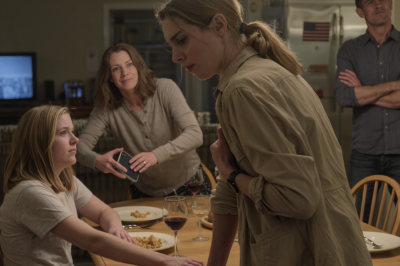
My younger sister shoved me into the corner of the table, a loud “crack” rang out — my mother snatched the phone out of my hand, “It’s just a rib,” my father barked “drama queen” as if the broken bone came from my personality. That night, I walked out the door of the house I grew up in, one arm still not even inside my coat sleeve. And what I did next… didn’t need to be loud.
By the time I heard the crack, the little plastic American flag magnet on our fridge was already tilted, pointing…
End of content
No more pages to load